
What Is a Ceramic Substrate Cleaning Brush?
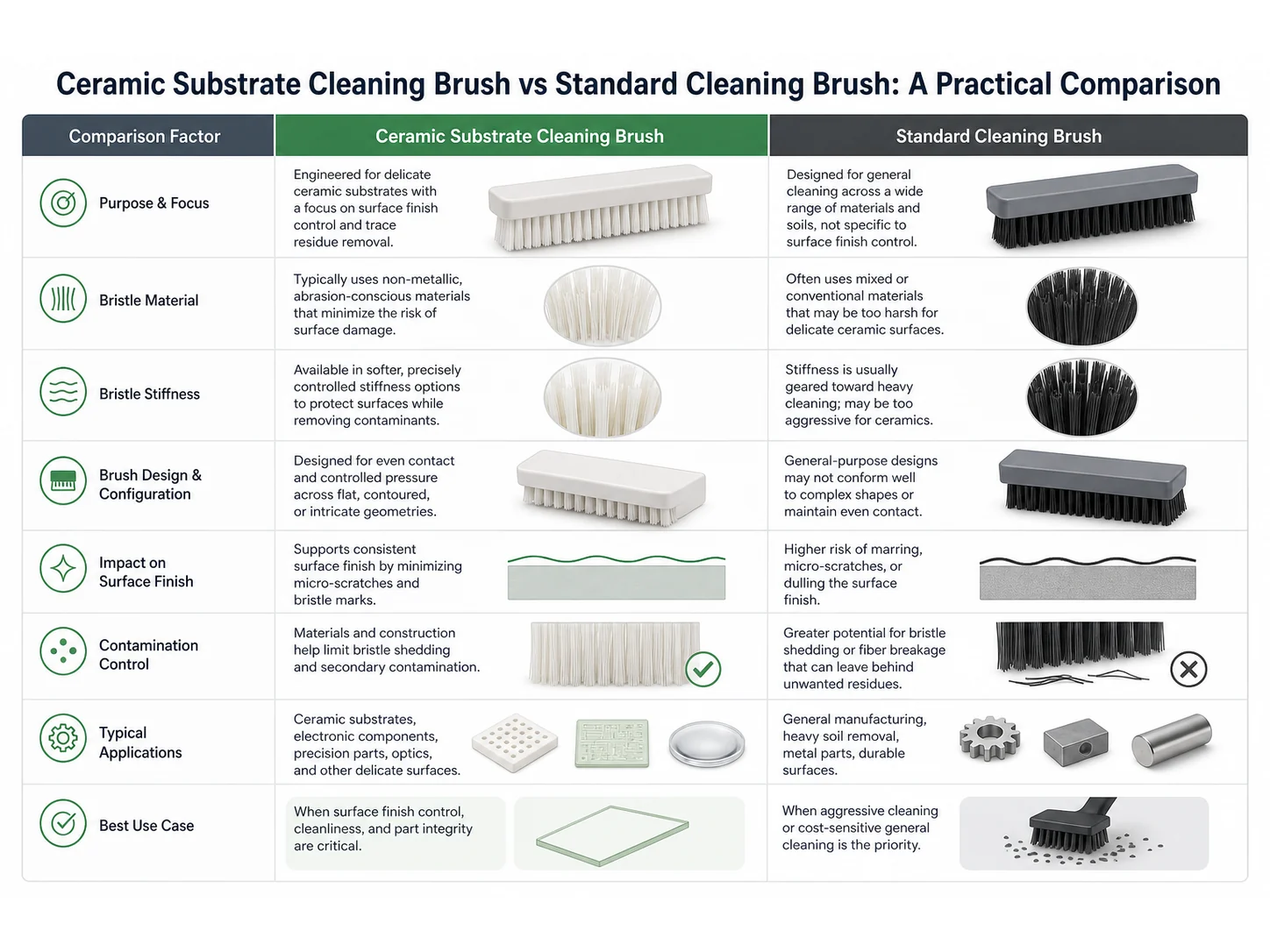
A ceramic substrate cleaning brush is a specialized tool engineered to clean flat or contoured ceramic surfaces without compromising surface integrity. Typically used in high-precision industries, these brushes feature non-abrasive or mildly abrasive bristles, controlled stiffness, and chemical-resistant cores and handles. They remove polishing slurries, process oils, fine particles, and light residues while preserving the substrate’s required roughness average (Ra) or optical clarity.
Standard cleaning brushes, on the other hand, are built for general maintenance tasks. Their bristles may be stiffer, less uniform, and made from materials that can shed, break, or leave scratches on sensitive surfaces.
How Surface Finish Control Differs from General Cleaning
Surface finish control is about maintaining or restoring a specific surface roughness or defect level after processing. In ceramic applications, even a single hairline scratch or embedded abrasive can render a component unusable. Standard cleaning often focuses on visible cleanliness, not microscopic surface quality. A ceramic substrate cleaning brush addresses this by using bristle materials that are softer than the substrate, have rounded tips, and resist particle entrapment.
Common Types of Ceramic Substrate Cleaning Brushes
Depending on your cleaning station design, you’ll encounter:
- Disc brushes – for rotary spindle cleaning of flat substrates.
- Cylinder / roller brushes – for conveyors or in-line cleaning of solar glass.
- Cup brushes – for localized cleaning around fixtures.
- Pencil brushes – for small, detailed areas.
Bristle materials include nylon 6.12 (often with abrasive grit), polypropylene, goat hair, and specially treated synthetics. Handles or cores are typically made of stainless steel, aluminum, or chemical-resistant plastics for wet environments.
Ceramic Substrate Cleaning Brush vs Standard Cleaning Brush: A Practical Comparison
| Factor | Ceramic Substrate Cleaning Brush | Standard Cleaning Brush |
|---|---|---|
| Bristle material | Soft nylon, abrasive-embedded nylon, natural fibers with rounded tips | Stiff nylon, steel, brass, or aggressive synthetic mixes |
| Stiffness control | Tightly controlled filament diameter and trim length | Highly variable; often designed for heavy scrubbing |
| Surface compatibility | Safe for polished ceramic, glass, semiconductor wafers | Best for tough surfaces; may scratch delicate substrates |
| Particle embedment risk | Low – bristles resist holding debris | Higher, especially with coarse or wire bristles |
| Chemical compatibility | Excellent; handles acids, solvents, and DI water | Dependent on core material; less chemical-resistant options common |
| Cost | Higher initial cost but designed for consistent, low-defect cleaning | Lower upfront cost, but higher risk of scrap or rework |
| Lifespan in precision use | Long when used within specs; bristle wear is predictable | Shorter in sensitive applications due to aggressive wear |
Key Factors for Choosing the Right Brush
To pick the right brush for ceramic substrate cleaning, evaluate these real-world factors:
- Residue type: Slurry, oil, glass dust, or process chemicals. Some require absorbent bristles; others need abrasive action without damage.
- Surface sensitivity: What is the maximum allowable scratch depth or Ra change? Choose a brush that is measurably softer than the substrate.
- Equipment interface: RPM, mounting shaft diameter, and wet/dry conditions. Ceramic brushes often use sealed bearings and stainless steel cores to handle cleaning chemicals.
- Chemical exposure: Ensure bristles and core are compatible with your cleaning agents (e.g., alkaline, acidic, or solvent-based).
- Hygiene requirements: In semiconductor or optical environments, non-shedding, low-linting brushes are essential.
- Maintenance frequency: How often will the brush be replaced or cleaned? Predictable wear helps with scheduling.
- Custom size requirements: Off-the-shelf brushes may not fit your machine. Custom diameter, length, or brush density may be needed, and a ceramic substrate brush supplier can often match manufacturer instructions specs.
Common Mistakes When Selecting a Ceramic Substrate Cleaning Brush
- Choosing by appearance: A brush that looks similar to the original may behave very differently. Always verify filament material, diameter, and stiffness.
- Ignoring bristle diameter: Even a 0.05 mm difference in filament thickness can change scratch behavior significantly.
- Using one brush for multiple substrates: Cross-contamination can embed hard particles into a softer substrate.
- Skipping sample testing: Without testing on actual substrates and residues, you risk unexpected surface defects.
- Overlooking core material: A carbon steel core in a wet process will rust and contaminate the cleaning line.
- Assuming all “soft” brushes are safe: Natural bristles may still contain abrasive silicates; treated synthetics are often safer.
When a Ceramic Substrate Cleaning Brush Is the Wrong Choice
A ceramic substrate cleaning brush is an excellent tool for mechanical cleaning in precision manufacturing, but it has limits:
- Deep contamination: If residues are chemically bonded or require etching, a brush alone won’t remove them. Chemical pre-treatment or ultrasonic cleaning may be necessary.
- Complex geometries: Brushes may miss internal channels or tight corners. A combination of spray systems and specialty brushes might be needed.
- Surface defect already present: Brushes clean, they don’t repair. Pre-existing scratches or micro-cracks need process adjustment first.
- Validation requirements: In high-reliability industries, always confirm performance with a sample run and, if needed, request a supplier drawing review or a custom sample before full-scale changeover.
Final Takeaway
For surface finish control on ceramic substrates, a purpose-made ceramic substrate cleaning brush is nearly always the safer choice. It reduces the risk of micro-scratching, particle embedment, and chemical incompatibility compared to a standard cleaning brush. Evaluate your residue, surface sensitivity, and process conditions first. If you’re unsure, work with a brush supplier that can provide material data sheets, flexible sample programs, and custom configurations that align with your exact machine and quality requirements.
Frequently Asked Questions
What bristle material works best for cleaning delicate ceramic substrates?
For most applications, soft nylon 6.12 with embedded mild abrasives (like aluminum oxide) or untreated polypropylene with rounded tips provides effective cleaning without scratching. Goat hair is sometimes used for ultra-sensitive optical surfaces.
Can I use a standard nylon brush instead of a ceramic substrate cleaning brush?
It depends on your substrate and tolerance. Standard nylon brushes often have sharper filament tips and higher stiffness that can leave micro-scratches. If surface finish control is critical, use a brush designed for ceramic substrates.
What bristle diameter should I choose?
For delicate surfaces, start with a fine filament (e.g., 0.10–0.20 mm). Thicker bristles increase scrubbing power but risk surface damage. Many brush suppliers offer a range and can advise based on your specific Ra target.
How do I know when the brush is wearing out and might damage surfaces?
Monitor bristle length, stiffness change, and embedding of debris. A worn brush may have a “matted” appearance, reduced cleaning action, or show visible particle entrapment. Regular inspection and scheduled replacement based on process cycles help prevent surface defects.
Should the cleaning process be wet or dry with these brushes?
Wet cleaning is typically recommended for ceramic substrates to flush away particles, cool the brush—substrate interface, and reduce friction. However, some processes use dry brushes for light dusting. Match the brush’s core and bristle material to the wet or dry environment to avoid corrosion or swelling.
Are custom-sized brushes necessary, or can I use standard off-the-shelf options?
In many high-precision lines, standard sizes don’t fit the machine’s mounting points or achieve the right contact pressure. Custom diameters, lengths, and bristle density allow you to match manufacturer instructions specifications exactly, improving cleaning consistency and surface finish control.
How do I clean and maintain the brush itself to prevent contamination?
Rinse with deionized water or a compatible solvent after use to remove residue. Periodically inspect for embedded particles; replace if contamination is visible. Store in a clean, dry area away from dust.
What happens if I use a standard brush and see no immediate damage?
Some surface damage manifests only after downstream processing or during quality inspection. Even if it looks clean, a standard brush may introduce subsurface stresses or contamination that reduces yield. A controlled test with a ceramic substrate cleaning brush is the only way to compare.
Technical References
Which bristle material fits this job — Nylon PA, AISI 304 Stainless Steel Wire or Goat Hair?
| Material | Continuous temperature (°C) | Peak temperature (°C) | Water absorption | Hardness |
|---|---|---|---|---|
| Nylon PA | 93 | 121 | 0.3–9% by PA grade and conditioning | Medium to firm; filament diameter and trim length control bending force. |
| AISI 304 Stainless Steel Wire | 400 | 500 | 0% | Rockwell B 70–95 depending on temper and cold work |
| Goat Hair | 50–70 | 90–110 | 12–20% | — |
| PVA Sponge | 60 | 90 | — | Soft absorbent contact material; hardness/compression is controlled by foam or sponge density. |
| PU Sponge | 80 | 110 | — | Soft absorbent contact material; hardness/compression is controlled by foam or sponge density. |
Figures as published by Brushtec / DuPont; Alleima. Confirm the exact grade against the supplier datasheet before ordering.
What should replace Roller and Conveyor Brushes for ceramic substrate cleaning brush?
- Roller and Conveyor Brushes — Roller and conveyor brushes hold cylindrical line contact across a working width, including helix-wound builds where the filament path is set to move loosened material toward one side; a strip brush holds the same line without rotating, so it seals or wipes but cannot carry residue along the width.
- Nylon PA — Compare Nylon PA with PP, PBT, PET. Change material when wet stiffness, temperature, chemical resistance, conductivity, particle shedding, or surface marking becomes the limiting factor.
- AISI 304 Stainless Steel Wire — Use AISI 316 stainless steel wire for chloride, marine, dairy, beverage, chemical washdown, or higher pitting-resistance requirements. Use carbon steel for dry aggressive cutting and brass or abrasive nylon for lower marking risk.
- Goat Hair — Compare Goat Hair with Boar bristle, goat hair, microfiber. Change material when wet stiffness, temperature, chemical resistance, conductivity, particle shedding, or surface marking becomes the limiting factor.