
What Is a Connector Cleaning Brush?
A connector cleaning brush is a precision cleaning tool with bristles engineered to reach into connector housings, pin sockets, and terminal block channels without damaging delicate contacts or plating. Unlike generic utility brushes, connector-specific brushes consider bristle stiffness, material, shape, and handle design to safely remove contaminants in tight, often fragile, electrical interfaces.
Common Types and Material Options
Connector cleaning brushes come in several material and design variations, each suited for different residue types and surface sensitivities:
- Natural horsehair – soft, static‑neutral, ideal for dust and light debris on sensitive gold‑plated contacts.
- Synthetic nylon – medium stiffness, solvent‑resistant, good for general‑purpose cleaning with cleaning fluids.
- Abrasive fiberglass – stiff, used for removing heavy oxidation or burnt flux, but can scratch delicate platings.
- Anti‑static nylon – dissipates static charges, essential for ESD‑sensitive electronics.
- Sponge or swab tips – used when minimal physical contact is needed and solvent application is the primary cleaning method.
Comparing Connector Cleaning Brush Options
| Brush Material | Stiffness Level | Best For (Residue Type) | Contact Surface Safety | Handle / Core Options | Common Mistake |
|---|---|---|---|---|---|
| Natural horsehair | Soft | Dust, light particles | Very safe for gold / tin plating | Wood, plastic pen‑style | Using with harsh solvents that degrade the bristle |
| Synthetic nylon | Medium | Oils, flux residues, general dirt | Generally safe; check stiffness | Plastic, metal, or anti‑static handles | Applying too much pressure, bending pins |
| Abrasive fiberglass | Stiff / abrasive | Heavy oxidation, burnt flux | High risk of scratching—use only when necessary | Fixed plastic or refillable pen | Using on gold plating or thin‑walled sockets |
| Anti‑static nylon | Soft to medium | Dust, light contaminants in ESD‑sensitive areas | Safe; designed for sensitive electronics | Conductive plastic or rubber grip | Skipping ESD wrist strap or mat, relying only on the brush |
| Metal wire (for reference) | Very stiff | Heavy rust, scale (not for connector contacts) | High damage risk—should be avoided for terminal blocks | Metal handle, often long | Using a wire brush on any connector contact |
How to Choose the Right Connector Cleaning Brush
Selecting an appropriate brush requires looking beyond just the size. Evaluate these factors:
- Residue type – dry dust needs soft bristles; stuck‑on flux or corrosion may require stiffer or fiberglass brushes.
- Contact surface sensitivity – gold, silver, and tin platings scratch easily. Always match bristle hardness to the least durable metal in the connector.
- Terminal block size and pitch – the brush diameter must allow bristle insertion without forcing. As a rule, choose a brush about 20–30% smaller than the cavity.
- Wet or chemical cleaning – if using solvents, verify the bristle and handle material are chemically compatible.
- Static sensitivity – in ESD‑protected areas, an anti‑static brush is not optional; it’s a requirement.
- Maintenance frequency – for daily high‑volume use, pick a durable handle and replaceable head design.
- Custom size requirements – off‑the‑shelf brushes may not reach deep connector housings. Custom length, diameter, or bent‑tip shapes can solve unique access problems.
Common Mistakes When Selecting and Using Connector Cleaning Brushes
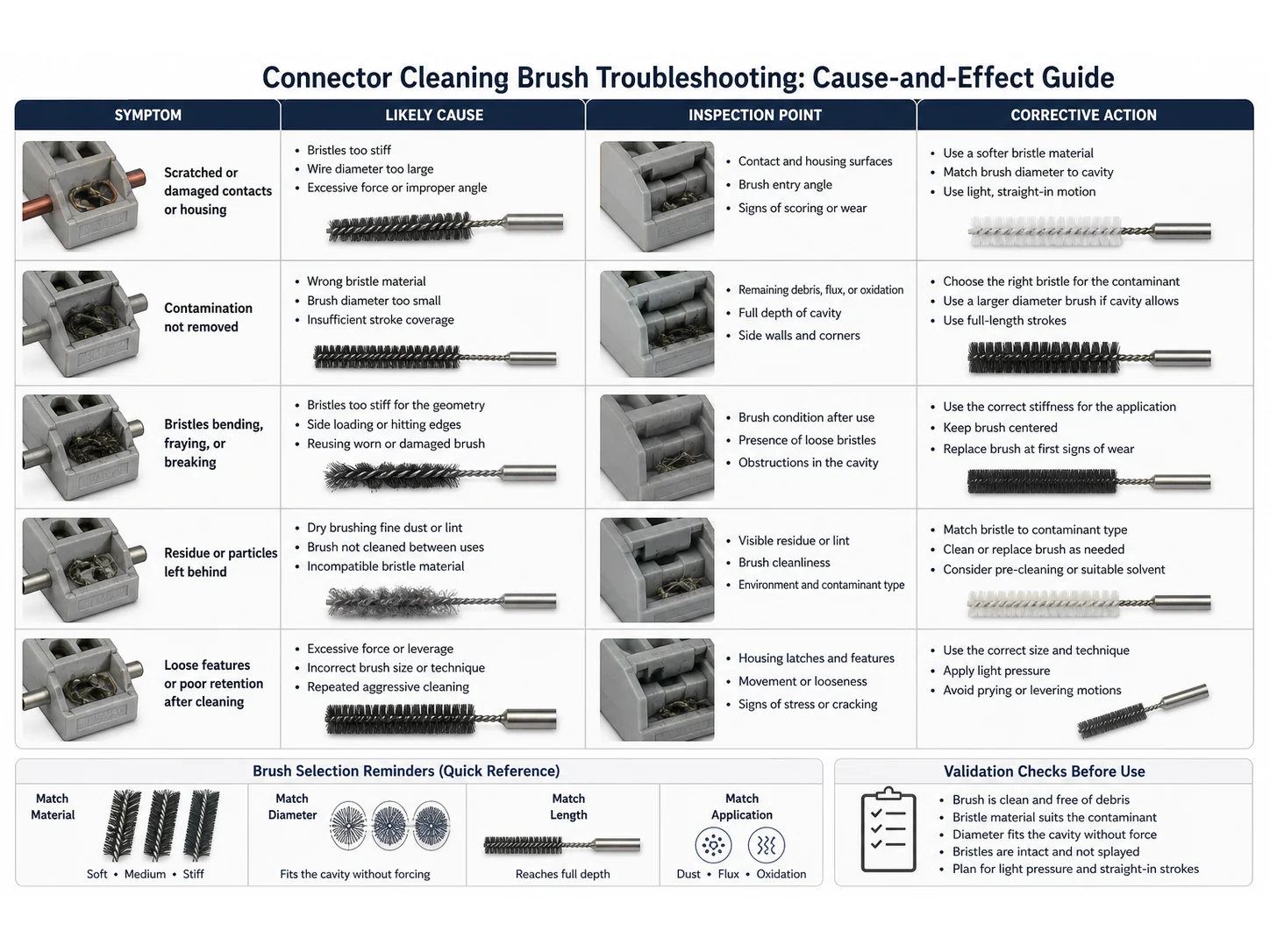
- Using a brush that is too stiff – scratches the plating, creating corrosion hot spots later.
- Choosing the wrong material for the solvent – natural bristles can swell or dissolve when exposed to alcohol or acetone.
- Ignoring ESD protection – a non‑conductive brush can accumulate and discharge static, damaging sensitive circuits.
- Reusing a dirty brush – transfers old contaminants and abrasive particles back onto clean connectors.
- Applying excessive force – bent pins or damaged socket walls cause intermittent connections that are hard to diagnose.
- Not checking brush size against terminal dimensions – a brush that is too large simply pushes debris deeper; one that is too small fails to clean effectively.
- Using metal brushes on any plated contact – instantly destroys the protective layer and voids reliability.
- Buying bulk without testing – a sample evaluation on a few connectors can prevent a facility‑wide cleaning failure.
When a Connector Cleaning Brush Is the Wrong Choice
Even the best brush has limits. Heavy oxidation or corroded pins often require a contact cleaner spray, a chemical treatment, or even terminal replacement. In extremely dense or micro‑connectors, a brush cannot reach the bottom of the socket; specialized swabs or ultrasonic cleaning may be the usually safer method. Also, if you are working on live equipment, a brush alone does not provide the required isolation—insulated tools and strict lockout/tagout procedures must be in place. Finally, if you find yourself cleaning the same terminal blocks repeatedly, investigate the root cause: dust ingress, condensation, or corrosive off‑gassing from nearby components. Addressing the environment can be more effective than any brush.
Final Takeaway
Choosing the right connector cleaning brush isn’t about finding the lowest-cost option or the stiffest bristle. It’s about matching the brush material, shape, and handle to the specific connector design, residue, and cleaning process. Always test a sample brush on a few connectors before committing to a bulk order, and if you’re unsure, consult with a manufacturer who can review your terminal block drawings and recommend a proven solution.
Frequently Asked Questions
What is the best material for a connector cleaning brush used on gold-plated contacts?
Soft horsehair or anti-static nylon brushes are typically recommended for gold-plated contacts. They clean effectively without scratching the thin gold layer that prevents corrosion on terminal block pins.
Can I use isopropyl alcohol with a connector cleaning brush?
Yes, but the bristle material must be solvent-resistant. Natural fibers like horsehair may absorb and degrade; synthetic materials such as nylon or polyester generally hold up well. Always check the brush manufacturer’s chemical compatibility guide before use.
How do I determine the right brush diameter for small terminal block sockets?
Measure the socket or pin cavity with a caliper, then choose a brush with a bristle diameter about 20–30% smaller than the cavity’s inner dimension. This allows the bristles to enter without forcing and still make adequate contact for cleaning.
What’s the difference between a connector cleaning brush and a wire brush?
A wire brush uses metal bristles that can easily scratch delicate plating and deform small connector pins. Connector cleaning brushes are designed with non‑metallic or very fine abrasive bristles that are safer for electrical contacts. Using a standard wire brush on terminal blocks is one of the most damaging mistakes you can make.
When should I order a custom connector cleaning brush instead of an off‑the‑shelf one?
Consider a custom brush when your terminal block has an uncommon cavity shape, a very deep connector housing, or requires a specific handle length/shape for ergonomic access. Custom brushes can also include anti‑static properties or a combination of bristle types for multi‑step cleaning in one tool.
How often should I replace a connector cleaning brush?
Replace the brush when bristles become permanently bent, flattened, or contaminated with hard‑to‑remove residues. In high‑volume maintenance environments, inspect brushes daily and replace at the first sign of wear to avoid inadvertently damaging contacts.
Is an anti‑static brush necessary for connector cleaning?
Not always, but it’s highly recommended when working on static‑sensitive components like circuit boards, sensors, or communication modules. Anti‑static brushes use conductive bristles or handles to dissipate charges safely, reducing the risk of ESD damage.
Technical References
Which bristle material fits this job — Nylon PA, Horsehair or Rubber?
| Material | Continuous temperature (°C) | Peak temperature (°C) | Water absorption | Hardness |
|---|---|---|---|---|
| Nylon PA | 93 | 121 | 0.3–9% by PA grade and conditioning | Medium to firm; filament diameter and trim length control bending force. |
| Horsehair | 60–80 | 100–120 | 8–15% | — |
| Rubber | 100 | 130 | very low | Specified by compound and Shore hardness; published TPE families can span roughly 50–80 Shore A, but that is a product-family example rather than a universal rubber range. |
| Goat Hair | 50–70 | 90–110 | 12–20% | — |
Figures as published by Brushtec / DuPont. Confirm the exact grade against the supplier datasheet before ordering.
What should replace Handheld Detail Brushes for connector cleaning brush?
- Handheld Detail Brushes — Handheld detail brushes cover general precision cleaning; auto-detailing brushes impose tighter controls for painted, polished, leather, display, and trim surfaces.
- Nylon PA — Compare Nylon PA with PP, PBT, PET. Change material when wet stiffness, temperature, chemical resistance, conductivity, particle shedding, or surface marking becomes the limiting factor.
- Horsehair — Compare Horsehair with Boar bristle, goat hair, microfiber. Change material when wet stiffness, temperature, chemical resistance, conductivity, particle shedding, or surface marking becomes the limiting factor.
- Rubber — Compare Rubber with Silicone elastomer, TPE, PVC profile, PVA sponge. Change material when wet stiffness, temperature, chemical resistance, conductivity, particle shedding, or surface marking becomes the limiting factor.