
What Is a Food Conveyor Belt Brush?
A food conveyor belt brush is a cleaning tool designed for direct contact with food processing belts to remove product residue, debris, and buildup—especially along belt edges and hard-to-reach transfer points. Unlike generic industrial brushes, these brushes must be made from materials approved for incidental food contact, resist moisture and chemicals, and withstand frequent washdowns without degrading. They come in strip, rotary, or hand-held forms and are installed at fixed cleaning stations or integrated into rotating assemblies.
Common Material and Design Options
The right brush depends on the bristle material, core, stiffness, and mounting style. Here are the most common options:
- Bristle Materials: Nylon (abrasion-resistant, good for general cleaning), Polypropylene (stiff, chemical-resistant, often used in wet areas), Polyester (good in wet environments, less moisture pickup), Horsehair (soft, for delicate surfaces), Stainless Steel Wire (heavy-duty scraping, risk of scratching plastic belts), Tampico (natural fiber, moderate stiffness).
- Core/Handle Materials: Polypropylene or PVC blocks (lightweight, chemical-resistant), Stainless Steel shafts or channels (required for high hygiene, rust-free), Aluminum (lightweight but not for caustic washdowns).
- Stiffness Levels: Soft, Medium, Hard—chosen based on residue type and belt surface sensitivity.
- Mounting Styles: Hand-held (manual cleaning), Fixed strip brushes (mounted along a frame), Rotary brushes (powered for continuous cleaning).
Choosing the Right Option: A Comparison Table
| Brush Type | Bristle Material | Stiffness | Best For | Residue | Surface Sensitivity | Typical Mounting | Wet/Chemical OK? |
|---|---|---|---|---|---|---|---|
| Hand-held detail brush | Nylon | Medium | Spot cleaning edges | Dry crumbs, light sticky | Low (plastic belts) | Manual | Yes |
| Fixed strip brush | Polypropylene | Hard | Continuous edge cleaning | Sticky, wet residue | Medium (rubber belts) | Bracket-mounted | Yes |
| Rotary brush insert | Polyester | Medium | Inline cleaning at transfers | Fine particles, light paste | Low–medium | Shaft-driven | Yes |
| Heavy-duty scraper | Stainless Steel | Hard | Baked-on or frozen residue | Hardened material | High (metal belts only) | Fixed or rotary | Limited (risk corrosion) |
| Soft polishing brush | Horsehair | Soft | Dusting, final finish | Light powder | Very high | Manual or low-RPM | No (absorbs moisture) |
| General washdown brush | Polypropylene | Medium | Routine cleaning with chemicals | Mixed wet residues | Medium | Hand-held or fixed | Yes (high chemical tolerance) |
How to Choose Based on Your Operation
Start by analyzing your specific contamination and process conditions:
- Residue type: Sticky, oily, or wet residues demand stiffer, non-absorbent bristles (polypropylene). Dry, powdery residues can be handled with softer nylon or natural fibers.
- Surface sensitivity: Plastic modular belts scratch easily—avoid metal bristles. Rubber belts can take harder nylon or polypropylene but still need controlled pressure.
- Equipment interface: Can you mount a fixed brush with a simple bracket, or do you need a spring-loaded holder to maintain contact? Rotary brushes require a drive mechanism and clearance.
- Wet or chemical exposure: In washdown zones, the brush core must be stainless steel or solid polymer; aluminum corrodes. Polypropylene and polyester bristles hold up best to repeated chemical cleaning.
- Hygiene expectations: For areas with direct food contact, verify that bristle materials meet FDA 21 CFR requirements and are detectable (metal/x-ray) if fragments could enter product.
- Maintenance frequency: A brush that runs continuously needs a wear monitoring schedule. Replace when bristles lose shape, tips mushroom, or shedding increases.
- Custom size requirements: Belt width, edge gap, and mounting hole spacing often drive a made-to-order brush. Provide the manufacturer instructions or brush supplier with precise drawings rather than guessing.
Common Mistakes in Brush Specification
- Choosing by cost drivers alone – A low-cost brush that fails in days costs more in downtime and contamination risk.
- Ignoring bristle stiffness impact on belt wear – Overly aggressive bristles can abrade the belt surface, creating crevices for bacteria.
- Overlooking core material in wet environments – A plastic brush with a steel core hidden inside will rust, leading to product adulteration.
- Not checking bristle material compliance – Just because it’s blue doesn’t mean it’s FDA-compliant for food contact. Request a certificate of material composition.
- Wrong mounting type – A hand-held brush used on a fixed bracket may not have the right shank or retention; a rotary brush mounted stationary will wear unevenly.
- Assuming one brush fits all zones – Edge contamination near an oven is different from a cooling tunnel; each may need a different bristle stiffness.
- Underestimating cleaning frequency’s effect on lifespan – Frequent chemical exposure degrades some plastics; account for replacement cycles in your PM plan.
When a Food Conveyor Belt Brush Is the Wrong Choice
A brush alone cannot solve every belt cleaning problem. Consider upgrading or adding systems when:
- Heavy, baked-on buildup – If residues require scraping force that bends bristles, you may need a mechanical scraper followed by a brush for fine removal.
- High-volume liquid or slurry – A brush without a washdown spray system just spreads the mess. Integrate a spray bar and collector pan.
- Extreme temperatures – Near ovens or freezers, standard plastic bristles can melt or become brittle. Specialized high-temp nylon or metal are needed.
- Stringent hygienic design – When Copan or EHEDG requirements apply, brush mounting, core design, and crevice-free construction must be reviewed, and in some cases, a validated CIP system replaces manual brushes.
- Constant product contact – If the brush is in contact with product-contact surfaces continuously, it must withstand daily inspection and cleaning; a sample test with your actual product is wise before full implementation.
Final Takeaway
Select a food conveyor belt brush by matching bristle material to your residue and surface, choosing a corrosion-resistant core suited to your washdown chemicals, and specifying mounting that maintains even contact without damaging the belt. Always verify regulatory compliance for your application, and be ready to test a custom size if off-the-shelf options don’t fit your belt gap or frame. Avoid the trap of treating the brush as a simple commodity—poor specification quickly becomes a food safety liability.
Frequently Asked Questions
What is the best bristle material for sticky food residue?
Stiff polypropylene or medium-hard nylon work well. Polypropylene resists moisture and chemicals, so it doesn’t soften or shed when exposed to sticky, wet deposits. For extremely sticky residues, consider a brush with a “grit-impregnated” nylon filament that adds mild abrasion without scratching.
Can I use the same brush for dry and wet cleaning?
It depends on the core and bristle material. Nylon and polyester can handle both, but natural fibers like horsehair absorb water and degrade quickly. Also, a metal core can rust if not fully sealed. If you switch between dry and wet zones, choose a solid polypropylene core with synthetic bristles.
How often should I replace my conveyor belt brushes?
Inspect weekly for bristle splaying, mushrooming tips, or noticeable loss of stiffness. Replace when bristles no longer make full contact with the belt or when shedding accelerates. In a 24/7 operation, expect to replace a strip brush every 3–6 months; hand-held brushes may last longer with proper care.
What is the standard diameter for a belt edge brush?
There is no universal standard. The diameter is determined by the gap between the belt edge and the frame, the desired contact pressure, and whether the brush is fixed or rotating. Provide a measurement of the target gap and the belt width when ordering custom brushes.
Are stainless steel brushes safe for all conveyor belts?
No. Stainless steel wire can gouge plastic modular belts and rubber surfaces, creating niches for bacteria. Reserve metal bristles for metal belts or for secondary cleaning where belt damage is not a concern. Even then, metal fragment contamination is a risk—use a detectable metal-detectable plastic alternative if possible.
How do I measure for a custom brush size?
Measure the clear opening between the belt edge and any guard or frame where the brush will sit. Specify the bristle length, total brush length, and the mounting hole layout or holder type. A dimensioned sketch sent to the brush manufacturer reduces errors.
Do food conveyor belt brushes need to be FDA approved?
Brushes themselves are not FDA “approved,” but the materials—bristles, core, adhesive—must comply with FDA 21 CFR for indirect or incidental food contact. Always request a material certification or statement of compliance from the supplier that confirms the specific brush meets FDA requirements for your application.
What if my brush isn’t removing all the residue?
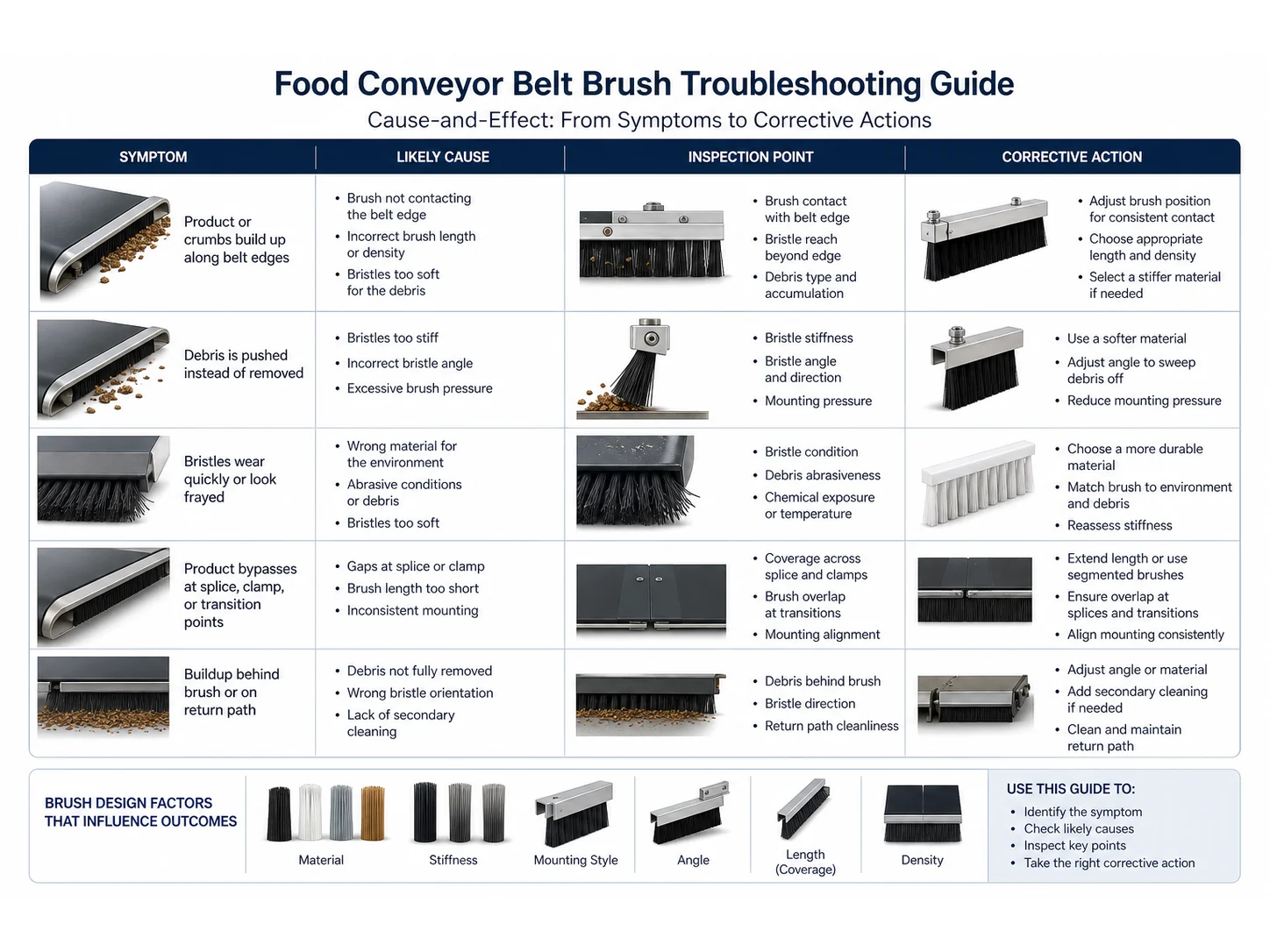
First, check that the bristle tips are actually contacting the belt with moderate pressure. If they are, the bristle stiffness or material may be wrong for your residue type. Try a sample test with a higher stiffness or a different bristle material (e.g., switch from nylon to polypropylene). If that fails, you may need to add a pre-cleaning step like a water spray or scraper before the brush.
Technical References
- FDA — Food Code
- eCFR — 21 CFR 177.1500 Nylon Resins
- eCFR — 21 CFR 177.1520 Olefin Polymers
- eCFR — 21 CFR 177.1630 Polyethylene Phthalate Polymers
- OSHA — Machine Guarding
- OSHA — Control of Hazardous Energy
Which bristle material fits this job — Nylon PA, AISI 304 Stainless Steel Wire or Horsehair?
| Material | Continuous temperature (°C) | Peak temperature (°C) | Water absorption | Hardness |
|---|---|---|---|---|
| Nylon PA | 93 | 121 | 0.3–9% by PA grade and conditioning | Medium to firm; filament diameter and trim length control bending force. |
| AISI 304 Stainless Steel Wire | 400 | 500 | 0% | Rockwell B 70–95 depending on temper and cold work |
| Horsehair | 60–80 | 100–120 | 8–15% | — |
| Rubber | 100 | 130 | very low | Specified by compound and Shore hardness; published TPE families can span roughly 50–80 Shore A, but that is a product-family example rather than a universal rubber range. |
| AISI 316 Stainless Steel Wire | 400 | 500 | 0% | Rockwell B 70–95 depending on temper and cold work |
Figures as published by Brushtec / DuPont; Alleima. Confirm the exact grade against the supplier datasheet before ordering.
What should replace Roller and Conveyor Brushes for conveyor belt?
- Roller and Conveyor Brushes — Roller and conveyor brushes hold cylindrical line contact across a working width, including helix-wound builds where the filament path is set to move loosened material toward one side; a strip brush holds the same line without rotating, so it seals or wipes but cannot carry residue along the width.
- Nylon PA — Compare Nylon PA with PP, PBT, PET. Change material when wet stiffness, temperature, chemical resistance, conductivity, particle shedding, or surface marking becomes the limiting factor.
- AISI 304 Stainless Steel Wire — Use AISI 316 stainless steel wire for chloride, marine, dairy, beverage, chemical washdown, or higher pitting-resistance requirements. Use carbon steel for dry aggressive cutting and brass or abrasive nylon for lower marking risk.
- Horsehair — Compare Horsehair with Boar bristle, goat hair, microfiber. Change material when wet stiffness, temperature, chemical resistance, conductivity, particle shedding, or surface marking becomes the limiting factor.