
What Is a Food Conveyor Cleaning Brush?
A food conveyor cleaning brush is a purpose‑built tool designed to clean conveyor surfaces while meeting the hygiene requirements of food production. These brushes may be fixed in place along the belt or used in rotary or strip configurations to continuously or intermittently remove debris. Their design must resist moisture, chemicals, and temperature swings while avoiding bristle loss that could contaminate food.
Common Types of Food Conveyor Cleaning Brushes
Food plants typically use one of three brush types:
- Strip brushes – mounted along the belt edge or underneath for continuous light cleaning of crumbs, powders, or dust.
- Roller brushes – powered rotating cylinders that scrub the belt surface in high‑speed or heavily soiled applications.
- Disk or cup brushes – targeted cleaning of chains, crevices, and transfer points that accumulate tough residues.
Bakery vs Dairy vs Meat Processing: A Quick Comparison
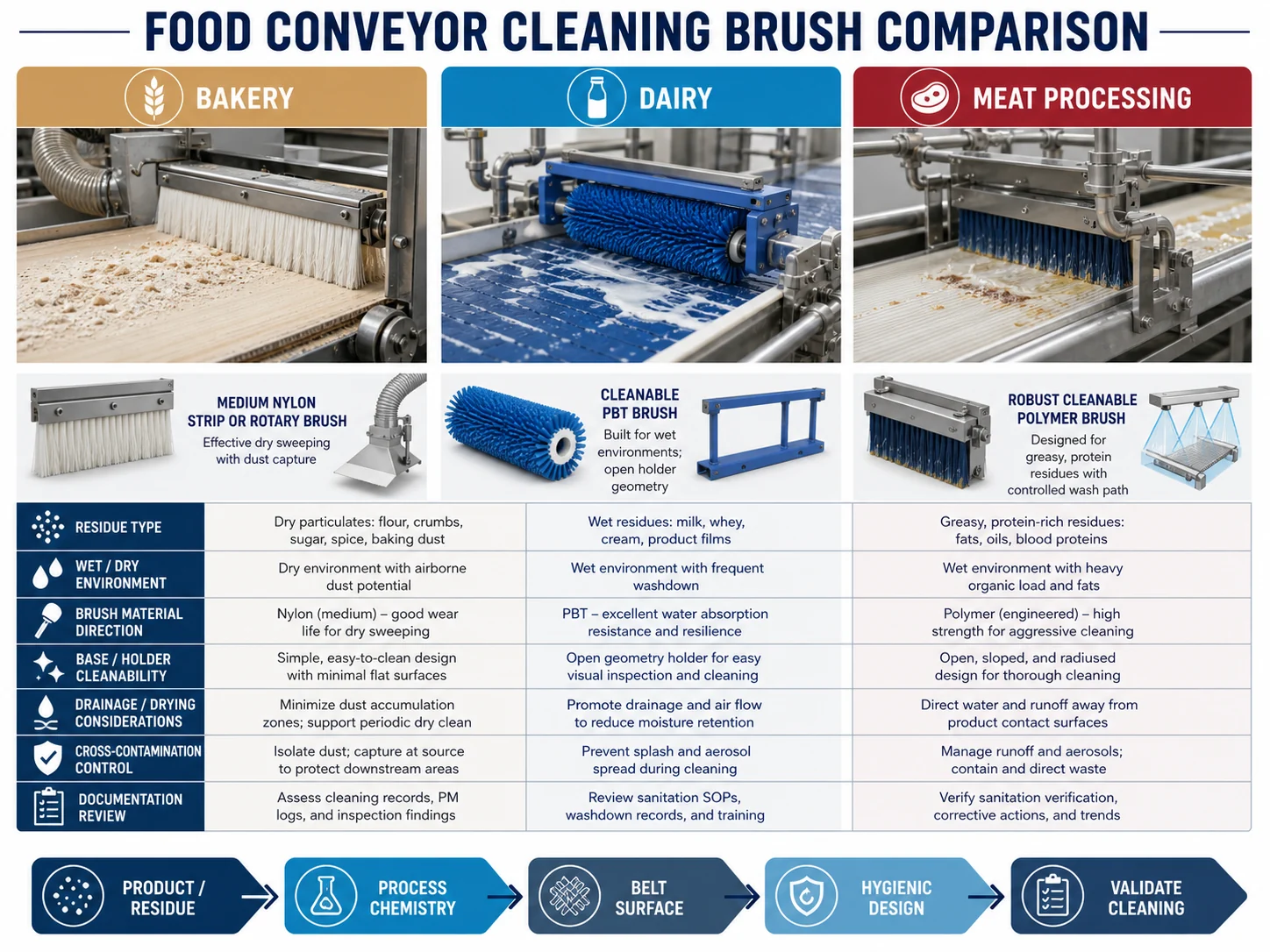
The table below highlights how cleaning demands shift across three key high‑care food environments.
| Factor | Bakery | Dairy | Meat Processing |
|---|---|---|---|
| Typical Residue | Flour dust, sugar, oils, baked crumbs | Milk solids, fat, protein films, biofilms | Fat, blood, protein, bone fragments, sticky fluids |
| Washdown Needs | Frequent dry cleaning plus periodic wet washdowns | Continuous or frequent wet cleaning with chemicals | Heavy‑duty washdowns with hot water and strong detergents |
| Temperature Exposure | Moderate; ambient to warm belts near ovens | Chilled lines; occasional hot CIP systems | Cold rooms and hot washdowns (up to 60°C / 140°F or more) |
| Bristle Retention Priority | High: loose bristles in dough or baked goods are a serious foreign body risk | Critical: bristle fragments in liquid milk or cream are nearly impossible to detect | Critical: bristle contamination can trigger costly recalls and regulatory action |
| Chemical Compatibility | Mild detergents; some caustic foam cleaners | Acidic and alkaline cleaners; sanitation cycles with chlorine or peracetic acid | Aggressive alkaline degreasers, foaming acids, and sanitizers |
| Documentation Focus | HACCP compliance for foreign body control | Material traceability and cleanability reports | USDA/FDA compliance, 3‑A standards, and sanitation SOPs |
Dry‑Food Processing: An Often‑Overlooked Category
Dry‑food environments (snacks, grains, powders) present a different challenge: minimal or no water cleaning. Brushes must remove fine dust and sticky residues without wet lubrication. Static dissipation, abrasive resistance, and bristle materials that do not attract particles become important. Even here, bristle retention remains a top concern, as loose filaments can easily go unnoticed in bulk dry products.
How to Choose the Right Food Conveyor Brush
Instead of defaulting to any “food‑grade” brush, buyers and maintenance teams should verify:
- Food‑contact status: If the brush directly touches food or food‑contact surfaces, it must comply with FDA 21 CFR or equivalent regional regulations. Request supplier documentation—not just a verbal claim.
- Cleanability: Can the brush be fully disassembled or cleaned in place? Hidden cavities or metal backings can harbor bacteria.
- Chemical compatibility: Confirm that the bristle material and block/setting compound withstand the specific detergents and sanitizers used in the plant.
- Temperature range: A brush that softens in a hot washdown loses cleaning effectiveness and may shed bristles.
- Bristle material: Nylon, polyester, polypropylene, and PEEK each have different heat, chemical, and moisture absorption profiles. Match to the most aggressive condition, not the average.
- Mounting and access: A brush that cannot be easily removed for inspection and cleaning will eventually become a contamination source.
Common Mistakes When Selecting or Using Conveyor Cleaning Brushes
- Assuming one brush works across all food lines – A bakery brush exposed to dairy wet conditions can swell, trap residue, and shed bristles.
- Ignoring trapped residue behind brush strips or inside rollers – Invisible buildup creates biofilm that can withstand sanitizers.
- Choosing by cost or size alone – A low-cost brush with poor bristle retention costs far more in contamination risk than the upfront saving.
- Overlooking cleaning access – Brushes mounted in tight spaces may never be inspected or changed until a failure occurs.
- Missing chemical compatibility data – Using a polyester bristle brush in a high‑alkaline meat plant can cause rapid degradation.
- Delaying brush replacement – Worn brushes lose pattern and leave residue behind, compromising belt hygiene.
When a Conveyor Cleaning Brush Is the Wrong Choice
Brushes support cleaning, but they are not a complete sanitation solution. In the following situations, additional measures or expert review are required:
- Regulatory audit or HACCP review – Auditors will expect validated cleaning protocols, not just brush installation. You need documented evidence of cleaning effectiveness.
- Third‑party material verification – If a supplier cannot provide full material traceability or 3‑A certification (when required), a lab‑based material review may be necessary.
- Recurring contamination events – When product safety issues persist despite brush cleaning, it signals that the entire cleaning system—spray bars, chemical dosing, conveyor design—needs a fresh engineering analysis.
- High‑allergen production – Brushes that cannot be fully cleaned may carry allergen proteins between production runs, requiring changeover or dedicated brush sets.
Final Takeaway
Match the brush to the specific residue, cleaning chemistry, temperature, and regulatory framework of your food process. A dairy line demands materials that withstand constant wet cleaning and rigorous bristle retention; a bakery line prioritizes dry debris removal and foreign body prevention; a meat plant needs chemical‑resistant, heat‑tolerant brushes that are easy to inspect. Instead of picking a generic “food conveyor brush,” evaluate the four environments discussed here and let the harshest condition drive your selection.
Frequently Asked Questions
Can the same food conveyor brush be used for bakery and dairy?
It is generally not recommended. Dairy environments require brushes that handle constant moisture, acidic or alkaline cleaners, and frequent sanitation cycles. Most bakery‑grade brushes are built for dry or sporadic wet cleaning and may absorb water, swell, or shed bristles under dairy conditions.
What bristle material is best for meat processing washdowns?
Stiff, heat‑resistant synthetic filaments such as polyester or nylon 6.12 are common, but PEEK or high‑performance polyester blends are often preferred for their chemical resistance and ability to retain stiffness in hot, aggressive washdowns. Always verify with the brush manufacturer that the material suits the exact detergent and temperature cycle.
How often should food conveyor cleaning brushes be replaced?
There is no fixed calendar interval. Replace brushes when bristle length shortens beyond the recommended wear limit, when bristles begin to break or deform, or when cleaning effectiveness drops. In high‑speed lines, some plants inspect weekly and replace based on wear condition, operating load, and the equipment maintenance plan, but the right interval depends on visual condition checks.
Does a “food‑grade” brush automatically mean it is supported by food-contact documentation?
Not necessarily. The term “food‑grade” is not a regulated claim by itself. For direct food contact, the brush materials must meet FDA 21 CFR requirements and be supported by a letter of compliance from the manufacturer. Always request documentation rather than relying on marketing terms.
What are the biggest bristle retention risks in dairy and liquid food?
In liquid products, a single bristle can pass undetected into packaged milk, cream, or sauces. This makes bristle retention critical. Look for brushes with mechanically secured bristles (not just glued) and validated pull‑out force data. Some applications even require metal‑detectable bristle filaments.
Can I use a metal‑backed brush in a wet meat plant?
It is risky. Stainless steel backings can be used if they are designed without crevices and are fully cleanable, but any corrosion or loose components become contamination hazards. Plastic or composite backings are often preferred for easier cleaning and lower shedding risk, provided they withstand the chemicals.
What does 3‑A mean, and do I need it for a conveyor brush?
3‑A Sanitary Standards define design criteria for equipment used in dairy and some other food processing. If your plant requires equipment documented to the required hygienic standard, then any brush in direct product contact must meet the same standard. Many facilities require 3‑A for components on dairy or liquid egg lines.
How do I know if the brush material is compatible with our cleaning chemicals?
Ask the brush manufacturer for a chemical resistance chart specific to the bristle and block materials. Many synthetic materials have published resistance data for common sanitizers like chlorine, peracetic acid, and quaternary ammonium compounds. When in doubt, request a material coupon for in‑plant testing.
Technical References
- eCFR — 21 CFR 178.1010 Sanitizing Solutions
- FDA — Food Code
- eCFR — 21 CFR 177.1500 Nylon Resins
- eCFR — 21 CFR 177.1520 Olefin Polymers
- eCFR — 21 CFR Part 117 Human Food CGMP and Preventive Controls
- eCFR — 9 CFR Part 416 Sanitation
Which bristle material fits this job — Nylon PA, AISI 304 Stainless Steel Wire or PBT?
| Material | Continuous temperature (°C) | Peak temperature (°C) | Water absorption | Hardness |
|---|---|---|---|---|
| Nylon PA | 93 | 121 | 0.3–9% by PA grade and conditioning | Medium to firm; filament diameter and trim length control bending force. |
| AISI 304 Stainless Steel Wire | 400 | 500 | 0% | Rockwell B 70–95 depending on temper and cold work |
| PBT | 120–140 | 160–180 | 0.05–0.20% | Shore D 80–90 |
Figures as published by Brushtec / DuPont; Alleima; Perlon. Confirm the exact grade against the supplier datasheet before ordering.
What should replace Roller and Conveyor Brushes when they stop working?
- Roller and Conveyor Brushes — Roller and conveyor brushes hold cylindrical line contact across a working width, including helix-wound builds where the filament path is set to move loosened material toward one side; a strip brush holds the same line without rotating, so it seals or wipes but cannot carry residue along the width.
- Nylon PA — Compare Nylon PA with PP, PBT, PET. Change material when wet stiffness, temperature, chemical resistance, conductivity, particle shedding, or surface marking becomes the limiting factor.
- AISI 304 Stainless Steel Wire — Use AISI 316 stainless steel wire for chloride, marine, dairy, beverage, chemical washdown, or higher pitting-resistance requirements. Use carbon steel for dry aggressive cutting and brass or abrasive nylon for lower marking risk.
- PBT — Compare PBT with Nylon, PP, PET. Change material when wet stiffness, temperature, chemical resistance, conductivity, particle shedding, or surface marking becomes the limiting factor.