
What Is a Seafood Processing Cleaning Brush?
A seafood processing cleaning brush is a tool designed specifically for removing organic residues from equipment, conveyors, and surfaces in wet food processing environments. It uses materials and construction that resist moisture, chemicals, and bacterial harborage—features that standard brushes often lack. The goal is to clean effectively without shedding bristles, rusting, or trapping contaminants that could lead to food safety risks.
What Counts as a Wet Food Zone and Why It Matters
A wet food zone is any area where equipment surfaces are frequently exposed to water, product juices, or cleaning solutions. In seafood processing, this includes filleting lines, grading tables, washdown stations, and brine tanks. Brushes used here must endure repeated wet‑dry cycles, resist swelling or warping, and not react with acidic or alkaline cleaners. Standard brushes with wood handles or carbon‑steel wire can fail quickly, creating a hygiene and maintenance headache.
Common Types of Cleaning Brush Options for Seafood Plants
Seafood operations typically choose from four brush families:
- FDA‑grade polymer bristle brushes – non‑absorbent, temperature‑resistant, used on food‑contact surfaces.
- Stainless‑steel wire brushes – for tough baked‑on residue, but must be pocket‑free to avoid contamination.
- Full‑encapsulated block brushes – bristles molded into a solid polymer block, eliminating crevices.
- Standard off‑the‑shelf brushes – low cost, but may have open ferrules, wood handles, or unknown‑grade materials that fail in wet zones.
Each has a place, but only the first three are consistently safe for wet food zones.
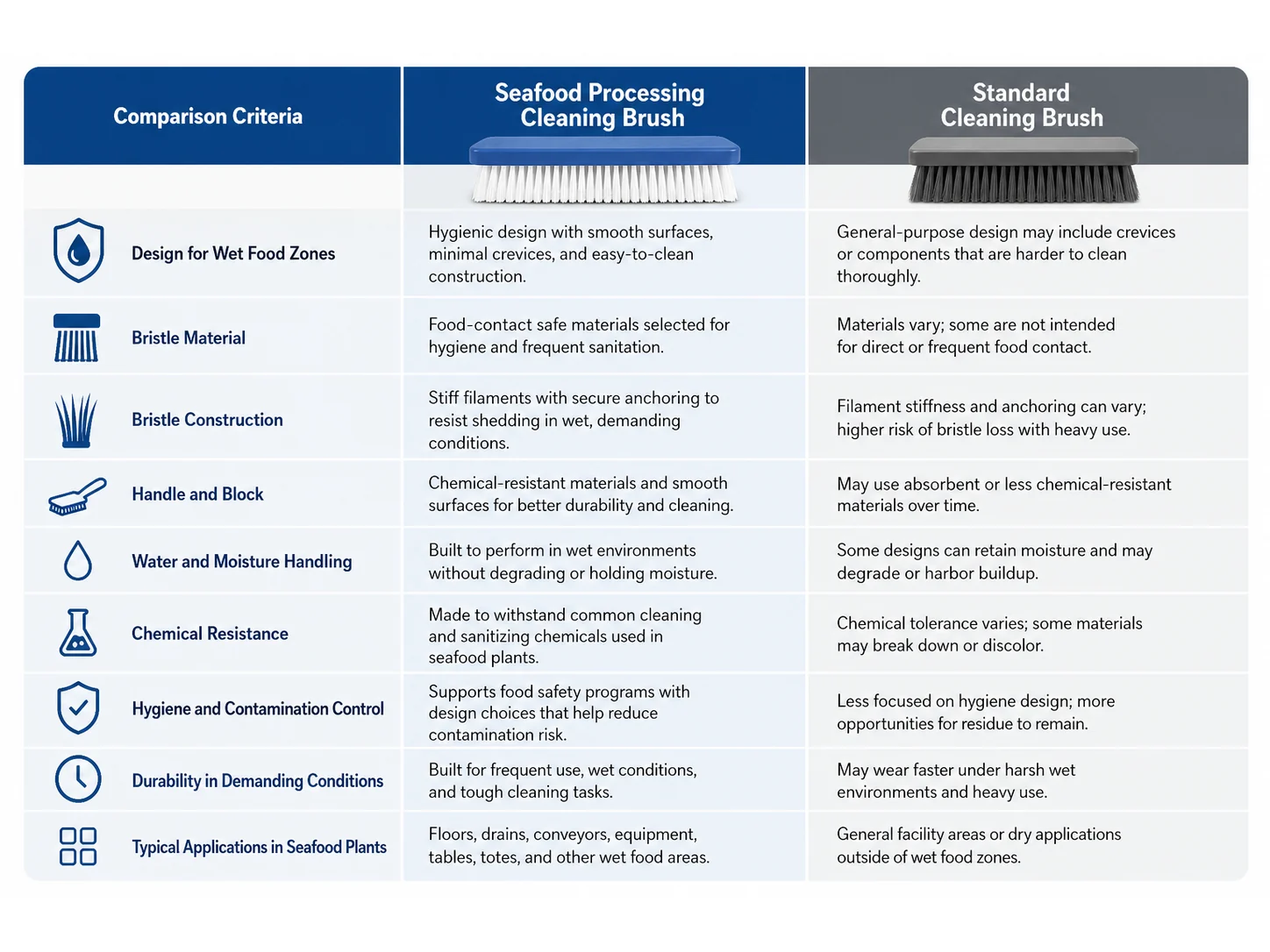
Seafood Processing Cleaning Brush vs Standard Cleaning Brush: A Side‑by‑Side Comparison
| Factor | Seafood Processing Cleaning Brush | Standard Cleaning Brush |
|---|---|---|
| Bristle material | FDA‑compliant polyester, polypropylene, or stainless steel (300‑series) | Mixed, often uncertified nylon, natural fibers, or carbon steel |
| Handle / core | Solid polymer or fully sealed stainless steel | Wood, painted metal, or open‑ferrule plastic |
| Moisture resistance | Non‑absorbent, will not swell or crack | Wood absorbs water and harbors bacteria |
| Chemical compatibility | Resists common detergents, sanitizers, and mild acids | May degrade, corrode, or leach colorants |
| Hygiene design | Smooth, crevice‑free, autoclavable or boilable options | Often has cracks, staples, or unsealed joints |
| Shedding risk | Low – bristles are mechanically locked or molded in | Higher – bristles may pull out after repeated wetting |
| Temperature range | Typically –20°F to 250°F (–29°C to 121°C) for polymer | Often limited; wood chars or glue fails |
| Mounting options | Compatible with quick‑connect shafts, CIP discs, magnets | Usually hand‑held or with generic thread |
| Typical use case | Filleting tables, conveyor belts, evisceration tools | Light floor scrubbing, maintenance shops |
The table makes it clear: in a wet food zone, the seafood processing brush is designed to avoid contamination pitfalls that standard brushes invite.
How to Choose the Right Brush for Your Seafood Wet Zone
Ask these questions before you buy or specify a brush:
- What kind of residue? Soft fat/oil → medium‑stiff polymer bristles. Baked‑on carbon → stainless wire with low‑pocket design.
- Surface sensitivity: Brushed stainless, plastic belts, or conveyor mesh each need different stiffness to avoid scratching.
- Equipment interface: Does the brush need to fit a specific holder, pipe, or rotary attachment? Check shaft diameter and connection type.
- Chemical exposure plan: Verify the brush material is compatible with your sanitation chemicals (chlorine, quaternary ammonium, peracetic acid).
- Hygiene protocol: If the brush must be boiled, autoclaved, or exposed to high‑pressure spray, choose fully sealed construction.
- Inspection and replacement frequency: Brushes that can be visually inspected in seconds win over those that hide damage inside a ferrule.
When in doubt, request a sample and run a cleaning trial in the actual wet zone. No datasheet replaces seeing how the brush handles your plant’s real conditions.
Setup, Usage, and Chemical Exposure Factors
Even the best brush will fail if you ignore three practical realities:
- Pre‑rinse temperature: Hot water above 140°F (60°C) can soften some polymer handles. Check the brush’s maximum continuous service temperature.
- Hanging storage: Brushes that sit in buckets of sanitizer overnight degrade faster. Use wall hooks or a dry‑rack system.
- Chemical concentration: Mixing cleaning agents at higher‑than‑recommended strength can discolor or stiffen polymer bristles prematurely.
These factors hit standard brushes even harder. Wood handles in a constant drip zone, for example, can start rotting within weeks.
Common Mistakes in Brush Selection for Wet Food Zones
- Mistake 1: Choosing a brush by handle color or cost drivers instead of material certification. Always ask for a USDA‑ or FDA‑acceptable statement for the bristle and block material.
- Mistake 2: Assuming stainless wire always means food‑grade. Only 304 or 316 stainless prevents rust and pitting in saline seafood environments.
- Mistake 3: Ignoring brush mount compatibility. A brush that does not fit existing quick‑change handles creates worker frustration and slower sanitation.
- Mistake 4: Using one brush type for every zone. Brushes that clean a non‑porous belt may still be too abrasive for a plastic grading sieve.
- Mistake 5: Not testing a sample before bulk ordering. A lower‑cost standard brush that lasts three months in a dry warehouse may fail in one week on a wet seafood line.
When a Seafood Processing Cleaning Brush Is the Wrong Choice
No brush can solve every wet‑zone cleaning challenge. Recognize these boundaries:
- For deep internal cavities (e.g., inside pump heads), a brush cannot replace a clean‑in‑place (CIP) system when validated cleaning is required.
- For biofilm control, mechanical brushing is just one step. It must be paired with proper sanitizing and verified by ATP or microbial swabs.
- When residues are physically bonded (baked scale, epoxy buildup), a brush may need to be replaced by a scraping tool or high‑pressure water jet.
- If certification to a specific standard (e.g., 3‑A sanitary standard) is mandatory, work with the brush supplier on a detailed drawing review and material traceability. A generic seafood cleaning brush may not be sufficient without that documentation.
In short, the brush is a critical tool—but it is part of a larger sanitation system, not a standalone Help confirm.
Final Takeaway: Matching the Brush to the Real Cleaning Task
For wet food zones in seafood processing, a purpose‑built seafood processing cleaning brush outperforms a standard brush on hygiene, chemical resistance, and tool life. However, the right choice still depends on residue type, surface compatibility, chemical exposure, and mounting requirements. Start with the cleaning problem, not the brush catalog. Specify materials, test a sample, and train operators to spot early wear. That practical, evidence‑based approach keeps your wet zones safe and your brush spend under control.
Frequently Asked Questions
Can I use a standard brush if I wash and sanitize it daily?
Daily sanitizing helps but does not fix material flaws. A wood handle will still absorb moisture, harbor bacteria, and eventually crack. For any direct or indirect food‑contact use in a wet zone, you need a brush constructed from non‑absorbent, cleanable materials.
What bristle stiffness is right for cleaning fish oil without scratching stainless steel?
A medium polyester or polypropylene bristle with a flagged (split‑end) tip offers enough scrubbing power to remove fish oil while being gentle on brushed stainless steel. Always test on a small area first, especially for highly polished or scored surfaces.
How do I know if a brush is truly food‑grade and not just marketed that way?
Look for documentation: the supplier should provide a letter of compliance stating that the bristle and block materials comply with FDA 21 CFR for the intended use, and be free of BPA, phthalates, and heavy metals. Some brushes also carry EU‑ or USDA‑acceptable statements.
Are stainless steel wire bristles safe for direct food contact in a seafood plant?
They can be, but only if the wire is 304 or 316 grade, the tuft‑set process eliminates pockets, and the plant has a verified approach to detect wire fragments if a bristle breaks. Many seafood HACCP plans require metal‑detectable or blue‑colored bristles to aid detection.
What is the best way to store brushes between shifts in a wet environment?
Hang brushes head‑down off the floor in a well‑drained area. Avoid soaking them in sanitizer buckets; prolonged chemical exposure can degrade the bristle media. A dry‑rack system with good air circulation works best.
Can a seafood processing brush also be used on dry ingredients or in a different plant zone?
Yes, but consider potential cross‑contamination. A brush used on raw seafood should not be used on cooked product without a validated cleaning step and possibly color‑coding. Many plants use brush colors to designate allergen or raw‑vs‑cooked zones.
When should I replace a seafood cleaning brush?
Replace when bristles show permanent bending (‘memory’), when the tip no longer recovers its shape, when cracks appear in the block, or when any sign of rust is visible. In heavy‑duty use, a visual inspection at each CIP cycle is a good practice.
Technical References
- eCFR — 21 CFR 178.1010 Sanitizing Solutions
- FDA — Food Code
- eCFR — 21 CFR 177.1500 Nylon Resins
- eCFR — 21 CFR 177.1520 Olefin Polymers
- eCFR — 21 CFR 177.1630 Polyethylene Phthalate Polymers
- eCFR — 21 CFR Part 117 Human Food CGMP and Preventive Controls
Which bristle material fits this job — AISI 304 Stainless Steel Wire, Nylon PA or Carbon Steel Wire?
| Material | Continuous temperature (°C) | Peak temperature (°C) | Water absorption | Hardness |
|---|---|---|---|---|
| AISI 304 Stainless Steel Wire | 400 | 500 | 0% | Rockwell B 70–95 depending on temper and cold work |
| Nylon PA | 93 | 121 | 0.3–9% by PA grade and conditioning | Medium to firm; filament diameter and trim length control bending force. |
| Carbon Steel Wire | 200–300 | 350–450 | 0% | Rockwell C 40–60 |
Figures as published by Alleima; Brushtec / DuPont. Confirm the exact grade against the supplier datasheet before ordering.
What should replace AISI 304 Stainless Steel Wire when it stops working?
- AISI 304 Stainless Steel Wire — Use AISI 316 stainless steel wire for chloride, marine, dairy, beverage, chemical washdown, or higher pitting-resistance requirements. Use carbon steel for dry aggressive cutting and brass or abrasive nylon for lower marking risk.
- Nylon PA — Compare Nylon PA with PP, PBT, PET. Change material when wet stiffness, temperature, chemical resistance, conductivity, particle shedding, or surface marking becomes the limiting factor.
- Carbon Steel Wire — Compare Carbon Steel Wire with Carbon steel wire, brass wire, abrasive nylon. Change material when wet stiffness, temperature, chemical resistance, conductivity, particle shedding, or surface marking becomes the limiting factor.