
What Is a Sink Edge Cleaning Brush?
A sink edge cleaning brush is a detail brush with a narrow, angled or tapered bristle profile specifically engineered to penetrate the gap between a sink rim and the countertop surface. It removes trapped food particles, soap scum, mold, and mineral deposits that accumulate in that linear seam. Unlike general-purpose brushes, its bristle length, stiffness, and head shape are matched to the typical width and depth of under-mount or drop-in sink joints, allowing effective cleaning without damaging sealants or delicate surfaces like granite, quartz, or stainless steel.
How Standard Cleaning Brushes Fall Short on Countertop Seams
Most households grab a standard dish brush, toothbrush, scrub pad, or bottle brush to clean around the sink. While these tools work for open surfaces, they present several problems when applied to countertop seams:
- Wrong shape: Bulbous or wide brush heads cannot fit into a seam that is often 3–10 mm wide.
- Inadequate stiffness: Soft bottle brush bristles may fold over without scrubbing hardened residue, while stiff deck brushes may scratch polished stone.
- Handle interference: Long, straight handles limit the attack angle, making it hard to scrub horizontally along the seam.
- Moisture trapping: Dense bristle clusters hold dirty water and redistribute grime instead of clearing it.
- Hygiene risk: Reusing the same brush for dishes and for sink-edge grime cross-contaminates surfaces.
Types of Brushes for Seam Cleaning
Several brush styles can clean sink edges, each with different strengths:
- Dedicated sink edge brush: A small head with angled, stiff bristles on a short or offset handle. Designed exclusively for seams.
- Grout brush: Narrow V-shaped bristles made for tile grout lines; can work on sink seams if the bristle stiffness matches the surface hardness.
- Detail brush with angled tip: A general-minute detail brush with a slanted bristle face used for automotive or household crevices.
- Laboratory-style test tube brush: A spiral-wound bristle brush on a twisted wire handle; useful for narrow gaps but can be too aggressive on some solid surfaces.
- Electric scrubber attachment: A small, motorized brush head with cone or flat bristle inserts; offers mechanical action but requires careful pressure control.
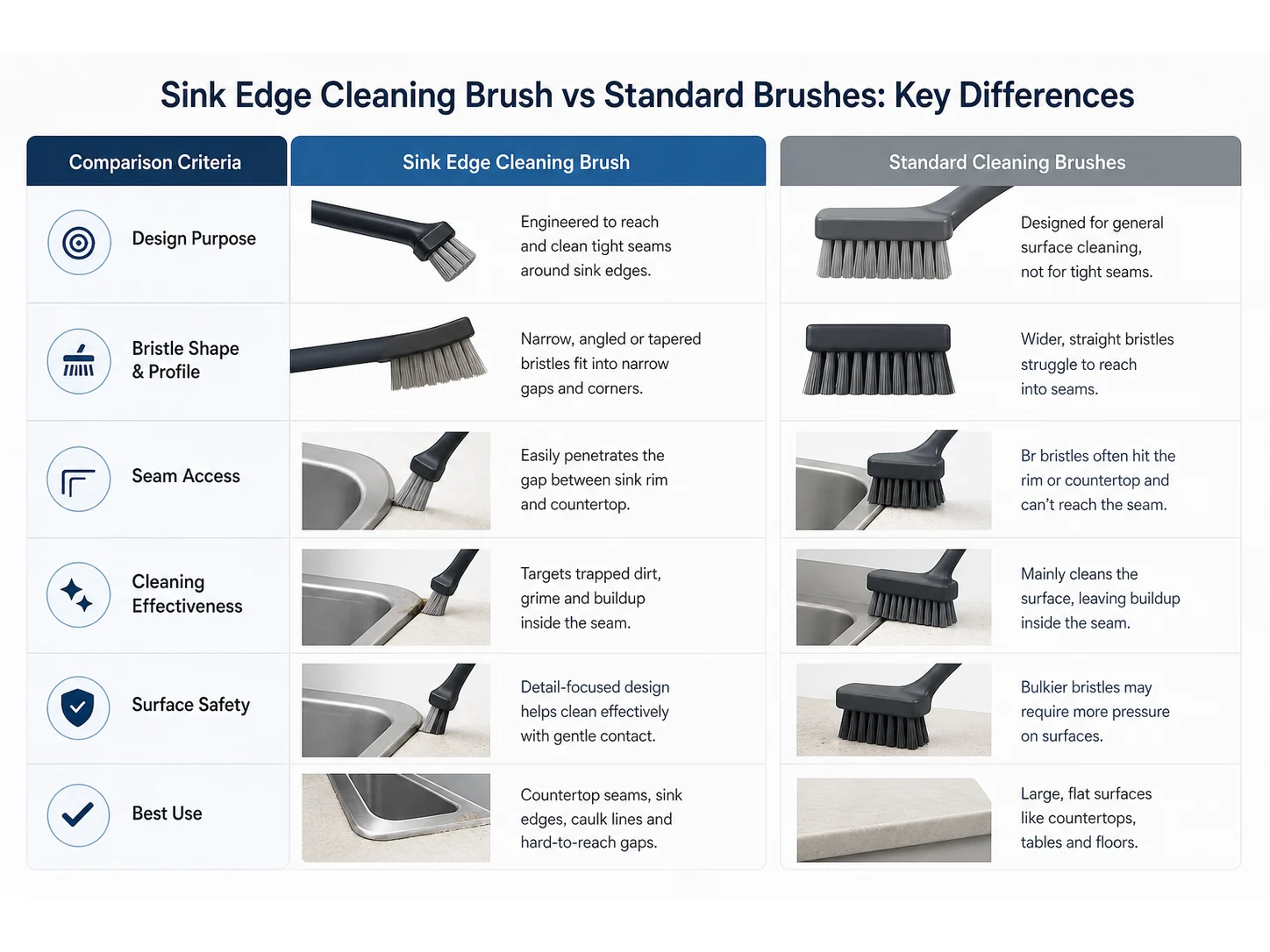
Sink Edge Cleaning Brush vs Standard Brushes: Key Differences
| Feature | Sink Edge Cleaning Brush | Standard Cleaning Brush (e.g., dish brush, toothbrush, bottle brush) |
|---|---|---|
| Bristle profile | Angled, tapered, or flat-edge; designed to slip into a narrow seam | Round, flared, or wide pad; cannot maintain contact inside a seam |
| Head width | Typically 5–15 mm, matched to seam width | Often 20 mm or larger; may not fit without forcing |
| Stiffness options | Available in soft, medium, firm for different surfaces | Limited; often too hard or too soft for seam residue |
| Handle design | Short, offset, or angled to allow horizontal scrubbing along the seam | Long straight handles; awkward to use sideways along a rim |
| Material compatibility | Bristles selected for sensitive materials (nylon, polyester, polypropylene) | May contain abrasive fillers or metal wire cores that risk scratching |
| Hygiene control | Often color-coded or single-use intended; easier to sanitize in thin sections | Multi-use design encourages cross-contamination |
| Best for | Under-mount and drop-in sink seams, backsplash joints, tight linear gaps | Open surfaces, wide grooves, general scrubbing |
How to Choose a Brush for Countertop Seams
Use this checklist to match the brush to your cleaning task:
- Measure the seam gap. For gaps under 5 mm, look for a brush with a very thin, flat bristle profile. For gaps 5–10 mm, a slightly tapered head works well. Wider gaps over 10 mm may be reached by a grout brush or a bottle brush.
- Identify the residue type. Soft soap scum needs medium stiffness; hardened limescale or crumbs need firmer bristles; oil-based kitchen residue benefits from a brush that can hold a small amount of cleaner.
- Assess surface sensitivity. Polished natural stone (granite, marble) and quartz demand soft to medium nylon bristles. Brushed stainless steel can handle firmer polypropylene. Do not use metal-bristle brushes on any finished surface.
- Consider chemical exposure. If using acid-based limescale removers or bleach solutions, choose polyester or polypropylene bristles; nylon can degrade over time. Check that the handle material resists the chemical you plan to use.
- Evaluate handle ergonomics. A short, offset handle reduces wrist strain when scrubbing back and forth along a horizontal seam. For frequent commercial cleaning, a removable/replaceable brush head on a sturdy handle may improve efficiency.
- Plan for hygiene and maintenance. In food-handling areas, dedicated brushes with color-coding help prevent cross-contact. Brushes with open bristle spacing dry faster and reduce bacterial growth.
- Check mounting or storage. Some detail brushes come with hanging holes or suction cups; this matters if the brush will live near the sink and needs to stay dry.
Common Mistakes When Using Seam Cleaning Brushes
- Using the stiffest brush available. Overly hard bristles can scratch polished stone, remove sink rim finishes, or erode silicone caulk, leading to leaks.
- Ignoring brush angle. Trying to push a straight brush perpendicularly into the seam often misses the actual buildup, which sits on the inner edges. A brush with a side-angled or tapered tip works with a horizontal scrubbing motion.
- Rinsing poorly. Dirty brushes re-deposit grime. After use, rinse bristles under running water while gently squeezing to release trapped particles.
- Using one brush for all surfaces. The same brush used for sink seams should not scrub dishes, backsplashes, or appliance edges without thorough sanitation, as it spreads biofilm.
- Skipping the cleaning agent. A brush alone cannot lift heavy soap scum or mildew. Apply a suitable non-abrasive cleaner or a diluted vinegar/water solution before scrubbing.
- Neglecting brush replacement. Bristles that become permanently bent or matted no longer reach the seam bottom. Replace the brush when bristle shape no longer springs back.
When a Sink Edge Cleaning Brush Is the Wrong Choice
Even the best seam brush has limits. If you notice these conditions, a brush alone will not solve the problem:
- Persistent mold or mildew deep inside the caulk joint. A brush may clean surface staining, but fungal growth inside the sealant requires cutting out the old caulk, disinfecting, and re-caulking.
- Severe mineral etching on natural stone edges. Hard-water etching can penetrate the surface. A brush cannot reverse etching; you may need a poultice or professional refinishing.
- Loose or cracking sealant. Scraping with any brush can worsen the damage. Remove and replace the sealant first.
- Gaps wider than 15 mm or uneven sink mounting. A brush designed for a tight seam may miss buildup in large, irregular gaps. A grout brush, steamer, or even a crevice tool on a wet vacuum may be more appropriate.
- Commercial kitchens with HACCP sanitation requirements. A manual brush may not be sufficient for verifying clean. You may need a documented cleaning and sanitizing step with validation, such as ATP swab testing, beyond visual inspection.
Final Takeaway
Choose a sink edge cleaning brush when your main cleaning target is that stubborn, narrow sink-counter joint and you need a tool that reaches in, scrubs effectively, and protects the finish of both the sink and the countertop. If you only need to wipe down wide surfaces or occasionally touch up a visible edge, a standard detail brush or even a dedicated grout brush may work. Match the bristle material and stiffness to the residue you remove and the surface hardness you protect. Most important, measure the gap and select a brush whose head profile truly fits—because the difference between a 5 mm and a 15 mm brush head is the difference between a clean seam and a frustrating smear.
Frequently Asked Questions
Can I use an old toothbrush as a sink edge brush?
Yes, for occasional light cleaning and very narrow seams, a toothbrush can work. However, standard toothbrushes typically have a rectangular head that may not match the linear length of a sink seam, and the bristles are often too soft for hardened residue. A dedicated sink edge brush with an angled profile is faster and more effective for regular deep cleaning.
What bristle material is safe for granite countertops?
Soft to medium nylon is safe for polished granite. Avoid stiff polyester, polypropylene with abrasive fillers, and any brush containing metal wire or grit. Always test a small, inconspicuous area first.
How often should I replace a sink edge cleaning brush?
In a home kitchen, replace the brush every 3 to 6 months or sooner if bristles become matted or discolored. In a commercial setting, inspect bristle condition weekly and replace when the tip no longer springs back to its original shape.
Can I sanitize my seam cleaning brush in the dishwasher?
Many small detail brushes are not dishwasher-safe because the heat can warp the handle or loosen the bristle setting. Instead, soak the brush briefly in a diluted bleach solution (1 tablespoon bleach per quart of water), rinse thoroughly, and air-dry with bristles facing down.
Are electric scrubber attachments better than a manual brush?
Electric attachments offer extra mechanical action that helps lift stubborn residue, but they require careful pressure control. On polished stone or thin caulk lines, the rapid oscillation can abrade the surface or vibrate the sealant. Use a variable-speed tool and a soft bristle head, and stay within the seam rather than riding up onto the countertop edge.
What if my sink seam gap is very uneven?
An uneven gap may need two different brush widths: a thinner brush for narrow sections and a wider, softer brush for larger openings. If the gap varies due to poor installation, resealing the sink is the long-term solution, as a brush cannot correct the underlying problem.
Do I need a long-handled brush for sink edges?
A long handle is helpful if reaching behind a deep farmhouse sink or across a wide island. However, for most standard sink installations, a short, offset handle offers better control and reduces the tendency to apply too much pressure at the wrong angle.
Technical References
- FDA — Food Code
- FDA — Safe Food Handling
- EPA — Safer Choice
- American Brush Manufacturers Association — Brush Lingo
Which bristle material fits this job — Nylon PA, AISI 304 Stainless Steel Wire or Silicone?
| Material | Continuous temperature (°C) | Peak temperature (°C) | Water absorption | Hardness |
|---|---|---|---|---|
| Nylon PA | 93 | 121 | 0.3–9% by PA grade and conditioning | Medium to firm; filament diameter and trim length control bending force. |
| AISI 304 Stainless Steel Wire | 400 | 500 | 0% | Rockwell B 70–95 depending on temper and cold work |
| Silicone | 200–250 | 280–300 | 0.1–1.0% | Shore A 20–80 |
Figures as published by Brushtec / DuPont; Alleima. Confirm the exact grade against the supplier datasheet before ordering.
What should replace Nylon PA when it stops working?
- Nylon PA — Compare Nylon PA with PP, PBT, PET. Change material when wet stiffness, temperature, chemical resistance, conductivity, particle shedding, or surface marking becomes the limiting factor.
- AISI 304 Stainless Steel Wire — Use AISI 316 stainless steel wire for chloride, marine, dairy, beverage, chemical washdown, or higher pitting-resistance requirements. Use carbon steel for dry aggressive cutting and brass or abrasive nylon for lower marking risk.
- Silicone — Compare Silicone with PP, TPE, Nylon. Change material when wet stiffness, temperature, chemical resistance, conductivity, particle shedding, or surface marking becomes the limiting factor.