
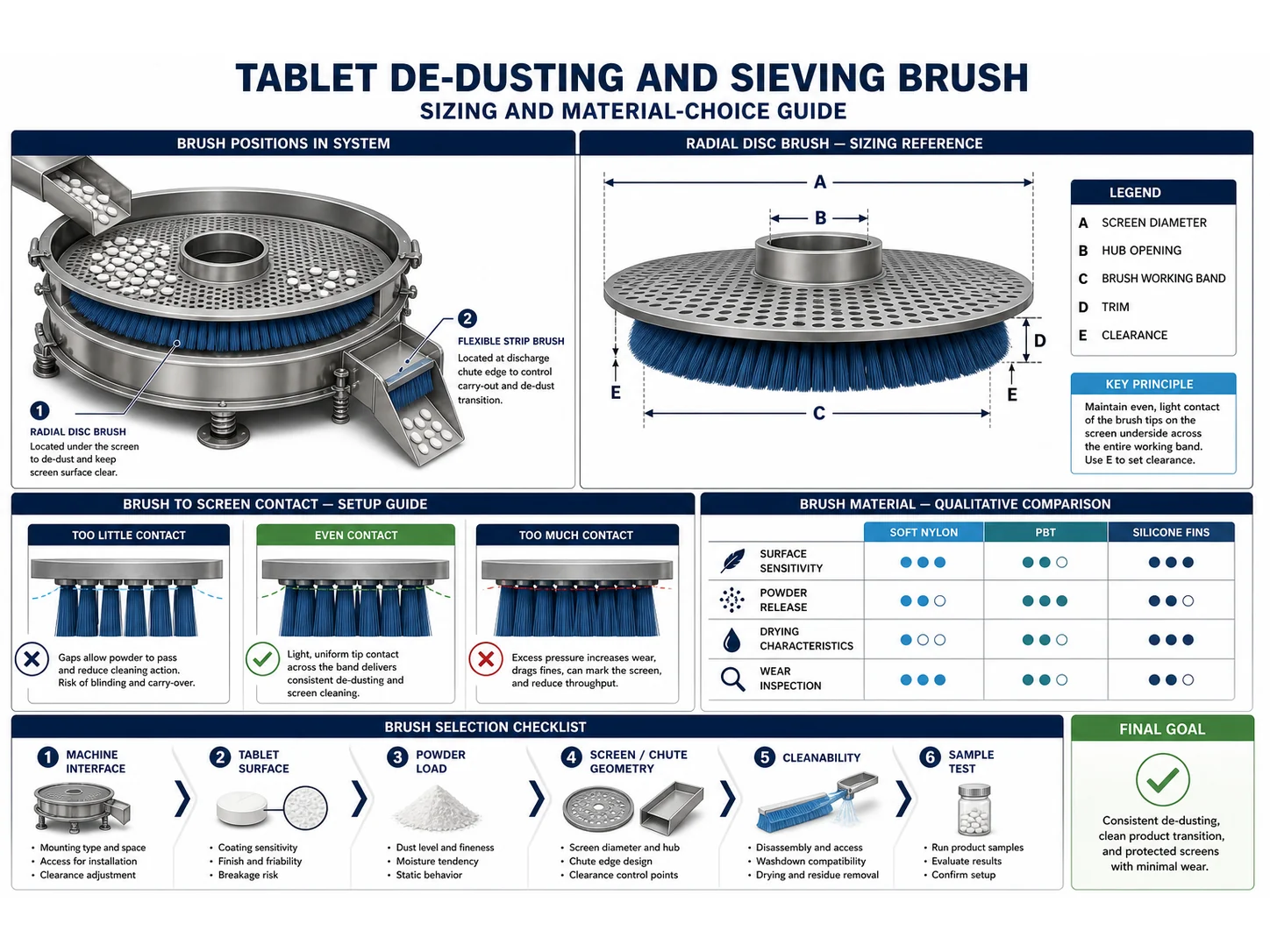
What Is a Tablet De-Dusting Brush?
A tablet de-dusting brush is a contact cleaning device made of soft bristles or flexible materials that physically wipe loose powder from tablet surfaces. Unlike air-only dedusting systems, brushes provide mechanical action that can dislodge adherent dust without damaging the tablet core. They are typically integrated into vibrating sieves, rotary dedusters, or conveyor transfer points in tablet compression and coating lines.
Common Types of De-Dusting Brushes
Three main brush configurations are used in tablet processing:
- Vibrating sieve brushes – mounted above or below a vibrating screen to gently brush tablets as they pass over the mesh, removing fines and dust.
- Roller brushes – rotating cylindrical brushes that contact tablets on a conveyor belt or in a deduster drum, providing uniform surface cleaning.
- Transfer point brushes – installed at chutes, turns, or drop points where tablets change direction, capturing dust at potential impact zones.
Roller Brush vs. Vibrating Sieve Brush vs. Transfer Point Brush
| Feature | Vibrating Sieve Brush | Roller Brush | Transfer Point Brush |
|---|---|---|---|
| Mechanism | Linear or orbital vibration with stationary or reciprocatng brush | Rotating cylinder covered with bristles | Fixed or adjustable brush at a specific angle |
| Typical Location | Inside vibrating sieve/de-duster | Above conveyor belts or in dedicated deduster drums | Chutes, bends, and drop points |
| Best For | Bulk tablet dedusting right after compression | Continuous high-speed lines; effective for both dust and surface cleaning | Localized dust removal at critical transfer positions |
| Material Sensitivity | Effective on hard to medium tablets; soft tablets may require reduced contact pressure | Good balance of cleaning force; can be tuned with roller speed and bristle type | Very gentle if adjusted correctly; ideal for fragile or coated tablets |
| Maintenance Complexity | Moderate; brush replacement requires sieve disassembly | Low to moderate; quick change designs available | Low; often simple bracket-mounted |
How Brush Material Choice Depends on Tablet Hardness
Bristle stiffness must be matched to tablet hardness to prevent surface erosion or breakage:
- Soft tablets (e.g., orally disintegrating tablets, low-compression formulations) require soft natural fibers like goat hair or extremely fine nylon (soft nylon brush for cleaning) to avoid tablet damage.
- Medium-hard tablets can use medium-density synthetic bristles such as polyester or nylon blends that provide effective dust removal without excessive abrasion.
- Hard tablets (e.g., film-coated tablets, high-compression formulations) can tolerate stiffer synthetics or mixed bristles that maintain their shape and cleaning efficiency over long runs.
Material compatibility with cleaning agents is also critical; natural bristles may absorb moisture and degrade faster in wet cleaning processes.
GMP Cleaning Protocols and Documentation
In GMP environments, de-dusting brushes must be designed for easy cleaning and validation. Key considerations include:
- Cleanability: Brushes should have smooth, non-porous backings, minimal crevices, and be resistant to common cleaning agents.
- Changeover procedure: Documented steps for brush removal, cleaning, and re-installation prevent cross-contamination.
- Cleaning log: Each brush should have a unique ID and a log recording cleaning dates, inspection results, and replacement status.
- Dedicated vs. multi-product use: High-risk facilities often dedicate brushes to a single product; shared brushes require validated cleaning between batches.
- Material certificates: Bristle material should be documented for food or pharma contact and free from shedding or leachable substances.
When Is a Sieve Shaker Without a Brush Acceptable?
Brushes are not always mandatory. A brushless vibrating sieve shaker may be sufficient when:
- Tablets are exceptionally hard and non-friable, and vibration alone dislodges all visible dust.
- The product is highly abrasive and would quickly wear out brushes, causing more particulate contamination.
- Air-only dedusting is already proven effective for the specific tablet shape and coating.
- Risk of bristle shedding is unacceptable due to patient safety (e.g., sterile or injectable-grade tablets).
However, if residual dust remains on tablets after sieving without a brush, a brush-assisted system is usually required to meet visual inspection standards.
Common Mistakes in Selecting or Using De-Dusting Brushes
- Choosing by cost alone: Inexpensive brushes may shed bristles or degrade quickly, leading to product contamination and frequent line stops.
- Ignoring bristle stiffness: Too stiff a brush on soft tablets causes chipping or powdering; too soft a brush on hard tablets fails to clean effectively.
- Overlooking brush dimensions: A brush that does not cover the full tablet path leaves uncleaned areas, reducing overall dedusting performance.
- Using worn-out brushes: Flattened or tangled bristles lose cleaning efficiency and may trap dust, releasing it later onto tablets.
- Not verifying GMP compliance: Brushes without documentation or unsuitable materials can lead to audit observations.
- Skipping in-process inspections: Regular visual checks of brush condition and cleaning effectiveness prevent batch failures.
Final Takeaway
Selecting a tablet de-dusting brush is not a one-size-fits-all decision. Match the brush type to your equipment layout, choose bristle material based on tablet hardness and cleaning chemistry, and maintain strict GMP documentation for every brush in use. Always test a new brush on a small batch before full-scale implementation to confirm it cleans effectively without damaging your product.
When a Tablet De-Dusting Brush Is the Wrong Choice
This brush is not enough when the main problem is blocked access, unsafe working conditions, damaged equipment, incompatible chemicals, or a process setting that keeps recreating the residue. In those cases, review access, residue type, surface sensitivity, brush stiffness, operating environment, and replacement routine and confirm the surrounding cleaning method before increasing brush stiffness or contact pressure.
Frequently Asked Questions
Can I use the same de-dusting brush for different products?
It is possible if a validated cleaning procedure exists between product changeovers, but many GMP facilities prefer dedicated brushes to eliminate cross-contamination risk entirely.
How often should tablet de-dusting brushes be replaced?
Replacement frequency depends on production volume and tablet abrasiveness. Visually inspect brushes at least once per shift and replace when bristles become flattened, tangled, or show signs of wear.
What bristle material is best for soft gel capsules?
Soft gelcaps require very gentle contact. Ultra-soft natural fibers like fine goat hair or special anti-static treated polyester are common choices to avoid capsule deformation.
How do I clean de-dusting brushes in a GMP facility?
Use a validated manual or automated cleaning process with approved detergent and purified water. Brushes should be rinsed thoroughly, dried completely to prevent microbial growth, and stored in a clean, dry area.
Are natural bristles better than synthetic for pharmaceutical use?
Not necessarily. Natural bristles provide excellent softness but may not withstand aggressive cleaning agents or high temperatures. Synthetic bristles offer better chemical resistance and durability, but stiffness must be carefully matched to the tablet.
What are signs that a brush is damaging tablets?
Increased tablet friability, chipped edges, surface scratches, or excessive powder generation after dedusting are clear indicators that the brush is too abrasive.
Is a roller brush always needed on a tablet conveyor?
No. If tablets are already clean after the primary deduster, a transfer point brush might be enough. Roller brushes are most beneficial when continuous, uniform cleaning is required across the entire belt width.
Can a roller brush be retrofitted to an existing conveyor?
In many cases, yes. Bracketed brush assemblies are available that can be mounted above a belt. Check available clearance, belt speed, and cleaning access before retrofitting.
Technical References
- eCFR — 21 CFR 211.67 Equipment Cleaning and Maintenance
- British Plastics Federation — Thermoplastics
- eCFR — 21 CFR Part 211 Finished Pharmaceutical CGMP
- NIST — Metric SI
Which nylon grade fits this job — Nylon PA, PA6 Nylon or PA66 Nylon?
| Grade | Continuous temperature (°C) | Peak temperature (°C) | Water absorption | Hardness |
|---|---|---|---|---|
| Nylon PA | 93 | 121 | 0.3–9% by PA grade and conditioning | Medium to firm; filament diameter and trim length control bending force. |
| PA6 Nylon | 80–100 | 130–160 | 1.5–3.0% | Shore D 75–85 |
| PA66 Nylon | 100–120 | 150–180 | 1.0–1.8% | Shore D 80–88 |
| PA610 Nylon | 90–110 | 130–150 | 0.5–1.0% | Shore D 72–82 |
| PA612 Nylon | 90–110 | 130–150 | 0.3–0.7% | Shore D 70–80 |
Figures as published by Brushtec / DuPont. Confirm the exact grade against the supplier datasheet before ordering.
What should replace Nylon PA for dust removal?
- Nylon PA — Compare Nylon PA with PP, PBT, PET. Change material when wet stiffness, temperature, chemical resistance, conductivity, particle shedding, or surface marking becomes the limiting factor.
- Goat Hair — Compare Goat Hair with Boar bristle, goat hair, microfiber. Change material when wet stiffness, temperature, chemical resistance, conductivity, particle shedding, or surface marking becomes the limiting factor.