What Is an Antibacterial Kitchen Brush?
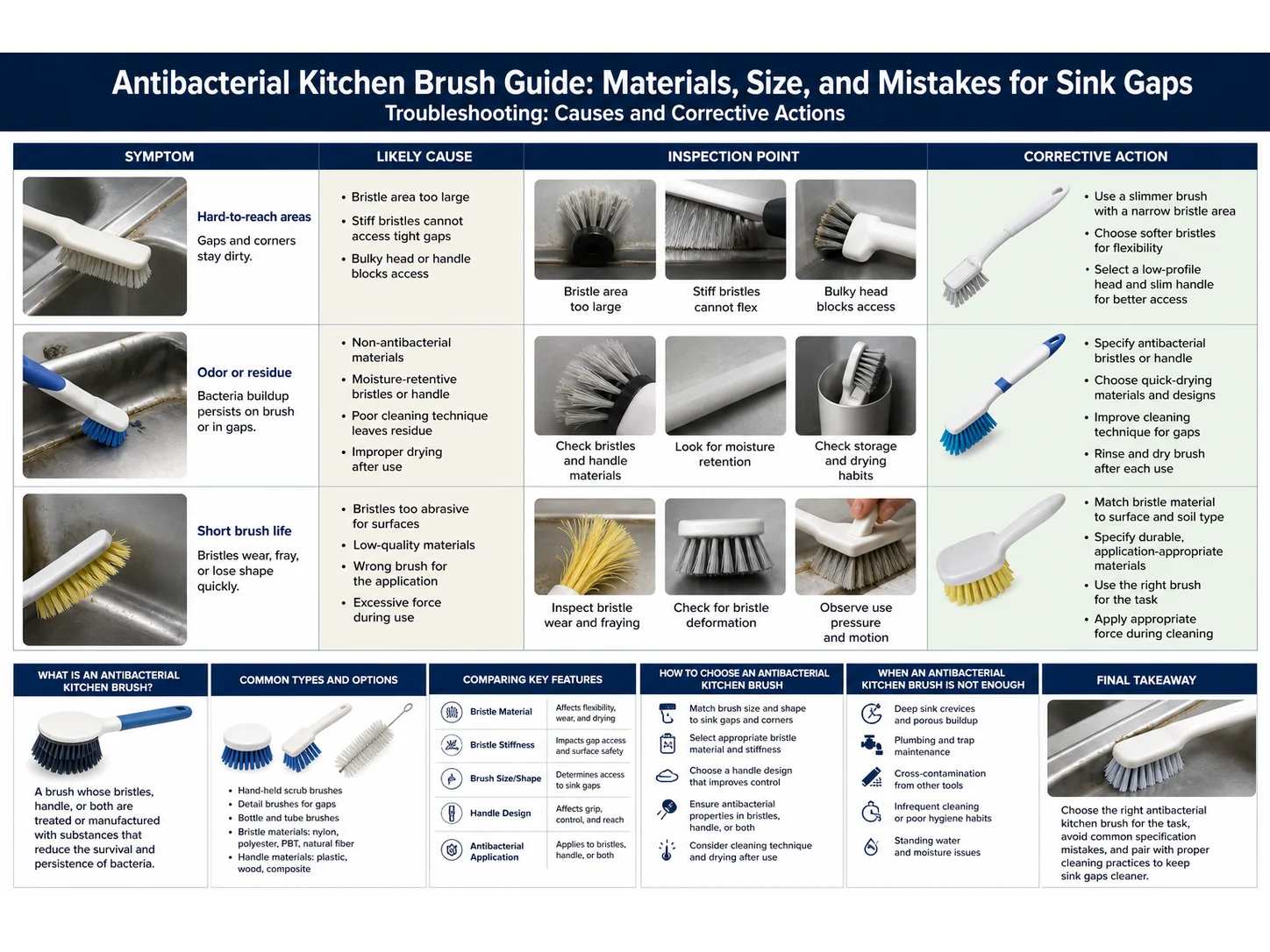
An antibacterial kitchen brush is a brush whose bristles, handle, or both incorporate materials or treatments that inhibit the growth of bacteria, mold, and mildew. The “antibacterial” property can be achieved through inherent filament additives (e.g., silver-based compounds, zinc pyrithione) or through post-manufacturing coatings. These brushes are designed not just to clean, but to remain hygienic between uses, reducing cross-contamination risks on food-contact and non-food-contact surfaces.
For grill brush bristle-shedding risk, this article cites the CDC MMWR — Wire Bristle Grill-Brush Ingestion Injuries instead of treating wire-bristle grill cleaning as a harmless detail.
For kitchen cleaning examples, the FDA — Food Safety in Your Kitchen supports the distinction between normal cleaning, food handling, and hygiene habits.
For general foodborne-illness prevention language, the CDC — Preventing Food Poisoning is used as the public-health reference.
For the material or regulatory boundary in this section, the supporting reference is eCFR — 21 CFR 177.1500 Nylon Resins.
For the material or regulatory boundary in this section, the supporting reference is eCFR — 21 CFR 177.1520 Olefin Polymers.
For the material or regulatory boundary in this section, the supporting reference is eCFR — 21 CFR 177.1630 Polyethylene Phthalate Polymers.
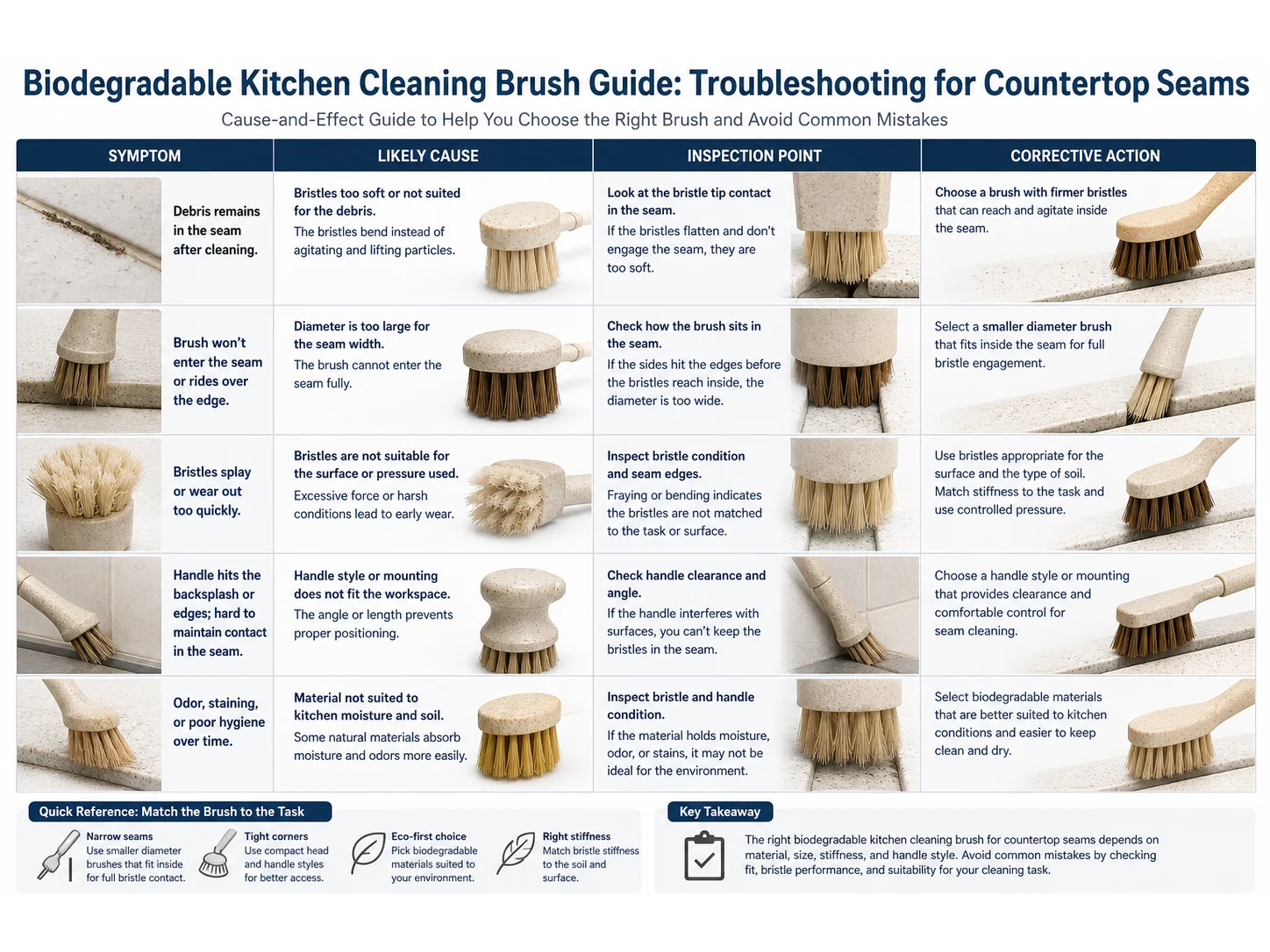
The defining feature for countertop seam use is a narrow, stiff but non-scratching bristle profile that can penetrate gaps as small as 1–3 mm without damaging delicate sealants or surface finishes.
Why Countertop Seams Need a Specialized Brush
Countertop seams—where two stone, laminate, stainless steel, or solid surface sections meet—create linear crevices that standard dish brushes or scrub pads cannot fully penetrate. In wet, food-exposed areas, these seams harbor biofilms, dried residues, and allergens. A specialized antibacterial brush with a precision tip and low-absorbency bristles provides mechanical cleaning action in these confined spaces while resisting bacterial colonization. Standard brushes may shed, leave bristles, or push debris farther into the seam, actually worsening hygiene.
Key Specifications to Evaluate Before Ordering
Before requesting a quote, prepare a clear specification list. The following points form a practical RFQ checklist:
- Seam dimensions: average width, depth, and length of seams to be cleaned.
- Bristle material: FDA-compliant? Chemical resistance required? Abrasion limits.
- Bristle stiffness: Shore A hardness or similar; must be stiff enough to scrub but not score surfaces.
- Antibacterial mechanism: additive in polymer or external coating? Data on durability and washdown resistance.
- Bristle diameter: typically 0.10–0.30 mm for seams; finer for tight joints.
- Brush block/handle material: waterproof, heat-tolerant (up to 85°C common in dishwashing), ergonomic grip if handheld.
- Mounting/interface: if for robotic or automated arms, specify thread type, shank size, or magnetic base.
- Overall dimensions: brush face length, width, trim length, and total length.
- Compliance: FDA 21 CFR (indirect food contact), NSF, or other relevant standards.
- Sample policy: can the supplier provide a pre-production sample for seam-fit testing?
Material and Bristle Options Comparison
Use this table to compare common filament materials for antibacterial kitchen brushes targeting countertop seams.
| Material | Antibacterial Mechanism | Stiffness | Water Absorption | Temperature Tolerance | Abrasiveness on Stone/Stainless | Best For |
|---|---|---|---|---|---|---|
| Nylon 6.12 with silver-ion additive | Silver ions bound in polymer matrix | Medium to high (Shore D 70–80) | Low | Up to 90°C intermittent | Low (safe on most surfaces) | General seam cleaning; wet environments |
| PBT (Polyester) with zinc pyrithione | Zinc pyrithione compounded in filament | High (stiffer than nylon) | Very low | Up to 100°C | Moderate; test on softer sealants | Heavy-duty scrubbing; high-temp washdown |
| PP (Polypropylene) with antimicrobial coating | Surface treatment/coating | Low to medium | Low | Up to 100°C | Low (softest option) | Sensitive sealants; very narrow seams |
| PTFE (Teflon®) with antimicrobial additive | Chemically inert; additive possible | Low | Nil | Up to 260°C | None; least likely to scratch | Chemical-resistant; high-heat; cleanroom-like |
| Natural fiber (e.g., Tampico) treated | Surface-applied antimicrobial | Low | High (requires drying) | Degrades above 60°C | Low (soft) | Not recommended for seam hygiene unless dry-only |
Note: Stiffness values are approximate; always request actual diameter and trim length specifications. Antimicrobial durability should be verified per ASTM E2180 or similar for lifespan under detergent and sanitizer exposure.
How to Choose the Right Brush for Your Application
Select the optimal brush by asking:
- What residues dominate? Oily or greasy soils may require stiffer, chemical-resistant bristles (PBT or nylon). Sugar-based syrups may clean easier with nylon.
- What is the surface sensitivity? Polished stone, epoxy seams, and stainless steel scratch differently. Conduct a scratch test with material samples.
- Handheld or machine interface? Hand brushes can have longer handles and ergonomic grips; machine brushes require precise shank dimensions and balanced construction.
- Exposure to chemicals? Chlorine-based sanitizers, quats, or acidic detergents accelerate material degradation. Request chemical compatibility chart.
- Temperature and washdown frequency: High-frequency automated wash cycles demand high-melt-point, low-water-absorption filaments.
- Hygiene protocol: If brush remains in the kitchen zone, antibacterial properties must survive repeated sanitization. Ask for test reports on antimicrobial efficacy after 500 cycles.
Custom Size and Shape Considerations
Seam cleaning brushes are rarely one-size-fits-all. Provide suppliers with:
- Target seam width and depth.
- Desired bristle trim: feathered (angled) for corner access, flat for long straight seams, or pencil-point for micro-gaps.
- Block material: polypropylene, wood (avoid in wet environments), or stainless steel.
- Handle design: detachable, flexible neck, or fixed. Consider dishwasher compatibility.
- Quantity: prototype needs vs. production volume; this affects tooling and cost, but a small custom order may be feasible with hand-drilling or CNC trimming.
Common mistake: specifying a brush diameter without accounting for bristle flare under pressure. Ask for a drawing showing free tip width vs. compressed width.
Common Mistakes When Ordering Custom Brushes
- Ignoring filament memory: Some bristles deform permanently after being compressed in seams. Always request recovery data.
- Focusing only on cost drivers: A low-cost filament may wear quickly or lose antibacterial properties early, requiring frequent replacement and increasing long-term cost.
- Forgetting the handle material: A perfectly designed bristle head mounted on a water-absorbing wooden handle will become a bacterial breeding ground.
- Overlooking seam sealant compatibility: Abrasive bristles can etch into silicone or acrylic sealants, creating new crevices.
- Skipping the sample stage: Without testing on actual countertop material and with your sanitizers, you cannot verify cleaning efficacy or chemical resistance.
- Assuming “antibacterial” means “self-cleaning”: Even antibacterial bristles need rinsing; they inhibit microbial growth but do not eliminate biofilm buildup.
When an Antibacterial Brush Is Not Enough
An antibacterial kitchen brush is only one element of a comprehensive seam hygiene program. Consider additional or alternative measures when:
- Seams are deeper than 3 mm and trap liquid; redesign the seam geometry (radius corners, FDA-approved sealants) rather than relying solely on manual brushing.
- The environment requires aseptic conditions (e.g., pharmaceutical kitchens, cleanrooms); steam or dry vapor cleaning may be needed before and after brushing.
- Biofilm has matured; enzymatic or chemical pre-treatment is necessary before mechanical brushing.
- Brushes must be color-coded for allergen or zone separation; discuss custom bristle color options with the supplier.
- Inspection after cleaning is critical; if you cannot visually verify seam cleanliness, a brush alone isn’t sufficient.
Final Takeaway
A custom antibacterial kitchen brush for countertop seams is a simple component but its specification requires careful thought. Focus on the seam geometry, material compatibility, and verifiable antibacterial performance. Always request samples, compare at least two filament types, and test under your actual cleaning protocol before placing a full order. The right brush contributes directly to passing health inspections and extending seam sealant life.
Frequently Asked Questions
What is the most reliable antibacterial additive for kitchen brushes?
Silver-ion technology is widely favored because it is inorganic, heat-stable, and can be compounded directly into nylon or polyester during extrusion. Zinc pyrithione is also common and effective, though it may leach slightly over time. Always ask for third-party test results per ISO 22196 or ASTM E2180.
Can I order a single sample brush before committing to a bulk order?
Many custom brush manufacturers offer low-cost sample runs, though they may involve a setup fee. Clearly state your seam dimensions and ask for a short batch (e.g., 5–10 pieces) to evaluate fit and durability. This is a standard and recommended practice.
How do I specify a brush for a seam that varies in width?
Provide the minimum, maximum, and typical seam widths. The supplier may suggest a tapered trim or dual-diameter bristles that bend to fill gaps. A drawing with cross-section details is essential.
Does an antibacterial brush replace sanitizing procedures?
No. An antibacterial brush reduces the likelihood of the brush itself becoming a contaminant source, but the cleaned surface still requires final sanitization per your food safety plan. The brush is a cleaning aid, not a sanitizer.
What bristle diameter is best for very tight quartz or granite seams?
For seams under 1 mm, bristles of 0.10–0.15 mm diameter are typical. Choose soft material like polypropylene or fine nylon to avoid chipping the stone edge. A pencil-point trim concentrates bristles at the tip.
How long do antibacterial properties last in a commercial kitchen with daily hot water rinses?
It depends on the additive and the filament matrix. Quality silver-ion nylon can maintain >99% antimicrobial activity for over 500 wash cycles. Ask the supplier for accelerated wear test data.
Is a stainless steel handle always better than plastic?
Stainless steel is durable, non-porous, and dishwasher-safe, but it conducts heat and can be slippery. Food-grade polypropylene handles with anti-microbial additive are lighter and cooler to touch, making them popular for handheld use. Plastic handles with texture improve grip.
What if my cleaning protocol uses high-pressure water? Will bristles survive?
Standard nylon or PBT bristles can withstand typical low-pressure spray (under 10 bar). For pressure washing up to 20 bar or higher, specify a larger diameter (0.30 mm+) and secure crimping or stapling. Discuss pressure limits with the brush maker.