
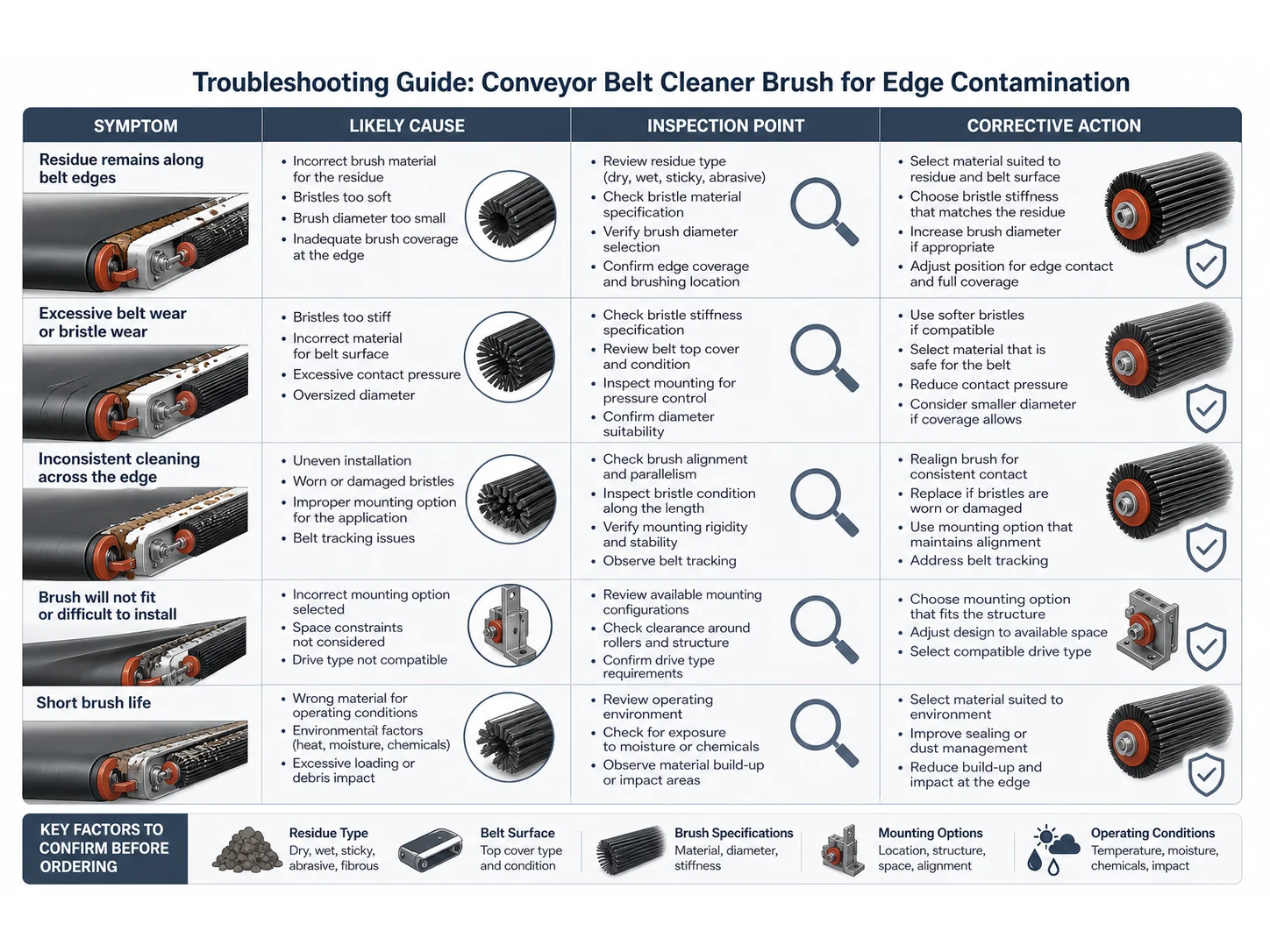
What Is a Conveyor Belt Cleaner Brush?
A conveyor belt cleaner brush is a rotating or stationary brush assembly that physically scrubs the belt surface to dislodge material that primary scrapers miss. Unlike flat scrapers, brush filaments reach into surface irregularities and maintain consistent contact without damaging the belt. For edge cleaning, the brush is usually narrower and positioned to contact only the belt edges where fine particles, dust, or sticky buildup often escape standard cleaning systems.
Why Belt Edge Contamination Requires a Different Approach
Belt edges are prone to contamination because:
- Material spills over the sides during loading.
- Standard mid-belt cleaners leave a narrow uncleaned strip.
- Static charge attracts airborne dust to edge surfaces.
- Edge tracking devices and skirt board gaps create shadow zones.
Ignoring edge buildup can accelerate belt wear, create slipping hazards, contaminate downstream products, and lead to unscheduled downtime. A dedicated conveyor belt cleaner brush for the edge zone solves these problems by applying targeted friction exactly where it’s needed.
Common Types of Conveyor Belt Cleaner Brushes for Edge Cleaning
Before specifying a custom brush, understand the main categories:
- Rotary roller brushes – Driven by belt contact or a motor, ideal for continuous, high-speed lines.
- Stationary strip brushes – Fixed in place, often with a holder; belt movement provides the cleaning action. Simpler and lower maintenance.
- Spiral-wound brushes – Filaments wound around a core in a helix, offering self-cleaning action and reduced clogging.
- Tube or pipe brushes – Cylindrical brushes with a through-bore, used for inline or scraper replacement applications.
Material, Diameter, Stiffness, and Mounting Options: A Comparison Table
Your application’s success depends on matching brush characteristics to the operating conditions. Below is a practical comparison of key variables:
| Option | Material / Type Examples | Best For | Watch Out For |
|---|---|---|---|
| Filament material | Nylon, polypropylene, horsehair, stainless steel wire, abrasive nylon | Nylon: general dry use; Polypropylene: wet/chemical resistance; Horsehair: delicate surfaces; Wire: heavy-duty scale | Nylon absorbs moisture and softens; polypropylene has lower temperature tolerance; horsehair degrades in wet conditions; wire can scratch belt |
| Brush diameter (OD) | Typically 2″ to 12″ | Smaller diameters for tight spaces and belt edges; larger diameters for longer filament life and higher surface speed | Too large and it won’t fit; too small and it wears rapidly |
| Filament stiffness | Soft, medium, firm, extra-firm | Soft: gentle cleaning, food-grade; Firm: heavy residue removal | Too stiff can damage belt covers; too soft won’t clean effectively |
| Core/handle | Solid shaft, tube core, quick‑change hub, bolt‑on flange | Solid shaft for motor drive; quick‑change for frequent replacement | Ensure core material is compatible with chemicals and shaft size matches existing hardware |
| Mounting | Fixed bracket, spring‑loaded arm, adjustable angle plate, pillow block bearing | Fixed for simple installations; spring‑loaded for consistent pressure; adjustable for fine‑tuning contact | Rigid mounts can cause chatter; over‑tensioned springs accelerate wear |
How to Choose the Right Conveyor Belt Cleaner Brush for Your Application
Walk through these decision points before you open an RFQ:
- Residue type – Is it dry dust, sticky syrup, abrasive sand, or oily film? Filament material and stiffness depend on this.
- Belt surface sensitivity – Thin PVC, food-grade rubber, or rough-top belts need specific filament softness to avoid damage.
- Equipment interface – Measure available space, shaft diameter, and distance from the belt edge. Confirm rotation direction and speed.
- Wet or chemical exposure – Determine if cleaning solutions, water washdown, or CIP chemicals are present. Choose filaments and core metals that resist corrosion.
- Hygiene expectations – Food and pharma applications may require FDA-listed filaments, stainless steel cores, and designs that prevent filament loss.
- Maintenance frequency – How often can you replace or adjust the brush? A quick‑change design reduces downtime.
- Custom size requirements – Provide exact length, diameter, and bore specifications. Even 1/8″ difference can cause misalignment.
Common Mistakes When Ordering a Custom Conveyor Belt Cleaner Brush
- Not measuring the belt edge width accurately – Guessing leads to brushes that either miss the edge or interfere with the belt structure.
- Ignoring chemical compatibility – Nylon filaments may swell in high humidity; steel cores rust if not specified as stainless.
- Choosing stiffness by cost drivers alone – The lowest-cost option often lacks the resilience needed, resulting in premature replacement.
- Forgetting mounting clearance – A brush that fits on paper may collide with frame members, rollers, or chute walls.
- Overlooking lead times and spare parts – Custom brushes can take weeks to produce; order spares upfront.
- Assuming one brush works for every belt on the site – Different belts may have different speeds, widths, and contamination profiles.
When a Conveyor Belt Cleaner Brush Is the Wrong Choice
Edge brushes handle routine buildup, but they have limits. Consider supplementing or replacing with another solution when:
- Heavy caking – Hardened material that requires hammering or heavy scraping may need a primary scraper before the brush.
- High-temperature applications – Above 200°F, standard filaments lose stiffness; specialized high‑temp materials are required.
- Self-cleaning capabilities are missing – Sticky residues can mat down filaments. A spiral brush or an air purge may be needed.
- Belt edge damage is already present – Frayed edges will chew up brush filaments quickly. Repair the belt first.
- Validation or sample testing is necessary – For critical applications, request a sample brush and run a trial before finalizing the order.
Pre-Order Checklist: Questions to Answer Before You Send an RFQ
Use this list to communicate clearly with potential suppliers:
- Conveyor belt width and edge width to be cleaned (in inches or mm).
- Belt speed (FPM or m/s) and direction of travel.
- Description of the residue (dry, sticky, abrasive, oily, etc.).
- Belt cover material and surface texture.
- Temperature range (minimum and maximum) during cleaning.
- Wet or dry environment? List any chemical exposure.
- Available mounting space: center distance, shaft diameter, clearance from obstacles.
- Preferred filament material and stiffness (or let supplier recommend based on above).
- Required brush diameter and overall length (OD and face width).
- Core type and shaft interface details.
- Hygiene or food‑safety requirements (if any).
- Expected service life or replacement interval goal.
- Drawing or photo of the installation area (if available).
Final Takeaway
Specifying a custom conveyor belt cleaner brush for belt edge contamination isn’t about finding a one-size-fits-all solution. It’s about matching filament material, stiffness, diameter, and mounting geometry to your exact residue, belt type, and operating environment. By providing detailed answers to the checklist questions, you help suppliers deliver a brush that fits the first time, cuts cleanup time, and protects your belt investment—without unnecessary trial and error.
Frequently Asked Questions
How do I measure the correct brush diameter for edge cleaning?
Measure the distance from the belt edge to the nearest obstruction. The brush diameter must be smaller than that clearance by at least 1/4″ to avoid interference while still making full filament contact with the edge zone.
Can I use one brush to clean both the belt surface and the edges?
It is rarely effective. A full-width brush will wear unevenly, and edge pressure is difficult to maintain. Dedicated edge brushes placed at the correct angle deliver better results without compromising the belt center.
What is the most durable filament material for a conveyor belt cleaner brush?
For heavy abrasion, nylon or polyester filaments offer a good balance of stiffness and wear life. In wet or chemical environments, polypropylene resists degradation but is slightly less stiff. Wire brushes are the most durable but can damage the belt cover.
How often should edge cleaner brushes be replaced?
Inspect weekly at first. When filament length wears to half its original length, cleaning efficiency drops and replacement is recommended. Keep a log to establish a predictable replacement interval based on your specific throughput.
Does a stiffer brush always clean better?
No. Too stiff a brush can skate over residues instead of digging them out, and it may scuff or groove the belt. The goal is the right filament stiffness for the contamination type—firm enough to dislodge, soft enough to conform and not damage.
How do I avoid brush filament shedding onto the product?
Select a brush with crimped filaments and a well-anchored core design. For food applications, request FDA-listed monofilament and ask suppliers about filament retention test data. Avoid over-flexing filaments during installation.
Can I test a custom brush before committing to a bulk order?
Yes. Most reputable manufacturers offer sample or prototype brushes. Provide your operating parameters and ask for a test unit. Run it under real conditions for at least a few hundred hours to validate performance and wear.
What if my conveyor operates in a washdown environment with harsh chemicals?
Specify polypropylene or polyester filaments with a stainless steel core and end seals. Avoid nylon, which absorbs water and swells. Communicate all cleaning agents to the supplier to verify chemical compatibility.
Technical References
- OSHA — Machine Guarding
- OSHA — Control of Hazardous Energy
- OSHA — Combustible Dust
- EPA — Particulate Matter Basics
Which bristle material fits this job — Nylon PA, AISI 304 Stainless Steel Wire or Horsehair?
| Material | Continuous temperature (°C) | Peak temperature (°C) | Water absorption | Hardness |
|---|---|---|---|---|
| Nylon PA | 93 | 121 | 0.3–9% by PA grade and conditioning | Medium to firm; filament diameter and trim length control bending force. |
| AISI 304 Stainless Steel Wire | 400 | 500 | 0% | Rockwell B 70–95 depending on temper and cold work |
| Horsehair | 60–80 | 100–120 | 8–15% | — |
| Abrasive Nylon | 120 | 150 | 0.1–1.0% | Abrasive filament; stiffness and cutting level is controlled by PA base, grit type, grit size, filament diameter and trim height. |
Figures as published by Brushtec / DuPont; Alleima; Perlon. Confirm the exact grade against the supplier datasheet before ordering.
What should replace Nylon PA for conveyor belt?
- Nylon PA — Compare Nylon PA with PP, PBT, PET. Change material when wet stiffness, temperature, chemical resistance, conductivity, particle shedding, or surface marking becomes the limiting factor.
- AISI 304 Stainless Steel Wire — Use AISI 316 stainless steel wire for chloride, marine, dairy, beverage, chemical washdown, or higher pitting-resistance requirements. Use carbon steel for dry aggressive cutting and brass or abrasive nylon for lower marking risk.
- Horsehair — Compare Horsehair with Boar bristle, goat hair, microfiber. Change material when wet stiffness, temperature, chemical resistance, conductivity, particle shedding, or surface marking becomes the limiting factor.
- Abrasive Nylon — Compare Abrasive Nylon with PP, PBT, PET. Change material when wet stiffness, temperature, chemical resistance, conductivity, particle shedding, or surface marking becomes the limiting factor.