
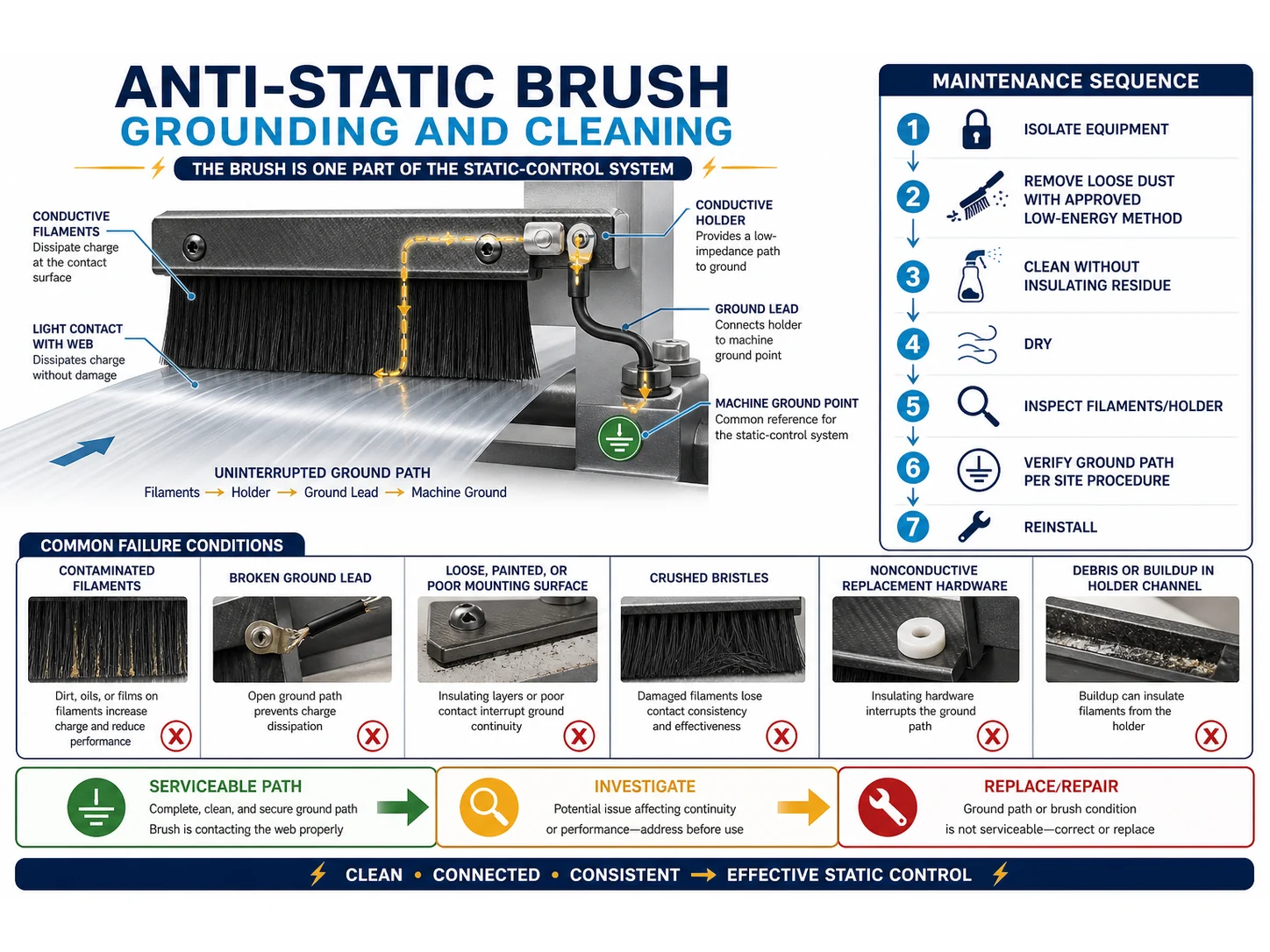
What Is Anti-Static Brush Maintenance?
Anti-static brush maintenance encompasses all activities that preserve a brush’s ability to safely bleed static charge to ground while keeping the bristles clean and intact. This includes inspecting the ground path, gentle cleaning of conductive filaments, and timely replacement when the brush no longer meets performance requirements.
Why Grounding Continuity Matters
Anti-static brushes rely on a continuous conductive path from bristle to handle to ground terminal. If continuity is broken—by dirty contacts, a fractured wire, or worn fibers—static charges can accumulate and cause ESD events. A common field mistake is assuming the brush is grounded simply because it has a ground wire; regular testing is the only way to confirm safe operation.
How to Check Ground Continuity
- Visually inspect the ground cord, strain relief, and connector for cracks, corrosion, or loose fittings.
- Set a digital multimeter to resistance (ohms). Place one probe firmly against the conductive brush fibers and the other on the ground terminal (banana plug, ring terminal, or alligator clip).
- Read the resistance. Acceptable values depend on brush type (typically 103 to 109 ohms), but the reading must be stable and within the manufacturer’s specification. An open (infinite) or wildly fluctuating reading indicates a failed brush.
- Perform this test after cleaning to verify that continuity has not been compromised by moisture or cleaning agents.
For critical ESD-protected areas, a dedicated wide-range ohmmeter or an ESD tester that applies a test voltage may be required for a complete evaluation.
Safe Cleaning Methods Without Damaging Conductive Filaments
Conductive filaments often contain carbon particles, metal fibers, or anti-static coatings. Aggressive cleaning can strip, dissolve, or mechanically abrade these conductive elements. The table below compares common methods and their risks.
| Cleaning Method | Risk to Conductive Filaments | Recommended? |
|---|---|---|
| Low-pressure compressed air | Low – removes dry debris without contact | Yes, ideal first step |
| Wiping with isopropyl alcohol & lint-free cloth | Low if gentle; alcohol dissolves some contaminants | Yes, for light oil/dust |
| Mild soap and deionized water rinse | Moderate – residue can remain; ensure thorough DI rinse and complete air-dry | Only when necessary, with caution |
| Scrubbing with abrasive pad | High – physically removes conductive surface layers | No |
| Aggressive solvents (acetone, MEK, etc.) | High – dissolves binders or coatings | No |
| Ultrasonic cleaning | Varies – can dislodge fibers or break internal bonds | Check manufacturer; generally not recommended |
After any wet cleaning, allow the brush to air-dry completely in a clean environment. Never use heat, which can warp fibers or alter conductive coatings.
Indicators It Is Time to Replace the Brush
- Visible bristle wear, clumping, or flattening
- Excessive shedding (more than 10% of filaments missing)
- Brittle or stiff bristles that could scratch sensitive surfaces
- Corroded, bent, or broken ground terminal
- Resistance measurement outside the acceptable range and not correctable by cleaning
- Recurrent sparking or static buildup despite thorough cleaning
- Handle damage that compromises ergonomics or the ground path
Common Mistakes in Anti-Static Brush Care
- Skipping continuity testing: Even a visually intact brush can have a broken internal ground path.
- Using harsh chemicals: Solvents like acetone or gasoline permanently ruin conductive filaments.
- Twisting or pulling bristles: This snaps the conductive fiber network and creates high-resistance hot spots.
- Storing in dirty or damp conditions: Contamination and moisture degrade both cleanliness and electrical performance.
- Ignoring physical drops: A drop can crack the handle or break internal connections—retest immediately.
- Assuming all black brushes are anti-static: Color alone means nothing; only labeled, tested ESD brushes are safe.
- Using one brush for everything: Cross-contamination from heavy debris can embed particles that later scratch sensitive components.
When Is a Conductivity Test Required?
A simple multimeter resistance check is adequate for routine maintenance. However, a full conductivity test under load or at working voltage becomes necessary in the following situations:
- The brush is used in ultra-sensitive environments (e.g., semiconductor cleanrooms, medical device assembly lines).
- A brush has been repaired, modified, or reassembled after cleaning.
- You are introducing a new batch of brushes and need to verify compliance with standards like ANSI/ESD STM4.1 or IEC 61340-5-1.
- An ESD damage incident has occurred and the brush is a suspected contributor.
If you cannot verify the brush with a high-resistance meter or an ESD simulator, do not use it where a failure could cause costly damage or safety risks.
Final Takeaway
Regular anti-static brush maintenance is not complicated, but it demands consistency. Test the ground path frequently, clean with methods that preserve conductive filaments, and replace the brush at the first reliable sign of wear or failure. A few minutes of care can prevent ESD events that cost far more than a new brush.
Frequently Asked Questions
How often should I test my anti-static brush’s ground continuity?
For frequent use, test weekly or before each shift in critical applications. Always retest after cleaning, dropping, or any incident that may affect the ground path.
Can I use a regular nylon brush in place of an anti-static brush?
No. Regular brushes can generate high static charges. Only use brushes specifically designed with conductive or static-dissipative materials to protect ESD-sensitive devices.
What if I see small sparks when using my anti-static brush?
Sparks indicate a broken ground path or insufficient conductance. Stop use immediately, test the resistance, and replace the brush if it fails the continuity check.
Can I repair a broken ground wire on my anti-static brush?
Most brushes have molded connections that are not user-serviceable. A field repair may compromise safety and reliability. Replacement is recommended unless the manufacturer provides a repair kit and instructions.
Is it safe to use a damp anti-static brush on energized circuits?
No. Never use a wet or damp brush on live electronics. Even after cleaning, ensure the brush is completely dry before it touches any circuit.
Do anti-static brushes for vinyl records require the same maintenance?
Yes, the principles are identical: keep bristles clean and verify that the brush can still dissipate static. For record brushes, also make sure no debris becomes embedded that could scratch the vinyl.
Can I use an ultrasonic cleaner to clean an anti-static brush?
Generally, no. Ultrasonic vibration can dislodge conductive fibers or weaken the bond between the bristle material and the handle. Only use if the manufacturer explicitly approves it.
What is the difference between conductive and dissipative brushes in terms of maintenance?
Conductive brushes have very low resistance and may be more sensitive to small amounts of contamination; dissipative brushes have higher resistance and can tolerate slightly larger shifts. Both should be cleaned gently and tested to their specified resistance range.
Technical References
Which nylon grade fits this job — Nylon PA, PA6 Nylon or PA66 Nylon?
| Grade | Continuous temperature (°C) | Peak temperature (°C) | Water absorption | Hardness |
|---|---|---|---|---|
| Nylon PA | 93 | 121 | 0.3–9% by PA grade and conditioning | Medium to firm; filament diameter and trim length control bending force. |
| PA6 Nylon | 80–100 | 130–160 | 1.5–3.0% | Shore D 75–85 |
| PA66 Nylon | 100–120 | 150–180 | 1.0–1.8% | Shore D 80–88 |
| PA610 Nylon | 90–110 | 130–150 | 0.5–1.0% | Shore D 72–82 |
| PA612 Nylon | 90–110 | 130–150 | 0.3–0.7% | Shore D 70–80 |
Figures as published by Brushtec / DuPont. Confirm the exact grade against the supplier datasheet before ordering.
When is Nylon PA the wrong choice?
- Nylon PA — The nylon family spans several grades, so heat, moisture and chemical limits should follow the selected PA resin rather than a generic nylon value.
What should replace Nylon PA when it stops working?
- Nylon PA — Compare Nylon PA with PP, PBT, PET. Change material when wet stiffness, temperature, chemical resistance, conductivity, particle shedding, or surface marking becomes the limiting factor.