
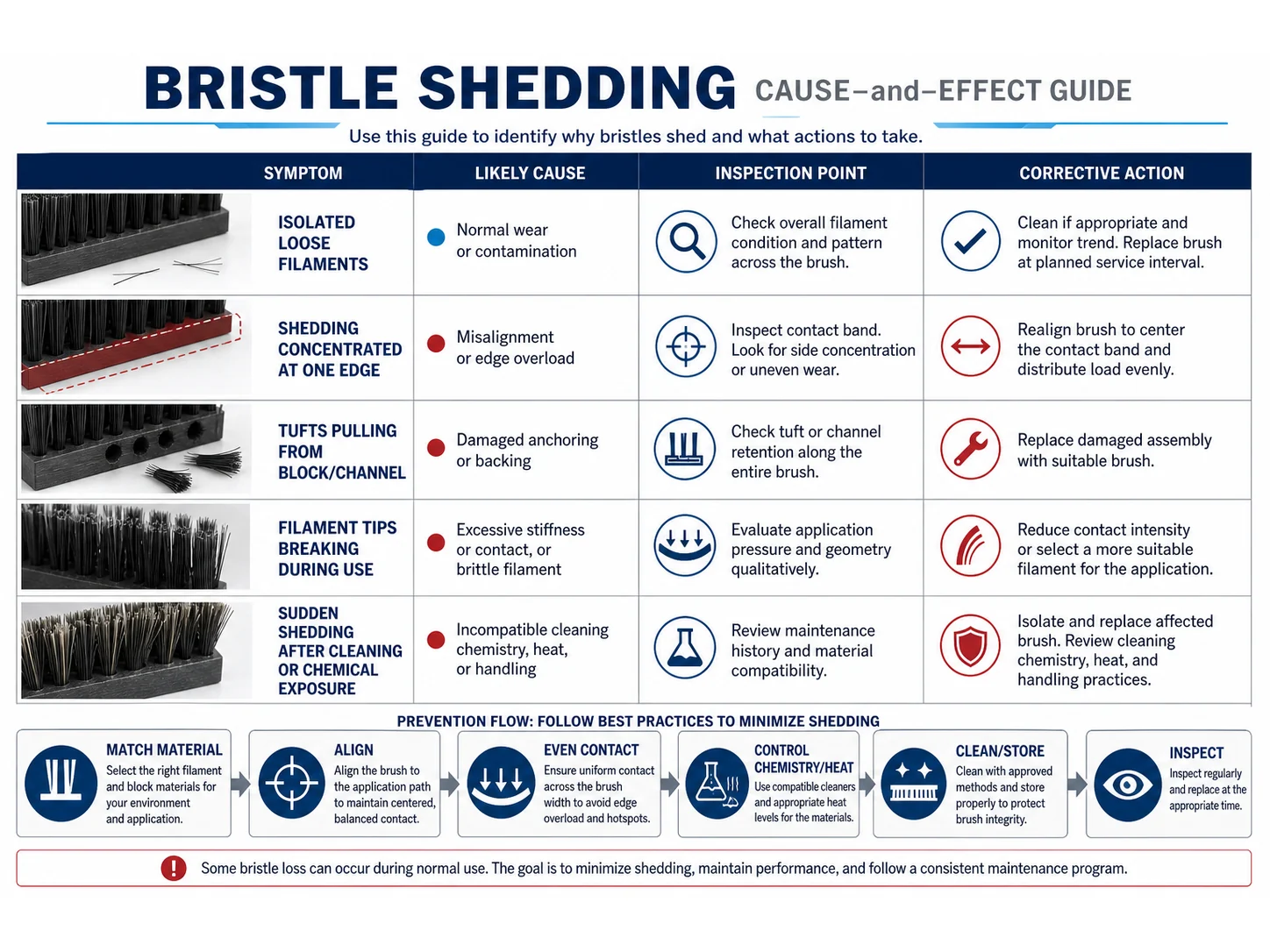
What Is Bristle Shedding?
Bristle shedding is the separation of individual bristles or clusters from a brush’s base or retaining structure. It can happen with wire brushes, abrasive filament brushes, or natural bristle brushes, and often signals excessive wear, chemical damage, or improper operating conditions. While some minor wear is normal over time, accelerated shedding usually points to a mismatch between the brush and its application.
Common Causes of Bristle Shedding
Mechanical Stress
Excessive speed, high contact pressure, or heavy impact loads can fracture bristles or pull them from the brush base. Running a wire brush beyond its rated RPM creates centrifugal forces that can snap individual wires. Abrasive filament brushes may lose bristles if used with too much deflection or on sharp edges.
Chemical Attack
Brushes exposed to solvents, acids, alkalis, or aggressive cleaning agents can suffer chemical degradation. Certain chemicals can dissolve, embrittle, or weaken the bristle material, causing it to snap or fall out. This is common when a brush is used with a fluid that is incompatible with its filament chemistry.
Thermal Degradation
High ambient temperatures or frictional heat buildup can soften synthetic bristles, crystallize natural fibers, or anneal metal wires. This changes the bristle’s mechanical properties, making it prone to breakage. Continuous use without cooling, or using a brush near its maximum temperature rating, greatly increases shedding.
Age and Fatigue
Even with proper use, all brushes wear out. Oxidation, UV exposure, and repeated flexing cause material fatigue. Old brushes stored in direct sunlight or harsh environments may shed prematurely. Over time, the bond between bristle and holder can weaken due to vibration and thermal cycling.
Prevention Strategies at a Glance
| Cause | Typical Symptoms | Prevention Strategies |
|---|---|---|
| Mechanical Stress | Snapped bristles, uneven wear, bent wires | Run at or below rated speed & pressure; use proper angle; avoid impacts |
| Chemical Attack | Discolored, brittle, or softened bristles; crumbled tips | Check chemical compatibility; rinse after use; use resistant materials (e.g., polypropylene, nylon) |
| Thermal Degradation | Melted tips, loss of stiffness, color change | Stay within temperature limits; use intermittent operation; choose high-temp filaments |
| Age / Fatigue | Powdery residue, general thinning, many broken bristles | Store properly; inspect regularly; replace after a defined service interval |
How to Inspect for Bristle Shedding
Regular inspections catch shedding early and prevent quality issues. Use this checklist:
- Look for missing or loose bristles—count per square inch or compare to a new brush.
- Check for bent, kinked, or compressed bristles that no longer return to shape.
- Inspect bristle ends for mushrooming, melting, or splitting.
- Test flexibility by bending a few bristles—brittle bristles snap easily.
- Note any discoloration or chemical smell that indicates material breakdown.
- Measure bristle length; if length is reduced by more than 30%, shedding is likely.
Inspection frequency depends on use intensity: daily for heavy industrial applications, weekly for medium-duty tasks, and frequent for light or occasional use.
When Bristle Shedding Signals a Need for Upgraded Brush Material
If shedding persists despite following all prevention strategies, the brush material may be fundamentally unsuitable. Consider upgrading when:
- The operating temperature routinely exceeds the bristle’s rating, and no cooling is possible.
- Chemical exposure cannot be avoided, and all compatible materials show degradation.
- The required speed or pressure falls above the safe limits of standard filaments.
- Bristle breakage occurs within hours of installation even at low loads.
In these cases, consult a brush manufacturer to select a higher-performance material, such as heat‑stabilized nylon, PEEK, or specialized alloy wires. Upgrading may cost more initially but drastically reduces downtime and contamination risk.
Common Mistakes That Accelerate Bristle Shedding
- Assuming all brushes are interchangeable—ignoring differences in filament material, diameter, and bonding.
- Using a wire brush on delicate surfaces that require a softer abrasive filament.
- Applying too much pressure, thinking it will clean faster; this generates heat and may break bristles.
- Neglecting to rinse chemical residue after wet cleaning, allowing long-term degradation.
- Storing brushes in direct sunlight, near heat sources, or in damp environments.
- Skipping scheduled inspections because the brush “looks fine” from a distance.
Final Takeaway
Bristle shedding is rarely random. By matching the brush to the job, respecting speed, pressure, and chemical limits, and inspecting proactively, most shedding can be prevented. When shedding continues despite good practices, evaluate whether the brush material itself needs to be upgraded. This approach improves safety, product quality, and overall equipment effectiveness.
Frequently Asked Questions
Can shed bristles damage my equipment or product?
Yes. Loose bristles can clog machinery, scratch finished surfaces, or contaminate food, pharmaceutical, or electronics products. This is why controlled shedding is critical in sensitive environments.
How quickly should I replace a shedding brush?
Replace a brush as soon as shedding exceeds normal wear. If you notice clusters of missing bristles or the brush shape is visibly uneven, stop using it to prevent quality issues.
Does bristle type affect shedding rate?
Absolutely. Wire bristles may snap under bending fatigue; synthetic filaments can melt or become brittle; natural bristles wear down gradually. Choose a bristle material designed for your specific operating conditions.
Can I reduce shedding by lowering speed or pressure?
Often yes. Running a brush at 75–80% of its maximum rated speed and using the lightest effective pressure significantly extends bristle life and reduces shedding.
What’s the difference between normal wear and abnormal shedding?
Normal wear is a slow, uniform shortening of bristles. Abnormal shedding is rapid loss of whole bristles or chunks, often accompanied by visible damage like melting or discoloration.
Are there brushes that don’t shed?
All brushes eventually shed some material, but certain designs and materials minimize shedding. For example, abrasive-impregnated nylon filaments break down gradually rather than snapping off, and high-quality wire brushes use fatigue-resistant alloys.
How do chemicals cause bristle shedding?
Chemicals can attack the polymer chains in synthetic bristles or corrode metal wires, making them brittle. Even mild cleaners can cause gradual damage if the brush isn’t rinsed and dried after use.
Which bristle material fits this job — Nylon PA, Polypropylene PP or PEEK Filament?
| Material | Continuous temperature (°C) | Peak temperature (°C) | Water absorption | Hardness |
|---|---|---|---|---|
| Nylon PA | 93 | 121 | 0.3–9% by PA grade and conditioning | Medium to firm; filament diameter and trim length control bending force. |
| Polypropylene PP | 80–100 | 120–140 | ≤0.03% | Shore D 65–75 |
| PEEK Filament | 250–260 | 300 | 0.10–0.50% | Shore D 85–90 |
Figures as published by Brushtec / DuPont; Perlon; Ensinger. Confirm the exact grade against the supplier datasheet before ordering.
When is Nylon PA the wrong choice?
- Nylon PA — The nylon family spans several grades, so heat, moisture and chemical limits should follow the selected PA resin rather than a generic nylon value.
- Polypropylene PP — Avoid high-temperature brushing or heavy abrasion where nylon/abrasive nylon is needed.
- PEEK Filament — Not needed for low-cost general cleaning where PP/Nylon is sufficient.
What should replace Nylon PA when it stops working?
- Nylon PA — Compare Nylon PA with PP, PBT, PET. Change material when wet stiffness, temperature, chemical resistance, conductivity, particle shedding, or surface marking becomes the limiting factor.
- Polypropylene PP — Compare Polypropylene PP with Nylon, PBT, PET. Change material when wet stiffness, temperature, chemical resistance, conductivity, particle shedding, or surface marking becomes the limiting factor.
- PEEK Filament — Compare PEEK Filament with PBT, PTFE, Nylon. Change material when wet stiffness, temperature, chemical resistance, conductivity, particle shedding, or surface marking becomes the limiting factor.