What Is Brush Core Protection?
Brush core protection involves using correct tools, techniques, and torque limits to prevent bending, cracking, thread stripping, or hub deformation in the central mounting point of a brush tool. A damaged core can cause imbalance, reduced efficiency, or sudden breakage during operation.
Common Brush Core Types and Vulnerabilities
| Brush Type | Core Material | Common Damage Risk | Prevention Key Point |
|---|---|---|---|
| Wire wheel brushes | Steel hub with arbor hole | Bent hub or enlarged arbor hole from hammering | Use a proper puller or press |
| Twisted-in-wire brushes | Wire stem or threaded end | Stem bending or thread stripping | Avoid overtightening; hand-start threads |
| Abrasive filament brushes | Plastic or composite hub | Cracking from impact or uneven pressure | Use even, gentle force; no prying |
| Cup brushes | Metal cup with threaded nut | Nut rounding or thread galling | Use correct wrench size; apply anti-seize sparingly |
Proper Installation Techniques
Always verify the brush’s mounting interface matches the tool spindle. Hand-start the brush to avoid cross-threading. Use a torque wrench calibrated to the manufacturer’s recommended specs—typically between 10 and 30 ft-lbs for small brushes, but refer to specific documentation. Avoid impacting wrenches unless the brush is designed for them; sudden torque can crack brittle cores. If the brush has a keyway or set screw, ensure full engagement without overtightening.
Safe Removal Methods
Never hammer or pry against the core. Use a three-jaw puller or bearing separator if the brush is press-fitted. For threaded brushes, apply penetrating oil before loosening. If stuck, gentle tapping with a soft mallet around the hub (not on the wires) can help. Heat expansion with a heat gun may be needed, but avoid direct flame on plastic cores. Always support the brush weight while unscrewing to prevent bending the stem.
Torque and Specification Considerations
Exceeding torque limits is a top cause of thread damage and hub deformation. Use a torque wrench for installation and document the setting for each tool type. Even a partial thread strip weakens the core, leading to wobble or ejection under load. For press-fit brushes, use an arbor press with controlled force and never hammer at an angle.
Common Mistakes That Cause Core Damage
- Hammering directly on the brush hub or stem to install or remove.
- Using pliers or pipe wrenches on threaded brush stems, causing thread deformation.
- Prying against the brush face with a screwdriver or bar, bending the core.
- Overtightening with power tools without a torque limiter.
- Ignoring misalignment during installation, leading to uneven stress and early fatigue.
Signs of Irreparable Core Damage
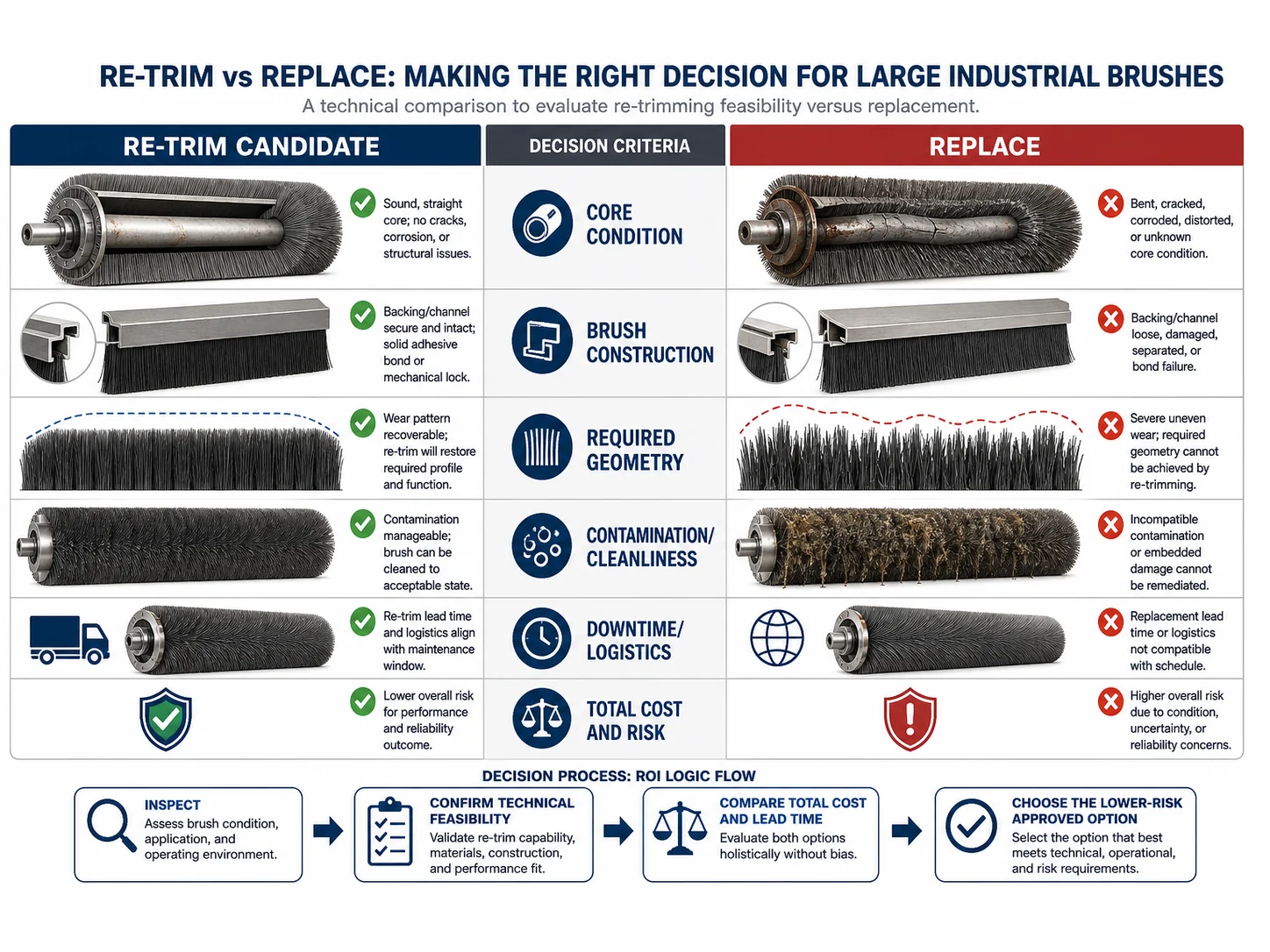
When the core shows visible cracks, severe bending beyond 0.005 inch runout, stripped threads, or elongated mounting holes, the brush should be replaced immediately. Attempting to straighten a bent stem or re-thread a stripped nut compromises safety and performance; the repaired area will remain a stress riser. In critical applications, any detectable damage means full replacement.
Final Takeaway
Prioritizing brush core protection means using the right tools, controlled torque, and patient handling. Investing a few extra minutes in proper technique saves hours of downtime and the cost of replacement brushes. Always consult the brush manufacturer’s guidelines and never force a fit.
What Should Buyers Check Before Requesting a Brush?
Before asking for a replacement or custom brush, collect the details that affect fit and performance: the surface being cleaned, the residue or material being removed, the working environment, brush dimensions, mounting method, available space, and any equipment manual or drawing you already have. Photos of the worn brush and its installation position often prevent wrong assumptions.
- Measure the brush length, outside diameter, core size, and mounting interface.
- Describe whether the brush works dry, wet, hot, dusty, oily, or with chemicals.
- Explain what problem you are trying to solve, not only what brush you want to buy.
- Share any surface-damage, shedding, noise, vibration, or short-life problem from the current brush.
Frequently Asked Questions
What should I check before choosing preventing core damage during brush installation and removal?
Start with the surface you need to clean or finish, the material being removed, the available space, and how the brush will be mounted. A brush that looks correct in a catalog can still fail if the trim length, filament stiffness, or holder style does not match the real machine.
Can a bent hub be straightened and put back in service?
No. The problem is not the bend, it is that the brush no longer runs true, and true is not something that can be judged by eye on a straightened hub. A brush that runs out of balance vibrates, and the vibration damages the spindle bearings well before anyone notices it in the finish. A bent hub is scrap.
Does anti-seize change the tightening torque?
It does, and this is a common way cores get crushed. A lubricated thread reaches a much higher clamp load at the same torque reading than a dry one, so a figure taken from a dry-thread table over-tightens a greased one. If anti-seize is used, the torque figure has to come down with it, and it should be applied sparingly to the thread rather than to the seating face.
How should a brush be stored so the core is not stressed?
Supported on the core, never resting on the bristle face. A brush stood on its face takes a set in the filament, and a long brush laid flat and unsupported at the ends takes a set in the core itself — which then shows up as run-out the next time it is mounted. Hanging by the core, or sitting on end blocks that carry the shaft, avoids both.
Does it matter which wrench is used on a cup brush nut?
It matters more than the torque. An adjustable wrench rounds the flats, and rounded flats are the reason a brush that will not come off gets levered, hammered or gripped by the cup — which is how the core is damaged during removal rather than during use. A correctly sized box or open-end wrench prevents the whole sequence.
When is a Force-Fitted Brush Core the wrong choice?
A standard brush may not be enough when the machine has a special holder, the contact area is narrow, the material is sensitive, or the process needs controlled stiffness, conductivity, chemical resistance, or documentation for a specific use.