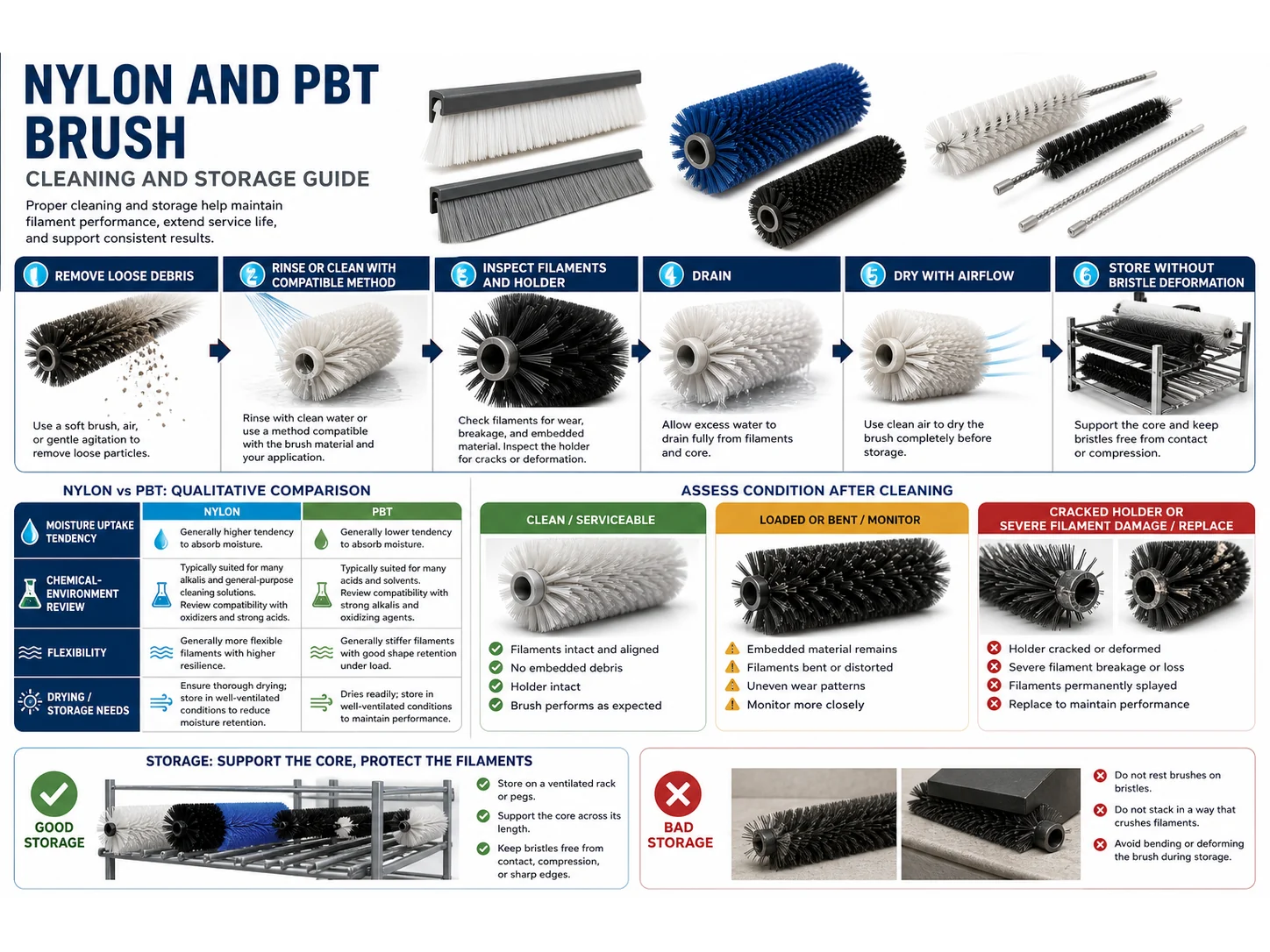
What Is Nylon Brush Maintenance?
Nylon brush maintenance means systematically removing process residue, cleaning agents, and moisture from synthetic filament brushes—both nylon 6/6 and PBT—then storing them under conditions that preserve bristle shape, stiffness, and hygienic integrity. Proper maintenance includes routine cleaning after use, periodic deep cleaning when residue builds up, and correct storage between cycles. The goal is to prevent filament softening, swelling, microbial growth, and permanent set that reduces cleaning performance.
For machine guarding and moving-part safety context, this section references OSHA — Machine Guarding.
For lockout/tagout and maintenance isolation context, this section references OSHA — 1910.147 Control of Hazardous Energy.
For thermoplastic material family and polymer property context, this section references British Plastics Federation — Thermoplastics.
For brush construction terminology, bristle/fill/backing/stem terms, this section references American Brush Manufacturers Association — Brush Lingo.
Common Types of Nylon and PBT Brushes That Need Regular Maintenance
Most synthetic brushes fall into three families based on bristle stiffness and abrasiveness. Each type demands slightly different cleaning care, especially around drying and temperature exposure.
- Soft nylon brushes: Used on delicate surfaces, food-contact equipment, and fine polishing. They trap moisture easily and need thorough drying.
- Abrasive nylon bristle cup brushes and wheel brushes: Filaments are impregnated with silicon carbide or aluminum oxide. They retain abrasive grit; improper cleaning can clog the abrasive and reduce cutting action.
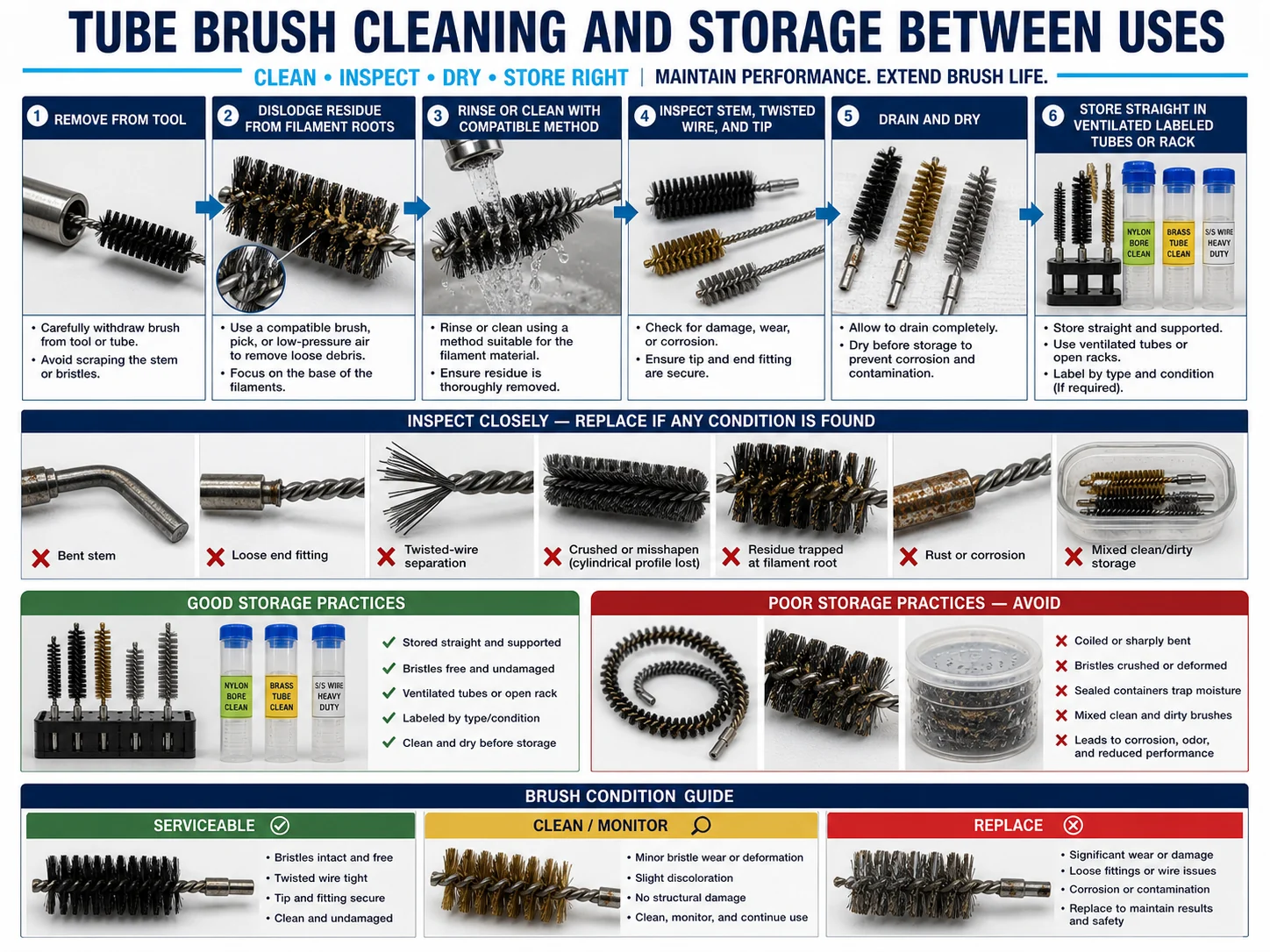
- Nylon tube, pipe, and boiler service brushes: Long stems and dense bristle packs make complete drying difficult. Trapped moisture leads to hidden mildew and bristle weakening.
Cleaning Method Comparison: Water Rinse vs. Solvent Soak vs. Compressed Air
| Method | Best For | Pros | Cons | Critical Step |
|---|---|---|---|---|
| Water rinse (warm, mild detergent) | Water-soluble residue, light oils, food soils | Simple, low cost, non-hazardous | Risk of corrosion on steel cores; must dry completely | Immediate drying with compressed air or hung in warm, low-humidity area |
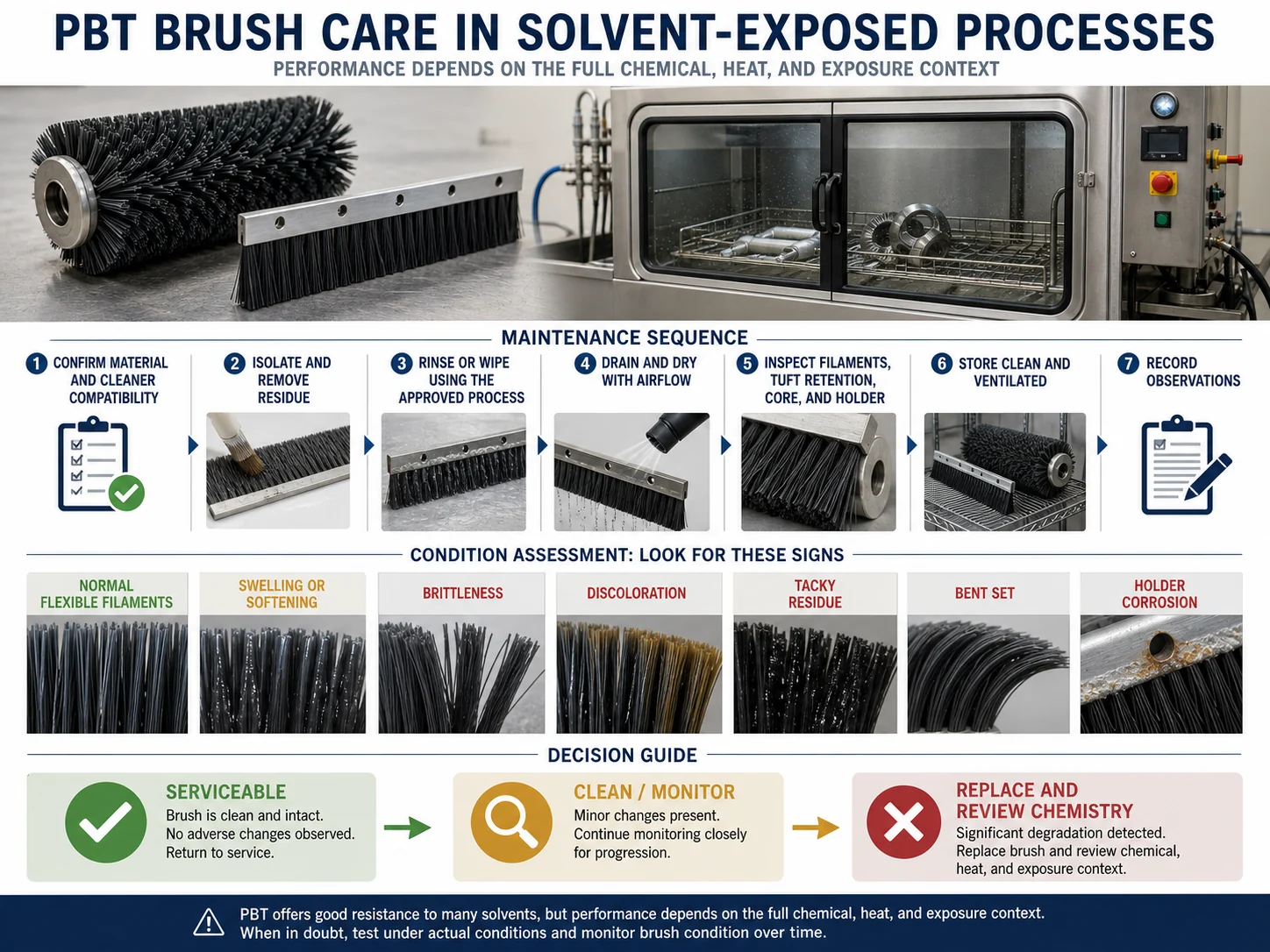
| Solvent soak (isopropyl alcohol, mineral spirits, or citrus solvent) | Heavy grease, adhesives, cured coatings | Cuts stubborn soils without abrasive scrubbing | Can soften some PBT grades if soaked too long; flammability and ventilation needed | Follow with warm detergent rinse to remove solvent residue, then dry |
| Compressed air blowout | Final drying, dust removal, preventing water spots | Reaches inside cup brushes and tube brush cores; accelerates drying | Does not remove greasy films; can embed debris deeper if used alone on wet soils | Use filtered, dry air at moderate pressure (<30 psi for fine filaments) |
Step-by-Step Routine for Cleaning Nylon Brushes After Use
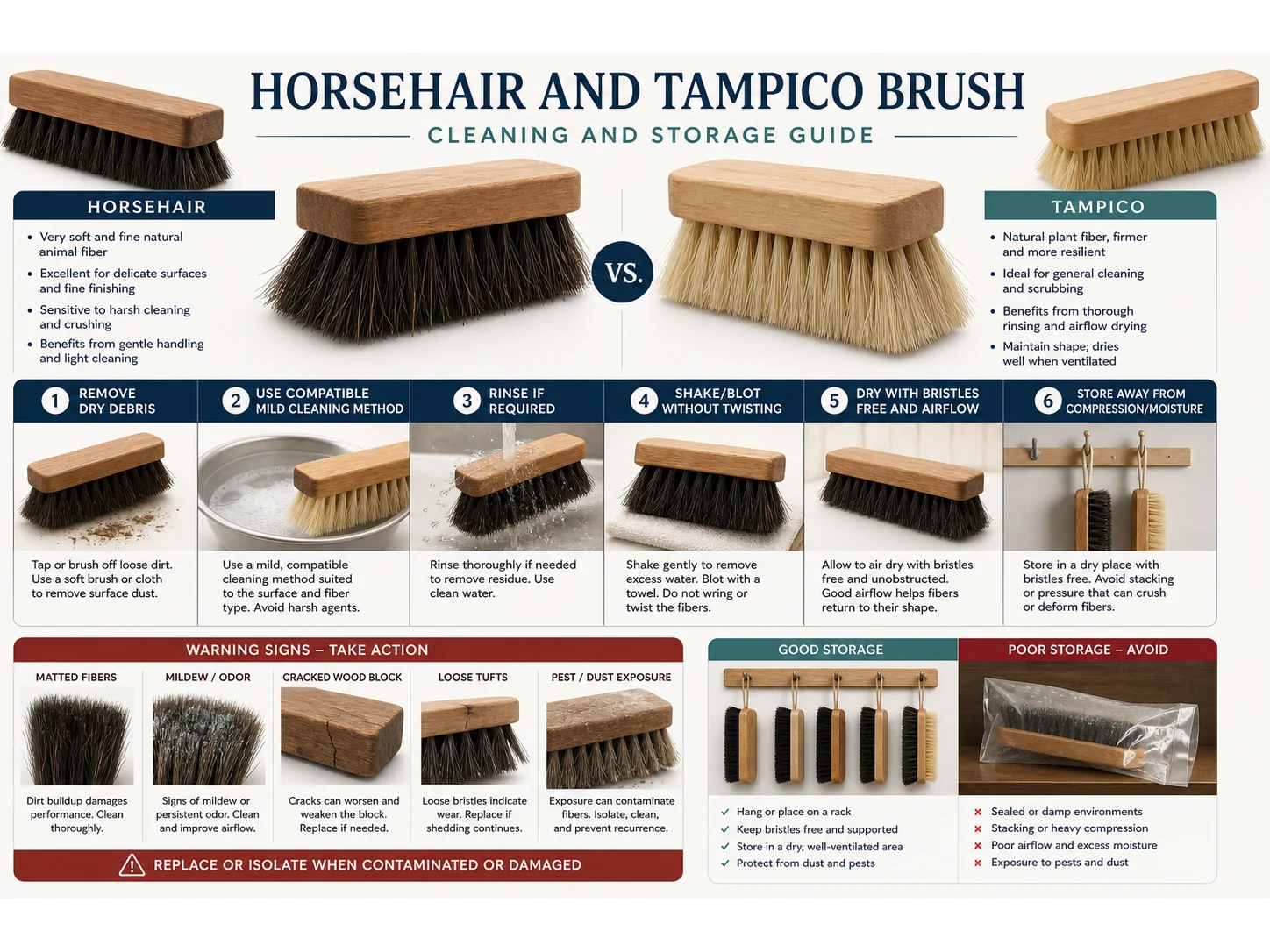
- Immediately after use, knock out loose debris by tapping the brush block or stem against a hard surface. Do not strike bristle tips directly.
- Rinse under warm (<120°F/49°C) water to flush out water-soluble residues. Avoid hot water on PBT brushes—temperatures above 180°F can relax bristles.
- If greasy or waxy buildup remains, soak bristles in a mild alkaline detergent solution for 15–30 minutes. For abrasive nylon brushes, use a low-alkaline cleaner to avoid damaging the grit bonding.
- If heavy grease or cured adhesive remains, dip only the bristle portion in a solvent compatible with nylon/PBT. Limit soak time to 10 minutes for PBT and 20 minutes for nylon 6/6. Never soak the ferrule or block if glue-mounted.
- After solvent cleaning, wash again with warm detergent water to remove solvent film.
- Shake off excess water, then blow dry thoroughly with clean, dry compressed air. Direct air from the base of the bristles outward to prevent moisture from being forced into the core.
- For tube brushes and mini cleaning nylon brushes, insert the air nozzle into the core and rotate while blowing. A final pass over the bristle face removes remaining droplets.
Storage Conditions That Preserve Bristle Life
Even a perfectly clean brush will fail quickly if stored wrong. Nylon and PBT filaments are hygroscopic—they absorb moisture, which causes swelling, softening, and microbial growth. Temperature and UV exposure also accelerate aging.
- Avoid direct sunlight and UV sources: Nylon degrades under UV; PBT yellows and embrittles. Store in opaque containers or closed cabinets.
- Control temperature: Ideal range is 50–77°F (10–25°C). Avoid storage near boilers, ovens, or uninsulated exterior walls.
- Control humidity: Keep relative humidity below 60%. In high-humidity environments, add desiccant packs to sealed storage bins.
- Hang brushes when possible: For cup, wheel, and stem-mounted brushes, hanging prevents bristle deformation and allows air circulation. Place hooks at the block or stem—never hang by the bristles.
- Flat storage alternatives: If hanging isn’t possible, lay brushes on racks with bristles facing up or sideways, not down. Rotate flat-stored brushes periodically to prevent set.
- Never store wet brushes in closed bags or toolboxes: Trapped moisture causes mildew, rust on metal components, and bristle distortion. Air-dry completely before capping or bagging.
Common Mistakes That Shorten Nylon Brush Life
- Storing brushes damp: The number one cause of premature failure. Mildew grows on natural residues in the bristle surface, and permanently bent bristles result from compressed storage when filaments are water-swollen.
- Using high-temperature drying: Blast drying with heated air over 150°F or laying brushes on hot surfaces anneals the bristles, causing permanent softening and loss of recovery.
- Soaking in strong acids or chlorinated solvents: Nylon 6/6 resists many chemicals but degrades in formic acid, phenols, and strong oxidizing agents. PBT is attacked by some alkaline concentrates above 140°F. Always check chemical compatibility for both bristle and block materials.
- Neglecting the brush core and ferrule: For tube brushes, water trapped inside the twisted wire stem corrodes from the inside. After cleaning, stand tube brushes bristle-end down for 24 hours to let residual water drain out.
- Using high-pressure air too close to the bristle face: This can permanently bend fine filaments or drive debris deeper into abrasive cup brushes. Maintain at least 6 inches of distance and use a regulator.
- Stacking brushes on top of each other: Weight deforms bristles, especially on soft nylon floor cleaning brushes or wide-face wheel brushes. Always separate brushes with spacers or store in individual compartments.
When Professional Cleaning or Replacement Is the Right Call
In-house maintenance works for most brushes, but there are boundaries where continued cleaning wastes time or risks product quality:
- Embedded metallic particles: Abrasive nylon wheel brushes used for deburring can trap metal slivers that become lodged beyond the brush face. If compressed air and mild tapping can’t dislodge them, professional ultrasonic cleaning or replacement is safer than risking surface scoring on the next job.
- Hygiene-critical applications: In food processing, pharmaceuticals, or medical device cleaning, simple wash–dry routines may not meet sanitation standards. If the brush contacts product surfaces, use validated cleaning protocols or dedicated autoclave-safe brushes. When in doubt, rotate in a professionally sterilized set.
- Bristle chemical damage: If filaments show discoloration, brittleness, or a tacky surface after cleaning, the polymer has been chemically attacked. No amount of washing will restore mechanical properties—the brush should be retired.
- Uneven wear or permanent set: If bristles are flattened on one side or the brush no longer stands straight after hanging, it will clean inconsistently. At that point, replacement is more cost-effective than fighting poor results.
Final Takeaway
Effective nylon brush maintenance isn’t complicated, but it does require consistency. Match the cleaning method to the soil type, dry thoroughly every time, and store in a cool, dark, dry place with bristles free of weight or contact. For abrasive nylon bristle cup brushes and tube brushes, pay extra attention to core drying and grit preservation. A five-minute post-use routine will often double the brush’s usable life—and keep your cleaning results predictable.
Frequently Asked Questions
Can I use hot water to clean nylon brushes?
Warm water (up to 120°F) is safe for both nylon 6/6 and PBT. Avoid temperatures above 140°F for PBT and above 180°F for nylon, as prolonged heat can relax bristle memory. Use hot water only if the manufacturer’s data sheet explicitly allows it.
How do I clean a nylon tube brush after heavy grease?
First, wipe off bulk grease with a rag. Second, soak the brush in a warm alkaline cleaner, then rotate under running water to flush out the core. Finally, use compressed air to blow out the hollow center and dry the bristles. For extremely thick grease, a brief mineral spirits soak followed by a detergent wash is effective.
What is the best way to dry brushes without compressed air?
Shake off excess water, then hang the brush in a well-ventilated area with low humidity. Place a fan nearby to circulate air. For flat brushes, stand them on edge with bristles facing up. Avoid towel drying, which can bend fine filaments. Drying may take a condition-based interval, so rotate brushes if you need one ready sooner.
Can I store nylon brushes in a sealed container with silica gel?
Yes, but only after the brushes are completely dry. Sealable containers with desiccant packs are excellent for humid environments. Check the desiccant regularly and recharge or replace it. Do not store damp brushes inside—this traps moisture and accelerates mildew growth.
How often should I deep-clean abrasive nylon brushes?
Deep-clean when you notice reduced cutting speed, glazing on the brush face, or visible loading of the abrasive grit. For frequent-use abrasive cup or wheel brushes, a solvent soak every a condition-based operating interval helps maintain aggressiveness. For light deburring, a weekly warm detergent wash may suffice.
Why are my nylon brushes getting moldy even after washing?
Mold usually indicates incomplete drying before storage. Nylon absorbs moisture, and residues from soaps or process materials provide nutrients. After washing, dry for at least 24 hours in moving air. If mold appears, clean with a mild bleach solution (1% sodium hypochlorite), rinse thoroughly, and dry completely before returning to storage.
Does PBT require different care than nylon 6/6?
PBT generally has better chemical resistance and lower moisture absorption, so it dries faster and is less prone to swelling. However, it is more sensitive to strong alkaline cleaners at elevated temperatures. For PBT brushes, stick to neutral to mild alkaline detergents and avoid soaking in high-pH solutions above 140°F. Drying and storage recommendations are otherwise similar.