
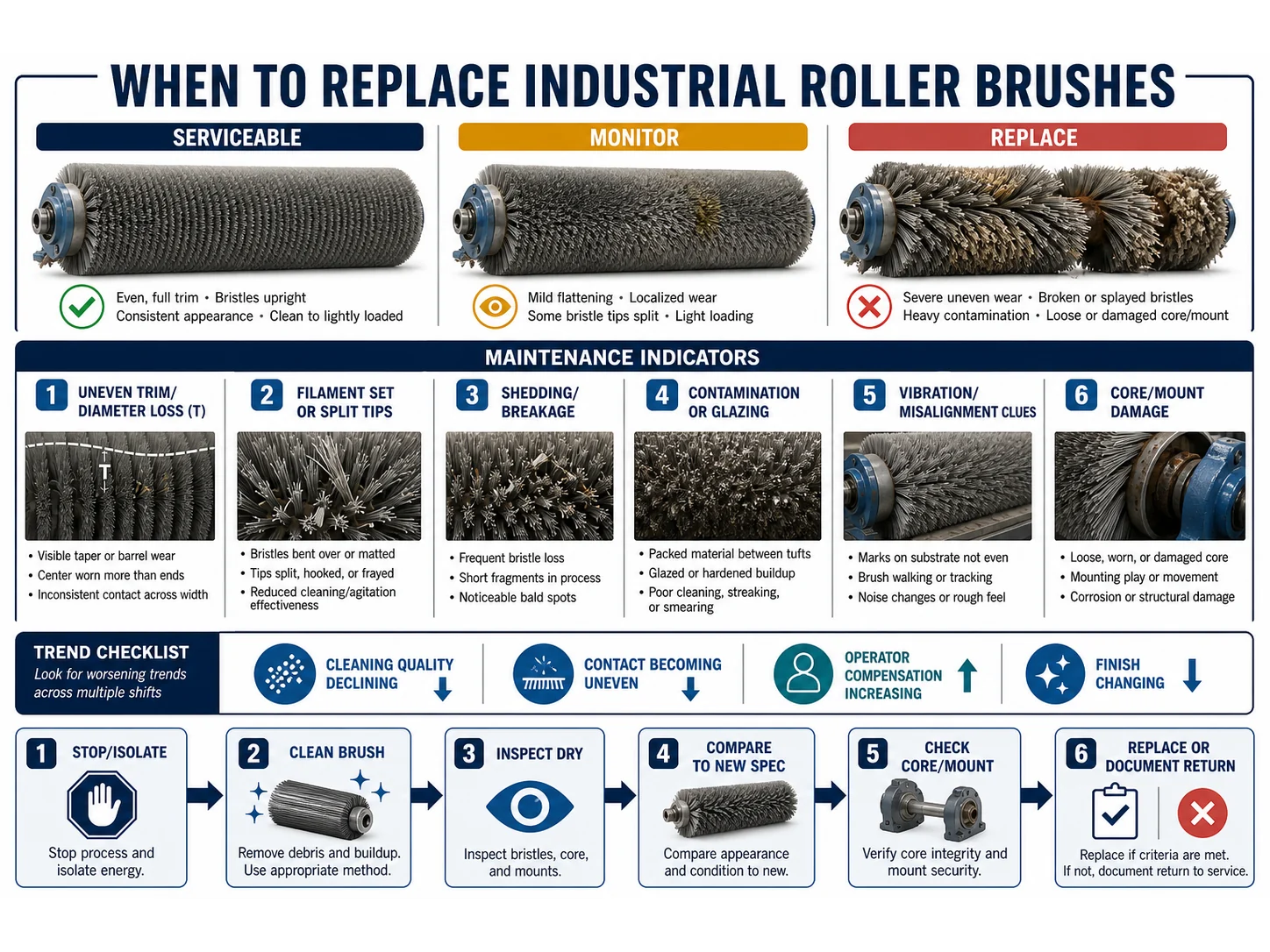
What Are the Key Replacement Cycle Indicators for Industrial Roller Brushes?
A replacement cycle indicator is any measurable sign that tells you a brush has reached the end of its useful service life for a given application. The four most important indicators are bristle loss, diameter reduction, uneven wear, and performance decline. No single indicator works alone. Operators must evaluate them together because different applications stress brushes differently. For example, aggressive deburring may cause rapid bristle shortening while surface cleaning shows more performance fade before mechanical wear becomes obvious.
Common Types of Wear in Industrial Roller Brushes
Recognizing the wear type helps you identify the root cause and forecast future replacements more accurately.
| Wear Type | What You See | Typical Root Causes | Implication for Replacement |
|---|---|---|---|
| Bristle Loss | Missing bristles, thinning tufts, loose bristles on the floor or product | Excessive pressure, chemical attack, fatigue from high rotational speed | Loss of working density; replace when bristle loss exceeds 20-30% of the original fill |
| Diameter Reduction | Overall outside diameter smaller than original specification | Abrasive wear from prolonged contact | Reduced contact force and effective brushing area; replace when diameter drops below 85-90% of original |
| Uneven Wear | Brush face looks wavy or grooved, not cylindrical | Misalignment, uneven pressure, machine vibration, or inconsistent feed rate | Creates inconsistent finish; replace immediately if it cannot be corrected by realignment |
| Performance Decline | Workpiece quality slips: incomplete deburring, poor cleaning, lower gloss | Combined effects of dull, short, or missing bristles | Often the first practical indicator; schedule replacement when quality drifts outside tolerance |
Visual Inspection Checklist for Roller Brush Wear
Print or laminate this checklist and use it during routine walk-downs. Each item should trigger a go/no-go decision or trigger a measurement step.
- Look for missing bristles or tufts along the entire brush face—especially near edges where wear concentrates.
- Check for uneven bristle length: hold a straightedge against the brush face to spot high/low spots.
- Look for melted, fused, or flattened bristle tips (common with heat-sensitive nylons).
- Examine the core for cracks, corrosion, or dents that affect balance.
- Inspect the mounting hub and keyway for wear or fretting—this can cause runout.
- Note any discoloration that suggests chemical attack or overheating.
Measurement Methods for Quantifying Wear
Visual checks get you only so far. Use simple tools to build objective replacement records.
| Measurement | Tool | How to Do It | Typical Alarm Threshold |
|---|---|---|---|
| Outside diameter | Caliper or micrometer | Measure at center and both ends; average three readings | 10-15% reduction from new specification |
| Bristle length | Depth gauge or steel rule | Measure from brush face inward at multiple spots | 30% shorter than original bristle length |
| Runout (TIR) | Dial indicator on machine | Rotate brush slowly and read total indicated runout | Exceeds manufacturer’s tolerance (often 0.005-0.010 in. or 0.13-0.25 mm) |
| Brush core balance | Static balancer or on-machine vibration meter | Check for any wobble or excessive vibration during spin-up | Vibration sharply increases from baseline; visible shaking |
How to Establish a Replacement Schedule Based on Operating Hours and Application
An hourly schedule prevents surprise downtime, but numbers vary widely. Start with these steps:
- Document initial specifications: Record O.D., bristle length, material, and fill density when new.
- Set a baseline inspection interval: For a continuous operation, inspect weekly for the first 200 hours.
- Track replacement cycle indicators: Log diameter, bristle condition, and workpiece quality at each check.
- Identify your wear rate: Use trend data to calculate the hours between “new” and your alarm threshold.
- Build in a safety margin: Schedule replacement at about 80% of that predicted life. For example, if you hit the alarm threshold at 500 hours, replace at 400 hours.
- Adjust for application severity: Aggressive deburring shortens life; low-pressure cleaning extends it. Create separate tracking for different lines.
Keep in mind that brush life is also a function of material compatibility. A nylon abrasive brush may last 800 hours in light cleaning but only 200 hours in heavy edge radiusing.
Common Mistakes When Running Worn Brushes
Most replacement decision errors come from three places: cost pressure, lack of measurement, or misunderstanding the effect on the product.
- Delaying replacement to “save money”: Running a brush past its useful life shifts the cost to rework, scrap, and increased machine wear from vibration.
- Relying on visual guesswork alone: Without measurements, operators tend to run brushes too long. A brush that “looks okay” may already be producing out-of-spec work.
- Ignoring uneven wear: A grooved brush can scratch, smear, or create inconsistent finishes. The cost of replacing a brush is almost always lower than the cost of a rejected lot.
- Assuming all brushes die the same way: Material and construction make a difference. Crimped wire brushes lose shape differently than abrasive nylon. Use failure mode data to adjust inspection criteria.
- Neglecting core condition: A bent shaft or cracked metal core can fail catastrophically, damaging the machine and endangering operators.
When Brush Core Damage Requires Immediate Replacement
Some conditions are not negotiable. If the brush core shows any of the following, pull the brush and replace it immediately—do not try to “run just one more shift.”
- Cracks in the metal hub or end rings
- Deformation from impact that causes measurable runout
- Corrosion that has reduced the wall thickness of tubular cores by more than 20%
- Spun keyway or damaged mounting bore that prevents proper locking
- Any sign that the core has slipped on the shaft, even slightly
Core damage can lead to sudden, catastrophic brush failure. A brush thrown from a machine at operating speed is a serious safety hazard.
Final Takeaway: Proactive Replacement Saves More Than It Costs
Industrial roller brushes are consumable precision tools. Using a combination of visual checks, simple measurements, and documented operating hours, you can build a replacement program that prevents quality drift and unplanned downtime. The most reliable replacement cycle indicator is often the first measurable drop in workpiece quality, followed closely by diameter or bristle length thresholds. Let those indicators—not the purchase cost—govern your replacement decisions.
Frequently Asked Questions
How often should we inspect industrial roller brushes for wear?
In continuous operations, scheduled weekly inspections are typical during the first few hundred hours to establish a wear baseline. Once the wear rate is known, inspection intervals can be extended to match scheduling needs, but should never exceed the expected 80% life point.
What measurement device is best for tracking brush diameter?
A standard digital caliper or outside micrometer works well for most roller brushes up to 12 inches in diameter. For large brushes, a pi tape or a custom gauge may be needed. Consistency in measurement location and pressure is more important than the tool brand.
Can uneven wear be corrected, or does it always mean replacement?
Minor uneven wear can sometimes be corrected by realigning the brush, reducing speed, or adjusting the workpiece feed. Once bristle length varies by more than 10-15% across the face, replacement is the safer choice because dressing the brush is difficult and may lead to further inconsistency.
Is it safe to use a brush with 20% bristle loss?
It depends on the application. In light cleaning or dusting, 20% loss may still produce acceptable results. In precision deburring or finishing, even 10% loss can cause missed edges. Always cross-check against workpiece quality requirements.
What is the danger of running a brush with a bent shaft?
A bent shaft causes vibration that accelerates bearing wear, can damage the machine, and creates uneven workpiece finish. Worse, a bent shaft indicates that the core has been stressed and may crack, leading to sudden failure. Do not attempt to straighten a bent brush core—replace it.
How does brush material affect replacement thresholds?
Abrasive-impregnated nylon wears through gradual diameter reduction, so diameter monitoring is key. Wire brushes lose bristles through fatigue and fracture; bristle loss count is a better indicator for them. Natural fiber brushes may compress rather than break; watch for matting and reduced stiffness. Always match your replacement indicator to the brush type.
Can we sharpen or re-dress an industrial roller brush?
Some wire brushes can be crush-dressed to re-expose sharp edges, but the procedure shortens overall life and the core may already be fatigued. Abrasive nylon brushes cannot be re-dressed. For most finishing applications, it is safer to replace the brush on a planned schedule rather than attempting to extend its life with secondary operations.
How do I calculate the cost of running a worn brush too long?
Compare the cost of the replacement brush against the cost of rework, scrap, increased inspection, machine downtime, and potential damage to tooling. In most industrial environments, the brush replacement cost is the smallest number in that equation. If even one batch is rejected because of a worn brush, the losses usually exceed the brush cost by multiples.
Which abrasive filament fits this job — Abrasive Nylon, Silicon Carbide Abrasive Nylon or Aluminum Oxide Abrasive Nylon?
| Filament | Continuous temperature (°C) | Peak temperature (°C) | Water absorption | Hardness |
|---|---|---|---|---|
| Abrasive Nylon | 120 | 150 | 0.1–1.0% | Abrasive filament; stiffness and cutting level is controlled by PA base, grit type, grit size, filament diameter and trim height. |
| Silicon Carbide Abrasive Nylon | 80–120 | 140–170 | 0.3–2.0% | Carrier Shore D 70–85; SiC Mohs Hardness Approximately 9.2 |
| Aluminum Oxide Abrasive Nylon | 80–120 | 140–170 | 0.3–2.0% | Carrier Shore D 70–85; Al2O3 Mohs Hardness Approximately 9 |
| Ceramic Abrasive Fiber | 80–120 | 140–170 | 0.3–2.0% | Carrier Shore D 72–86; Ceramic Grain Mohs Hardness Approximately 9 |
| Diamond Abrasive Filament | 80–120 | 140–170 | 0.3–2.0% | Carrier Shore D 72–86; Diamond Mohs Hardness 10 |
Figures as published by Perlon. Confirm the exact grade against the supplier datasheet before ordering.
When is Abrasive Nylon the wrong choice?
- Abrasive Nylon — Exposed grit can change a surface finish, and high heat or aggressive chemicals can weaken the polymer carrier.
- Nylon PA — The nylon family spans several grades, so heat, moisture and chemical limits should follow the selected PA resin rather than a generic nylon value.
What should replace Abrasive Nylon when it stops working?
- Abrasive Nylon — Compare Abrasive Nylon with PP, PBT, PET. Change material when wet stiffness, temperature, chemical resistance, conductivity, particle shedding, or surface marking becomes the limiting factor.
- Nylon PA — Compare Nylon PA with PP, PBT, PET. Change material when wet stiffness, temperature, chemical resistance, conductivity, particle shedding, or surface marking becomes the limiting factor.