
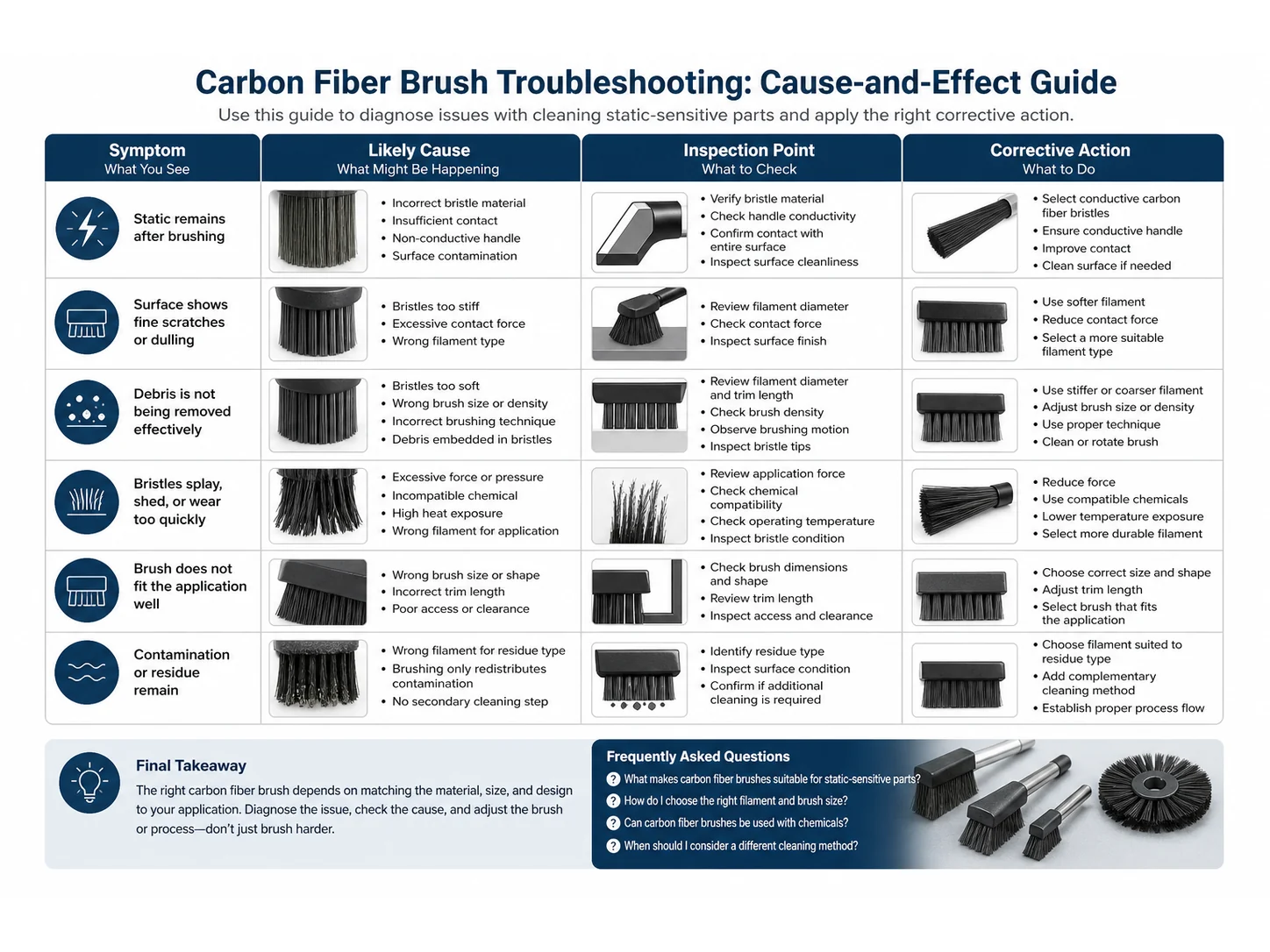
What Is a Carbon Fiber Brush?
A carbon fiber brush is a brush whose bristles are made primarily of carbon filaments, known for their electrical conductivity, low abrasiveness, and resistance to heat and chemicals. The conductive nature of carbon fiber allows the brush to dissipate static charges while cleaning, making it ideal for static-sensitive parts such as circuit boards, optical components, and laboratory instruments. Unlike typical nylon or animal-hair brushes, a carbon fiber brush does not generate static charge buildup during use, minimizing the risk of electrostatic discharge (ESD) damage.
Common Material, Size, and Configuration Options
Carbon fiber brushes come in a range of materials, diameters, stiffness levels, and handle designs. Understanding these options is essential before selecting a brush for a specific application.
- Filament type: Pure carbon fiber filaments provide excellent conductivity and softness. Some brushes blend carbon with conductive polymers or metal fibers to adjust stiffness or cost. Blends may be labeled as “carbon-infused” or “conductive fiber” brushes.
- Bristle diameter and length: Filament diameter influences softness. Fine filaments (micron-level) are used for delicate surfaces; thicker filaments add stiffness for light scrubbing. Trim length affects the brush’s reach and flexibility.
- Handle and core materials: Common handles include wood, plastic, or aluminum. In ESD-sensitive environments, conductive handles (metal or carbon-loaded plastic) are often specified. The ferrule (metal band attaching bristles to handle) may also need to be conductive if grounding is required.
- Mounting styles: Handheld brushes may have ergonomic grips, while machine-mounted brushes use threaded studs, flanges, or shaft ends. Always verify the interface before ordering a replacement.
Comparing Key Variations of Carbon Fiber Brushes
The table below provides a practical comparison of typical carbon fiber brush variations based on filament stiffness and intended use.
| Variation | Filament Feel | Typical Application | Limitations |
|---|---|---|---|
| Ultra-fine carbon fiber (soft) | Very soft, flexible | Delicate electronics, film, optics | Not for heavy debris removal; may wear quickly |
| Standard carbon fiber (medium) | Moderate stiffness | General ESD-safe cleaning, computer internals | May be too stiff for sensitive coatings |
| Stiff carbon fiber blend | Firm, with enhanced backbone | Light scrubbing, textured surfaces, maintenance tasks | Higher risk of scratching if misused; verify surface hardness |
| Full conductive handle model | Filament as above, all-metal mount | Machine integration, grounding required | Not suitable where metal could cause shorts |
How to Choose the Right Carbon Fiber Brush
Start by defining your cleaning problem and operating environment. Use the following decision factors to narrow the options:
- Residue type: Dry dust, loose particles, or light films can be handled by soft carbon fiber. Oily residues or thicker deposits in static-sensitive areas may require a slightly stiffer brush or a combination with a safe solvent — always check chemical compatibility.
- Surface sensitivity: Components with delicate coatings, exposed circuits, or polished optical surfaces demand the softest filaments. Mistake here leads to micro-scratches or ESD damage.
- Equipment interface: Is the brush handheld or mounted on an automated system? For automation, ensure the ferrule, thread, or shank dimensions match your machine, and confirm conductivity if grounding is needed.
- Chemical and moisture exposure: Carbon fiber itself resists many chemicals, but the handle, ferrule, and adhesive must be compatible. In high-humidity or wash-down areas, stainless steel ferrules and sealed handles may be required.
- Hygiene and contamination control: Cleanrooms and food/pharma applications may require brushes with low particle shedding, non-outgassing binders, and validated wash-down ability. Discuss these needs with the supplier early.
- Maintenance and replacement frequency: Carbon fiber brushes are consumables. Estimate how often they will need replacement based on duty cycle, and consider standard sizes versus custom orders to manage lead time.
- Custom size requirements: Off-the-shelf brushes may not fit proprietary equipment. When customizing, supply a drawing with trim length, overall length, bristle area, and ferrule details to avoid back-and-forth delays.
Common Mistakes When Specifying Carbon Fiber Brushes
Avoid these frequent errors that lead to poor performance or procurement headaches:
- Choosing by looks or cost drivers alone: Inferior brushes may use sparse filament fill, loose ferrules, or non-conductive handles, compromising anti-static properties.
- Assuming all carbon fiber brushes dissipate static equally: Conductivity varies with filament quality, density, and handle material. Always ask the supplier for the brush’s resistance specification (e.g., surface resistivity or tip-to-ground resistance).
- Overlooking the ferrule adhesive: Glues or epoxies can outgas in vacuum or cleanroom environments, contaminating sensitive surfaces. Specifiy low-outgassing adhesives if needed.
- Ignoring handle material in solvent applications: Plastic handles may swell or degrade in alcohol or other cleaning agents. Wood handles can absorb moisture and warp. Match handle material to chemical exposure.
- Ordering a standard size without verifying the mount: Even 1–2 mm difference in ferrule diameter or thread pitch can make the brush unusable on a machine. Always double-check the existing brush or mounting specs.
- Missing sample validation: For critical processes, skipping a sample test can lead to batch failures. A sample allows you to check cleaning effectiveness, electrostatic performance, and mechanical fit before committing to a full order.
When a Carbon Fiber Brush Is the Wrong Choice
Carbon fiber brushes excel at dry, light-duty dust removal and static control on smooth surfaces, but they have limits. Recognize the boundaries to avoid misapplication:
- Heavy or baked-on residues: A carbon fiber brush is not a scrubbing tool. For tough deposits, consider soft metal wire brushes or abrasive pads, but assess ESD risk separately.
- Aggressive chemical environments: If the brush will be immersed in strong acids, alkalis, or solvents at elevated temperatures, even carbon fiber may degrade. Check with the manufacturer for chemical resistance data or explore PTFE or PEEK filament brushes.
- Autoclave sterilization needs: Some carbon fiber brushes use bonding agents that cannot survive repeated autoclave cycles. Ask for validated sterilizable designs if required.
- Critical ESD protection with tight tolerances: If your process demands resistance below a specific threshold (e.g., <10^3 ohm tip-to-ground), a generic carbon fiber brush may not qualify. Request a certificate of conformance or resistance test report.
- When a drawing or supplier review is essential: Whenever the brushing system is part of an automated production line, involve the supplier early. A quick drawing review can prevent costly mismatches in size, mounting, and performance requirements.
Final Takeaway
Specifying a carbon fiber brush starts with the cleaning task and the static sensitivity of the parts. Look beyond the “carbon fiber” label: evaluate filament softness, handle conductivity, chemical compatibility, and interface dimensions. Align the brush with your actual operating conditions, and always validate your choice through a sample or supplier drawing — this simple step avoids most downstream problems.
Frequently Asked Questions
What is the difference between a carbon fiber brush and a standard anti-static brush?
Not all anti-static brushes use carbon fiber. Some rely on conductive nylon or metal-coated fibers. A genuine carbon fiber brush typically offers lower abrasive risk and consistent conductivity due to the filament’s inherent nature, but the term “anti-static” should always be supported by a resistance specification.
How do I measure the correct brush diameter for my equipment?
Measure the existing brush or the mounting port with calipers. Key dimensions include the bristle trim diameter (diameter of the brush face) and the ferrule or shank diameter. For machine-mount brushes, also note thread type (if any) and overall length from mounting face to bristle tip.
Can carbon fiber brushes be used with solvents like isopropyl alcohol?
Carbon fiber itself is generally resistant to isopropyl alcohol and similar solvents. However, the handle, ferrule, and adhesive must be compatible. Check with the supplier, especially if the brush will be dipped or soaked, to prevent loosening of filaments or handle damage.
How often should I replace a carbon fiber brush in production?
Replacement frequency depends on duty cycle, surface abrasiveness, and cleanliness requirements. Monitor bristle wear, shape loss, or any increase in surface resistance. As a rule of thumb, if the brush begins to shed filaments or fails to clean effectively without extra pressure, it is time to replace it.
What does “anti-static” actually mean in the context of a cleaning brush?
It means the brush is designed to dissipate electrostatic charges rather than generate them. A true anti-static carbon fiber brush will have a low electrical resistance from the filament tips to the handle or ground connection, preventing charge buildup during use. Always verify the resistance range from the supplier.
Can I get a custom carbon fiber brush to fit my unique machine?
Yes, many manufacturers offer custom configurations. Provide a drawing specifying overall length, trim length, bristle material, stiffness, ferrule dimensions, and any grounding requirement. A small sample run is advisable to confirm fit and performance before full production.
Is a carbon fiber brush safe for cleaning optical lenses or AR-coated surfaces?
Ultra-fine, soft carbon fiber brushes are often used for lens and filter cleaning because they can lift dust without scratching when used gently. However, always test on a non-critical area first, and avoid pressing hard on coated surfaces. For critical optics, confirm the brush’s filament cleanliness and absence of abrasive contaminants.
Does the handle material matter if I only care about static protection?
Yes. An insulating handle can leave the brush body floating, potentially allowing charge to accumulate and discharge to the part. For sensitive electronics, a conductive handle that grounds the brush through the operator or to a known ground point is preferable. Discuss grounding options with the supplier if your process is ESD-sensitive.
Technical References
- EOS/ESD Association — ESD Fundamentals
- EOS/ESD Association — Principles of ESD Control
- British Plastics Federation — Thermoplastics
- NIST — Metric SI
Which bristle material fits this job — Carbon Fiber, AISI 304 Stainless Steel Wire or Conductive Nylon?
| Material | Continuous temperature (°C) | Peak temperature (°C) | Water absorption | Hardness |
|---|---|---|---|---|
| Carbon Fiber | 200–350 | 400–500 | ≤0.10% | — |
| AISI 304 Stainless Steel Wire | 400 | 500 | 0% | Rockwell B 70–95 depending on temper and cold work |
| Conductive Nylon | 80–110 | 130–160 | 0.5–2.5% | Shore D 75–88 |
Figures as published by Alleima. Confirm the exact grade against the supplier datasheet before ordering.
What should replace Handheld Detail Brushes for carbon fiber brush?
- Handheld Detail Brushes — Handheld detail brushes cover general precision cleaning; auto-detailing brushes impose tighter controls for painted, polished, leather, display, and trim surfaces.
- Carbon Fiber — Compare Carbon Fiber with Conductive nylon, anti-static filament, stainless micro-wire, standard nylon. Change material when wet stiffness, temperature, chemical resistance, conductivity, particle shedding, or surface marking becomes the limiting factor.
- AISI 304 Stainless Steel Wire — Use AISI 316 stainless steel wire for chloride, marine, dairy, beverage, chemical washdown, or higher pitting-resistance requirements. Use carbon steel for dry aggressive cutting and brass or abrasive nylon for lower marking risk.
- Conductive Nylon — Compare Conductive Nylon with Anti-static filament, carbon fiber, stainless conductive filament, standard PA6. Change material when wet stiffness, temperature, chemical resistance, conductivity, particle shedding, or surface marking becomes the limiting factor.