
What Is a Brass Wire Brush?
A brass wire brush consists of brass wire filaments—either straight, crimped, or twisted into knots—set into a handle, wheel, cup, or other mounting. It is widely used for removing light rust, oxidation, paint, and deposits from metal surfaces. Unlike steel wire brushes, brass brushes are less aggressive and non-sparking, making them a preferred choice for cleaning softer metals and for use in environments where sparking is a safety hazard.
Why Use a Brass Wire Brush for Rust Removal?
Brass offers a middle ground between stiff steel bristles and non-metallic abrasives. Key advantages include:
- Softer than steel, so it reduces the risk of deep scratches on aluminum, brass, copper, and plated surfaces.
- Non-sparking, which improves safety around flammable vapors or dust.
- Effective at removing light to moderate rust without immediately wearing down the base metal.
- Resistant to corrosion from moisture, so it can be used with light oils or water-based rust removers.
However, these same properties can cause problems when the brush is used incorrectly.
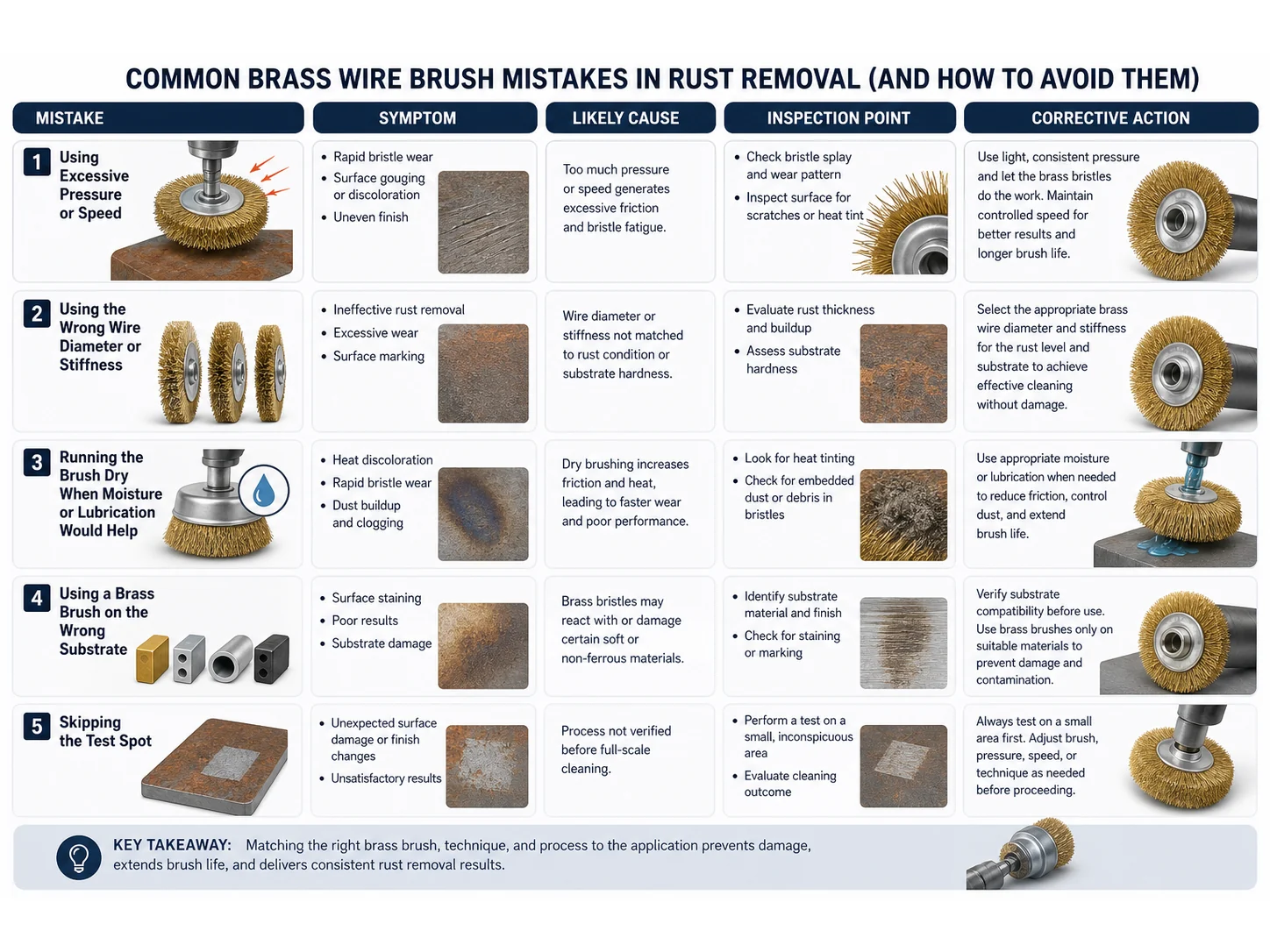
Common Brass Wire Brush Mistakes in Rust Removal (and How to Avoid Them)
Even experienced operators make these errors. Each one can ruin a workpiece, shorten tool life, or create hidden corrosion problems later.
Mistake 1: Using Excessive Pressure or Speed
What happens: High pressure or RPM generates heat and friction. Brass bristles can bend, break off, or embed into the surface. On soft metals like aluminum, this leaves behind brass transfer marks that are difficult to remove and may lead to galvanic corrosion if the part is later exposed to moisture.
How to avoid: Use light, even pressure. Let the bristle tips do the work. For power tools, choose an RPM rating at the lower end of the brush’s range and test on a scrap piece first. If you see a brass-colored smear, reduce pressure or switch to a finer, softer brass brush.
Mistake 2: Using the Wrong Wire Diameter or Stiffness
What happens: Coarse, stiff brass wire removes material quickly but can leave deep scratches on delicate surfaces. A brush that is too fine may not remove rust effectively, causing operators to press harder and compound the problem.
How to avoid: Match the wire diameter to the job. For fine, polished, or anodized surfaces, choose a fine brass wire brush (typically 0.1–0.15 mm wire). For heavier rust on cast iron or mild steel, a medium or coarse brass wire brush (0.2–0.3 mm) may work, but always test first. If the substrate is particularly soft, start with the finest brush available.
Mistake 3: Running the Brush Dry When Moisture or Lubrication Would Help
What happens: Dry brushing generates dust that can contain rust particles mixed with brass fragments. It also increases friction heat, accelerating bristle fatigue and making the brush feel harsher on the surface.
How to avoid: For most rust removal tasks, use a light lubricant such as penetrating oil, mineral spirits, or water with a rust inhibitor. A wet film traps debris, cools the contact area, and extends brush life. Always verify chemical compatibility with the substrate.
Mistake 4: Using a Brass Brush on the Wrong Substrate
What happens: Brass bristles can leave microscopic brass residue on stainless steel. In humid or corrosive environments, this may initiate galvanic corrosion, pitting, or discoloration. On titanium or some high-nickel alloys, brass contamination can even cause metallurgical problems during welding.
How to avoid: Reserve brass wire brushes for non-ferrous metals and mild steel where light rust removal is needed. For stainless steel, use a dedicated stainless steel brush and never mix brushes between material types. If you must use brass on stainless for a one-time light cleaning, follow with a thorough passivation or chemical cleaning to remove brass traces.
Mistake 5: Skipping the Test Spot
What happens: A brush that seems soft on a test card can behave very differently on a curved surface, near edges, or on a coated part. Without testing, you may discover scratches, brass marks, or uneven finish too late.
How to avoid: Always perform a quick test on an inconspicuous area or a sample coupon of the same material and surface condition. This is especially important for anodized aluminum, plated parts, and antique restoration where the original finish must be preserved.
Mistake 6: Choosing the Wrong Mounting or Tool Interface
What happens: A large wheel brush on an angle grinder can be unwieldy for small parts, while a tiny hand brush is too slow for a production line. Forcing a drill-mounted cup brush into a tight corner can cause the bristles to bend sideways, leading to uneven wear and accidental gouging.
How to avoid: Select the brush shape and mounting based on access and control. Hand brass wire brushes give maximum feel for intricate work. Rotary cup brushes handle flat surfaces efficiently. Wheel brushes suit edges and weld seams. Mini brushes or detail brushes clean threads and narrow recesses. For angle grinder use, make sure the brush’s maximum safe RPM matches your grinder.
Mistake 7: Neglecting Brush Maintenance and Replacement
What happens: A worn, clogged brush becomes ineffective. Operators compensate by increasing pressure, which accelerates the other mistakes. Rust particles trapped among the bristles can scratch the next workpiece.
How to avoid: Clean brass wire brushes regularly by tapping or brushing against a block of wood to dislodge debris. For oil-clogged brushes, soak in a degreaser and rinse. Replace the brush when bristles become permanently bent, shorter than 50% of original length, or when the face no longer makes uniform contact.
Quick Reference: Common Brass Wire Brush Types for Rust Removal
The table below compares common brush configurations. Use it to spot which mistake you are most likely to avoid by picking the right form.
| Brush Type | Typical Mount | Best For | Key Mistake It Helps Avoid | Wire Diameter Range (Guide Only) |
|---|---|---|---|---|
| Fine hand brush | Hand (plastic or wood handle) | Intricate parts, soft metals, final finish | Excessive pressure & scratching | 0.1–0.15 mm |
| Medium hand brush | Hand | General light rust on mild steel, large surfaces | Using too-fine bristles on heavy rust | 0.15–0.2 mm |
| Coarse hand brush | Hand | Heavy rust on cast iron, structural steel | Slower work from underpowered brushing | 0.2–0.3 mm |
| Cup brush (crimped wire) | Drill, die grinder | Flat or slightly curved panels, boat hulls | Missing tight areas (cup contour helps) | 0.15–0.3 mm |
| Cup brush (twist knot) | Angle grinder | Heavy corrosion, aggressive cleaning | Using too-soft a brush for the workload | 0.3–0.5 mm (high torque needed) |
| Wheel brush | Bench grinder, drill | Edges, weld cleaning, long seams | Lack of reach on linear joints | 0.15–0.3 mm |
| Mini/detail brush | Rotary tool, drill | Threads, small bores, electronics | Oversized brush damaging fine threads | 0.1–0.15 mm |
| Set (assorted sizes) | Hand/power tool | Versatile; test different stiffness | Guessing without a test piece | Varies |
When a Brass Wire Brush Is the Wrong Choice (Boundary Conditions)
Brass wire brushes are not a one-size-fits-all solution for rust removal. Recognize these limits to avoid frustration and rework:
- Heavy scale or mill scale: Brass may wear out before penetrating thick, hard rust. Switch to a stainless steel brush, needle scaler, or abrasive blasting.
- High-speed automated lines: Brass filaments fatigue quickly under continuous impact. Consider steel or abrasive-impregnated nylon brushes if cycle time is critical.
- Stainless steel passivation: As noted above, brass contamination can compromise corrosion resistance. Use a dedicated stainless brush and follow with passivation.
- Food-grade or medical surfaces: Brass residue is unacceptable in many sanitary applications. Verify material compatibility with industry standards (e.g., 3-A Sanitary, FDA) before using brass brushes.
- Precision surface preparation for coating: If a specific surface profile (Rz, Ra) is required, brass wire brushing may not achieve the necessary anchor pattern. Abrasive blasting or other surface preparation methods are required to achieve the specified profile.
Bottom Line
The best result comes from matching brass wire brush mistakes in rust removal and how to avoid them to the real cleaning task rather than forcing one brush to solve every condition. Confirm access, residue, surface limits, and replacement routine first; then use a small trial or inspection step before scaling the method into daily work.
Frequently Asked Questions
What materials are suitable for brass wire brush rust removal?
Brass wire brushes work best on softer non-ferrous metals like copper, brass, aluminum, and light rust on mild steel. Avoid using them on stainless steel, titanium, and high-nickel alloys to prevent cross-contamination and galvanic corrosion.
How can I prevent brass residue transfer onto the workpiece?
Use light pressure, keep the brush moving, and consider using a lubricant to minimize friction and metal transfer. After brushing, clean the surface with a compatible solvent or passivation treatment to remove any microscopic brass particles.
When should I replace a brass wire brush?
Replace the brush when bristles are permanently bent, worn to less than 50% of their original length, or no longer make uniform contact. Also replace if the brush is heavily clogged and cleaning doesn’t restore performance.
Can brass wire brushes be used with power tools?
Yes, brass wire brushes are available in cup, wheel, and end configurations for drills, die grinders, and angle grinders. Always check the maximum safe RPM of the brush and match it to your tool’s speed.
Why is a test spot important before full-scale rust removal?
Testing on a hidden area reveals how the brush interacts with the specific material, finish, and geometry. It helps avoid scratches, brass smears, or uneven results that could ruin the workpiece.
Technical References
- World Stainless — Corrosion Resistance of Stainless Steels
- Copper Development Association — Brasses: Copper-Zinc Alloys
- British Plastics Federation — Thermoplastics
Which bristle material fits this job — Brass Wire, AISI 304 Stainless Steel Wire or Nylon PA?
| Material | Continuous temperature (°C) | Peak temperature (°C) | Water absorption | Hardness |
|---|---|---|---|---|
| Brass Wire | 150–200 | 250–300 | 0% | Rockwell B 40–90 |
| AISI 304 Stainless Steel Wire | 400 | 500 | 0% | Rockwell B 70–95 depending on temper and cold work |
| Nylon PA | 93 | 121 | 0.3–9% by PA grade and conditioning | Medium to firm; filament diameter and trim length control bending force. |
Figures as published by Alleima; Brushtec / DuPont. Confirm the exact grade against the supplier datasheet before ordering.
What should replace Brass Wire for rust removal?
- Brass Wire — Compare Brass Wire with Steel wire, stainless wire, nylon. Change material when wet stiffness, temperature, chemical resistance, conductivity, particle shedding, or surface marking becomes the limiting factor.
- AISI 304 Stainless Steel Wire — Use AISI 316 stainless steel wire for chloride, marine, dairy, beverage, chemical washdown, or higher pitting-resistance requirements. Use carbon steel for dry aggressive cutting and brass or abrasive nylon for lower marking risk.
- Nylon PA — Compare Nylon PA with PP, PBT, PET. Change material when wet stiffness, temperature, chemical resistance, conductivity, particle shedding, or surface marking becomes the limiting factor.