
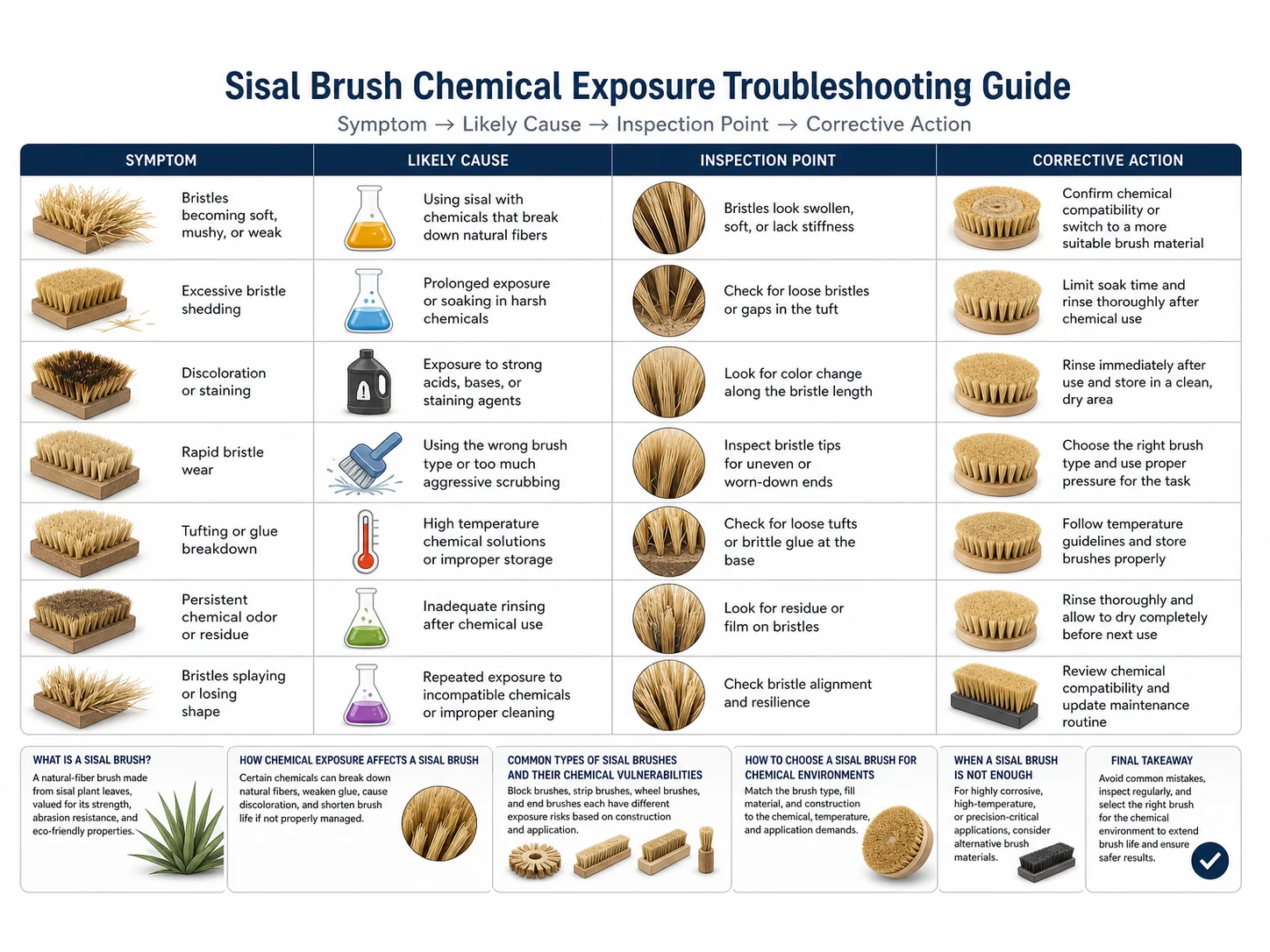
What Is a Sisal Brush?
A sisal brush is a brush whose bristle material is natural sisal fiber, harvested from the leaves of the agave sisalana plant. The fibers are stiff, slightly coarse, and highly absorbent. In brush form, they are often used for wet or dry scrubbing, light deburring, conveyor cleaning, and surface texturing. Because sisal is a cellulosic fiber, it behaves differently from synthetic bristles when exposed to water, acids, alkalis, solvents, or disinfectants. Understanding this behavior is the first step to preventing chemical-related brush failure.
How Chemical Exposure Affects a Sisal Brush
Chemicals attack sisal fibers in three main ways:
- Swelling and weakening: Water and aqueous solutions cause the fibers to swell, which loosens the natural binders and reduces stiffness. Repeated wet-dry cycles accelerate bristle breakage.
- Hydrolysis: Acidic or alkaline conditions can break the cellulose chains, leading to brittle fibers that snap easily.
- Leaching and residue: Chemically treated sisal may release organic residues or leftover treatment chemicals, contaminating sensitive surfaces.
The severity depends on the chemical type, concentration, contact time, temperature, and whether the brush is rinsed and dried properly between uses.
Common Types of Sisal Brushes and Their Chemical Vulnerabilities
Sisal brushes come in various forms, each with different exposure risks. The table below compares typical types by their construction and weak points in chemical service.
| Brush Type | Typical Use | Main Chemical Risk | Advantage in Mild Chemicals |
|---|---|---|---|
| Twisted-in-wire wheel | Pipe cleaning, heavy scrubbing | Moisture trapped at wire roots causes hidden corrosion and fiber rot | High stiffness retention if dried promptly |
| Staple-set block/roller | Conveyor cleaning, surface conditioning | Adhesive or staple metal can react with chemicals, causing bristle loss | Good for low-pressure wet applications with water-based solutions |
| Disc brush (mounted) | Floor scrubbers, rotary machines | Center hub metal corrosion plus uneven chemical wicking through the tufts | Uniform contact with chemical, but demands frequent rinsing |
| Hand brush with wooden block | Manual cleaning, lab use | Wood absorbs chemicals and swells, splitting the block and releasing bristles | Easy to rinse and dry, but wood block limits chemical compatibility |
| Cylinder brush (wound strip) | Processing lines, produce washing | Retained moisture inside the core leads to internal degradation | Continuous rotation helps shed liquids if drainage is designed in |
How to Choose a Sisal Brush for Chemical Environments
Start by answering these practical questions:
- What is the chemical? Identify the active agent, pH, and whether it is oxidizing, reducing, or solvent-based. Strong acids (pH <4), strong alkalis (pH >10), and organic solvents are generally aggressive to sisal.
- What is the contact mode? Is the brush submerged, sprayed, or intermittently wetted? Continuous submersion shortens life drastically.
- What temperature? Hot solutions accelerate chemical attack and soften sisal fibers. Keep under 140 °F (60 °C) for most water-based applications.
- What is the required service life? If a brush must last weeks versus hours, you may need to sacrifice surface aggressiveness and move to a synthetic alternative.
- Can the brush be rinsed and dried? If yes, a properly chosen sisal brush may work. If no, consider other materials.
- Is contamination a concern? Food, pharmaceutical, or electronic applications often cannot tolerate natural fiber residue. Verify with a small trial.
Common Mistakes When Using Sisal Brushes with Chemicals
These errors appear repeatedly in field reports and can turn a cost-effective brush into a maintenance headache:
- Mistake 1: Assuming “natural” means chemical-resistant. Sisal is organic and will react with many common industrial chemicals. Always check compatibility before ordering.
- Mistake 2: Using the same brush for multiple chemical steps. Cross-contamination between acidic and alkaline cleaners can accelerate fiber degradation and leave residues.
- Mistake 3: Ignoring mounting hardware. Steel centers, staples, or shafts corrode and can stain workpieces or cause premature brush failure. Request stainless steel or coated hardware if corrosion is possible.
- Mistake 4: Storing wet brushes without rinsing. Chemical-laden moisture sits on fibers and weakens them overnight. Always rinse with clean water and dry away from direct heat.
- Mistake 5: Choosing by cost drivers alone. A low-cost sisal brush that fails after one shift costs more than a slightly more expensive brush correctly matched to the chemical.
- Mistake 6: Overspecifying stiffness. Extra-dense or extra-stiff sisal brushes hold more chemical and take longer to dry. Match stiffness to the actual task, not the maximum possible.
When a Sisal Brush Is the Wrong Choice
Sisal brushes have clear limits. Consider switching to a different bristle material when:
- The pH is consistently below 3 or above 11. Strong acids (e.g., sulfuric) or caustics (e.g., sodium hydroxide) will destroy sisal within hours.
- Oxidizing agents like hydrogen peroxide or hypochlorite bleach are present. These rapidly break down cellulose.
- High purity is required. Cleanroom, medical device, or food-contact surfaces after sanitization often demand synthetic or metal-detectable fibers.
- The brush cannot dry between cycles. Constant immersion in any liquid will ruin a sisal brush.
- Operating temperatures exceed 180 °F (82 °C). Fibers soften and wear quickly.
In these cases, evaluate polypropylene, nylon, polyester, Tampico (another natural fiber with different properties), or stainless steel wire brushes. A sample test with the actual chemical solution is the best way to confirm suitability.
Final Takeaway
A sisal brush can handle mild chemical exposure when you match the bristle grade, construction, and mounting to the real operating conditions. The most common mistakes boil down to treating sisal as if it were synthetic, skipping compatibility checks, and neglecting rinse-and-dry routines. Before you commit to a large order, test a few sample brushes in your exact chemical process for a full shift cycle, then inspect for fiber softening, shedding, and hardware corrosion. If performance falls short, you will know early which alternative filament or design direction to pursue.
Frequently Asked Questions
Can I use a sisal brush with diluted bleach solutions?
Short, occasional contact with mild bleach (under 1% sodium hypochlorite) can be acceptable if the brush is rinsed immediately and dried thoroughly. Repeated or prolonged exposure will degrade the sisal fibers and should be avoided.
How do I test a new chemical on a sisal brush without risking a full batch?
Take a small sample brush or a tuft of sisal fibers and submerge it in the chemical at the working concentration and temperature. Check after 1 hour, 4 hours, and 24 hours for softening, color change, or breakage. Compare to a dry control sample.
What is the typical lifespan of a sisal brush in wet chemical use?
Lifespan varies from a few hours in aggressive cleaning lines to several weeks in light-duty water-only applications. With mild detergent and regular drying, a well-chosen sisal brush can last 100–300 operating hours. Always track wear per shift to plan replacements.
Are there food-grade sisal brushes that can handle sanitizers?
No sisal brush can be certified as food-grade across all sanitizers because natural fibers can harbor bacteria and absorb chemicals. If your process requires validated sanitation, use brushes with FDA-compliant synthetic filaments and stainless steel hardware.
Why do the bristles fall out when I switch to a stronger cleaner?
Strong alkalis or acids can attack the adhesive or the wire that holds the tufts in place, and they also swell the fibers at the base, loosening them from the block or staple. Switching to a more chemically resistant holding method or a synthetic filament may be necessary.
Can I use a sisal brush on hot surfaces with chemicals?
Combining heat and chemicals accelerates fiber damage. For temperatures above 140 °F (60 °C), even short contact can soften sisal and cause rapid wear. Use a heat-resistant synthetic brush in these situations.
What mounting hardware is best to avoid corrosion in chemical environments?
For wet or chemical applications, specify stainless steel (304 or 316 grade) for shafts, centers, and staples. Avoid plain steel and zinc-plated hardware, which will rust and stain the work area. Plastic blocks or composite centers can also eliminate metal corrosion.
Technical References
- OSHA — Hazard Communication
- OSHA — Chemical Hazards and Toxic Substances
- British Plastics Federation — Thermoplastics
Which bristle material fits this job — AISI 304 Stainless Steel Wire, Sisal Fiber or Nylon PA?
| Material | Continuous temperature (°C) | Peak temperature (°C) | Water absorption | Hardness |
|---|---|---|---|---|
| AISI 304 Stainless Steel Wire | 400 | 500 | 0% | Rockwell B 70–95 depending on temper and cold work |
| Sisal Fiber | 70–90 | 110–130 | 10–20% | — |
| Nylon PA | 93 | 121 | 0.3–9% by PA grade and conditioning | Medium to firm; filament diameter and trim length control bending force. |
Figures as published by Alleima; Brushtec / DuPont. Confirm the exact grade against the supplier datasheet before ordering.
What should replace Handheld Detail Brushes for sisal brush?
- Handheld Detail Brushes — Handheld detail brushes cover general precision cleaning; auto-detailing brushes impose tighter controls for painted, polished, leather, display, and trim surfaces.
- AISI 304 Stainless Steel Wire — Use AISI 316 stainless steel wire for chloride, marine, dairy, beverage, chemical washdown, or higher pitting-resistance requirements. Use carbon steel for dry aggressive cutting and brass or abrasive nylon for lower marking risk.
- Sisal Fiber — Compare Sisal Fiber with Cotton, felt, abrasive nylon. Change material when wet stiffness, temperature, chemical resistance, conductivity, particle shedding, or surface marking becomes the limiting factor.
- Nylon PA — Compare Nylon PA with PP, PBT, PET. Change material when wet stiffness, temperature, chemical resistance, conductivity, particle shedding, or surface marking becomes the limiting factor.