What Is a TPR Grip Brush in a Wet Cleaning Context?
These brushes typically combine a TPR handle with bristles made from polyester, nylon, polypropylene, or natural fibers, depending on the cleaning task. The brush body may be polypropylene or nylon, while the TPR is strategically placed at the grip areas. The definition is straightforward: a TPR grip brush is any brush where thermoplastic rubber forms the primary hand-contact surface to improve handling in wet or slick conditions.
For thermoplastic material family and polymer property context, this section references British Plastics Federation — Thermoplastics.
For brush construction terminology, bristle/fill/backing/stem terms, this section references American Brush Manufacturers Association — Brush Lingo.
Common TPR Grip Brush Options: A Practical Comparison
Not all TPR grip brushes are the same. Below is a comparison of typical configurations across handle material, diameter, stiffness, and mounting styles that affect wet cleaning performance.
For cleaning-chemical ingredient and safer cleaning chemistry context, this section references EPA — Safer Choice.
| Feature | Option A: TPR Overmolded Handle with Standard Core | Option B: Full Plastic Handle with TPR Inserts | Option C: TPR-Sleeved Metal Handle | Option D: TPR Block Handle (No Core) |
|---|---|---|---|---|
| Wet Grip Performance | High—rubberized entire grip zone | Moderate—rubber only in thumb or palm areas | High—sleeve provides full grip | High—handle is entirely TPR |
| Chemical Resistance | Moderate; depends on TPR grade and core | Good if plastic is chemically resistant; inserts may swell | Good; metal core resists many chemicals, but sleeve may degrade | Moderate; can swell or lose shape with harsh solvents |
| Durability / Impact Strength | Good; plastic core light but can crack | Good; plastic body is sturdy | Excellent; metal core handles drops and rough use | Low; all-TPR may deform or tear under heavy use |
| Weight | Light to medium | Light | Heavy—may cause fatigue | Medium |
| Typical Use Case | General food processing, janitorial | Light-duty cleaning, ergonomic quick tasks | Heavy industrial, high-temperature cleaning | Handheld scrubbers, small detail brushes |
Often, buyers choose a TPR grip brush based solely on cost drivers or availability, but the table above illustrates that the handle construction, weight, and chemical compatibility can dramatically affect how the brush performs in a wet environment.
Key Selection Factors for TPR Grip Brushes in Wet Cleaning
To avoid common mistakes, evaluate each brush against the real-world conditions of your cleaning process. Use the following checklist before ordering or specifying:
- Residue Type: Does the task involve heavy grease, sticky food residue, loose dust, or abrasive particles? Grease and oil may require a firm filament and a solvent-resistant handle.
- Surface Sensitivity: Scrubbing stainless steel? Use medium-firm bristles to avoid scratching. Cleaning soft plastics or painted surfaces? Choose softer filaments and a brush with a lightweight handle to reduce accidental damage.
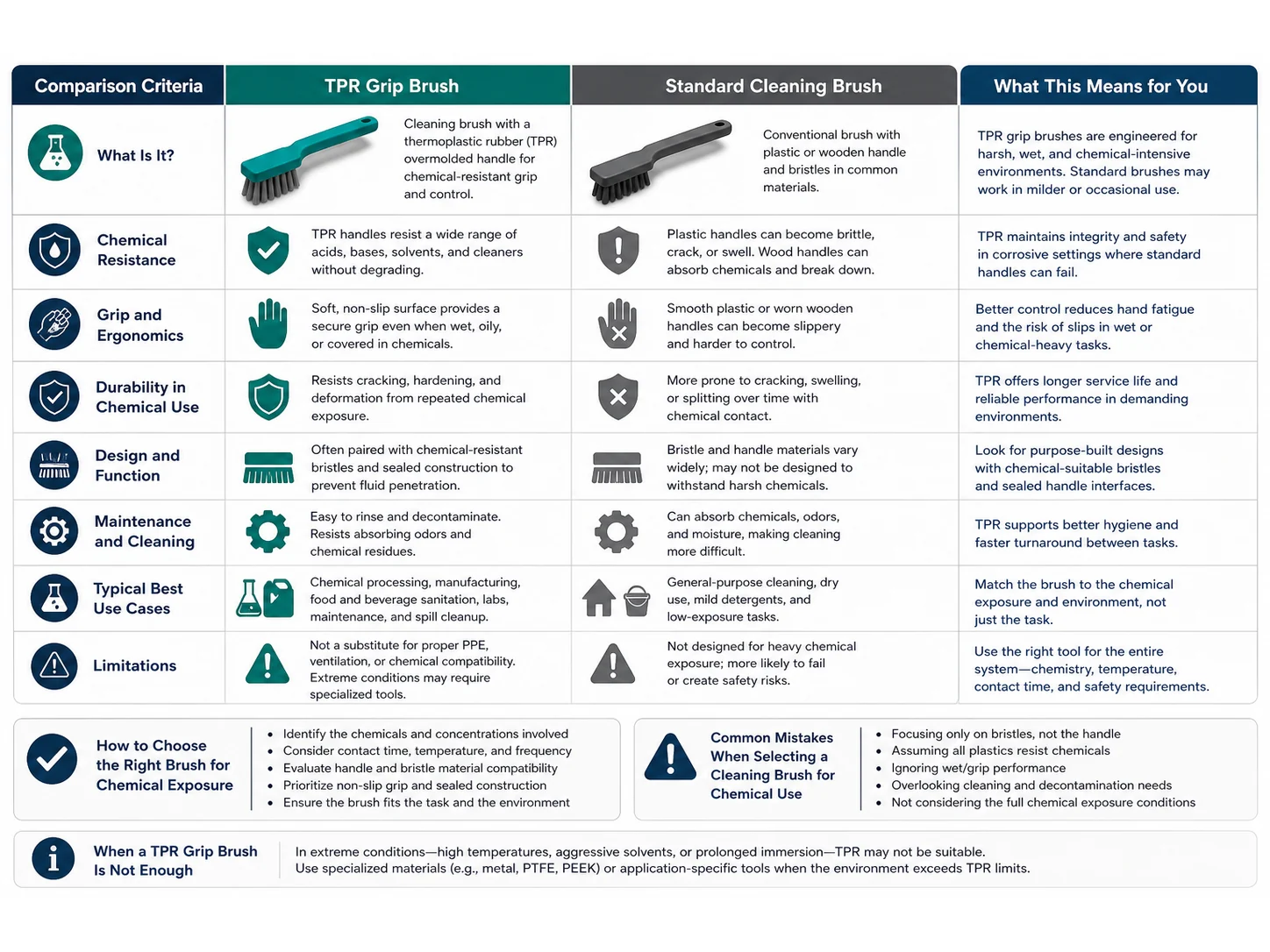
- Chemical Exposure: Check TPR compatibility with your cleaning agents. Acetone, strong acids, or chlorinated solvents can cause some TPR grades to swell, soften, or crack. Ask for TPR material data if you regularly use aggressive chemicals.
- Equipment Interface: Is the brush handheld, or does it mount to a machine? Confirm the brush’s handle end (threaded, quick-connect, or plain shank) matches your holder or equipment. For automated systems, the TPR grip may be irrelevant if the brush is gripped by a machine, but the handle body must still withstand the environment.
- Hygiene Expectations: In food or cleanroom settings, choose brushes with sealed handle joints and non-porous TPR to prevent bacteria harboring. Smooth TPR surfaces are easier to sanitize than textured ones.
- Operator Comfort & Fatigue: For extended scrubbing, a TPR grip should be ergonomically shaped and vibration-dampening. A heavy metal-handled brush with TPR sleeve might still cause shoulder strain over a full shift.
- Custom Size Requirements: Off-the-shelf TPR grip brushes may not fit your specific tool holder or space constraint. If you need a non-standard diameter or handle length, expect custom tooling. Ordering advice: always provide a detailed drawing with dimensions, material specifications, and expected working conditions.
5 Most Common TPR Grip Brush Mistakes in Wet Cleaning (and How to Avoid Them)
- Choosing the Wrong Bristle Material for Chemicals. Many operators focus only on the handle grip and forget that the bristles must also resist the cleaning chemicals. Polypropylene bristles, for example, are excellent for acids and alkalis but can degrade with high-pH solutions over time. Always match the brush filament to your chemical SDS and temperature range.
- Assuming All TPR is the Same. TPR is a family of materials, not a single formula. Some TPR compounds are oil-resistant but not heat-resistant; others withstand repeated autoclaving but soften in solvents. Don’t just ask for “TPR”—specify or verify the grade for your environment. A quick supplier material datasheet review prevents failures.
- Ignoring Handle Swelling and Delamination. A poorly bonded TPR overmold can separate from the core after prolonged water exposure. This creates a hollow space that traps moisture and breeds mold. Avoid brushes with obvious parting lines near the grip, and opt for chemically fused TPR rather than merely press-fit or glued on.
- Using a TPR Grip Brush for High-Temperature Washdowns. Standard TPR starts softening around 80°C (176°F). In meat processing or canning lines where hot water and steam are used, the grip can lose shape quickly. In such cases, consider a silicone or high-temperature polymer alternative, or a brush that doesn’t rely on a soft grip at all.
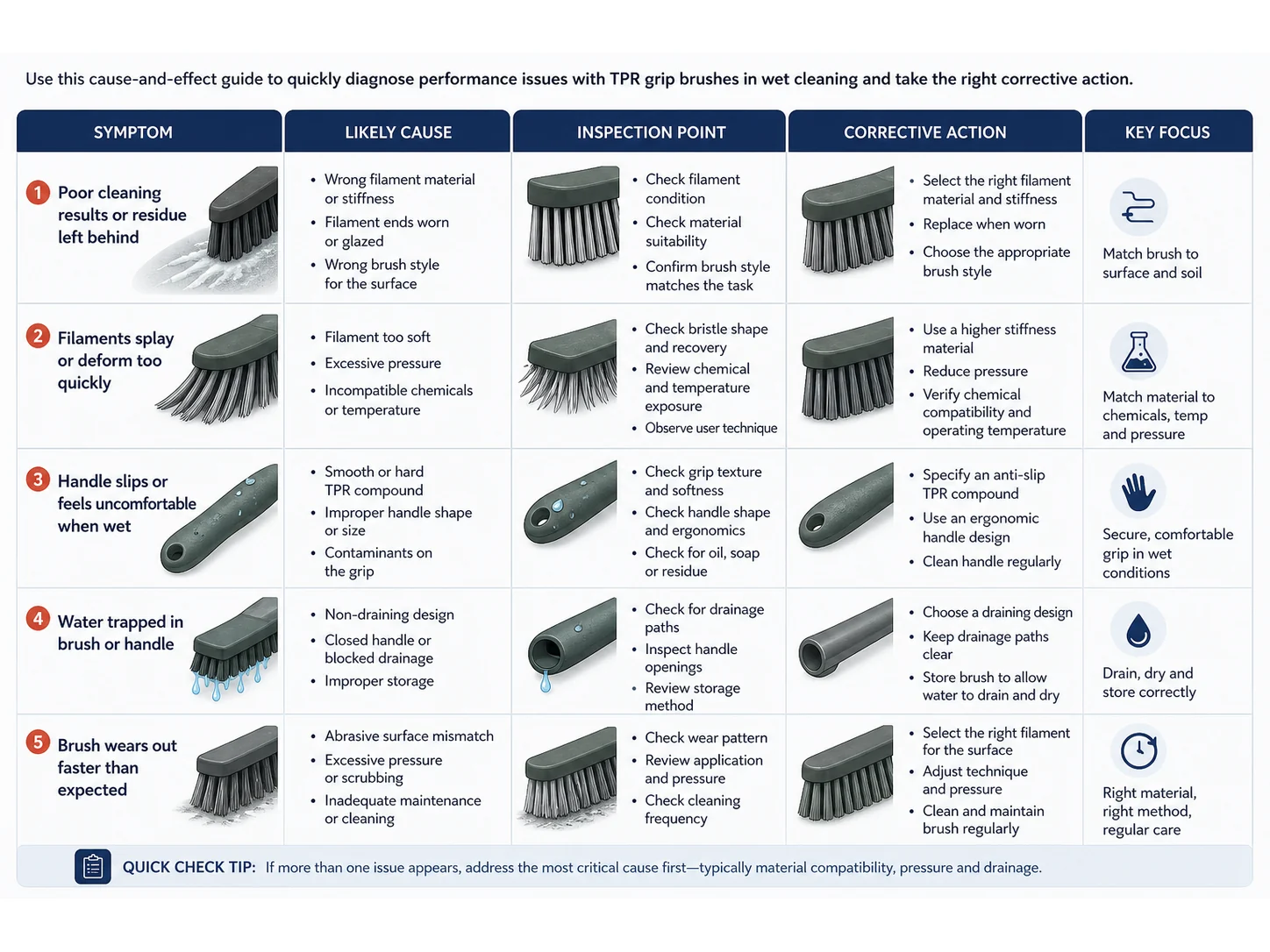
- Not Planning for Replacement Cycles. Even a well-chosen TPR grip brush wears out. Over time, the grip becomes smooth, the bristles splay, and the handle micro-cracks. A common mistake is running brushes until they fail visibly. Instead, set a replacement schedule based on hours of use and inspect brushes weekly for grip integrity and bristle wear.
When a TPR Grip Brush Is Not Enough
While TPR grip brushes solve many wet cleaning challenges, they have limitations. Recognizing these boundaries is just as important as choosing the right model.
- Extreme Chemical Environments: If your process uses toluene, strong oxidizing acids, or ketones daily, even the best TPR will degrade. Here, a fully stainless steel or PTFE-coated handle might be necessary, with or without a grip enhancement like a silicone sleeve.
- High-Heat Applications (>85°C): As noted, TPR loses mechanical strength at elevated temperatures. Choose brushes with heat-resistant polymer or metal bodies in high-temperature washdowns.
- Cleanroom or Autoclave Requirements: Many TPR compounds outgas or degrade under steam sterilization. For pharmaceutical cleanrooms, look for brushes made from silicone, PTFE, or autoclavable thermoplastics with validated cycles.
- Heavy-Duty Mechanical Scrubbing: If the operator applies high lateral force, an all-TPR handle may flex or break. In such cases, a solid metal core with a textured (non-TPR) grip might be more durable.
- Custom Interface Needs: When the brush must integrate into a machine with tight dimensional tolerances, the TPR grip may interfere with mounting. Suppliers often need a drawing to confirm that the grip won’t impede the connection.
When any of these conditions apply, request a sample test or a supplier drawing review. A quick pilot test under real conditions will reveal whether the TPR grip holds up before you commit to a bulk order.
Final Takeaway: Get the Details Right Before You Specify
A TPR grip brush can improve safety and cleaning efficiency in wet environments, but it’s not a one-size-fits-all solution. The most frequent mistakes stem from overlooking chemical compatibility, assuming all TPR compounds are equal, and neglecting maintenance and replacement schedules. By matching the handle design, bristle type, and TPR grade to your actual cleaning conditions—and verifying performance through samples when in doubt—you’ll avoid downtime, protect operators, and maintain surface quality. Use the comparison table and checklist above as your starting point, and treat brush selection as a process-driven decision, not a commodity purchase.
Frequently Asked Questions
What does TPR stand for in a brush handle?
TPR stands for Thermoplastic Rubber. It is a synthetic material that combines the flexibility and grip of rubber with the processing ease of plastics. In brush handles, it provides a non-slip surface that improves safety during wet cleaning.
Can TPR grip brushes be used with all cleaning chemicals?
No. TPR compatibility varies by formulation. While many TPR grades resist mild detergents and water, strong solvents, acids, or caustics can cause swelling, softening, or cracking. Always check the brush manufacturer’s chemical resistance chart or ask for a material datasheet.
How often should I replace a TPR grip brush in a wet cleaning environment?
Replacement frequency depends on usage intensity, chemical exposure, and brush construction. A good rule is to inspect brushes weekly for cracks, loss of grip texture, or splayed bristles. In high-cycle food plants, brushes may need replacement every few weeks; in light janitorial use, they may last months. Establish a preventive replacement schedule based on visual wear, not just failure.
Is a TPR grip brush suitable for food-contact applications?
Yes, but only if the TPR compound is FDA-compliant for incidental food contact and the handle design prevents crevices where bacteria can grow. Look for smooth, non-porous TPR surfaces and sealed handle joints. Always verify with the supplier that the brush meets your required hygiene standards, such as HACCP or 3-A Sanitary Standards.
What’s the difference between TPR and rubber handles?
Natural rubber handles offer excellent grip but can degrade faster with oils and certain chemicals. TPR is synthetic and can be engineered for better chemical resistance, UV stability, and processing consistency. TPR also bonds well to plastic cores, making it ideal for overmolding. Rubber handles are typically bulkier and heavier but may have a more “soft” feel.
Can I get a TPR grip brush custom-sized for my equipment?
Yes, many brush manufacturers offer custom options for handle diameter, length, grip placement, and bristle configuration. To get an accurate quote, provide a detailed drawing with dimensions, tolerances, intended chemical environment, and any regulatory requirements. Custom tooling may have minimum requirement details (minimum order quantity) restrictions, so plan accordingly.
How do I clean and sanitize a TPR grip brush between uses?
Rinse the brush thoroughly with water to remove residues, then apply a compatible sanitizer according to the manufacturer’s instructions. Avoid soaking in harsh chemicals for extended periods. Hang the brush or store it bristle-side down to air dry completely; trapped moisture can degrade the TPR over time. Do not autoclave unless the brush is specifically rated for it.
What should I do if the TPR grip starts peeling or becomes sticky?
Peeling or stickiness usually indicates chemical attack, improper storage, or a manufacturing defect. If the brush is relatively new, contact the supplier for a warranty evaluation. Otherwise, retire the brush immediately—a degraded grip can lead to slips and operator injuries. Review the chemical exposure and storage conditions before reordering.