
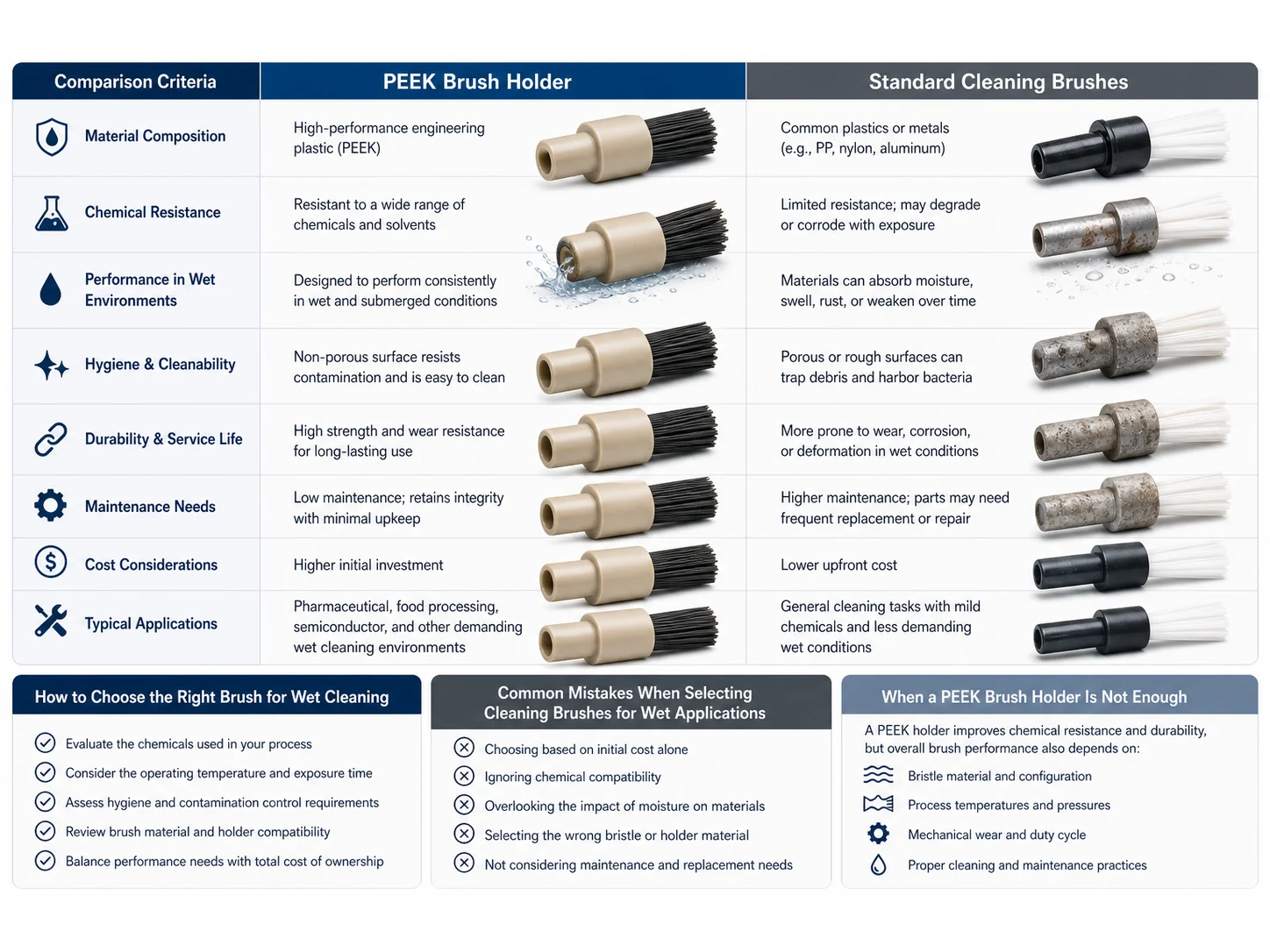
What Is a PEEK Brush Holder?
A PEEK brush holder is a brush body, core, or handle manufactured from PEEK resin. PEEK is known for outstanding chemical resistance, low moisture absorption (around 0.1–0.5% at saturation), and the ability to maintain mechanical strength up to 250 °C (482 °F) continuously. In a brush holder, this means the part that grips the bristles and interfaces with the cleaning equipment stays dimensionally stable, resists swelling, and does not leach contaminants into the cleaning solution. These properties make PEEK holders popular in pharmaceutical, biotech, food processing, and semiconductor cleaning where steam sterilization, aggressive CIP chemicals, or ultrapure water are used.
Standard Cleaning Brushes in Wet Environments
Everyday cleaning brushes use holders made from more common materials:
- Wood: Absorbs water, swells, cracks, and traps bacteria. Not suitable for sanitary or repeated wet use.
- Polypropylene (PP): Good chemical resistance but softens around 80–100 °C. Not ideal for hot washdowns.
- Nylon: Strong and flexible but can absorb up to 8% moisture by weight, leading to dimensional changes and loss of stiffness. Hydrolysis at elevated temperatures in acidic or alkaline solutions is a concern.
- Stainless steel: Excellent mechanical strength but can corrode in certain acids or chlorides. Metal-to-metal contact can scratch sensitive equipment surfaces and metal particles may become a contamination risk.
These standard holders work well for occasional or light-duty wet cleaning, but in demanding processes, the holder material becomes the weak link.
Comparing PEEK Brush Holders and Standard Brushes for Wet Cleaning
| Feature | PEEK Brush Holder | Standard Brush (PP, Nylon, Wood, Metal) |
|---|---|---|
| Material composition | High‑performance thermoplastic (polyetheretherketone) | Varies (polypropylene, nylon 6/6, wood, stainless steel) |
| Moisture resistance | Extremely low water absorption; maintains dimensions in continuous wet exposure | Wood swells and degrades; nylon absorbs significant moisture; PP is moderate |
| Chemical resistance | Excellent against most acids, bases, solvents, and steam; resists hydrolysis | Nylon can be attacked by acids and hot water; PP resists many chemicals but weakens at higher temperatures |
| Temperature range | Continuous use up to 250 °C (482 °F); short‑term higher | Wood chars; PP softens ~100 °C; nylon softens ~180 °C; metal handles stay cool but may corrode |
| Stiffness and structural integrity | High stiffness and creep resistance even in hot water or steam | Nylon loses rigidity when wet; wood cracks; metal is rigid but heavy |
| Cleanability and hygiene | Non‑porous, smooth surface; resists biofilm; compatible with autoclave and CIP sterilization | Porous materials (wood, some plastics) harbor bacteria; metal may pit or scratch |
| Typical service life in wet conditions | Long; often outlasts bristles; reduced replacement frequency | Shorter; holder failure causes early brush change-out |
| Cost and availability | Higher unit cost but lower lifecycle cost in harsh environments | Lower upfront cost; widely available off‑the‑shelf |
How to Choose the Right Brush for Wet Cleaning
Selecting between a PEEK holder and a standard brush should start with your process conditions, not just the brush catalog. Evaluate these factors:
- Residue type: Abrasive residues may wear holder edges, but chemical residues dictate material compatibility. If you work with strong acids, caustics, or organic solvents, PEEK’s inertness is a strong advantage.
- Surface sensitivity: If cleaning polished stainless steel, glass‑lined vessels, or optical surfaces, avoid metal holders that can scratch. PEEK’s hardness is lower than metal, reducing marring risk.
- Equipment interface: Does the brush mount on an automated rotating shaft, a fixed pipe, or a manual handle? PEEK can be machined to fine tolerances for shaft bores, keyways, or threaded connections, but standard holders are easy to adapt for simple handles.
- Wet or chemical exposure: Continuous immersion, high‑pressure spray, or CIP cycles demand a holder that won’t swell or soften. PEEK is justified here; a nylon brush may fail within days.
- Hygiene expectations: In food, pharma, or cleanroom environments, non‑porous and autoclave‑ready holders reduce contamination risk. Wood and many plastics are ruled out. PEEK meets common sanitary design principles (smooth, crevice‑free).
- Maintenance frequency: If brushes are changed daily due to holder degradation, upgrading to PEEK often reduces downtime and overall cost.
- Custom size requirements: Standard brushes come in limited diameters and lengths. PEEK brush holders can be custom‑machined to fit unusual pipe IDs, tank necks, or complex geometries while keeping the holder one piece.
Common Mistakes When Selecting Cleaning Brushes for Wet Applications
- Choosing by cost drivers alone: A low-cost nylon brush may need replacement after a few CIP cycles, while a PEEK holder lasts for years in the same environment.
- Ignoring holder material when bristles are chemically resistant: Bristles may be PTFE or PEEK, but if the holder is wood or nylon, the brush still fails prematurely.
- Assuming all “plastic” brushes behave the same: Polypropylene and PEEK differ enormously in temperature and chemical limits. Treating them interchangeably leads to rapid failure.
- Overlooking mounting dimensions: A brush holder that fits the equipment today may swell just enough to seize or slip under torque. Confirm wet‑state dimensions.
- Believing metal handles are always food‑safe: Stainless steel can still cause galvanic corrosion or shed particles. PEEK avoids metal contamination altogether.
- Neglecting thermal expansion: In hot cleaning, holder expansion can change brush fit. PEEK’s low coefficient of thermal expansion helps, but it still must be accounted for in precision fits.
- Over‑specifying PEEK for every application: If the brush is used once then discarded, or if wet exposure is momentary, a standard polypropylene holder may be perfectly adequate and more cost‑effective.
When a PEEK Brush Holder Is the Wrong Choice
PEEK is a powerful material, but it has limits. Recognize when to consider an alternative or seek expert guidance:
- Extreme temperatures: Above 300 °C (572 °F) continuous, PEEK loses mechanical integrity. For such conditions, ceramic or high‑grade metal holders (e.g., Hastelloy) may be required.
- Concentrated oxidizing acids: Nitric, sulfuric, or chromic acids above certain concentrations and temperatures can attack PEEK. A sample immersion test or supplier review is essential.
- Radiation exposure: In nuclear or certain sterilization processes using gamma radiation, PEEK may embrittle. Material selection must be application‑specific.
- High‑impact or heavy‑load cleaning: If the brush is used for scraping hard deposits under high torque, a metal core with a compatible coating (e.g., electropolished stainless with PEEK bristles) may provide better rigidity.
- Strict regulatory compliance: While PEEK resins are often compliant with FDA and EU food contact regulations, part‑specific certifications must be obtained from the manufacturer. Never assume a generic PEEK holder meets a specific standard without a supplier drawing review or material certificate.
- Budget‑only projects: If wet exposure is truly minimal and the process runs at ambient temperature, a properly sealed nylon or PP holder may work, and the significant cost difference cannot be ignored.
In these edge cases, involve the brush supplier early. A sample test or engineering drawing review ensures the holder material matches the real operating window.
Final Takeaway
For most demanding wet cleaning operations—especially those involving hot chemicals, steam, or hygienic requirements—a PEEK brush holder outperforms standard cleaning brushes in reliability, cleanliness, and lifespan. Standard brushes made from nylon, polypropylene, wood, or metal still serve well in light‑duty, intermittent, or cost‑sensitive applications. The better brush is not universal; it is the one that fits your specific residues, surfaces, equipment interfaces, and process chemistry. When water, chemicals, and high temperatures overlap, PEEK is often the safest long‑term choice. When in doubt, test a sample under your actual conditions before committing to a full rollout.
Frequently Asked Questions
What is a PEEK brush holder made of?
It is made from polyetheretherketone, a high‑performance engineering thermoplastic with excellent chemical and thermal resistance.
Can a PEEK brush holder replace a metal brush holder in food plants?
Often yes. PEEK holders eliminate the risk of metal corrosion, scratching, and particle generation, and they withstand typical CIP conditions. However, always verify the specific holder grade is FDA‑compliant for your application.
Is PEEK safe for use with aggressive solvents?
PEEK resists most organic and inorganic solvents, but compatibility depends on temperature and concentration. For strong oxidizing acids like concentrated nitric or sulfuric, consult chemical resistance charts or request a sample test from your supplier.
How do I know if my process needs a PEEK holder instead of a standard nylon brush?
Check if your process involves temperatures above 80 °C (176 °F), repeated hot water or chemical washdowns, sanitizing cycles, or requirements for low particle generation. If so, nylon may soften or degrade quickly; PEEK is a safer bet. If your cleaning is cold water only and infrequent, nylon or PP may suffice.
Will a PEEK brush holder work in hot CIP cleaning?
Yes. PEEK handles continuous CIP temperatures up to 250 °C (482 °F) without loss of stiffness, making it suitable for most hot caustic and acid detergent cycles used in food and pharma.
Are custom sizes available for PEEK brush holders?
Typically yes. PEEK can be machined to custom diameters, lengths, bore sizes, and mounting features such as threads or keyways. Expect longer lead times and higher cost compared to standard brush holders.
How long does a PEEK brush holder last compared to standard plastic holders in wet conditions?
In continuous hot wet environments, a PEEK holder can outlast nylon or PP holders by a factor of 5 to 10 or more, often surviving beyond the bristle replacement schedule. Exact life depends on process specifics.
Can I use a standard brush with PEEK bristles but a different holder?
Yes, but the performance advantage of the bristles is lost if the holder swells, softens, or corrodes. For maximum system reliability, match the holder material to the same level of chemical and thermal resistance.
Which bristle material fits this job — Nylon PA, AISI 304 Stainless Steel Wire or Polypropylene PP?
| Material | Continuous temperature (°C) | Peak temperature (°C) | Water absorption | Hardness |
|---|---|---|---|---|
| Nylon PA | 93 | 121 | 0.3–9% by PA grade and conditioning | Medium to firm; filament diameter and trim length control bending force. |
| AISI 304 Stainless Steel Wire | 400 | 500 | 0% | Rockwell B 70–95 depending on temper and cold work |
| Polypropylene PP | 80–100 | 120–140 | ≤0.03% | Shore D 65–75 |
| PEEK Filament | 250–260 | 300 | 0.10–0.50% | Shore D 85–90 |
Figures as published by Brushtec / DuPont; Alleima; Perlon. Confirm the exact grade against the supplier datasheet before ordering.
What should replace Strip Seal Brushes for peek brush?
- Strip Seal Brushes — Strip brushes create a linear barrier or guide; machine-table brush plates distribute load and support products over a broad area. Closest alternative: Machine Table Brush Plates.
- Nylon PA — Compare Nylon PA with PP, PBT, PET. Change material when wet stiffness, temperature, chemical resistance, conductivity, particle shedding, or surface marking becomes the limiting factor.
- AISI 304 Stainless Steel Wire — Use AISI 316 stainless steel wire for chloride, marine, dairy, beverage, chemical washdown, or higher pitting-resistance requirements. Use carbon steel for dry aggressive cutting and brass or abrasive nylon for lower marking risk.
- Polypropylene PP — Compare Polypropylene PP with Nylon, PBT, PET. Change material when wet stiffness, temperature, chemical resistance, conductivity, particle shedding, or surface marking becomes the limiting factor.