
Custom Cleaning Brush
PEEK Brush
High-temperature PEEK brush for PCB/SMT tooling, hot molds, e-cigarette parts and cleanroom surfaces to 260°C. Custom sizes and antistatic options.
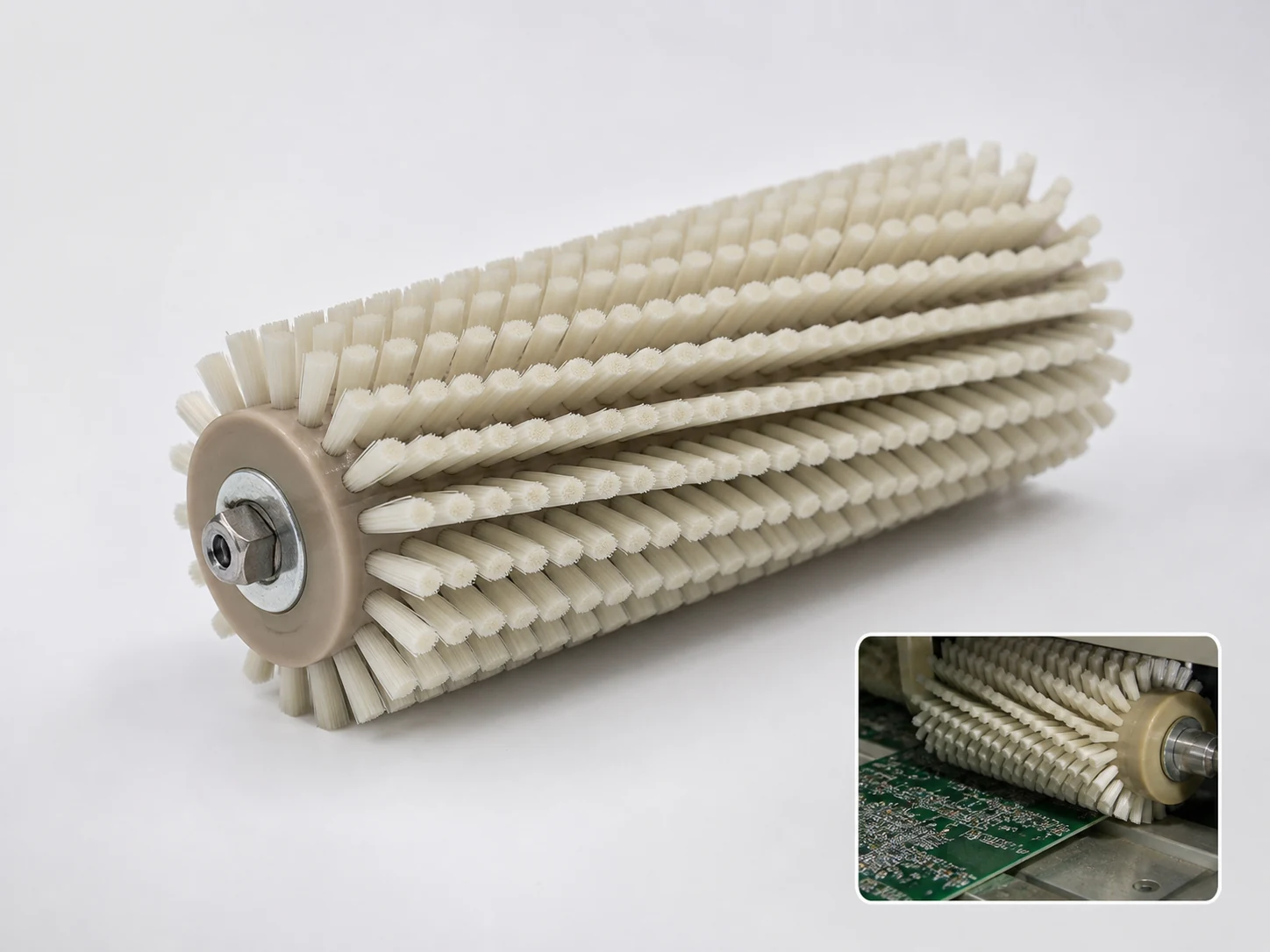
Large-format brush
100 pcs
Minimum order
Built one at a time on a core or channel: full-width rollers, sweeper brooms and long strip.
Production lead time, once the specification is confirmed
- Up to 100 pcsWithin 20 days
- 101–1,000 pcsWithin 30 days
- Over 1,000 pcsConfirmed with your quotation
Peak season can extend these times; the shipping date is confirmed in writing with your quotation. Sampling and shipping are quoted separately.
A PEEK brush uses high-temperature PEEK monofilament contact to remove dust, flux residue, powder, and light process contamination from hot molds, PCB/SMT tooling, electronic cigarette components, and cleanroom equipment. It keeps its stiffness and scrubbing action on surfaces up to 260°C while resisting aggressive solvents and shedding far fewer broken fibers than nylon or natural-bristle brushes.
What can this brush do for you?
Works while surfaces are still hot
PEEK retains mechanical strength and springback at continuous operating temperatures near 260°C, well above the point where nylon, polypropylene, and natural fibers soften or melt. Operators can sweep warm molds, heating plates, and reflow fixtures without waiting for cool-down, and without leaving melted bristle smear on the part.
Handles aggressive solvent-wipe cleaning
PEEK filament resists IPA, acetone, most flux removers, dilute acids and alkalis, and steam. A brush can be used repeatedly with the aggressive wipe-down chemistry found in electronics assembly and mold maintenance without the fiber swelling, softening, or breaking down the way standard plastic brushes do.
Reduces bristle-fragment contamination on precision work
PEEK monofilament resists flex fatigue and brittle breakage better than many natural and commodity plastic fibers. That means fewer snapped bristle fragments left on stencils, PCBs, glass substrates, or mold cavities, reducing downstream defect and rework risk in cleanroom and precision assembly areas.
Cleans without marking polished or coated surfaces
PEEK is hard enough to dislodge dust, powder, and soft process films, but far softer than metals, glass, and ceramics. The filament tips provide a non-scratching contact for polished mold surfaces, PCB pads, and coated interiors where a brass or steel brush would leave marks.
Reaches fine-pitch and recessed areas
Fine PEEK filament diameters paired with short trim lengths produce a firmer, more controlled contact for tight spaces such as fine-pitch SMT apertures, mold vents, heating element recesses, and electronic cigarette atomizer chambers. The same brush can be built with longer trim for larger flat areas.
What is a PEEK Brush?
A PEEK Brush is a manual or machine-mounted cleaning tool whose working contact is PEEK (polyetheretherketone) monofilament rather than nylon, horsehair, or steel wire. PEEK is a semi-crystalline high-performance polymer selected for high-temperature resistance, chemical resistance, and controlled flex recovery. The brush is normally supplied as a strip brush section, hand brush, or holder-mounted tool, with rows of PEEK filaments captured in a stainless steel, aluminum, or high-temperature polymer channel.
During cleaning, the operator draws the brush across the part in a linear or rotary stroke. The filaments flex, flick loose particles and light residue out of the working area, and return to their original position. It is a particulate-removal tool, not an absorbent wipe and not a replacement for hard scraping or aggressive abrasive action.
Two operating details matter. First, PEEK filament itself tolerates soldering and molding temperatures, but the backing, handle, adhesive, and any insert materials must also be rated for the same temperature and chemical environment. Second, PEEK is a stiff engineering polymer; it is not a soft conformable contact. If an application needs a soft, compliant face for curved or delicate interiors, a silicone or low-durometer nylon product may be more appropriate.
Technical Specifications
| Parameter | Value / Options |
|---|---|
| Filament material | PEEK monofilament; natural or carbon-filled conductive grade |
| Continuous service temperature | Up to 260°C; short excursions above this depend on duration and load |
| Filament diameter | 0.10–0.50 mm; fine grades for delicate contact, heavier grades for firm scrubbing |
| Trim length | 10–40 mm; shorter for stiffer scrubbing contact, longer for reach into recesses |
| Working width | 5–620 mm; custom strip widths and multi-section assemblies available |
| Backing / core | Stainless steel, aluminum, or high-temperature polymer channel, selected for temperature and chemical exposure |
| Handle / mounting | Hand grip, threaded ferrule, grounded handle, strip mount, or machine holder |
| Chemical exposure | Compatible with IPA, acetone, most flux removers, dilute acids and alkalis, steam, and hot water |
| Static-dissipative option | Grounded core, grounded handle, or conductive PEEK filament blend; target resistance 10³–10⁹ Ω when specified |
| Operating environment | Dry or solvent-wipe use on hot surfaces; not for continuous direct flame or sustained operation above 300°C |
| Brush type | Custom Strip Seal Brushes |
| How it is driven | Supplied hand-guided or machine-mounted |
| Cleaning target | pcb and smt assembly, hot mold and tool maintenance, and cleanroom and precision equipment cleaning |
| Surface or part | molds, tooling, plastic, plates, glass, fixtures, aluminum, and channel |
| Residue or debris | dust, powder, mold, flux, flux residue, fiber, carbon, and adhesive |
| Mounting / connection | Hand grip, threaded ferrule, grounded handle, strip mount, or machine holder |
Where does this brush work best?
- PCB and SMT assembly: remove dried solder paste, flux residue, and particulate from stencil apertures, squeegee blades, board carriers, misprint frames, and reflow tooling while the tooling is still warm.
- Hot mold and tool maintenance: sweep release powder, plastic flash, light char, and process dust from injection molds, thermoforming tools, embossing rolls, and hot plates without pausing for temperature cool-down.
- Electronic cigarette manufacturing and maintenance: remove dust, powder, and light carbon/ash from atomizer chambers, heating elements, ceramic bases, contact pads, and assembly fixtures without scratching the component surfaces.
- Cleanroom and precision equipment: low-shedding dry brushing on glass substrates, wafer cassettes, optical fixtures, semiconductor handling parts, and instrument surfaces where a broken bristle fragment would be a defect.
- Precision metal and glass surfaces: particulate removal from machined parts, polished surfaces, display panels, and coated components where metallic contact would leave marks or alkaline deposits.
How do I choose the right one?
Check the actual contact temperature
PEEK brush filaments are rated for continuous service near 260°C. If the surface or cycle temperature routinely exceeds 300°C, filament creep and permanent bending become real risks, and the brush should be replaced by a stainless steel wire brush or another metallic contact. Know both the setpoint and the actual surface temperature, not just the machine display value.
Match filament diameter and trim length to access and force
Fine filaments around 0.10–0.20 mm give the control needed in narrow apertures and fine-pitch features without excessive contact pressure. Coarser filaments of 0.30–0.50 mm apply more scrubbing force to larger, flat areas. Short trim lengths of 10–20 mm produce firm, stable contact; longer trim lengths of 25–40 mm reach into pockets and cavities but apply less pressure. The working width should cover the area in one pass when possible.
Define the residue honestly
PEEK removes dust, powder, loose particles, dried flux film, release agent, and light process films. It will not remove hard mineral scale, baked-on carbon crust, cured adhesive, or heavy oxidation. Those residues require brass, stainless steel, or abrasive filament. Using PEEK on hard encrustations only polishes the contamination and accelerates bristle tip wear.
Pick the mount to match the cleaning motion
Manual hand brushes are suitable for operator cleaning and spot maintenance. Strip or machine-mounted brushes suit linear wiping across stencils, conveyors, or plates. When cleaning is rotary, a cylindrical or wheel-shaped PEEK brush can be built. If the brush will be used on ESD-sensitive electronics, specify a grounded handle, grounded core, or conductive PEEK filament grade rather than assuming standard PEEK will dissipate static charge.
Confirm the backing and handle materials
PEEK filament selection is only part of the decision. A brush built on a steel or aluminum channel with a high-temperature polymer handle can operate continuously in warm environments. A low-cost plastic handle or temperature-limited adhesive will fail before the PEEK filament does. Supply the full chemical and temperature sequence during specification.
Can I customize this brush?
PEEK brushes are configured to the cleaning process because the same PEEK filament can be built into very different brush forms. We use the operating temperature, surface material, residue type, chemical exposure, required brush dimensions, motion path, and static-control requirement to define each build. A drawing, sample part, or photo of the cleaning zone shortens the specification process.
Typical adjustable parameters include:
- Filament: PEEK grade, filament diameter, trim length, row spacing, bristle density, and color or conductive fill.
- Brush form: strip, hand brush, cylinder, wheel, cup, or custom-shaped face.
- Backing and core: stainless steel, aluminum, high-temperature polymer channel, curved or notched backing, and mounting holes.
- Handle and mount: grip form, threaded ferrule, grounded handle with conductive path, machine-mount plate, or quick-change adapter.
- Identification and packaging: color coding, printed or laser marking, bulk pack, cleanroom bag, or individual packaging.
If your project requires material certificates, cleanroom-packaging verification, inspection documentation, or third-party testing support, those requirements can be coordinated as part of the customization process.
How do you confirm a PEEK brush has actually cleaned the surface?
Will a PEEK brush scratch PCBs, glass, or polished metal?
PEEK is softer than glass, ceramic, and metals, so clean PEEK filament tips normally will not scratch these surfaces under normal pressure. However, hard particles trapped between the bristles can act as an abrasive and mark the surface. Rinse or replace the brush if it has been used on heavily contaminated parts before moving to a polished surface.
Can the brush be used briefly above 260°C?
PEEK can tolerate short excursions above 260°C, but prolonged exposure near the 343°C melting point will soften the filaments, cause them to bend, and destroy springback. If the process consistently stays above about 300°C, choose a stainless steel wire brush or another metallic contact instead.
How do I verify the static-dissipative version is working?
Measure the resistance from the filament contact area to the grounded point on the handle or core with a megohmmeter. The reading should fall within the specified 10³–10⁹ Ω range. If the measured resistance moves outside that range after cleaning or wear, clean the contact path and re-test; replace the brush if the path remains open or highly resistive.
What should be checked before using the brush in a cleanroom?
Confirm the brush has not been used outside the controlled area, inspect the filament tips for bends, splits, or embedded debris, and verify that the packaging is intact if the brush is stored between uses. Many cleanroom sites dedicate a brush to a single product line or material to avoid cross-contamination.
Can the same brush be used with acetone and then in hot water?
PEEK filament tolerates both, but the backing, core, adhesive, and handle must also be rated for the same chemical and temperature sequence. Specify the complete cleaning process during customization so the entire brush, not just the filament, is compatible.
When is a PEEK brush the wrong tool for the job?
Use a different tool when the residue is hard scale, baked-on carbon, cured adhesive, or heavy corrosion, because PEEK will not cut these deposits. Use a silicone or soft nylon brush when a conforming, low-force contact is required on curved or sensitive interiors. Use a single-use swab when cross-contamination control is more important than repeated cleaning.
Guides that go deeper on this
Custom Manufacturing RFQ
Describe Your Application
An accurate custom quote starts with the dimensions, working surface, residue, material choice, connection, quantity, and reference files.
Drawing or photo optional — it speeds things up, it does not gate the enquiry.
Custom Brush RFQ
Send Your Brush Project
Upload a drawing, product photo, or sample photo and provide the core dimensions and cleaning conditions.
“We need a brush to remove wet residue from a stainless steel conveyor, about 800mm wide. The current brush wears quickly. We can send photos.”
“We sell drinkware and need a cleaning brush to include with the product. Quantity around 5,000 pieces.”