
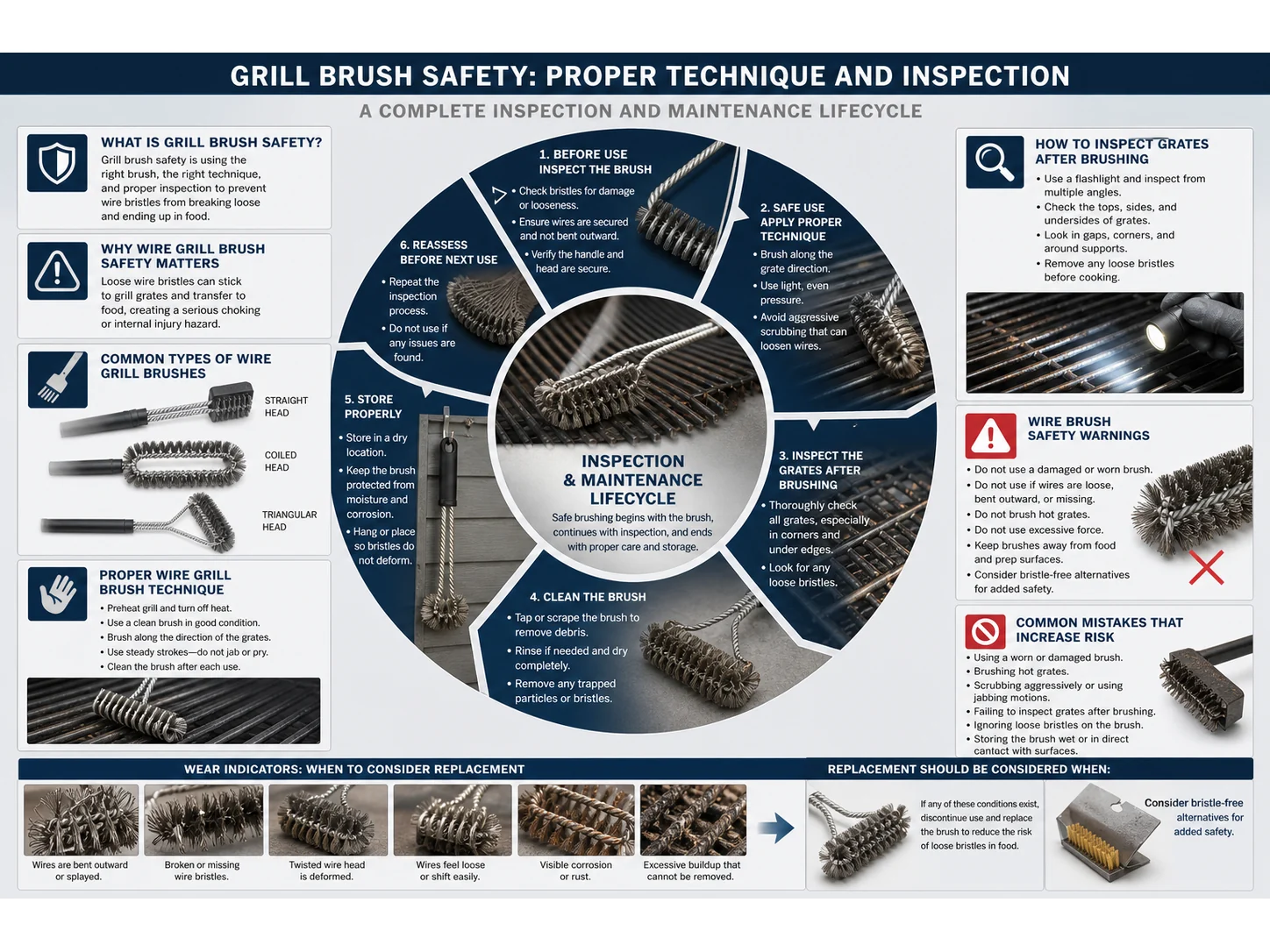
What Is Grill Brush Safety?
Grill brush safety means following a set of practices that reduce the risk of wire bristle ingestion. A typical wire grill brush has hundreds of small metal bristles. Over time, heat, pressure, and wear can cause bristles to break off and stick to the cooking grate. If unnoticed, a bristle can transfer to food and become a dangerous foreign object that can puncture the throat, stomach, or intestines. Safe technique, regular inspection, and knowing when to replace the brush are the three pillars of grill brush safety.
Why Wire Grill Brush Safety Matters
Wire bristles are small, hard to see, and can cause serious internal injuries. They can perforate the esophagus, cause peritonitis, or require emergency surgery. The risk is not theoretical: medical journals and public health agencies have documented cases where grill brushes were the source. Because the injury often goes undiagnosed at first, prevention is the only reliable defense. Even a single bristle can turn a meal into a medical emergency.
Common Types of Wire Grill Brushes
Not all wire brushes are the same. Bristle material, brush design, and handle construction all influence safety and durability. The table below outlines common types and their main safety considerations.
| Brush Type | Bristle Material | Typical Use | Safety Concern |
|---|---|---|---|
| Standard wire brush | Stainless steel | General grill grate cleaning | Most common source of loose bristles; rust can weaken bristles |
| Brass bristle brush | Brass | Porcelain or delicate grates | Brass is softer; bristles can still detach and are hard to see |
| Soft bristle wire brush | Fine gauge steel or brass | Light residue, frequent touch-ups | Thin bristles fatigue faster and break more easily |
| Long-handled brush | Stainless steel | Large grills; reduces proximity to heat | Harder to control pressure; can snap bristles from torque |
Proper Wire Grill Brush Technique
Using the right technique dramatically lowers the chance of leaving bristles behind. Follow these steps every time you clean a grill grate:
- Brush in one direction only. Avoid back-and-forth scrubbing. A single, smooth, push motion along the grate bars reduces bristle breakage and keeps any loose bristles moving in one predictable path.
- Use light to moderate pressure. Let the bristles do the work. Pressing too hard bends and fatigues the metal, causing bristles to snap. If the brush cannot remove baked-on residue with moderate pressure, it may be time to replace it or pre-soak the grate.
- Hold the brush at a low angle. A 15–30° angle against the grate surface helps the bristles scrape along the metal instead of digging in and breaking. A steep angle increases bending stress at the base of each bristle.
- Brush when the grate is warm, not scorching. A grate around 200–300°F (93–149°C) will release residue more easily than a cold grate, but extreme heat can soften brush handles and accelerate metal fatigue. Never use a brush directly over an active flame.
How to Inspect Grates After Brushing
Post-brush inspection is the most important step in grill brush safety. Assume bristles may be present and check systematically:
- Visual check. Bend down and look across the entire grate surface from multiple angles. Use a flashlight or your phone’s light to catch metallic reflections. Pay extra attention to corners, welds, and the underside of grate bars.
- Wipe test. Crumple a damp paper towel or a clean cloth and wipe it firmly along the grate bars. If a bristle is present, it will snag on the fabric. Use a fresh towel for each section to avoid transferring bristles to another spot.
- Onion or potato test (optional). Cut an onion in half and rub the cut side across the warm grate. The natural moisture and texture can help dislodge and reveal loose bristles. Discard the onion half afterward.
- Double-check before cooking. Right before placing food on the grates, do a quick flashlight scan. Even a few seconds can catch a bristle that shifted during preheating.
Wire Brush Safety Warnings
- Do not use a rusty or worn brush. Rust weakens the wire, making it more likely to snap. Replace the brush at the first sign of significant rust, flattened bristles, or a lose bristle tuft.
- Store the brush properly. Hang it in a dry place away from rain and humidity. A wet brush corrodes quickly. Never leave a brush resting on the grill between uses.
- Inspect the brush before each use. Gently pull on bristles to see if any are already loose. If you find more than one loose bristle, discard the brush.
- Do not use a wire brush on a grate with a non-stick coating. Wire bristles will damage the coating, creating a different food safety hazard.
- Never assume a new brush is automatically safe. Manufacturing defects can leave loose bristles. Always do a dry swipe on a piece of cardboard before first use to dislodge any poorly attached bristles.
Common Mistakes That Increase Risk
- Skipping post-brush inspection. Relying on the brushing alone without a follow-up check is the number one cause of missed bristles.
- Using a worn-out brush. A brush with flattened or missing bristles cannot clean effectively, and the remaining bristles are under greater stress, so they break more easily.
- Brushing in both directions. Scrub-like motion fatigues the metal and scatters any broken bristles randomly across the grate.
- Ignoring the condition of the grate itself. A heavily rusted or pitted grate can snag and break bristles. Smooth, well-maintained grates are safer to brush.
- Assuming a bristle-free history means you are safe. Bristle failure can happen at any time. Consistency in inspection is what prevents injury.
When to Choose a Bristle-Free Grill Brush Alternative
A wire brush is not the only way to clean a grill grate, and it may not be the best choice for every user. Consider switching to a bristle-free method if:
- You consistently lack the time or patience for thorough post-brush inspection.
- Someone in your household has a history of digestive tract surgery or is at higher risk from a foreign body injury.
- You grill frequently for children or older adults, who may be more vulnerable to complications from an ingested bristle.
- You simply want to eliminate the risk entirely.
Bristle-free grill cleaners include:
- Coiled metal scrapers: A single piece of twisted metal wire with no individual bristles. They clean effectively and never shed bristles, though they can scratch porcelain grates if used aggressively.
- Pumice stone blocks: An abrasive stone designed to wear down with use. They leave behind a fine dust that can be rinsed off. They work well on warm grates but can be messy.
- Nylon or polymer brushes: Safe for all grate types, including porcelain and non-stick. Best used on a cool or warm grate; they can melt on a hot surface.
- Wooden scraper paddles: The wood forms grooves that match your grate bars over time. No broken bristles, but they require a bit of practice to get an even clean.
The table below compares wire brushes with common bristle-free alternatives to help you decide.
| Method | Cleaning Effectiveness | Safety Risk | Best For |
|---|---|---|---|
| Wire brush (stainless steel) | Excellent on baked-on residue | High risk of loose bristles | Fast cleaning with thorough inspection |
| Coiled metal scraper | Very good; strong scrubbing | No bristle risk; can scratch soft grates | Those wanting near-brush performance without bristle risk |
| Pumice stone | Good for light to medium buildup | No bristle risk; dust needs rinsing | Enamel or porcelain grates; safety-first users |
| Nylon brush | Moderate; best on warm grates | No bristle risk; melts at high heat | Quick touch-ups; non-stick grates |
| Wooden scraper | Adequate; works best with care | No bristle risk; learning curve | Char-grilled flavor enthusiasts; low-maintenance users |
Final Takeaway: A Simple Safety Routine
Grill brush safety is not complicated, but it requires consistency. Brush in one direction with light pressure, inspect every inch of the grate with a damp cloth and a light, and replace the brush at the first sign of wear. If that routine feels too demanding, move to a bristle-free cleaner. The goal is the same: delicious grilled food that is safe for everyone at the table.
Frequently Asked Questions
How often should I replace my wire grill brush?
Replace it as soon as bristles appear flattened, bent, or missing. For frequent grillers, that may be based on wear condition, operating load, and the equipment maintenance plan. Even a lightly used brush should be replaced annually because humidity and heat cycles weaken the metal over time.
Can I use a wire brush on a hot grill grate?
Warm grates (around 200–300°F) are ideal for cleaning. Avoid using a wire brush on grates directly over an active flame, as extreme heat can soften the handle and accelerate metal fatigue in the bristles. If your brush has a plastic handle, keep it well away from hot surfaces to prevent melting.
What should I do if I find a loose bristle on the grate?
Remove it immediately with tweezers or by wiping with a damp paper towel. Throw away the used towel. Then inspect the brush: if one bristle has come out, others are likely loose. Consider discarding the brush. Before cooking, do a full visual and wipe inspection again.
Is a brass bristle wire brush safer than a stainless steel one?
Brass bristles are softer and may cause less scratching on porcelain grates, but they can still break off. They are also harder to see because brass is less reflective than stainless steel. The safety practices—technique, inspection, replacement—are the same for both types.
Are there any situations where a wire brush should never be used?
Never use a wire brush on grates with a non-stick coating; the bristles will damage the coating. Also avoid using a wire brush on a public grill or in a setting where you cannot control the inspection process. Many commercial kitchens now use bristle-free tools as a safety policy.
Can I clean my BBQ without a wire brush?
Yes. A coiled metal scraper, pumice stone, nylon brush, or wooden scraper all work without bristle risk. Many home cooks find a combination—scraper for heavy deposits and a damp cloth for final wipe-down—effective and completely bristle-free.
How can I tell if my grill brush is rusting or wearing out?
Look for discoloration, especially rust spots on the bristles or metal base. Bristles that no longer stand up straight or are bent at odd angles have lost their temper and will break soon. If more than one bristle comes out during a gentle tug test, replace the brush.
Technical References
Which bristle material fits this job — AISI 304 Stainless Steel Wire, Nylon PA or AISI 316 Stainless Steel Wire?
| Material | Continuous temperature (°C) | Peak temperature (°C) | Water absorption | Hardness |
|---|---|---|---|---|
| AISI 304 Stainless Steel Wire | 400 | 500 | 0% | Rockwell B 70–95 depending on temper and cold work |
| Nylon PA | 93 | 121 | 0.3–9% by PA grade and conditioning | Medium to firm; filament diameter and trim length control bending force. |
| AISI 316 Stainless Steel Wire | 400 | 500 | 0% | Rockwell B 70–95 depending on temper and cold work |
| Aramid Fiber | 160–200 | 250–300 | 2–7% | — |
| Carbon Steel Wire | 200–300 | 350–450 | 0% | Rockwell C 40–60 |
Figures as published by Alleima; Brushtec / DuPont. Confirm the exact grade against the supplier datasheet before ordering.
When are Handheld Detail Brushes the wrong choice for grill brush?
- Handheld Detail Brushes — Use a tube brush, powered brush, scraper, wipe, sponge, or vacuum when the target is internal, heavily bonded, or highly delicate.
- AISI 304 Stainless Steel Wire — Avoid using AISI 304 as the default in marine, brine, hypochlorite, and persistent chloride environments; use AISI 316 when higher pitting and crevice-corrosion resistance is required.
- Nylon PA — The nylon family spans several grades, so heat, moisture and chemical limits should follow the selected PA resin rather than a generic nylon value.
- AISI 316 Stainless Steel Wire — AISI 316 is not immune to chloride stress-corrosion cracking, concentrated hypochlorite, strong reducing acids, or crevice attack; duplex or higher-alloy grades may be required in severe conditions.
What should replace Handheld Detail Brushes for grill brush?
- Handheld Detail Brushes — Handheld detail brushes cover general precision cleaning; auto-detailing brushes impose tighter controls for painted, polished, leather, display, and trim surfaces.
- AISI 304 Stainless Steel Wire — Use AISI 316 stainless steel wire for chloride, marine, dairy, beverage, chemical washdown, or higher pitting-resistance requirements. Use carbon steel for dry aggressive cutting and brass or abrasive nylon for lower marking risk.
- Nylon PA — Compare Nylon PA with PP, PBT, PET. Change material when wet stiffness, temperature, chemical resistance, conductivity, particle shedding, or surface marking becomes the limiting factor.
- AISI 316 Stainless Steel Wire — Use AISI 304 for general wet service without persistent chlorides. Use duplex, 904L, or higher-alloy wire when AISI 316 is insufficient for chloride stress-corrosion, severe crevice conditions, or aggressive acids.