What Is a High Speed Door Brush Seal?
A high speed door brush seal is a flexible strip of densely packed synthetic or natural bristles mounted along the frame or bottom edge of a rapid-cycling door. Unlike rigid rubber blades or compression gaskets, brush seals maintain continuous light contact with the moving door panel without significant friction or bounce. They are common in cold storage, cleanrooms, food processing, and high-traffic logistics doors where opening speeds exceed 1 m/s. The key job of the seal is to conform to minor surface irregularities while letting the door travel freely, so the optimization challenge is combining just enough interference with minimal wear on both the door skin and the brush itself.
For engineering drawings, GD&T, dimensions, tolerances, model/drawing requirements, and RFQ dimension control, this article references ASME — Y14.5 Dimensioning and Tolerancing.
For moving machine parts, guards, crushing/amputation hazard context, this article references OSHA — Machine Guarding.
For lockout/tagout standard during machine servicing, this article references OSHA — 1910.147 Control of Hazardous Energy.
For thermoplastic material families and property variation, this article references British Plastics Federation — Thermoplastics.
For brush construction terminology, filament/backing/stem terms, this article references American Brush Manufacturers Association — Brush Lingo.
Key Variables That Affect Seal Performance and Part Wear
- Brush-to-door interference height: the overlap distance when the door is closed. Too little reduces seal contact; too much causes bristle bending, scuffing, and motor load increase.
- Contact angle: the angle at which bristles meet the door. A perpendicular brush creates a denser barrier but can dig into surface coatings; a slight lead angle lets bristles flex and recover better on fast cycles.
- Door travel speed: higher speeds increase bristle vibration and heat at the contact line, accelerating wear and potentially softening thermoplastic filaments.
- Bristle material and diameter: polypropylene and nylon are common; thicker bristles resist deformation but may be too stiff for painted or coated doors. The choice affects abrasion rate, temperature rating, and moisture absorption.
- Environmental exposure: wet, oily, or dusty conditions change the coefficient of friction and can pack debris into the bristle base, stiffening the brush and turning it into a scouring pad.
- Door surface geometry: ribbed or corrugated panels need a brush with enough filament length and density to follow the profile without losing seal integrity at the valleys.
Adjustment Methods Comparison
| Adjustment Method | Best for | Risk if overdone | Typical trial parameter |
|---|---|---|---|
| Bracket shimming (change interference) | Initial setup; compensating for mounting flatness | Excessive drag; bristle permanent set | Start with 3–5 mm interference, reduce or increase by 1 mm steps |
| Angle bracket adjustment | Fast doors (>2 m/s); improving bristle recovery | Reduced seal density if tilted too far | Tilt 5–15° from perpendicular in the direction of door travel |
| Brush holder rail with sliding nuts | Quick repositioning during trials | Loosening under vibration if not locked | Move in 2 mm increments, check uniform drag across full width |
| Dual brush or double-row holder | High-pressure differentials; dust exclusion zones | Excessive total drag; heat buildup between rows | Stagger bristle density front row firmer, second row softer |
| Wear strip on door panel | Long service life on abrasive environments | Added cost; may affect door balance if strip is heavy | Attach a UHMW or nylon wear strip 2–3 mm wider than brush contact line |
| Bristle trimming (shorten length) | Reducing interference when bracket adjustment is maxed out | Irreversible; risk of uneven trim causing gaps | Trim only 1–2 mm at a time with a sharp shear, check seal with light test |
How to Run Controlled Trials for Brush Seal Optimization
A controlled trial turns guesswork into a repeatable setup. Follow these steps without exceeding safe limits.
- Isolate one variable at a time. Change only interference, angle, or bristle material, not all three together.
- Measure baseline drag. Use a simple spring scale to pull the door through the seal at slow speed and record the force. Repeat at three points across the door width.
- Mark a reference position on the bracket before any adjustment so you can return to the known starting point.
- Record door motor current or drive torque if available. A sudden increase after seal adjustment indicates excessive friction.
- Perform a light-gap test. Place a bright light on one side of the door and look for visible gaps on the other side after each change. Mark gap locations for targeted shimming.
- Run a cycle count test. Operate the door for at least 500 cycles at the test setting and inspect the brush face and door surface for wear marks, melted bristle tips, or coating removal.
- Document each trial with photos and measured values so different team members can replicate the optimal setup later.
Common Mistakes in Brush Seal Setup and Maintenance
- Selecting the brush by cost rather than filament material and density. A low-cost brush may have hollow or tapered bristles that collapse quickly under high-cycle use.
- Assuming “more pressure = better seal.” Over-compressing bristles causes them to splay, lose recovery, and create paths for air leakage.
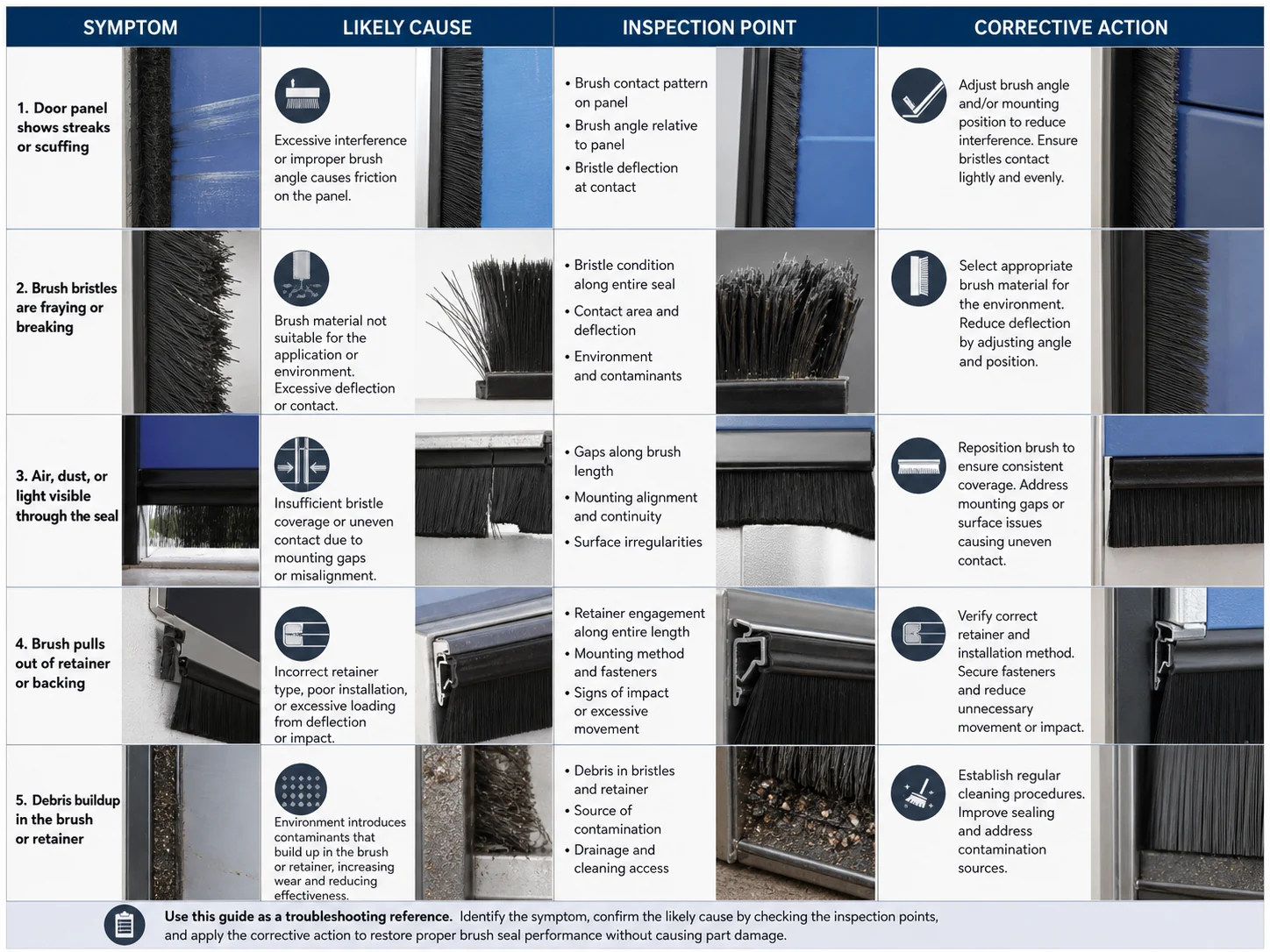
- Ignoring the door panel surface condition. Chipped paint, weld spatter, or sealant beads act like sandpaper, drastically shortening brush life.
- Replacing only part of a worn brush strip. Uneven brush height across the door width leads to variable sealing force and accelerated wear on the new section.
- Using the same brush material in wet and dry zones. Nylon absorbs moisture, swells, and stiffens; polypropylene is hydrophobic and better suited for cold, wet environments.
- Forgetting to clean brush strips regularly. Embedded dust, metal chips, or frost turns a flexible seal into a rigid scraper that can gouge door skins.
When a High Speed Door Brush Seal Is Not Enough
Brush seals work well for light to moderate pressure differences, high-cycle dry-running doors, and applications where low friction matters most. However, they reach practical limits when:
- High static pressure or strong wind loads push bristles aside. In this case, consider a combination of brush and flexible rubber blade or an air curtain supplement.
- Extreme temperatures (sustained above 80°C or below -40°C) degrade standard filament materials. Specialized high-temperature aramid or PTFE brushes may be required, but they are more expensive and usually less flexible.
- Food-contact or washdown requirements demand frequent chemical cleaning. Bristle filaments may retain bacteria; a fully flush-mounted seal stripped design with supported by food-contact documentation elastomer lips might be needed.
- suitable for the site safety requirements or spark-free environments rule out certain synthetic filaments that can generate static or friction sparks. Conductive brush materials or alternative non-contact labyrinth seals should be evaluated.
- Door panels with large cutouts or irregular shapes that a linear brush cannot follow. A conforming inflatable seal or multiple short segmented brushes with independent suspension may be necessary.
In these cases, treat the brush seal as one component of a multi-stage sealing system rather than a standalone solution. A process engineer should review the total system requirements before writing a specification.
Final Takeaway
Optimizing a high speed door brush seal without damaging the door or the seal comes down to controlling interference, choosing the right filament and angle, and testing systematically instead of by feel. Start with a documented baseline drag force, change one variable at a time, and verify both the seal’s airtightness and the door’s surface condition after an extended cycle run. The result is a seal that performs its job for years while protecting the more expensive moving door components.
Frequently Asked Questions
What is a safe starting point for brush seal interference?
Most standard synthetic brush seals for high-speed doors work well with an initial interference of 3–5 mm on flat door panels. If the door surface has ribs or seams, you may need slightly more to fill the valleys, but always check for increased drag.
How do I know if the bristle material is too stiff for my door surface?
Inspect the door after a few hundred cycles. If you see faint scratches or burnishing of the paint or coating, the bristles are too aggressive. Switch to a finer filament diameter or a softer material like polypropylene instead of nylon.
Can I adjust the brush seal to work with both a cold side and a warm side of the same door?
Yes, but different sides may need different brush materials. On the cold side, a moisture-resistant filament prevents frost buildup. On the warm side, a denser, softer seal may be better for thermal performance. Test each side independently.
Should I lubricate a brush seal to reduce friction?
No. Lubricants attract dust and dirt, clog the bristles, and can degrade some filament materials. The bristles are designed to operate dry. If friction is too high, reduce interference or change the contact angle instead.
How often should I replace the brush seal in a high-cycle door?
There is no fixed number. Monitor bristle length and density. When the bristles wear down to less than 50% of their original length or gaps start appearing at the same interference setting, it’s time to replace the strip. Keep a spare brush holder pre-loaded for quick changeouts.
Does a brush seal work on a curved or tracked door panel?
Yes, but it requires a flexible brush holder that can follow the curve. You may need shorter brush segments mounted on adjustable clips rather than one continuous rigid strip. Check that the brush does not bind or leave gaps at the transition points.
What is the difference between a bottom door brush seal and a perimeter brush seal?
A bottom door brush seal sits under the door and often has to cope with floor debris and moisture, so it typically uses stiffer, shorter bristles and may have a waterproof backing. A perimeter seal on the sides and top handles dust and air leakage with longer, more flexible bristles for continuous light contact.