
What Are Wet and Dry Brushing?
Wet brushing introduces a fluid—typically a water-based coolant, synthetic fluid, or cleaning solution—at the brush–workpiece interface. The fluid cools, lubricates, and flushes away debris, reducing thermal stress on both the brush and the part. Dry brushing relies solely on the mechanical action of the brush filaments against the surface, with no liquid present. Heat generation is higher, and debris must be managed through extraction or shielding.
Both methods use similar brush media (abrasive filaments, wire, or fiber) and can be applied with rotary, belt, or cup brush machines. The presence or absence of fluid changes nearly every process parameter.
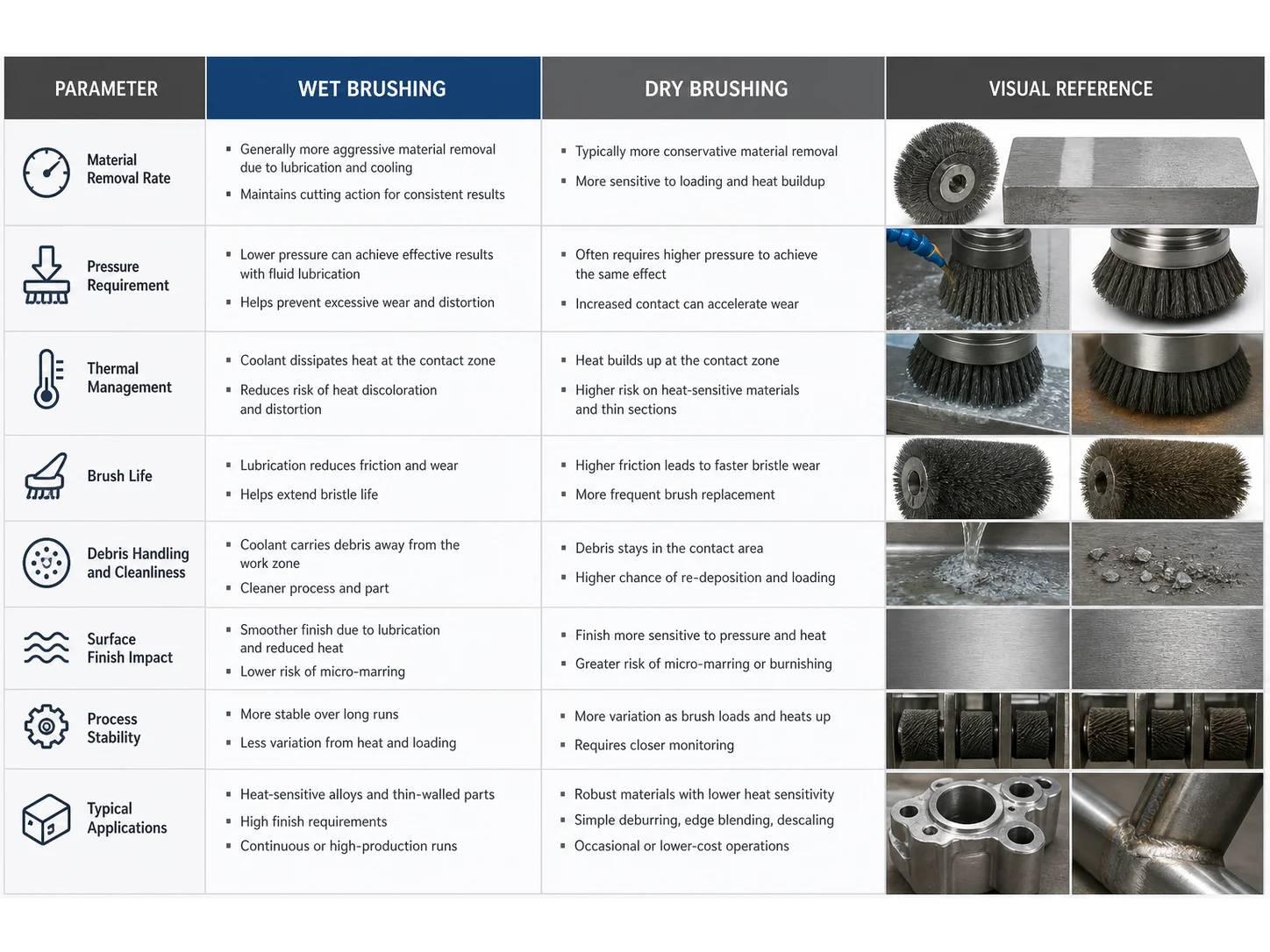
Wet vs Dry Brushing: Key Parameter Comparison
The table below summarizes how core process parameters differ between wet and dry brushing. These are general trends observed across common industrial applications.
| Parameter | Wet Brushing | Dry Brushing |
|---|---|---|
| Typical Speed Range | Often lower to avoid fluid misting and allow effective heat removal; 200–500 SFM is common. | Can run higher without fluid drag limitations; 400–800 SFM often achievable. |
| Applied Pressure | Higher pressure possible because coolant prevents burn; limited by brush distortion and machine rigidity. | Pressure limited by workpiece temperature rise and filament heat tolerance. |
| Brush Life | Longer due to cooling, lubrication, and debris flushing; abrasive filaments break down more slowly. | Shorter; heat and embedded debris accelerate filament wear and fatigue. |
| Material Removal Rate | Lower instantaneous removal, but more consistent and controllable. | Potentially higher removal per pass, but risk of subsurface damage. |
| Surface Finish | Typically finer and more uniform; coolant minimizes scratches and smearing. | Can be rougher; may cause smearing on softer metals without lubrication. |
| Debris Management | Slurry requires filtration, settling, and fluid recycling. | Dust, swarf, and broken filaments need powerful extraction. |
| Typical Applications | Stainless steel finishing, aluminum edge radiusing, medical device cleaning, aerospace part deburring. | Carbon steel scale removal, heavy weld blending, cast iron flash removal, high-volume deburring where coolant is impractical. |
How to Choose Between Wet and Dry Brushing
Select the brushing method based on these practical decision factors, not just machine availability.
- Workpiece Material: Aluminum and other non-ferrous metals load brushes quickly when dry; wet brushing prevents loading and improves finish. Stainless steel generates intense heat—wet cooling avoids blue discoloration and micro-cracking. Plastics require cooling to prevent melting. Cast iron and mild steel often tolerate dry brushing well.
- Surface Finish Requirements: If Ra < 0.8 µm or strict cosmetic standards apply, wet brushing is usually the safer choice. Dry brushing can meet coarser finishes (Ra > 1.2 µm) economically.
- Production Speed: High-throughput lines that can manage fluid may still benefit from wet brushing for consistency. When cycle times are short and in-line fluid delivery is difficult, dry brushing may be preferred.
- Part Geometry: Complex shapes with deep cavities may trap coolant and require thorough drying after wet processing. Dry brushing avoids fluid entrapment but may leave debris in recesses.
- Cleanliness Requirements: Applications sensitive to residue (electronics, medical) need careful fluid selection or post-cleaning. Dry processes eliminate fluid residue but may leave fine dust.
- Cost and Infrastructure: Wet systems require fluid management, filtration, and mist collectors. Dry systems need dust extraction and appropriate combustible-dust hazard controls when handling fine or reactive dusts. Compare total cost of ownership over the expected brush life and production volume.
Process Setup and Operational Factors
Implementing either method requires attention beyond the brush itself.
Wet brushing setup: Nozzle placement, fluid pressure, and flow rate directly influence performance. The fluid must reach the contact zone effectively. Filtration is critical—contaminated coolant recirculates abrasive particles that damage the workpiece. Drying stations may be needed downstream to prevent staining or corrosion. Operator safety involves protection from mist and handling of used fluids per environmental regulations.
Dry brushing setup: High-efficiency dust extraction must be positioned close to the brushing head. Enclosures or shrouds reduce airborne particles. Brush speed and pressure are the primary levers; incremental adjustments are necessary to avoid overheating. In some cases, a periodic “air puff” can clear debris from the brush face. Operators require respiratory protection and must be trained on explosion risks if fine metal dust is present.
Common Mistakes When Selecting a Brushing Method
- Choosing dry brushing for heat-sensitive materials: This leads to thermal cracking, discoloration, or warping, especially on thin-walled parts.
- Ignoring fluid maintenance costs: Wet brushing can become expensive if tramp oil, bacteria, and filter media are not managed properly.
- Not testing brush compatibility with coolant: Some coolants degrade certain synthetic filaments, leading to premature breakdown.
- Assuming wet always gives a better finish: On some cast irons, wet brushing can form a smeared surface if the fluid chemistry isn’t optimized. Dry may be better for breaking off brittle edges.
- Overlooking drying time: Wet parts often need additional drying or corrosion prevention steps, which can bottleneck the line.
- Running dry at speeds meant for wet: Without coolant, the same speed will quickly burn the brush and part. Parameters must be revalidated when switching methods.
When Wet Brushing Is Necessary: Thermal Management Limits
Wet brushing becomes non-negotiable when the process cannot dissipate heat fast enough through air or natural cooling alone. Typical thermal warning signs include:
- Material discoloration: Blue or straw hues on stainless steel indicate oxidation from excessive heat.
- Surface micro-cracking: Sensitive to heat-affected zones (HAZ), especially in aerospace alloys like Ti‑6Al‑4V or hardened tool steels.
- Burnishing or smearing: On aluminum, dry heat causes the metal to transfer onto the brush, leading to surface contamination.
- Part distortion: Thin-wall tubing or delicate components can warp under localized dry heat input.
If any of these occur, switching to a wet process with properly directed coolant is the first corrective step. Conversely, dry brushing remains effective for robust materials, low‑speed operations, or where part geometry prevents fluid containment. In those cases, adjusting speed, feed rate, or adding intermittent cooling pauses may suffice.
Final Takeaway
The wet vs dry brushing decision hinges on thermal management, surface finish requirements, and operational practicalities, not on a universal “better” method. Start by mapping your material’s heat tolerance and desired finish, then evaluate the cost of fluid or extraction infrastructure. Run short trials with the same brush type in both modes if possible, and measure cycle time, finish quality, and brush wear directly. This data‑driven approach reduces rework and helps standardize the best-fit process for your production environment.
Frequently Asked Questions
Can I convert an existing dry brushing machine to wet?
Yes, many machines can be retrofitted with a coolant nozzle and fluid handling system, but the conversion requires careful integration of filtration, mist control, and corrosion‑resistant components. Confirm with your machine builder that seals, bearings, and motors are rated for wet environments.
What coolants are commonly used in wet brushing?
Water‑soluble synthetic or semi‑synthetic coolants are typical because they offer good cooling, rust protection, and low residue. In some cases, alkaline cleaning solutions are used when simultaneous degreasing is needed. Always verify compatibility with your brush filament material.
Does wet brushing always produce a better surface finish?
Not always. Wet brushing generally yields a finer, more uniform finish, but on brittle materials like some cast grades or powder metals, dry brushing can produce a sharper edge break without smearing. The final finish depends heavily on media selection and parameter tuning.
How do I know if my brushing process needs coolant?
Monitor for heat tint, work‑hardening on stainless surfaces, reduced brush life, or inconsistent finishes. If any of these appear, test with minimal coolant flow. If the problem resolves or improves, wet brushing is likely necessary.
What maintenance is required for a wet brushing system that doesn’t apply to dry?
Fluid management tasks include checking concentration, topping up coolant, cleaning filters, removing sludge, and controlling bacteria levels. Mist collectors also need filter changes. These tasks add ongoing labor but extend brush life and process stability.
Is dry brushing ever preferred for aluminum?
It is generally avoided because aluminum galls easily without lubrication, loading the brush and smearing the surface. However, very light passes with fresh abrasive brushes can work for cosmetic edge breaking if followed by a cleaning step. For consistent results, wet brushing is the strong default.
What safety concerns differ between wet and dry brushing?
Dry brushing produces fine dust, which may be combustible if metal particles are sufficiently small; proper dust extraction and site-approved combustible-dust controls may be required. Wet brushing reduces airborne dust but introduces slip hazards from spills, mist inhalation risks, and chemical handling requirements for the coolant.
How does brush material (wire vs abrasive filament) change the wet/dry decision?
Wire brushes tolerate dry operation better because of higher heat resistance, but they can still embed fragments in softer alloys. Abrasive filaments, especially ceramic or SiC, perform far better with coolant to prevent binder thermal breakdown and maintain consistent stock removal. For both, fluid compatibility must be verified to avoid chemical attack on the filament bonding.
Which bristle material fits this job — AISI 304 Stainless Steel Wire, Carbon Steel Wire or Silicon Carbide Abrasive Nylon?
| Material | Continuous temperature (°C) | Peak temperature (°C) | Water absorption | Hardness |
|---|---|---|---|---|
| AISI 304 Stainless Steel Wire | 400 | 500 | 0% | Rockwell B 70–95 depending on temper and cold work |
| Carbon Steel Wire | 200–300 | 350–450 | 0% | Rockwell C 40–60 |
| Silicon Carbide Abrasive Nylon | 80–120 | 140–170 | 0.3–2.0% | Carrier Shore D 70–85; SiC Mohs Hardness Approximately 9.2 |
Figures as published by Alleima; Perlon. Confirm the exact grade against the supplier datasheet before ordering.
When are Cup Brushes the wrong choice?
- Cup Brushes — Use a wheel brush for a narrow edge or profile, an end brush for a confined recess, or a non-brush method when the surface cannot tolerate rotating filament contact.
- AISI 304 Stainless Steel Wire — Avoid using AISI 304 as the default in marine, brine, hypochlorite, and persistent chloride environments; use AISI 316 when higher pitting and crevice-corrosion resistance is required.
- Carbon Steel Wire — Not for soft plastic, glass, PCB, coated solar glass or polished paint.
- Silicon Carbide Abrasive Nylon — Silicon carbide cuts quickly and can over-radius edges or mark coatings when grit, filament size, trim or motion is too aggressive.
What should replace Cup Brushes when they stop working?
- Cup Brushes — Cup brushes cover a broader face than wheel brushes; end brushes are better for small recesses or pockets where the cup body blocks access.
- AISI 304 Stainless Steel Wire — Use AISI 316 stainless steel wire for chloride, marine, dairy, beverage, chemical washdown, or higher pitting-resistance requirements. Use carbon steel for dry aggressive cutting and brass or abrasive nylon for lower marking risk.
- Carbon Steel Wire — Compare Carbon Steel Wire with Carbon steel wire, brass wire, abrasive nylon. Change material when wet stiffness, temperature, chemical resistance, conductivity, particle shedding, or surface marking becomes the limiting factor.
- Silicon Carbide Abrasive Nylon — Compare Silicon Carbide Abrasive Nylon with PP, PBT, PET. Change material when wet stiffness, temperature, chemical resistance, conductivity, particle shedding, or surface marking becomes the limiting factor.