
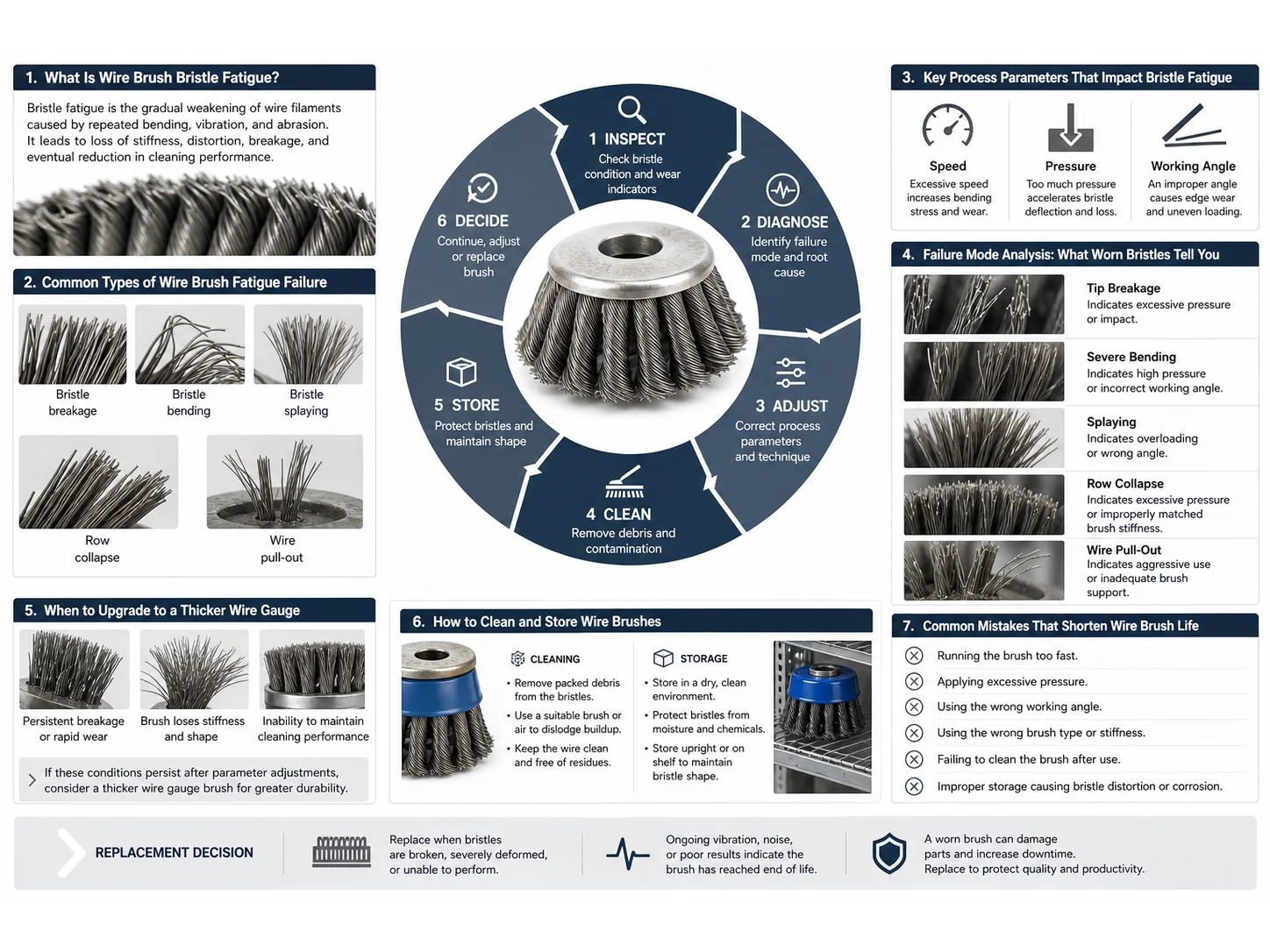
What Is Wire Brush Bristle Fatigue?
Wire brush bristle fatigue is the progressive damage and eventual failure of individual wire bristles under repeated mechanical stress. During brushing, each bristle flexes thousands of times per minute, experiencing bending, tension, and impact. Over time, micro-cracks initiate at surface defects or stress risers, grow, and lead to sudden breakage or permanent deformation. This fatigue process reduces the brush’s cutting action, increases the risk of flung wires, and shortens the usable life of the tool.
Common Types of Wire Brush Fatigue Failure
Not all wire brush failures look the same. Identifying the failure mode helps pinpoint which process parameter needs adjustment.
| Failure Mode | Appearance | Primary Cause | Process Parameter Fix |
|---|---|---|---|
| Brittle Fracture | Clean break near the hub or midpoint | Excessive speed, over-hardened wire | Reduce RPM, check MSFS rating |
| Ductile Bending | Permanently bent or curled bristles | High contact pressure, wrong angle | Lighten pressure, adjust angle to 15–30° |
| Tip Wear/Erosion | Shortened, rounded tips without breakage | Normal use, abrasive media | Accept gradual wear; monitor for thinning |
| Fatigue Cracking | Multiple small cracks along the wire, eventual flaking | Cyclic bending at high frequency | Reduce speed, increase wire diameter if persistent |
Key Process Parameters That Impact Bristle Fatigue
Three adjustable process parameters have the greatest influence on wire brush fatigue: rotational speed, contact pressure, and working angle. The table below summarizes their effects and optimal ranges.
| Parameter | Excessive Setting | Deficient Setting | Optimal Range Guidance |
|---|---|---|---|
| Rotational Speed | Heat buildup, rapid fatigue, bristle breakage | Poor cutting action, smearing instead of cleaning | Operate at 80–100% of brush’s maximum safe free speed (MSFS) |
| Contact Pressure | Bending stress, ductile deformation, motor stall | Insufficient material removal, glazing | Apply moderate pressure so bristles flex slightly without bottoming out |
| Working Angle | Edge loading, uneven bristle wear, snapping | Face contact reduces chip clearance, overheating | Hold brush at 15–30° to the workpiece surface |
Optimal Process Parameter Ranges to Maximize Brush Life
Fine-tuning these parameters can significantly extend wire brush life without sacrificing performance.
- Speed: Always stay within the maximum safe free speed (MSFS) marked on the brush. For most power brushes, operating at 80–100% of MSFS balances cutting efficiency and fatigue life. Lower speeds reduce heat and stress but may not achieve the desired surface finish.
- Pressure: Use just enough pressure to let the bristle tips do the work. Avoid pushing so hard that the bristles are forced to bend beyond their elastic range. A good rule is to allow the brush to “clean itself” through centrifugal force; excessive pressure traps debris and accelerates wear.
- Angle: A 15–30° angle between the brush face and the workpiece distributes load evenly across many bristles and prevents single-edge loading. Cup brushes often perform best at the higher end of this range, while wheel brushes may tolerate slightly flatter angles.
- Feed Rate: If using automated systems, match the traverse speed to the brush’s ability to remove material without dwelling. Dwell marks or burns indicate a feed rate that is too slow.
Failure Mode Analysis: What Worn Bristles Tell You
Examining a used brush before discarding it reveals valuable information for process tuning.
- Even, short tip wear with no breakage: Normal fatigue; the parameter set is well balanced.
- Bristles broken near the middle, few bent ends: Speed likely too high, or the brush is hitting a sharp edge repeatedly.
- Many bent or curled bristles: Pressure is excessive; the bristles are being permanently deformed.
- One side of the brush heavily worn while the other is fresh: Working angle is incorrect, causing uneven loading.
- Discolored or blued bristles: Overheating from excessive speed, pressure, or poor chip clearance.
When to Upgrade to a Thicker Wire Gauge
Optimizing process parameters should always be the first step. However, if you have verified that speed, pressure, and angle are within recommended ranges but still experience unacceptably short brush life, the wire gauge may be undersized for the application. Indicators include:
- Frequent brittle fracture even at MSFS.
- Excessive bending or rapid fatigue when working hard materials like hardened steel or thick mill scale.
- Requirements for heavy stock removal that exceed the brush’s design intent.
Upgrading from a fine wire (0.014 in) to a medium (0.020 in) or coarse (0.024 in) diameter increases bending strength and fatigue resistance. Also consider switching from crimped to knotted wire configurations when abrasive aggression is the limiting factor.
Common Mistakes That Shorten Wire Brush Life
- Exceeding rated RPM: The single fastest way to destroy a wire brush; centrifugal force and impact stress skyrocket.
- Using excessive pressure: Treating the brush like a grinding wheel causes permanent deformation and heat buildup.
- Running at 90° to the workpiece: This concentrates wear on a narrow edge and prevents bristles from flexing correctly.
- Mixing brush types: Using a carbon steel brush on stainless steel then on mild steel can embed carbon particles, leading to corrosion and premature failure.
- Ignoring safety guards: A brush operated outside its safety guard can contact surfaces unpredictably, causing uneven loads.
- Using a damaged or out-of-balance brush: Vibration accelerates fatigue and can be hazardous.
Final Takeaway
Wire brush bristle fatigue is not inevitable; it is a manageable process outcome. By controlling rotational speed, maintaining moderate contact pressure, and holding the correct working angle, operators can double or triple brush life. When fatigue persists despite proper parameter settings, a thicker wire gauge or a knot‑style brush often provides the necessary robustness. Regular inspection of spent brushes closes the feedback loop, turning each replacement into a diagnostic event that improves future process efficiency.
When a Wire Brush Bristle Fatigue Is the Wrong Choice
This brush is not enough when the main problem is blocked access, unsafe working conditions, damaged equipment, incompatible chemicals, or a process setting that keeps recreating the residue. In those cases, review access, residue type, surface sensitivity, brush stiffness, operating environment, and replacement routine and confirm the surrounding cleaning method before increasing brush stiffness or contact pressure.
Frequently Asked Questions
How do I know if wire brush fatigue is caused by speed or pressure?
Examine the broken bristles. If they are snapped cleanly with little bending, speed is the likely culprit. If they are permanently bent or curled, pressure is too high. A mix of both often indicates an incorrect working angle causing edge loading.
Can I change the wire gauge of my existing brush to prevent fatigue?
No, wire gauge is fixed during manufacturing. You must purchase a brush with a thicker wire diameter. Match the brush style (crimped or knotted) and trim length to your tool’s power and the workpiece geometry.
What is the best working angle for a cup brush vs. a wheel brush?
For cup brushes, a 20–30° angle typically yields the best blend of action and life. For wheel brushes, a 15–25° angle allows the bristles to strike the workpiece at their tips rather than on their sides. Always consult the brush manufacturer’s specific recommendations.
Does wire brush fatigue happen faster with stainless steel brushes?
Stainless steel wire is generally more ductile than carbon steel, so it may bend rather than break under the same conditions. However, it work-hardens quickly; repeated flexing can lead to sudden failure. Keep speeds moderate and inspect for surface cracks.
How often should I inspect brushes for fatigue cracks?
For continuous production, a visual inspection at each shift change is recommended. Look for broken or bent wires, uneven wear, and signs of overheating. Any brush showing cracks should be replaced immediately to prevent wire fly-off.
Is there a way to recondition fatigued wire brushes?
No. Once fatigue cracks have initiated, the bristle’s structural integrity is compromised. Trimming or reshaping does not restore fatigue resistance. The brush should be replaced.
What are the signs that I need a heavier wire gauge instead of just adjusting parameters?
If you have already dialed in speed, pressure, and angle to the recommended ranges and still see frequent bristle breakage or rapid bending, the wire gauge is likely too fine for the workpiece material. Upgrading to a 0.020 in or 0.024 in wire is a common first step, especially for ferrous metals and heavy scale removal.
Does cooling or lubrication reduce wire brush fatigue?
In some applications, a light mist or cutting fluid can reduce heat buildup and extend brush life, especially when working stainless steel or aluminum. However, many wire brushing operations are performed dry because lubricant can trap abrasive particles and cause accelerated wear. Test first, and ensure the lubricant is compatible with the workpiece material and any subsequent coatings.
Which steel wire grade fits this job — AISI 304 Stainless Steel Wire, AISI 316 Stainless Steel Wire or Carbon Steel Wire?
| Wire grade | Continuous temperature (°C) | Peak temperature (°C) | Water absorption | Hardness |
|---|---|---|---|---|
| AISI 304 Stainless Steel Wire | 400 | 500 | 0% | Rockwell B 70–95 depending on temper and cold work |
| AISI 316 Stainless Steel Wire | 400 | 500 | 0% | Rockwell B 70–95 depending on temper and cold work |
| Carbon Steel Wire | 200–300 | 350–450 | 0% | Rockwell C 40–60 |
| Galvanized Steel Wire | 150–200 | 250–300 | 0% | Rockwell B 70–100 |
Figures as published by Alleima; Material manufacturer TDS / ISO / ASTM / industry reference. Confirm the exact grade against the supplier datasheet before ordering.
What should replace Wheel Brushes when they stop working?
- Wheel Brushes — Wheel brushes give narrow edge contact; cup brushes cover a broader open face, while end brushes concentrate contact at the end of a small stem for recesses.
- Cup Brushes — Cup brushes cover a broader face than wheel brushes; end brushes are better for small recesses or pockets where the cup body blocks access.
- AISI 304 Stainless Steel Wire — Use AISI 316 stainless steel wire for chloride, marine, dairy, beverage, chemical washdown, or higher pitting-resistance requirements. Use carbon steel for dry aggressive cutting and brass or abrasive nylon for lower marking risk.
- Carbon Steel Wire — Compare Carbon Steel Wire with Carbon steel wire, brass wire, abrasive nylon. Change material when wet stiffness, temperature, chemical resistance, conductivity, particle shedding, or surface marking becomes the limiting factor.