
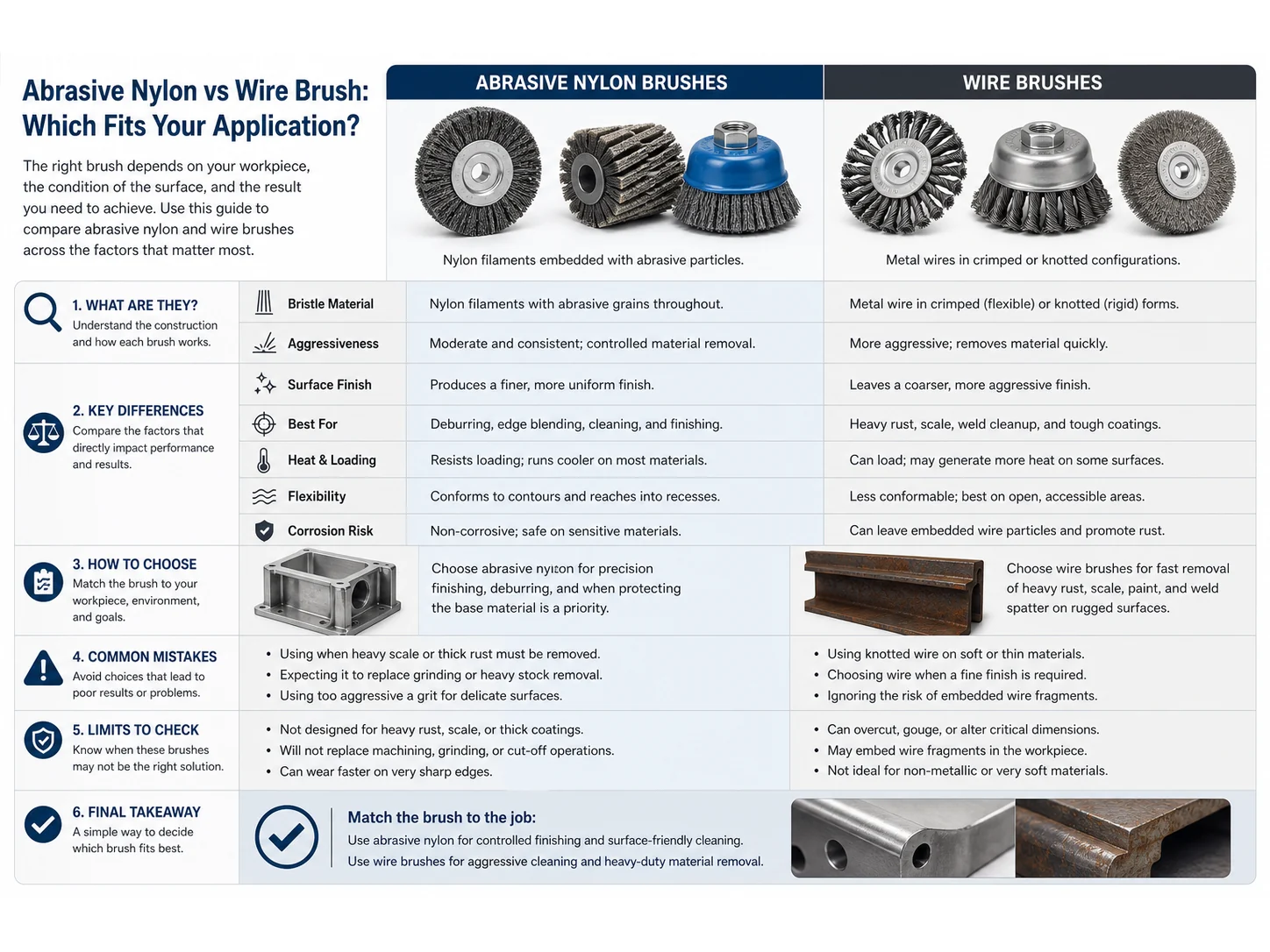
What Are Abrasive Nylon and Wire Brushes?
An abrasive nylon brush uses filaments made of nylon that are impregnated with abrasive grit—typically silicon carbide, aluminum oxide, or ceramic. The nylon acts as a resilient carrier, and the grit does the cutting. These brushes are designed for controlled material removal, blending, deburring, and finishing while preserving part geometry.
A wire brush uses metal wire bristles—often carbon steel, stainless steel, or brass—that rely on the stiffness and sharp tips of the wires to scrape, scratch, or impact the surface. They are highly aggressive and work well for heavy rust, scale, weld spatter, and thick coatings on hard metals.
Key Differences Between Abrasive Nylon and Wire Brush
| Feature | Abrasive Nylon Brush | Wire Brush |
|---|---|---|
| Bristle Material | Nylon filaments loaded with abrasive grit (SiC, Al₂O₃, ceramic) | Metal wires (steel, stainless steel, brass, bronze) |
| Abrasiveness / Aggressiveness | Controlled, consistent grit cutting action; less aggressive but predictable finish | High aggressiveness; can gouge or scratch if misused |
| Surface Safety | Won’t remove base material easily; preserves part tolerances | Can remove base metal, alter dimensions, or embed steel particles (ferrous contamination) |
| Typical Lifespan & Wear Pattern | Filaments wear gradually; grit dulls over time; brush “self-sharpens” slightly as nylon wears | Wires break, bend, or fatigue; loss of aggression after significant wire loss |
| Mounting Options | Wheel, cup, end brush, disc, tube brush | Wheel, cup, end brush, scratch brush, tube brush, knotted wheel |
| Best for Residue Type | Light to medium residue: paint, coatings, burrs, oxidation, light rust, edge blending | Heavy residue: thick rust, scale, weld slag, heavy epoxy, mill scale |
| Dry or Wet Use | Works dry or wet; many grits are water-tolerant without rust risk (nylon doesn’t rust) | Dry typically; some stainless or brass can be used wet, but steel wires rust quickly |
| Typical Workpiece Materials | Aluminum, brass, copper, soft steel, composites, plastics (with care), wood | Hard metals: carbon steel, cast iron, stainless steel; avoid on soft metals unless using softer wire like brass |
How to Choose the Right Brush for Your Workpiece
Use these factors to decide between abrasive nylon vs wire brush:
- Workpiece material hardness: For soft metals (aluminum, copper) or composites, abrasive nylon prevents gouging and dimensional change. Wire brushes, especially steel, can quickly damage such surfaces.
- Residue type and thickness: Heavy rust, thick scale, or weld spatter usually demands a wire brush. Light paint, oxidation, or fine burrs favor abrasive nylon.
- Desired surface finish: Abrasive nylon leaves a smoother, more uniform finish; wire brushes often leave scratches and may require additional steps to blend.
- Dry vs. wet environment: Abrasive nylon brushes can run wet without corroding, making them suitable for wet grinding or use with coolants. Steel wire brushes will rust if not dried promptly.
- Production speed: Wire brushes can remove material faster but may need more frequent changeovers and can cause rework if they dig in. Nylon brushes offer predictable, repeatable results with less risk.
- Cost per part: Consider both initial brush cost and replacement frequency. Abrasive nylon brushes often have a higher upfront cost but can last longer in consistent applications, while wire brushes are cheaper but wear more aggressively.
Common Mistakes When Selecting a Brush
- Using a steel wire brush on stainless steel or aluminum: Carbon steel wire can embed in stainless steel and cause after-rust (crevice corrosion). On aluminum, it gouges and contaminates.
- Choosing only by diameter: Filament length, grit size, wire gauge, and trim length drastically affect performance—not just OD.
- Ignoring brush speed rating: Running a brush above its maximum safe speed can cause filament or wire breakage, posing a safety hazard.
- Assuming all nylon brushes are abrasive: Non-abrasive nylon brushes exist for wiping or light cleaning and won’t cut or deburr. Confirm the grit loading.
- Overlooking wet/dry compatibility: A wire brush used with water or coolant may rust quickly unless a stainless or brass option is selected.
- Not checking mounting style: Arbor hole size, stem diameter, and attachment type must match your grinder, drill, or machine tool.
When Neither Abrasive Nylon Nor Wire Brush Is Enough
For extremely heavy, bonded deposits like concrete spatter or thick epoxy that have cured for years, neither brush type may be efficient. In such cases, mechanical impact methods (needle scaler, chipping hammer) or chemical strippers might be required. When part geometries are highly complex with deep recesses, a standard brush may not reach all areas; a custom filament pattern or encapsulated brush design may be necessary. If contamination control is critical (e.g., food-grade or medical devices), verify that brushes do not leave any filament or wire fragments. Sometimes a non‑brush method such as ultrasonic cleaning or dry‑ice blasting is more appropriate.
Final Takeaway
Abrasive nylon brushes are the right starting point when you need controlled, consistent material removal without altering part dimensions, especially on softer alloys or when a fine finish is required. Wire brushes excel at heavy‑duty stripping and scale removal on hard ferrous metals. Evaluate your predominant workpiece material, residue challenge, and throughput needs—then test both brush types if possible—to find the lowest total cost per part, not just the lowest-cost brush.
When an Abrasive Nylon vs Wire Brush Is the Wrong Choice
This brush is not enough when the main problem is blocked access, unsafe working conditions, damaged equipment, incompatible chemicals, or a process setting that keeps recreating the residue. In those cases, review base material, burr or oxide level, target finish, brush speed, pressure, and acceptable surface change and confirm the surrounding cleaning method before increasing brush stiffness or contact pressure.
Frequently Asked Questions
Can I use a wire brush on aluminum?
Carbon steel wire brushes will quickly gouge aluminum and can leave embedded steel particles that cause galvanic corrosion. Use a brass wire brush for general aluminum cleaning or an abrasive nylon brush for deburring and finishing without damage.
Are abrasive nylon brushes safe for food contact surfaces?
Some abrasive nylon brushes are made with FDA‑compliant materials and can be used for cleaning food equipment, but you must verify the specific grade and ensure no grit or filament shedding contaminates the product. For final cleaning on direct food contact, often non‑abrasive nylon is preferred.
Do abrasive nylon brushes work when wet?
Yes. The nylon base does not absorb water or rust, making these brushes suitable for wet operations with coolants or in wash‑down environments. Ensure the hub and hardware are also corrosion‑resistant if used continuously wet.
How do I know when to replace a wire brush?
Replace a wire brush when bristles become significantly shortened, bent, or uneven, when the brush no longer cuts efficiently, or when you notice excessive vibration. Inspect for broken wires that could fly off at high speed.
What’s the difference between crimped and knotted wire brushes?
Crimped wire brushes have more individual wire filaments and provide a softer, more flexible action for light cleaning and paint removal. Knotted (twisted knot) wire brushes are more aggressive and durable for heavy‑duty applications like weld slag removal. Both belong to the wire brush category but differ in aggressiveness and debris removal pattern.
Can I use an abrasive nylon brush to remove heavy rust?
For thick, scaly rust on steel, an abrasive nylon brush will be very slow and wear out quickly. A crimped or knotted wire brush is more appropriate. If the rust is light surface oxidation, an abrasive nylon brush can work, especially when a finer finish is needed afterward.
Which brush type creates less dust?
Both create dust, but abrasive nylon filaments wear more slowly and tend to produce finer, less visible debris. Wire brushes can generate larger metallic particles and broken wire fragments. Always use proper extraction and PPE regardless of brush type.
Technical References
- World Stainless — Corrosion Resistance of Stainless Steels
- British Plastics Federation — Thermoplastics
Which abrasive filament fits this job — Abrasive Nylon, Silicon Carbide Abrasive Nylon or Aluminum Oxide Abrasive Nylon?
| Filament | Continuous temperature (°C) | Peak temperature (°C) | Water absorption | Hardness |
|---|---|---|---|---|
| Abrasive Nylon | 120 | 150 | 0.1–1.0% | Abrasive filament; stiffness and cutting level is controlled by PA base, grit type, grit size, filament diameter and trim height. |
| Silicon Carbide Abrasive Nylon | 80–120 | 140–170 | 0.3–2.0% | Carrier Shore D 70–85; SiC Mohs Hardness Approximately 9.2 |
| Aluminum Oxide Abrasive Nylon | 80–120 | 140–170 | 0.3–2.0% | Carrier Shore D 70–85; Al2O3 Mohs Hardness Approximately 9 |
| Ceramic Abrasive Fiber | 80–120 | 140–170 | 0.3–2.0% | Carrier Shore D 72–86; Ceramic Grain Mohs Hardness Approximately 9 |
| Diamond Abrasive Filament | 80–120 | 140–170 | 0.3–2.0% | Carrier Shore D 72–86; Diamond Mohs Hardness 10 |
Figures as published by Perlon. Confirm the exact grade against the supplier datasheet before ordering.
What should replace Abrasive Nylon when it stops working?
- Abrasive Nylon — Compare Abrasive Nylon with PP, PBT, PET. Change material when wet stiffness, temperature, chemical resistance, conductivity, particle shedding, or surface marking becomes the limiting factor.
- Nylon PA — Compare Nylon PA with PP, PBT, PET. Change material when wet stiffness, temperature, chemical resistance, conductivity, particle shedding, or surface marking becomes the limiting factor.