
Custom Cleaning Brush
Machine Tool Brush
Configure a machine tool brush to clear chips, coolant, scale, and weld spatter from machine ways, T-slots, dies, and fixtures.
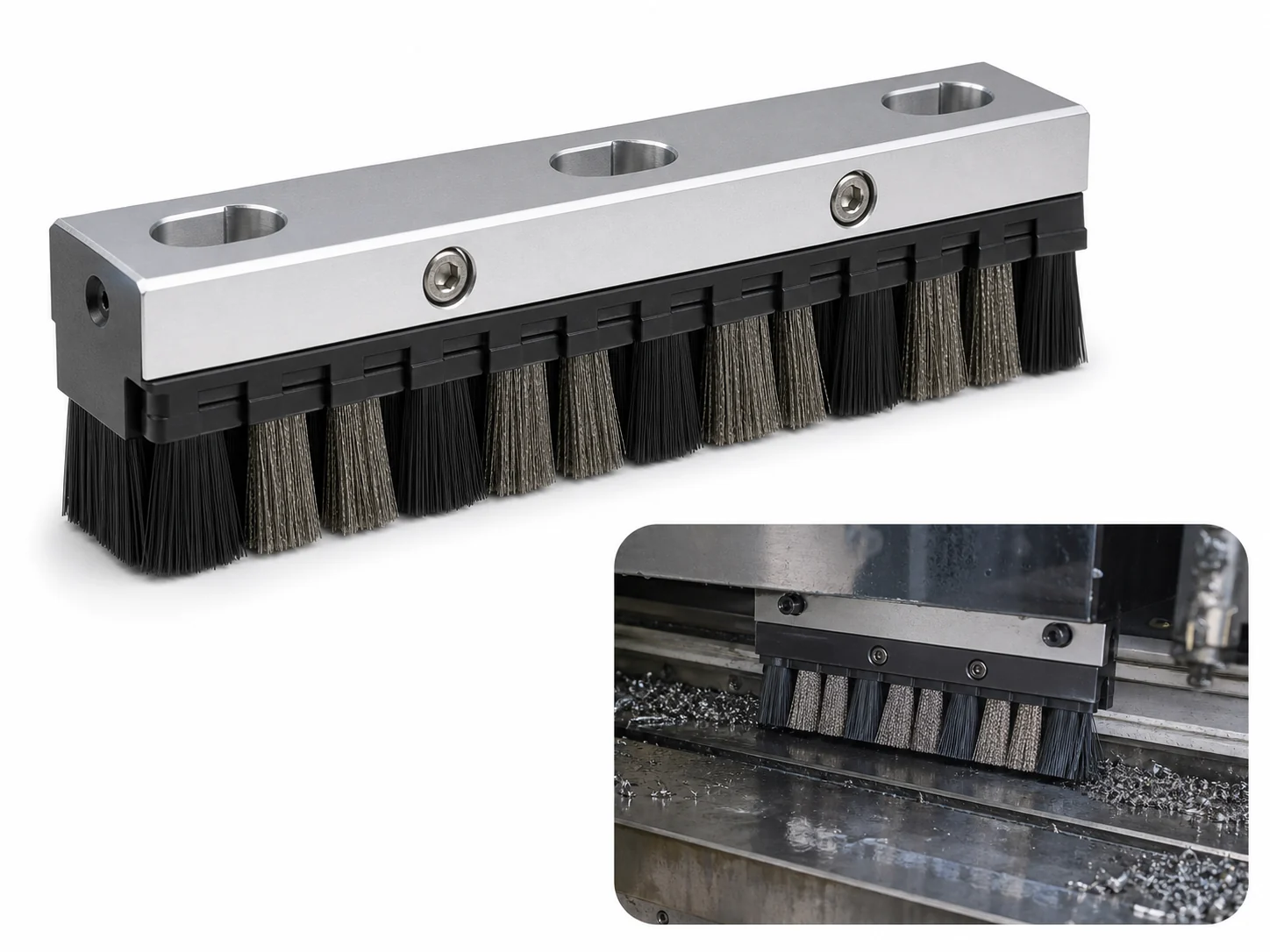
Medium brush
100 pcs
Minimum order
Worked with two hands or on a pole: chimney, gutter and pond-filter brushes, discs, cups and tank brushes.
Production lead time, once the specification is confirmed
- Up to 100 pcsWithin 7 days
- 101–5,000 pcsWithin 14 days
- 5,001–50,000 pcsWithin 21 days
- Over 50,000 pcsConfirmed with your quotation
Peak season can extend these times; the shipping date is confirmed in writing with your quotation. Sampling and shipping are quoted separately.
A machine tool brush configured to clear chips, coolant, oil, scale, and weld spatter from machine tables, ways, T-slots, dies, punches, and weld fixtures. Available as hand/detail, strip, or machine-mounted brush with nylon, PP, or 316 stainless steel wire fill matched to the surface and residue.
What can this brush do for you?
Clears Chips and Coolant from Ways, T-Slots, and Tables
Nylon or PP fill sweeps turning chips, fines, and coolant residue out of machine ways, T-slots, and table edges where they otherwise pack in and cause axis-binding or table scoring. Wavy or crimped filament keeps the tips open and releases chips as the brush moves, instead of loading up into a solid mat.
Removes Scale, Rust, and Spatter on Compatible Metal
When the fill is 316 stainless steel wire, the same brush body is configured for manual or mounted cleaning of rust, oxide, light scale, and weld spatter from fixtures, die shoes, weld bevels, and cast surfaces. Wire fill digs into attached deposits rather than skimming over them like a chip brush.
One Brush Family Covers Hand, Strip, and Machine-Mounted Cleaning
The brush can be built as a hand/detail brush for operators working around punches and pockets, as a strip brush that mounts along a machine way or inside a guard, or as a machine-mounted brush for powered chip and spatter removal during a cleaning cycle. Changing the form does not change the cleaning target — it changes how much of the job is manual.
Fill Material Matched to the Surface You Are Protecting
Nylon PA or PBT is soft enough for precision ground surfaces, PP adds chemical resistance for aggressive coolant and oil mixes, and 316 wire is reserved for surfaces that can accept metal contact. You do not have to use an aggressive brush where it will leave marks, or a too-soft brush where it will wear out in a shift.
Built for the Shop Environment
The holder, handle, and fill are selected for continuous exposure to cutting oil, water-based coolant, swarf, and common cleaning solvents. Polymer fills do not absorb coolant like natural bristles, and stainless channel or wire options prevent rust streaking on the surfaces you just cleaned.
What is a Machine Tool Brush?
A Machine Tool Brush is a cleaning brush engineered for metalworking equipment — machine tools, presses, welding cells, and heavy metal fabrication fixtures. It is used to remove chips, coolant, oil, scale, rust, oxide, weld spatter, and burrs from surfaces that must stay clean for accurate setup, safe operation, and long machine life.
The brush works by mechanically displacing attached debris when the fill sweeps or scrubs across the surface. In a hand/detail configuration, the operator controls the stroke to reach into T-slots, die cavities, and corners. In a strip configuration, the brush is fixed along a machine way, wiper position, or guard so it cleans as a slide or table moves. In a machine-mounted configuration, the brush is driven by a motor or fitted to a machine spindle or rotary actuator and removes debris continuously.
Contact surfaces include machine tables, ways, T-slots, chip trays, press beds, punches, dies, weld bevels, cast surfaces, fixtures, and metal edges. The brush does not replace chip conveyors or coolant filtration systems — it clears surfaces where chips and deposits interfere with moving parts, setup, or weld quality. The correct configuration depends on the access path, the surface sensitivity, the residue type, and how the cleaning is performed: by hand, on the machine stroke, or under power.
Technical Specifications
| Parameter | Value / Options |
|---|---|
| Brush form | Hand/detail, strip, or machine-mounted |
| Working width | 50–500 mm (strip); hand/detail 25–150 mm; custom beyond on request |
| Trim length | 10–80 mm, selected for reach into T-slots, recesses, or across a way face |
| Fill materials | Nylon PA6/PA66, PBT, PP, or 316 stainless steel wire |
| Filament diameter | Nylon/PP/PBT: 0.15–0.60 mm; 316 wire: 0.10–0.35 mm |
| Filament pattern | Straight, wavy, or crimped; wavy/crimped improves chip release and contact |
| Backing / holder | Galvanized steel, 304/316 stainless steel, or aluminum channel; PP or polyamide handle block for hand/detail |
| Handle (hand/detail) | Wood, PP, TPE-overmolded, or stainless steel; length to suit reach |
| Mounting | Holes, slots, clamps, or threaded inserts per machine drawing; shaft/bore for rotary versions |
| Operating temp | Polymer fills: -20°C to 80°C; wire fill: up to 150°C (holder-dependent) |
| Chemical exposure | Polymer fills compatible with cutting oils and water-soluble coolants; PP for stronger acids/alkalis |
| Brush type | Custom Handheld Detail Brushes |
| How it is driven | Machine-driven, mounted in the equipment |
| Cleaning target | machine tool table and way, press and die maintenance, and weld cell and fixture cleaning |
| Surface or part | welds, fixtures, punches, machine tables, metal, dies, cast surfaces, and weld bevels |
| Residue or debris | coolant, chips, scale, spatter, rust, oxide, oil, and burrs |
| Mounting / connection | Holes, slots, clamps, or threaded inserts per machine drawing; shaft/bore for rotary versions |
Working width, trim, holder profile, and mounting points are matched to the machine drawing or the cleaning path, so these values are configurable rather than fixed stock dimensions.
Where does this brush work best?
- Machine tool tables and ways: removes chips, fines, and coolant film from CNC machine tables, lathe beds, milling tables, T-slots, and way covers before they pack into bearing areas or score sliding surfaces.
- Press and die maintenance: cleans punches, die cavities, stripper plates, and press beds of stamping slugs, drawing compound, and light burrs during die changes and preventive maintenance.
- Weld cell and fixture cleaning: knocks spatter and oxide from clamp faces, weld bevels, positioning pins, and fixture bases; wire fill removes deposits that interfere with part fit-up.
- Cast and forged surface preparation: removes loose scale, core sand, rust, and oxide from cast surfaces, forged edges, and raw metal before machining or painting.
- Chip tray and coolant return cleaning: sweeps chips and sludge out of chip trays, drain channels, and coolant return areas where wet swarf accumulates.
How do I choose the right one?
Start by matching the brush form to how cleaning happens
Hand/detail brushes fit operator-reach cleaning around dies, punches, corners, and small pockets. Strip brushes install along a machine way, guard, or wiper position so the machine cleans itself as the table or slide moves. Machine-mounted brushes — rotary, cup, or wheel configuration — take over powered cleaning where cycle time or access makes hand brushing impractical. If the cleaning point is only reachable at tool change, a hand brush is the right starting point.
Then match the fill to the surface and residue
| Surface / Residue | Recommended Fill | Reason |
|---|---|---|
| Precision ways, ground tables, coated surfaces | Nylon PA6/PA66 or PBT | Soft enough to clear chips and coolant without scratching; good wear in oil |
| Aggressive coolants, acids, constant wet exposure | PP | Excellent chemical resistance, low moisture pickup, lower cost |
| Rust, scale, oxide, weld spatter on steel/cast iron | 316 stainless steel wire | Mechanically dislodges attached deposits; only where surface marking is acceptable |
| Light oxide, cosmetic rust, mill scale on non-precision metal | Abrasive nylon or wire depending on surface | Intermediate aggression between plain polymer and wire |
Size the brush to the cleaning path
Measure the width of the way, T-slot, or table face being swept. Working width should cover the full path in one pass; for strip brushes, choose a width that does not interfere with adjacent moving parts. Trim length must reach the bottom of the deepest slot or recess and still leave enough bending length to conform. If the brush is too long, the fill folds over and stops cleaning; too short, and residue remains at the bottom.
Check the environment before finalizing
Polymer fills have lower temperature limits than stainless steel wire. If the brush will contact hot parts or be used near weld heat, wire fill may be required. If the shop uses chlorinated solvents or strong alkaline cleaners, PP or PBT may outperform nylon. For washdown or high-humidity storage, specify stainless holder and wire to prevent red rust streaking.
When a different tool is the better answer
Do not use a wire-filled machine tool brush on precision ground ways, chrome-plated surfaces, aluminum, or soft alloys — the wire will leave marks. Use a nylon or PP fill there, or pre-soak heavy deposits and let the chemical do part of the work. For heavy hardened spatter or thick mill scale over large flat areas, a powered wire wheel or needle scaler may be faster than a hand brush. If the cleaning point is completely enclosed and inaccessible, consider a built-in strip brush or an air-blast/chip-conveyor upgrade instead of forcing a hand tool.
Can I customize this brush?
Machine tool brushes are almost always built to a specific machine or cleaning path, not bought from a fixed table. To configure one, provide the cleaning target, surface material, residue type, cleaning chemical, temperature, required working width, slot or recess depth, and whether cleaning is manual, machine-stroke, or powered. A machine drawing, photo, or rough sketch will reduce the number of iterations.
- Brush form and backing: hand/detail with ergonomic handle, strip with galvanized/304/316/aluminum channel, or machine-mounted with shaft, flange, or bore adaptation.
- Fill material and gauge: Nylon PA6/PA66, PBT, PP, 316 stainless wire, or abrasive nylon; filament diameter, density, length, and pattern (straight, wavy, crimped) chosen for the cleaning action.
- Working width and trim: working width from narrow detail sections to 500 mm+; trim length 10–80 mm or custom; multi-row and variable-height profiles for complex ways or steps.
- Mounting and interface: hole pattern, slots, clamps, threaded inserts, or clamp rail per machine drawing; rotation direction and guard fit for powered versions.
- Handle/holder features: handle material, grip texture, hanging hole, length, color, and molded part number or logo.
- Marking and packaging: pad print, laser mark, color coding for fill material, bulk cartons, individual bags, or VCI packaging for wire brushes to prevent storage rust.
If your project requires material declarations, documentation, inspection, or third-party testing, we can support those requirements during the customization process.
Which filament lasts longest on a machine tool brush?
Can I use the same brush on the machine ways and inside the T-slots?
Yes, if the trim profile and width allow it. A narrower section can be built into the same brush to reach the bottom of the T-slot while the wider face sweeps the way. If the slot is narrower than the brush width, choose a dedicated detail brush or confirm that the strip brush can be profiled with a center groove.
How do I keep nylon or PP fill from loading up with chips?
Specify wavy or crimped filament, which breaks up the chip mass and allows debris to release as the brush moves. Straight filament under heavy chip load can pack into a mat. Between uses, comb out packed chips with a stiff plastic comb or low-pressure air — do not reverse the bristles or twist them, which permanently deforms the fill.
Will a 316 stainless steel wire brush rust in a wet shop?
316-grade wire resists corrosion much better than carbon steel wire, but it is not completely immune in chloride-heavy or stagnant coolant. Rinse and dry wire brushes after use and store them off wet surfaces. If rust streaking is a serious concern, use polymer fill or specify a stainless holder and a dry storage procedure.
What is the best way to check whether the brush is doing its job?
After cleaning, run a clean white cloth or lint-free wipe across the way, table, or T-slot bottom. If the wipe picks up chips, coolant film, or gray oxide, the fill material, trim length, or stroke coverage is not sufficient. For T-slots, use a flashlight to check the bottom corners for packed fines — these are the most common missed zones.
Can a machine tool brush replace a chip conveyor or coolant filtration system?
No. The brush removes chips and deposits from the surfaces it contacts, but it does not transport chips out of the machine or filter coolant. It works alongside conveyors, augers, and filters. On machines without chip removal, the brush helps push chips to a collection point, but the process still needs a way to evacuate the volume.
Is it safe to use a wire-filled machine tool brush near electrical components or moving parts?
Stainless wire brushes can shed bristles and create conductive debris, and they can scratch. Keep wire brushes away from exposed electrical panels, sensors, and sealed areas. For cleaning near spindle seals or linear guides, use polymer fill and verify the brush cannot catch on ball screws, cables, or guards. Powered brush applications must include proper guarding and direction of rotation control.
Guides that go deeper on this
We have not written a guide specific to this one yet. The material that covers selection, filament, dimensions, maintenance and sourcing is collected in the technical resources library.
Custom Manufacturing RFQ
Describe Your Application
To quote this brush accurately, send the size, material, cleaning target, residue, quantity, and any available drawing or sample photo.
Drawing or photo optional — it speeds things up, it does not gate the enquiry.
Custom Brush RFQ
Send Your Brush Project
Upload a drawing, product photo, or sample photo and provide the core dimensions and cleaning conditions.
“We need a brush to remove wet residue from a stainless steel conveyor, about 800mm wide. The current brush wears quickly. We can send photos.”
“We sell drinkware and need a cleaning brush to include with the product. Quantity around 5,000 pieces.”