
Custom Cleaning Brush
Machine Tool Punch Press
Custom nylon cleaning brush for punch presses. Clears metal chips, slugs, and stamping debris from press tables, turrets, tool holders, and guide rails.
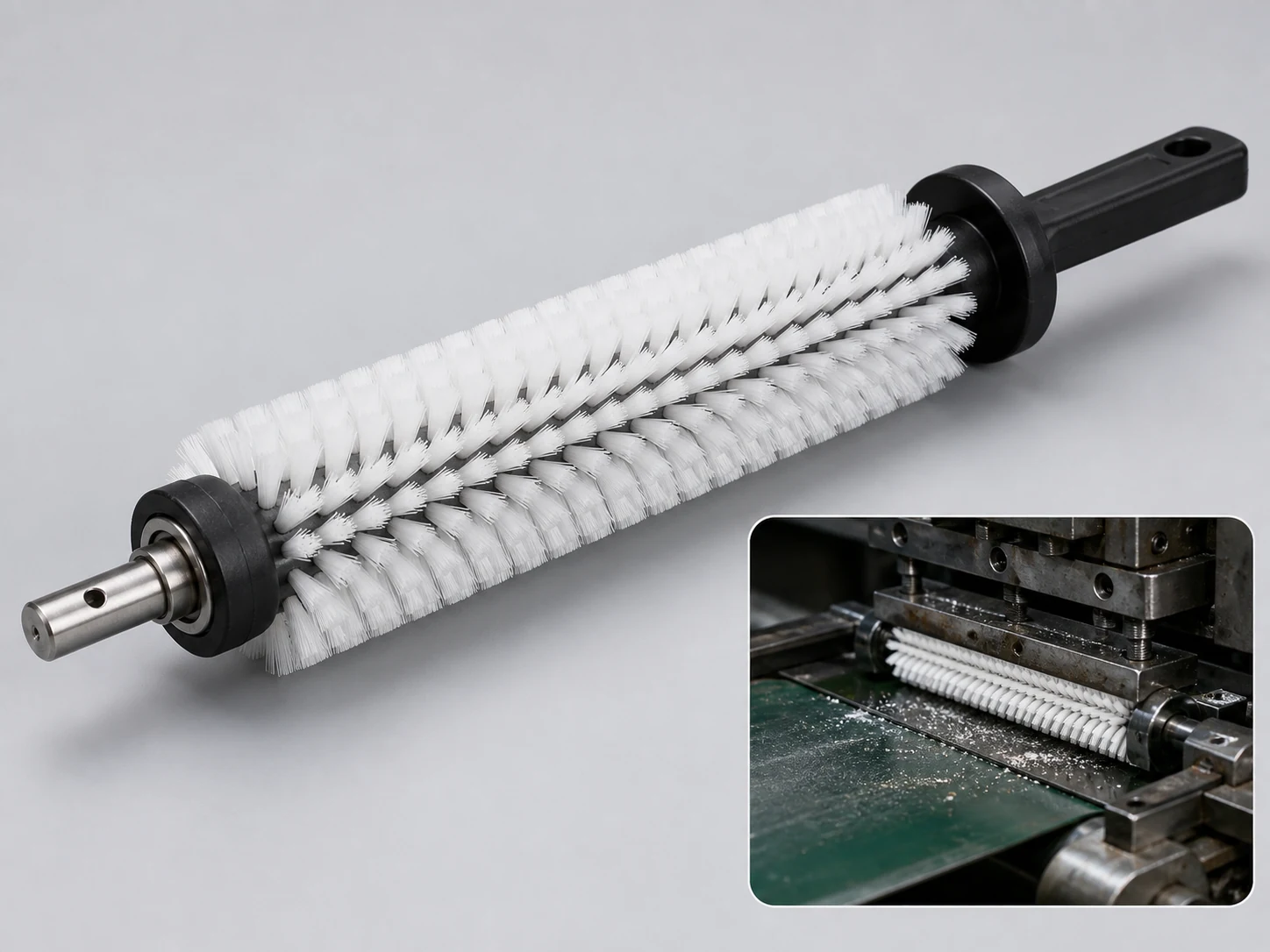
Large-format brush
100 pcs
Minimum order
Built one at a time on a core or channel: full-width rollers, sweeper brooms and long strip.
Production lead time, once the specification is confirmed
- Up to 100 pcsWithin 20 days
- 101–1,000 pcsWithin 30 days
- Over 1,000 pcsConfirmed with your quotation
Peak season can extend these times; the shipping date is confirmed in writing with your quotation. Sampling and shipping are quoted separately.
A purpose-configured nylon brush assembly for punch press and stamping operations. It clears metal chips, slugs, and stamping waste from press tables, turret tooling, tool holders, and guide rails without scratching sheet stock or linear guide surfaces.
What can this brush do for you?
Keeps the die and tooling zone clear between hits
Slugs and metal chips accumulate around punch and die sets every time the press cycles. This brush sits in the debris path — as a table plate under the sheet, a strip along the guide rail, or a hand brush for operator wipe-down — and moves chips and slugs out of the work zone before they cause misfeeds, tool jams, or indent marks on the next part.
Removes chips without marking sheet stock or guide surfaces
The fill is nylon PA or PBT rather than wire or abrasive. Filament tips contact the sheet and tooling surfaces with a compliant sweep that carries loose debris away instead of grinding it into the surface. The backing is set so the strip contacts only where needed; the holder never rides on the sheet or the rail.
Fits the actual press layout
Not every punch press has the same table gap, guide rail spacing, or slug path. The brush can be built as a flat table plate, a narrow side strip, a roller guard, or a hand pad, with trim height and plate dimensions matched to your press drawing. The brush works with the existing sheet travel and tooling stroke, not against it.
Handles oiled, wet chips and coolant residue
Stamping chips rarely arrive dry. Nylon PA and PBT fill resist common stamping oils, water-soluble coolants, and light cutting fluids, so the filament keeps its sweep action instead of matting or softening. Dense, straight-set trim releases debris on the reverse stroke or during normal cleaning, so the brush does not trap the chips it just removed.
What is a Machine Tool Punch Press?
A Machine Tool Punch Press is a brush element or brush assembly that is specifically configured to sit in and around the work zone of a punch press, turret press, or stamping line. It is not a general-purpose machining brush or a powered wire wheel. It is designed as a consumable contact component that clears chips, slugs, and process waste from the surfaces where they cause problems: press tables, punch guides, die seats, tool holders, and guide rails.
In operation, the brush either remains stationary while the sheet stock moves past it — sweeping loose chips and slugs into a collection gutter or tray — or it is used by an operator between runs to clean tooling and rail surfaces. Trim height is set so the filament tips reach the debris layer but do not load against the table surface or interfere with the tooling stroke. The common range is 10 to 50 mm, depending on the clearance available under the die and the size of the slugs being moved.
Because this brush works next to polished sheet surfaces and precision guides, the fill is almost always nylon PA or PBT. These materials move light-to-medium stamping debris without scratching sheet stock, and they hold shape under oil and coolant exposure. The brush is a precision cleaning component, not a heavy scraping tool.
Technical Specifications
The dimensions below are typical ranges for custom punch press brush assemblies. Final values are confirmed from your press and tooling drawing and the actual clearance in the work zone.
| Parameter | Value / Options |
|---|---|
| Brush form | Machine-table brush plate, strip brush, roller/hand brush; selected by press layout |
| Plate length | 500–2000 mm |
| Plate width | 500–1200 mm |
| Trim height | 10–50 mm |
| Fill material | Nylon PA, PBT, or PA/PBT blend; selected for debris type and surface sensitivity |
| Filament diameter | Typically 0.20–0.60 mm, adjusted to stiffness and wear life |
| Filament set | Straight, crimped, or flagged; straight for chip sweep, flagged for light dust |
| Backing / profile | Aluminum, galvanized steel, stainless steel, or polymer base |
| Mounting pattern | Slotted holes, clip channel, rail adapter, or custom bolt pattern per press drawing |
| Working clearance | Set to the press/die drawing; typically 0.5–2 mm standoff from sheet or rail surface |
| Operating environment | Dry or oil-wet stamping; coolant contact; ambient to moderate heat |
| Brush type | Custom Machine Table Brush Plates |
| How it is driven | Machine-driven, mounted in the equipment |
| Cleaning target | cnc turret punch press, stamping press die area, and coil-fed punch and blanking line cleaning |
| Surface or part | punches, sheets, tooling, rails, guide rails, metal, guides, and roller |
| Residue or debris | chips, metal chips, coolant, oil, and dust |
| Mounting / connection | Slotted holes, clip channel, rail adapter, or custom bolt pattern per press drawing |
Plate length and width cover common press table sizes; extended or segmented plates are available for larger beds. Mounting pattern and working clearance are established from your press model and tooling layout, not from a stock catalog.
Where does this brush work best?
- CNC turret punch press cleaning: clears punched slugs, metal chips, and scrap fragments from the worktable, turret stations, and tool holder areas during production.
- Stamping press die areas: sweeps stamping waste, slivers, and small scrap pieces from die seats, punch guides, and guide rails that affect alignment and tool life.
- Coil-fed punch and blanking lines: keeps the sheet path free of fine chips that would otherwise imprint into the next sheet or score the guide surfaces.
- Manual tooling touch-up: the hand pad or roller form is used by setup and maintenance crews to remove chips from punch guides, die seats, and turret tooling between runs.
- OEM press table brush replacement strips: replaces worn brush rails on existing machine tables where the original strip is no longer available.
How do I choose the right one?
Start with the press drawing, not a guess. The brush must follow the sheet path, the slug path, and the tooling clearances that already exist on the machine. Answer these questions in order:
1. Define where debris collects and how it moves
If chips and slugs drop onto the table behind the die and are carried by sheet movement, a fixed table plate or side strip under the sheet path is usually the right form. If debris builds on tool holders, punch guides, or rail edges that the sheet never touches, a hand brush or roller gives the operator access without changing the tooling setup.
2. Measure the mounting zone and working clearance
Plate length and width must match the available table area or the existing brush channel. Trim height is the most critical dimension: it must be tall enough to sweep the debris layer, but short enough to clear the die stroke and avoid loading against the table or sheet. If the clearance varies across the table, use the smallest gap as the design reference and compensate with backing shims or a stepped trim profile.
3. Match the fill to the debris and the surface
Nylon PA is the standard for general metal chips, slugs, and stamping dust on sheet surfaces that cannot be scratched. PBT is slightly stiffer and offers better wear life when the run is long or the debris is heavy. Use flagged or softer nylon only when the debris is mostly fine dust and the surface is especially sensitive.
4. Account for oil, coolant, and chip wetness
Wet slugs cling and pack. A denser filament set, a slightly stiffer trim, or a set angle that plows instead of flicking helps move oiled debris off the table. Nylon and PBT both resist common stamping fluids, but you should specify the actual oil or coolant so the polymer grade is correct.
When to use a different tool
Do not use this brush for heavy slugs that jam the table, welded scale, or burr removal. Those conditions call for a mechanical scraper, chip conveyor, or a separate abrasive tooling brush used by hand — not a nylon table brush. Wire or abrasive fill is only appropriate when the cleaning operation is on hardened tooling away from sheet surfaces and you accept the risk of scratching.
Can I customize this brush?
Yes. Every punch press table and tooling setup is different, so these brushes are configured to the press drawing rather than sold from a fixed catalog list. We need the press model, the table or rail drawing, the debris type and approximate chip size, and the oil or coolant used. A photo or sketch of the current brush or the mounting location helps confirm the interface.
We can adjust:
- Brush form: table plate, side strip, roller guard, or hand pad
- Plate dimensions: length, width, and overall profile to fit the press bed or existing channel
- Trim height: 10–50 mm and stepped or profiled trim for variable clearance
- Fill material and density: nylon PA, PBT, or blend; filament diameter; straight, crimped, or flagged set
- Backing material and profile: aluminum, galvanized steel, stainless steel, or polymer base with edge protection
- Mounting interface: slotted holes, clip channel, rail adapter, or the same bolt pattern as your current brush
- Identification: color coding, embossed mark, pad print, or label for quick replacement tracking
- Packaging: bulk, individually bagged strips, or replacement sets matched to your maintenance schedule
If your project needs material documentation, inspection reports, or third-party testing for a specific plant or customer requirement, we can support that during the customization process.
Which filament lasts longest on a machine tool punch press?
How can I check that the brush is not scratching my sheet or guide rails?
Run a trial on scrap sheet stock and inspect the surface under low-angle light. Fine longitudinal marks mean the trim is too short or the filament is too stiff; increase the working gap slightly or switch to a softer nylon. The backing plate should never contact the sheet or the rail — only the filament tips should touch.
What trim height do I need when the clearance varies across the press table?
Use the smallest clearance as the starting point. The trim height must clear the tightest point without bottoming out. For larger gaps elsewhere, use a stepped trim, angled set, or shim the backing so the filament still reaches the debris.
Will stamping oil or water-soluble coolant soften the nylon fill?
No. Nylon PA and PBT are resistant to most stamping oils, mineral oils, and water-soluble coolants. However, if your process uses chlorinated solvents, strong acids, or aggressive washdown chemicals, specify the fluid so we can select a compatible polymer grade.
How do I know when to replace the brush strip or plate?
Measure the remaining filament length at several points. When the tips wear down below about half the original trim height, or when the strip no longer reaches the debris layer at the tightest clearance, replace it. Also replace if you see missing tufts, glazed or melted tips, or corrosion on the backing.
Can I use this brush to de-burr punch tooling or remove scale?
No. Burr removal and scale removal require a smaller, stiffer abrasive or wire tooling brush used by hand. Using this brush for burrs will deform the nylon fill and may push burrs into adjacent surfaces. This brush is for loose chips, slugs, and process dust.
Does this brush replace a chip conveyor or air blow-off?
No. It supplements them. The brush clears fine residual chips and surface dust that conveyors and air jets miss, especially around tool holders and guide rails. For continuous high-volume slug removal, keep the conveyor or scraper as the primary system and use the brush as the finishing contact.
Guides that go deeper on this
Custom Manufacturing RFQ
Describe Your Application
Please share the brush dimensions, working area, residue type, material direction, quantity, and a drawing or photo for quotation.
Drawing or photo optional — it speeds things up, it does not gate the enquiry.
Custom Brush RFQ
Send Your Brush Project
Upload a drawing, product photo, or sample photo and provide the core dimensions and cleaning conditions.
“We need a brush to remove wet residue from a stainless steel conveyor, about 800mm wide. The current brush wears quickly. We can send photos.”
“We sell drinkware and need a cleaning brush to include with the product. Quantity around 5,000 pieces.”