
Custom Cleaning Brush
Brush Plate Punch Press
Custom-size tufted brush plates for CNC punch press tables. PBT/PET fibers support sheet metal, clear slugs and chips, and match your mounting pattern.
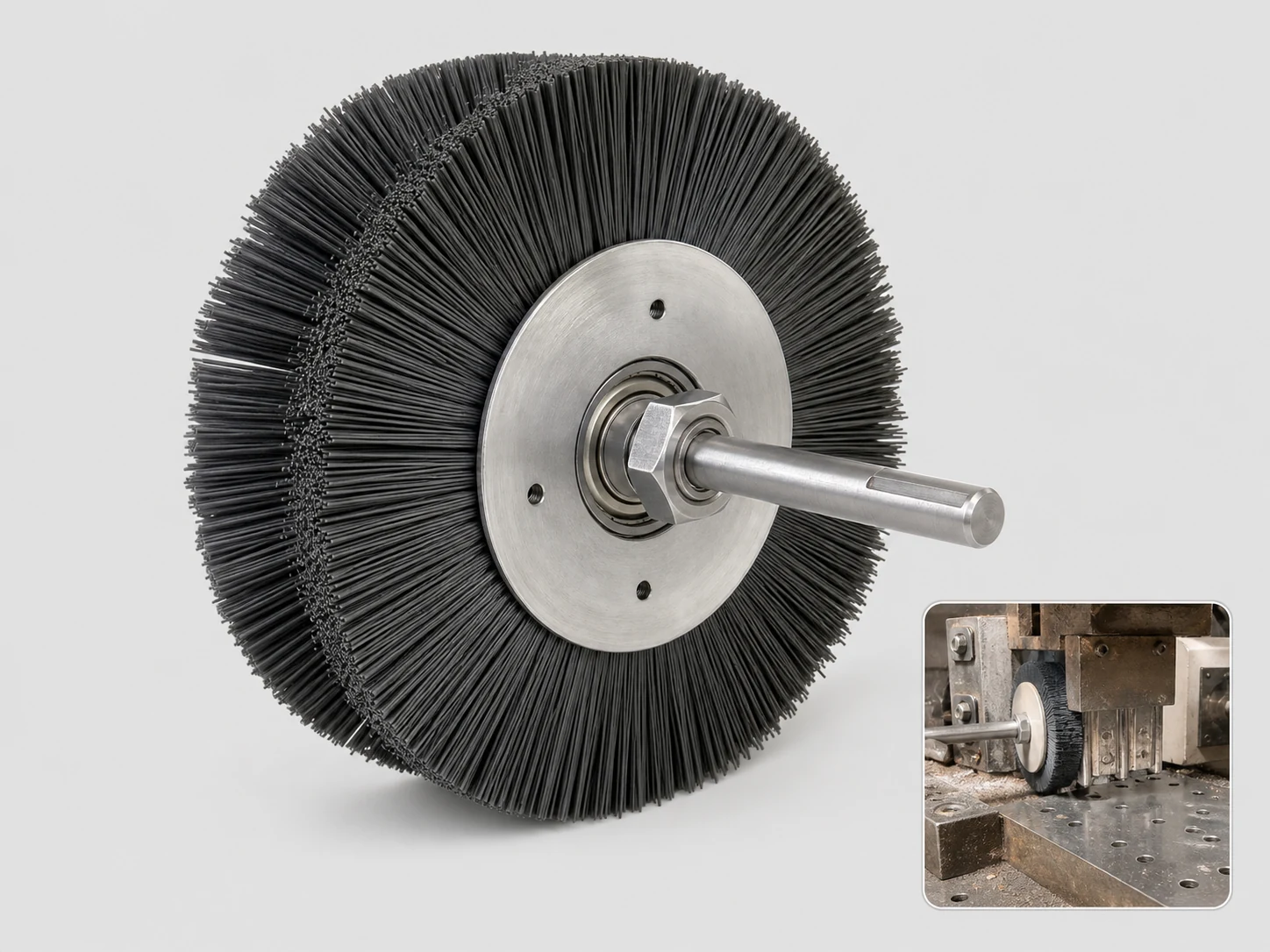
Large-format brush
100 pcs
Minimum order
Built one at a time on a core or channel: full-width rollers, sweeper brooms and long strip.
Production lead time, once the specification is confirmed
- Up to 100 pcsWithin 20 days
- 101–1,000 pcsWithin 30 days
- Over 1,000 pcsConfirmed with your quotation
Peak season can extend these times; the shipping date is confirmed in writing with your quotation. Sampling and shipping are quoted separately.
This custom brush plate mounts to the work table or die zone of a CNC punch press and serves as the replaceable contact surface for sheet metal workpieces. Its dense PBT/PET fiber bed supports the sheet during tool movement, allows slugs, burrs, and stamping chips to drop between the filaments, and keeps the sheet surface free of drag marks while damping punch impact.
What can this brush do for you?
Supports the sheet without dragging or marking the material
Dense rows of PBT or PET polyester filament create a compliant contact face under the workpiece. The fiber tips slide against the underside of the sheet instead of hard rollers, steel rails, or bare table plate, so pre-painted, galvanized, polished, and thin-gauge material moves through the press without score lines or transfer marks.
Gives slugs and chips a clear path out of the work area
The gap between tufts lets punched slugs, burrs, and small chips fall or be carried to the collection area below rather than piling up under the sheet. This prevents debris from marking the next part, binding the sheet, or reaching guides, sensors, and clamp surfaces.
Dampens punch shock and vibration at the table surface
The tufted fiber bed absorbs a portion of each stroke’s impact, reducing bounce and mechanical noise at the sheet support plane. The result is a calmer sheet travel path and less transmitted stress into the table frame and die tooling.
Installs as a direct-fit replacement component
Plate dimensions and the mounting pattern are cut to match the existing punch press table, including counterbores, slots, and cutouts around dies and clamps. The plate drops into the machine without table modification and works with the fasteners already in use.
Holds its shape through repeated oil and chip exposure
PBT and PET polyester resist common stamping oils, water-miscible coolants, and light solvent contact. Fiber tips recover after each stroke instead of staying folded, and embedded metal fragments tend to shake free between cycles rather than building up as permanent wear points.
What is a Brush Plate Punch Press?
A Brush Plate Punch Press is a tufted brush plate built into the sheet support area of a CNC punch press. It is not a handheld cleaning brush or a one-pass conveyor brush; it is a permanent machine contact surface that works continuously under moving sheet metal and repeated punch strokes.
The assembly combines a flat backing plate—typically mild steel, stainless steel, aluminum, or composite—with individual fiber tufts implanted in rows across the face. The plate carries the mounting pattern of the press table so the brush face sits flush at the correct work height. While the sheet travels across the press, the tuft tips wipe the underside, support the material, and allow stamped slugs and chips to fall between rows. The same surface shields the table and surrounding die zone from direct metal-to-metal contact.
Choosing the right plate is less about the size of the brush than about three operating conditions: the sheet material and finish, the punch tonnage and slug size, and the working environment including oil, coolant, temperature, and maintenance access. PBT and PET polyester are the standard fill because they combine predictable stiffness, chemical resistance, low moisture absorption, and fast recovery under repeated impact, but the plate is always configured around these conditions rather than supplied as a fixed stock item.
Technical Specifications
Dimensions and fill are matched to the machine rather than stocked as one size. The values below are the working configuration ranges we normally build for punch press tables.
| Parameter | Value / Options |
|---|---|
| Overall plate length | 500–2500 mm; custom up to 2500 × 1200 mm depending on backing and transport |
| Overall plate width | 500–1500 mm |
| Plate thickness | 6–20 mm, selected for clamping, flatness, and installed weight |
| Visible fiber trim length | 10–50 mm, selected for support stiffness and debris clearance |
| Filament material | PBT or PET polyester standard; optional high-temperature nylon, abrasive nylon, brass, or steel wire |
| Filament diameter | 0.15–0.50 mm, adjusted for required stiffness and recovery |
| Tuft pattern | Straight row, staggered, zigzag, or checkerboard; density matched to sheet weight and slug size |
| Backing plate material | Mild steel, stainless steel, aluminum, or composite depending on load and environment |
| Mounting pattern | Through holes, counterbores, slots, threaded inserts, or edge clamps matched to the existing table |
| Operating temperature | Standard PBT/PET fill for continuous surface conditions up to 100 °C (212 °F); higher-temperature fiber by project |
| Media resistance | Suitable for common stamping oils, water-miscible coolants, and light solvent contact; verify stronger chemistry during design |
| Brush type | Custom Machine Table Brush Plates |
| How it is driven | Machine-driven, mounted in the equipment |
| Cleaning target | cnc turret punch press brush table, die and tool perimeter area, and sheet loading and unloading zone cleaning |
| Surface or part | sheets, punches, metal, holes, plates, roller, aluminum, and composite |
| Residue or debris | chips, burrs, fiber, coolant, oil, and corrosion |
| Mounting / connection | Through holes, counterbores, slots, threaded inserts, or edge clamps matched to the existing table |
If the table requires segmented modules for maintenance access or transport, the plate can be divided along selected seams and supplied in sections that bolt together on the machine.
Where does this brush work best?
- CNC turret punch press brush tables: replace bare steel, ball-transfer, or roller support surfaces where sheet metal is indexed under the turret; brush tips support the sheet, let slugs clear, and protect the underside.
- Die and tool perimeter areas: plates mounted around die openings catch slugs, burrs, and chips before they reach linear guides, sensors, or clamp pads.
- Sheet loading and unloading zones: contact areas where operators slide blanks and finished parts onto or off the table, with brushed surfaces reducing scratch and handling marks.
- Punch and stamp combination cells: tables that contact both cut and uncut stock while experiencing heavy stroke vibration, where damping and debris clearance are both required.
- Replacement inserts for OEM brush tables: plates rebuilt to the original footprint and hole pattern when the factory brush surface is worn or the machine model is out of support.
How do I choose the right one?
Start with the table footprint and mounting points
Measure the installed plate length, width, and thickness, then locate every mounting hole, slot, and counterbore from a reference edge. Also note clearances under clamps, strippers, tool turrets, and any moving head travel zones. A plate that fits the bolt pattern but stands too tall or blocks tool travel will still be wrong.
Match the filament to the sheet surface and debris
Soft PBT or PET polyester is the standard when the sheet is painted, coated, galvanized, polished, or otherwise finish-sensitive. Abrasive nylon, brass, or steel wire becomes a consideration when the sheet is uncoated and the process produces heavy burrs, thick slugs, or embedded scale that a synthetic tuft cannot move. A stiffer fill removes more interlocked debris but may leave contact marks on a finished surface.
Set the trim length by the job
Short trim, roughly 10–20 mm, creates a flatter and more rigid support plane for thin or precision-indexed sheet. Longer trim, roughly 30–50 mm, provides more shock absorption and clearance for large slugs but allows more deflection. The right length depends on sheet gauge and travel accuracy, not on total plate size.
Balance tuft density between support and evacuation
A dense tuft field carries heavy sheet and keeps the surface even, but can hold fine chips at the root if the tufts are too close. A more open pattern lets slugs fall through but supports the sheet over fewer contact points. For mixed production, staggered rows with moderate density usually clear debris while keeping the sheet stable.
Select the backing for load, corrosion, and weight
Steel handles heavy punch impact and remains stable, stainless steel adds corrosion resistance for wet coolant areas, aluminum reduces installed weight for easier maintenance, and composite suits lower forces or non-metallic restrictions. The backing choice is driven by the plant environment as much as by the tonnage.
When a different approach may be better: if the process cannot tolerate any fiber deflection and flatness is critical, a hardened solid, roller, or ball table is the more suitable support. If the press generates a continuous stream of large hot slugs, add a scrap conveyor or vacuum extraction alongside the brush plate. If high-acidity or high-alkaline immersion is part of the wash process, PBT or PET may not be the correct fill and the plate materials need to be reviewed before ordering.
Can I customize this brush?
Most punch press brush plates are built to a machine-specific drawing. To define the configuration, provide the table drawing or sample plate, mounting pattern, sheet material and thickness, punch tonnage, travel path, coolant or oil used, operating temperature, and the slug or chip size the process creates. We can adjust:
- Plate geometry — length, width, thickness, notches, cutouts, chamfers, stepped edges, and segmented modules
- Mounting pattern — hole positions, counterbores, slots, threaded inserts, or edge clamping to match the existing table
- Filament fill — PBT, PET, high-temperature nylon, abrasive nylon, brass, or steel wire, with selected diameter and cross-section
- Tuft layout — trim length, row spacing, density, angle, and straight or staggered pattern
- Backing material and finish — mild steel, stainless steel, aluminum, composite, powder coat, or corrosion-resistant treatment
- Marking and packaging — part identification, installation orientation marks, bulk packing, or individually protected plates for export
Where your project requires material documentation, inspection records, or third-party testing on the plate and fill, those requirements can be supported during the customization process.
When is a brush plate punch press worn out rather than just dirty?
How do I measure my existing table for a replacement brush plate?
Measure the overall length, width, and thickness; the mounting-hole positions from a reference edge; counterbore or slot dimensions; any cutouts for die openings and clamps; and the clearance height under moving heads. If you have the machine table drawing or a used plate, send it and we will match the pattern. Do not estimate from a hand sketch alone where tolerances matter.
What should be checked before the first production run after installation?
Confirm all fasteners are seated and do not sit above the fiber face. Run a scrap sheet across the plate and check the underside for marks or snagging. Verify that slugs and chips fall through or are carried away rather than staying on top. Look under and around the plate for fiber tips that may have been compressed or broken during fixture.
How do I clean the brush plate between jobs?
Remove loose slugs and chips with a vacuum or low-pressure air blow from the underside. Do not soak the plate in strong solvents unless the backing and adhesive are rated for that. Inspect the tuft rows for metal fragments wedged at the root or flattened areas. After cleaning, the tips should return upright; any permanently folded section is a sign the trim is too long, the density is wrong, or the plate is beyond its service interval.
Will the brush plate scratch pre-painted or polished sheet?
Standard PBT and PET polyester tips are the non-marking option for this application and are specified for painted, galvanized, coated, and polished surfaces. Wire or abrasive nylon fills should be reserved for uncoated stock and heavy burr conditions where a small amount of contact marking is acceptable. Always validate the chosen fill on production scrap before committing a run.
When is a brush plate the wrong replacement for a solid support table?
If the part requires very tight flatness and the process cannot tolerate any fiber deflection, a hardened solid, roller, or ball table is more appropriate. Brush plates are also not a substitute for a scrap conveyor or extraction system when the press produces a continuous stream of large, hot slugs; in those cases the brush surface handles contact, while a separate evacuation method handles the volume.
How can I tell when the brush plate needs to be replaced rather than adjusted?
Compare the contact face over time. When visible trim is uneven, a large area no longer springs back, metal shards are embedded deeper than the surface, the sheet starts to show drag marks, or slugs no longer fall through, investigate. If cleaning and lowering trim length do not restore support, replace the plate or the affected segment. A reference photo of a new plate is useful for this check.
Guides that go deeper on this
Custom Manufacturing RFQ
Describe Your Application
Send the key measurements, cleaning requirement, residue, material direction, mounting method, quantity, and drawing or photo.
Drawing or photo optional — it speeds things up, it does not gate the enquiry.
Custom Brush RFQ
Send Your Brush Project
Upload a drawing, product photo, or sample photo and provide the core dimensions and cleaning conditions.
“We need a brush to remove wet residue from a stainless steel conveyor, about 800mm wide. The current brush wears quickly. We can send photos.”
“We sell drinkware and need a cleaning brush to include with the product. Quantity around 5,000 pieces.”