
Custom Cleaning Brush
Nylon PVC Brush Plate
Custom PVC-backed nylon brush plates for CNC, punch, and sheet-processing tables. Sweep dust and light chips while supporting workpieces.
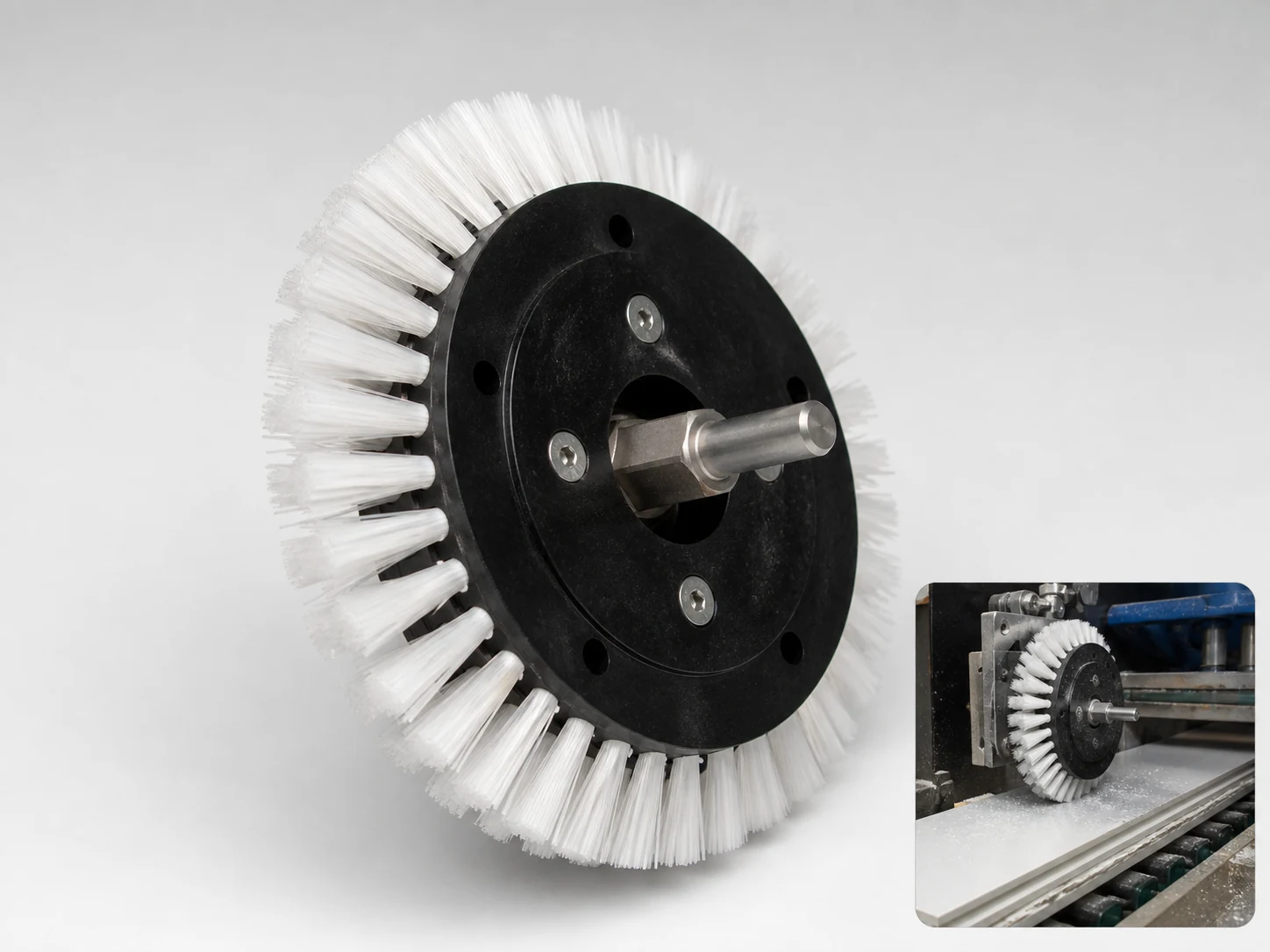
Large-format brush
100 pcs
Minimum order
Built one at a time on a core or channel: full-width rollers, sweeper brooms and long strip.
Production lead time, once the specification is confirmed
- Up to 100 pcsWithin 20 days
- 101–1,000 pcsWithin 30 days
- Over 1,000 pcsConfirmed with your quotation
Peak season can extend these times; the shipping date is confirmed in writing with your quotation. Sampling and shipping are quoted separately.
The Nylon PVC Brush Plate is a PVC-backed, nylon-filled brush plate built into machine tables and workpiece support surfaces where parts slide during processing. It sweeps loose dust and light chips out of the work path while cushioning the contact surface, so sheets and panels move through CNC, punching, and bending operations without scratching or jamming on debris.
What can this brush do for you?
Clears Loose Dust and Light Chips During the Work Cycle
The nylon PA tufts flex as a workpiece slides over the plate, then spring back and push loose dust, small chips, and particles toward the open edges of the table. Because the cleaning action happens every time a panel passes over the brush surface, debris is less likely to build up under the next workpiece and cause scratches, clamp misalignment, or feed interference.
Gives Coated and Finished Sheet a Non-Marking Contact Surface
Rounded, flexible nylon filament ends bend under load instead of digging into the surface. This supports powder-coated, anodized, pre-finished, or decorative sheet metal without the point-contact scuffing a bare table or hard plastic runner can leave. The PVC base holds the tufts in a controlled pattern, keeping contact even across the plate.
Supports Thin and Irregular Workpieces Without Hard Stops
Trimmed nylon filaments form a continuous compliant bed that accepts slight bow, edge curl, or surface variation. The part settles into the filament tips instead of rocking on high spots, so cutting, punching, and bending operations start from a more stable, repeatable workpiece position.
Protects the Machine Table as a Replaceable Wear Surface
The PVC backing takes mounting hardware and dimensional loads while the nylon fill absorbs sliding wear. When a section wears or is damaged, you replace the plate or the affected section rather than resurfacing the machine table. Mounting holes and plate dimensions are drawn to the existing table pattern for quick fitting.
Reduces Vibration Transfer and Sliding Noise
The filament pack cushions the moving panel and reduces hard metal-to-metal contact. This lowers transmitted vibration and chatter in light sheet processing, and can reduce the scraping and rattling sound that comes from parts traveling directly on steel tables.
What is a Nylon PVC Brush Plate?
A Nylon PVC Brush Plate is a flat, tufted industrial brush panel in which nylon PA monofilament is anchored into a rigid PVC backing plate. The plate is mounted on a support table, machine bed, or guide surface, and the filament face becomes the working surface that workpieces slide across.
In operation, the nylon tufts do two things at once. They cushion and stabilize the workpiece as it moves, and they sweep loose dust, chips, and small particles along the stroke path. The PVC base provides a flat, stable mounting structure with drilled or slotted fixing points, while the nylon provides the compliant, wear-resistant contact face.
This type of plate is selected for light debris loads and surface-sensitive parts. It is not a heavy chip scraper and is not intended to remove baked-on residue, weld spatter, or scale. Its role is continuous, low-pressure particle clearing and workpiece support on processing tables.
Technical Specifications
The following are typical starting values for a custom Nylon PVC Brush Plate. Final dimensions, trim height, fill size, and mounting pattern are set from the drawing and the duty of the machine table.
| Parameter | Typical Value / Options |
|---|---|
| Brush form | Tufted brush plate; straight or staggered row layout |
| Fill material | Nylon PA monofilament, round or profiled cross-section |
| Plate / base material | PVC backing plate; grade selected for rigidity and machining |
| Plate length | 500–3000 mm, one piece or sectioned to drawing |
| Plate width | 500–2500 mm |
| Plate thickness | 3–12 mm typical; adjusted to load and mounting surface |
| Trim height | 10–50 mm above the PVC face |
| Filament diameter | 0.10–1.00 mm, selected by dust/chip type and workpiece weight |
| Tuft density / pattern | Rows per 100 mm and spacing matched to duty and workpiece coverage |
| Mounting | Countersunk holes, slots, or customer-specified fastening positions |
| Operating temperature | PVC base practical for ambient to moderate machine environments; avoid continuous exposure above about 60°C (140°F) |
| Environment | Best in dry or light-mist conditions; specify cutting fluid, oil, or solvent exposure |
| Brush type | Custom Machine Table Brush Plates |
| How it is driven | Machine-driven, mounted in the equipment |
| Cleaning target | cnc router and machining table, punch press and stamping support surface, and panel cleaning |
| Surface or part | panels, pvc, sheets, machine tables, metal, plastic, edges, and holes |
| Residue or debris | chips, dust, loose dust, scale, fine dust, particles, spatter, and oil |
| Mounting / connection | Countersunk holes, slots, or customer-specified fastening positions |
Tuft density is set from the required contact pressure and debris size: finer filaments and tighter spacing for light dust on finished surfaces, coarser packing for heavier panels and larger chips. The trim height determines how much filament is available to flex and sweep while keeping the workpiece stable.
Where does this brush work best?
The plate is used where a workpiece has to slide repeatedly over a table or support surface during processing.
- CNC router and machining tables where sheet stock slides into position and fine dust, swarf, and small cut-off chips settle in the working area.
- Punch press and stamping support surfaces where blanks and drop-off slugs move across the table and small chips can interfere with clamp or sensor positions.
- Backgauge and bending machine tables where lighter sheet and coated panels need support without hard contact marks, while dust and scale are cleared from the stroke path.
- Panel handling and inspection tables for pre-finished metal, laminate, or composite panels that cannot tolerate scratches from steel or hard plastic contact.
- Transfer and feed sections between processing stations where brushes clear debris from guide rails, stops, and sensor detection zones as parts pass.
How do I choose the right one?
Match the plate to the table and travel path
Measure the length and width of the area the workpiece actually slides over, including the entry and exit strokes. Mark the mounting hole positions or slot locations, and make sure no screw head will sit above the trimmed filament height. The plate should cover the contact path without creating a raised edge that catches panel corners.
Set trim height around support and sweeping
Shorter trim heights, roughly 10–20 mm, give firmer workpiece support with less deflection and suit heavier sheets. Taller trim heights, up to about 50 mm, provide more compliance and more space for dust and chips to collect between rows, but they allow more part movement and may require wider row spacing.
Choose the nylon fill from the load and residue
Fine filaments from about 0.10–0.30 mm work well for light dust and sensitive coated surfaces because they flex easily and present a dense contact face. Larger diameters from 0.40 mm upward carry higher workpiece loads and resist permanent deflection from heavier panels. For metal chips with sharp edges, choose a larger monofilament diameter and heavier density so the fill lasts longer between replacement cycles.
Confirm PVC compatibility with the operating environment
PVC is rigid, machinable, and easy to drill for mounting, but it should not sit where warm workpieces over about 60°C (140°F) rest continuously or where hot chips land. Continuous oil, solvent, or aggressive coolant contact also needs to be specified so the plate grade and nylon type can be selected properly. If the table sees welding spatter, hot parts, or aromatic solvents, ask about alternative base materials before ordering this configuration.
Know when a brush plate is not the answer
This product clears loose dust and light chips and cushions the part. It does not replace a chip conveyor for high-volume machining chips, and it will not remove oil films, scale, or adhesive residue by itself. If the table needs aggressive scraping or if the parts are heavy enough to flatten the filaments permanently, a different support or cleaning solution is required.
Can I customize this brush?
Nylon PVC Brush Plates are built from the machine table drawing rather than sold only in stock sizes. To configure one, we need the overall plate length, width, thickness, mounting hole or slot positions, trim height, filament diameter and density, workpiece range, and the types of debris and fluids present.
- Plate geometry — overall size, corner radius, notches, cut-outs, and sectioning for large tables
- PVC base — thickness, grade, color, edge finish, and mounting strategy
- Nylon fill — filament diameter, cross-section, trim height, stiffness, color, and row or staggered pattern
- Tuft layout — full-face coverage, border-only rows, interrupted zones, or custom spacing to clear fixtures and guides
- Mounting interface — countersunk holes, slots, threaded inserts, or matched fasteners
- Wear and replacement features — sectional plates, index marks, or spare section provision for fast change-out
- Identification and packaging — part marking, label placement, bundling, or transport protection if required
We can also support project documentation, dimensional inspection, material declaration, or third-party testing where your purchasing or engineering team requires it as part of the custom order.
Which filament survives the cleaning and still lasts on a nylon PVC brush plate?
How do I check that the mounting holes will line up with my table?
Measure the existing table hole positions from a single datum in both directions and note hole diameter and countersink depth. Send those measured values with a photo or sketch of the table. Do not scale the drawing; use the actual numbers taken from the machine.
Can this plate work on a punch press table with oil mist present?
Light oil mist is generally tolerable, but pooled oil, aggressive stamping lubricant, or solvent cleaning agents can soften or swell PVC and carry fines into the filament pack. Specify the fluid type and contact level before ordering so the plate grade and nylon fill can be matched to the actual environment.
What should I do if chips start packing between the nylon rows?
Packing usually means the row spacing is too tight for the chip size or the chips are long and stringy. Check the gap between rows at shift change. If packing is consistent, increase row spacing, reduce tuft density in that zone, or add an air blow-off or vacuum pick-up upstream. The plate should sweep chips, not store them.
How do I know when a section is due for replacement?
Measure trim height in several places with a depth gauge or ruler. Replace the section when filament height falls below the level needed to support the workpiece, when tufts stay folded over and no longer spring back, or when the PVC backing shows cracking, hole elongation, or loose mounting.
Does this brush plate clean the part itself?
No. It keeps the table contact area clear of loose dust and light chips and cushions the panel as it slides. It does not remove coolant residue, oil film, or embedded dirt from the workpiece surface. A dedicated cleaning or wiping stage is still needed when the part has a finish or contamination specification.
Guides that go deeper on this
Custom Manufacturing RFQ
Describe Your Application
Send the key measurements, cleaning requirement, residue, material direction, mounting method, quantity, and drawing or photo.
Drawing or photo optional — it speeds things up, it does not gate the enquiry.
Custom Brush RFQ
Send Your Brush Project
Upload a drawing, product photo, or sample photo and provide the core dimensions and cleaning conditions.
“We need a brush to remove wet residue from a stainless steel conveyor, about 800mm wide. The current brush wears quickly. We can send photos.”
“We sell drinkware and need a cleaning brush to include with the product. Quantity around 5,000 pieces.”