
Custom Cleaning Brush
PET Brush Plate
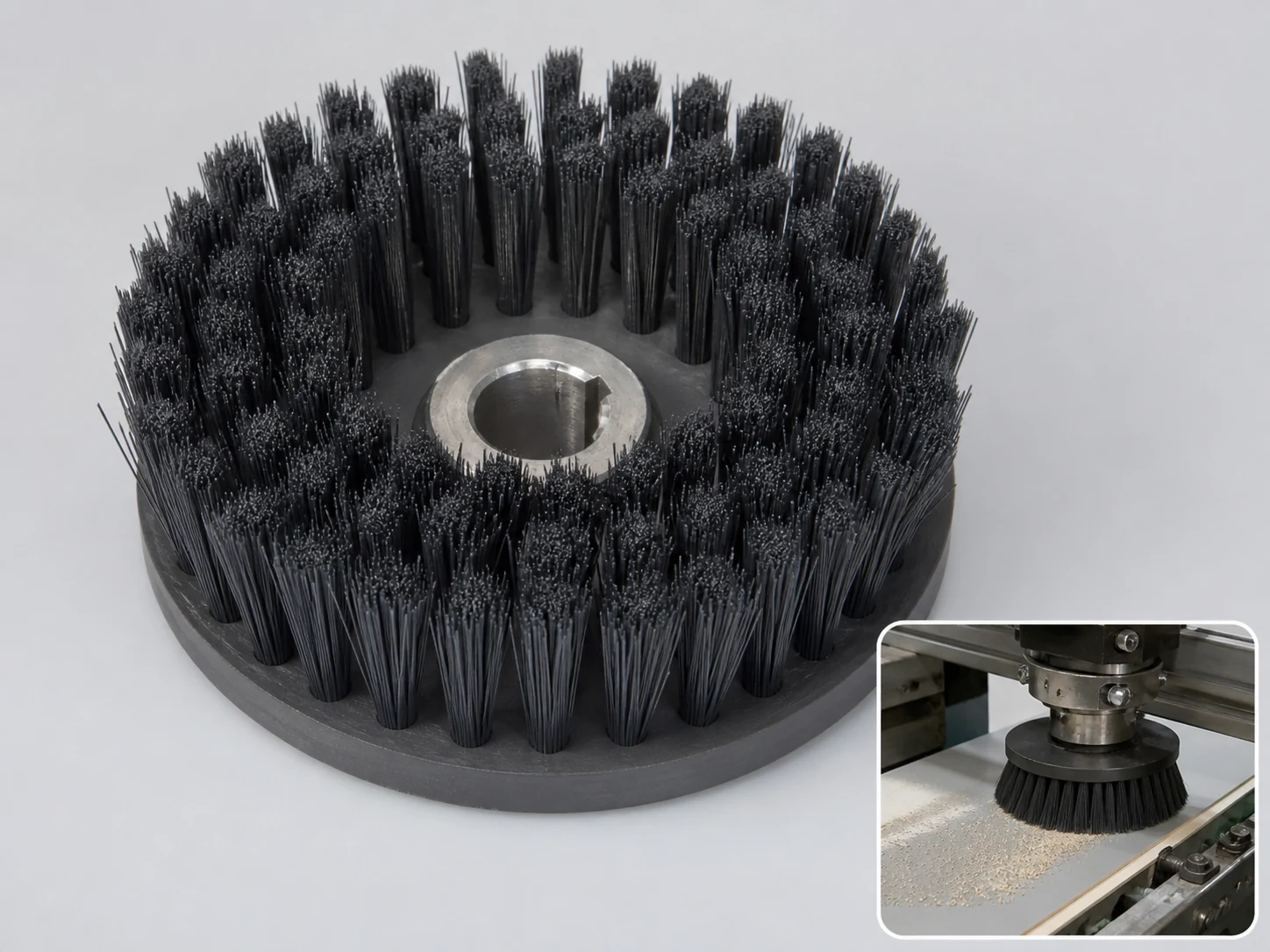
Configurable PET brush plates for industrial cleaning, deburring, and surface contact tasks.
Large-format brush
100 pcs
Minimum order
Built one at a time on a core or channel: full-width rollers, sweeper brooms and long strip.
Production lead time, once the specification is confirmed
- Up to 100 pcsWithin 20 days
- 101–1,000 pcsWithin 30 days
- Over 1,000 pcsConfirmed with your quotation
Peak season can extend these times; the shipping date is confirmed in writing with your quotation. Sampling and shipping are quoted separately.
A configurable tufted brush plate with PET polyester filaments for industrial cleaning, deburring, and surface-contact tasks. The plate mounts directly into production machines to remove dust, burrs, oxide, oil film, and loose particles from flat faces, edges, recesses, and moving webs.
What can this brush do for you?
Covers wide surfaces in a single pass
Plate geometry gives you continuous filament contact across the full working width instead of relying on multiple small brushes. Lengths up to 3000 mm and widths up to 2500 mm let one plate clean an entire conveyor belt, sheet, or panel path without leaving uncleaned gaps between rows.
Removes light burrs and loose debris without scratching
PET monofilaments are flexible and non-abrasive. The tips knock off loose particles, light burrs, oxide film, and surface dust while bending away from the substrate instead of gouging it. Filament diameter and stiffness can be matched to the job so you get the right aggressiveness without risking damage to coated, painted, or precision surfaces.
Stays stable in oily, wet, and mildly chemical environments
PET resists common machine oils, greases, aliphatic hydrocarbons, mild acids, and mild alkalis, and it absorbs very little moisture. The filaments keep their spring-back and cleaning action in conditions that cause natural fibers to soften or rot and many polymers to swell.
Trim height and tuft pattern set the contact behavior
Longer free filament length conforms to uneven or profiled surfaces and provides a softer sweep. Shorter trim height creates firmer tip pressure for edge contact or localized scrubbing. Tuft density and pattern determine how much debris is captured, flipped off, or allowed to fall through, so the plate can be tuned to the exact cleaning path and debris type.
Base plate integrates with your existing mounts
The base can be supplied in polymer, aluminum, steel, or wood and machined with through holes, counterbores, slots, threaded inserts, or edge clamping features that match the machine frame. Replacement plates drop into the same mounting hardware used by the original component.
What is a PET Brush Plate?
A PET Brush Plate is an industrial brush component made of a rigid or semi-rigid base plate with tufted bundles of PET polyester monofilament anchored into the plate. The plate is mounted on a rotating shaft, oscillating arm, or fixed position along a conveyor or machine frame, and the filament tips sweep, wipe, or lightly scrub the target surface as it moves past.
The typical cleaning action is a combination of wiping contact and tip deflection. Each filament tip removes loose material through mechanical dislodgement while the flexible filament body follows minor surface irregularities. The plate works best when the contact surface is flat, gently curved, or has accessible edges and recesses the filament tips can reach without excessive bending.
Rotary face cleaning, edge deburring, oxide film removal, polish compound wipe-off, and belt or roller face cleaning are common uses. The plate is not a heavy stock-removal tool. It is selected when the process needs consistent, non-damaging mechanical contact across a defined working area.
Technical Specifications
| Parameter | Specification |
|---|---|
| Brush form | Tufted plate / block brush |
| Filament material | PET (polyester) monofilament |
| Base material | Polymer (PP, HDPE), aluminum, steel, or wood; selected per project |
| Plate length | 100–3000 mm (custom) |
| Plate width | 10–2500 mm (custom) |
| Plate thickness | Typically 10–50 mm, adjusted to mounting and stiffness needs |
| Trim height (free filament length) | 10–50 mm |
| Filament diameter | 0.10–1.00 mm |
| Filament stiffness | Soft, medium, or firm grades based on diameter, crimp, and heat-set |
| Tuft pattern | Straight rows, staggered, diagonal, or custom layout; typical hole pitch 4–20 mm |
| Tuft density | Custom, specified as holes per 100 mm or filaments per tuft |
| Mounting | Through holes, counterbored holes, slots, threaded inserts, or edge clamps per drawing |
| Operating temperature | Up to approximately 100–120°C dry; verify for wet or chemical exposure |
| Chemical resistance | Good resistance to oils, greases, aliphatic hydrocarbons, mild acids and alkalis; limited in strong acids, phenols, and some solvents |
| Brush type | Custom Machine Table Brush Plates |
| How it is driven | Machine-driven, mounted in the equipment |
| Cleaning target | conveyor belt and return-roller, sheet metal, and wood and composite panel sanding and edge cleaning |
| Surface or part | edges, webs, belts, wood, plates, conveyors, recesses, and roller |
| Residue or debris | oxide, dust, burrs, oil, oil film, oxide film, particles, and loose particles |
| Mounting / connection | Through holes, counterbored holes, slots, threaded inserts, or edge clamps per drawing |
Values shown are standard ranges. Final dimensions, filament specification, and base material are confirmed against the machine drawing and process parameters before production.
Where does this brush work best?
- Conveyor belt and return-roller cleaning where dust, fines, and product residue accumulate on belt faces or roller surfaces.
- Sheet metal, coil, and panel processing lines where light burrs, oxide film, and dust must be removed before coating, lamination, or stacking.
- Wood and composite panel sanding and edge processing machines to clear dust and chips from feed surfaces and workpiece edges.
- Glass, film, and foil cleaning stations where a non-marring wipe is needed across a moving web.
- Printing, packaging, and textile machines where oil film, paper dust, or fiber lint accumulates on plates, guides, and transport surfaces.
- Deburring and surface finishing machines where flat plates contact moving parts for edge radiusing and light oxide removal.
How do I choose the right one?
Start by mapping the contact zone and the process conditions before deciding on filament and plate specs.
Define the contact area. Measure the machine width, available mounting space, and required cleaning width. The plate should cover the full target area without excessive overhang, and the mounting holes must align with existing brackets or shafts.
Match filament diameter and stiffness to the debris and surface. Use finer filaments in the 0.10–0.30 mm range for dust, light oil film, and delicate surfaces. Use coarser filaments in the 0.50–1.00 mm range for burrs, oxides, and heavier loose debris. Softer grades flex more and reduce scratching risk; stiffer grades apply more tip pressure for stubborn material removal.
Set trim height for conformability and wear reserve. Choose longer trim heights of 30–50 mm when the surface is uneven, profiled, or requires a longer service interval. Use shorter trim heights of 10–20 mm for compact installations, precise edge contact, and higher effective scrubbing pressure.
Select tuft pattern and density for the cleaning path. Dense tufting gives more complete coverage and captures fine debris better. Lower density lets larger particles fall through and is often preferred when the brush sweeps material off an edge. A staggered pattern prevents continuous unbrushed stripes on fast-moving webs.
Choose the base material for the environment and mounting. Aluminum offers rigidity and corrosion resistance. Steel provides strength and threaded-hole compatibility. Polymer bases such as PP or HDPE suit washdown or low-weight applications. Wood is a cost-effective option for dry indoor use only.
Check temperature and chemical exposure. PET retains useful stiffness up to about 100–120°C in dry conditions, but strong acids, phenols, and certain solvents will degrade it. If the process runs hotter or uses aggressive chemicals, consider nylon or PBT filament instead. If the residue is baked-on carbon, weld spatter, thick rust scale, or requires aggressive material removal, an abrasive-filament brush, wire brush, or other mechanical method is more appropriate than a PET plate.
Can I customize this brush?
PET brush plates are built to the machine, so the configuration is usually defined by a drawing, a sample, or a set of process parameters. To start, we need the plate length, width, and thickness, the mounting hole pattern, the required trim height and filament diameter or stiffness, the tuft layout, the working environment, and the type of debris being removed.
We can adjust the following to fit your project:
- Plate geometry — length, width, thickness, custom cutouts, angled or curved edges, and segmented sections.
- Base material — PP, HDPE, aluminum, steel, stainless steel, wood, or another project-suitable material.
- Filament specification — diameter, trim length, straight or crimped filament, stiffness grade, color, flame-retardant PET, or project-specific PET grades.
- Tufting — pattern, pitch, density, hole shape, and edge row treatment.
- Mounting features — hole pattern, counterbores, slotted holes, threaded inserts, press-fit studs, edge clamps, or quick-release features.
- Surface treatment and marking — base coating, anodizing, plating, laser marking, or identification labels.
- Packaging — bulk crates, individual wrapping, moisture barrier, kitting with spare plates, or project-specific packing.
If the project requires material certificates, inspection reports, or third-party testing support, we can assist with those requirements during the customization process.
When is a PET brush plate worn out rather than just dirty?
What information do I need to provide for a replacement PET brush plate?
Provide the existing plate’s length, width, thickness, hole pattern, trim height, filament diameter or stiffness, tuft layout, and base material. A photo or drawing speeds up confirmation. If the machine model is known, include that as well.
How do I know when the brush plate needs replacing?
Check the filament trim height against the original specification. When more than about 30–40% of the free filament length is worn, contact pressure drops and cleaning becomes inconsistent. Also inspect for flattened, broken, or melted tufts, a cracked base plate, or loose mounting holes. Uneven wear across the width usually means the plate is out of alignment or the contact path needs adjustment.
Can this brush plate be used in a washdown environment?
Yes, if the base material and mounting hardware are chosen for that environment. PET filaments resist moisture and many mild wash chemicals, but the base plate must be polymer or stainless steel with corrosion-resistant fasteners. Wood and plain steel bases are not suitable for regular wet exposure.
What does a PET brush plate not remove?
PET filaments are not abrasive. They remove loose dust, light burrs, oil film, polish compound, and similar surface debris, but they will not remove baked-on carbon, thick rust, paint, mill scale, or weld spatter. For those residues, use abrasive nylon, wire, or another mechanically aggressive cleaning method.
How do I set the correct contact pressure or deflection?
Contact pressure is controlled by trim height, tuft stiffness, and how far the filament tips penetrate the product path. As a starting point, set the plate so the filament tips bend about 10–20% of their free trim height during contact. Too little deflection gives poor coverage; too much leads to premature filament fatigue and breakage. Adjust after observing cleaning quality and the wear pattern.
How should I store and inspect a PET brush plate before installation?
Store the plate flat or on edge in a dry area away from direct sunlight and heat sources. Before installation, check that the base plate is flat and undamaged, filaments are uniformly tufted with no missing bundles, mounting holes are free of debris, and trim height is consistent across the working face. If the plate has been stored for a long time, flex a few tufts to confirm the filament still returns to shape.
Guides that go deeper on this
Custom Manufacturing RFQ
Describe Your Application
For an accurate quotation, please provide the main dimensions, material preference, working surface, residue, quantity, and a drawing or photo.
Drawing or photo optional — it speeds things up, it does not gate the enquiry.
Custom Brush RFQ
Send Your Brush Project
Upload a drawing, product photo, or sample photo and provide the core dimensions and cleaning conditions.
“We need a brush to remove wet residue from a stainless steel conveyor, about 800mm wide. The current brush wears quickly. We can send photos.”
“We sell drinkware and need a cleaning brush to include with the product. Quantity around 5,000 pieces.”