
Custom Cleaning Brush
Powder Press Cleaning Brush
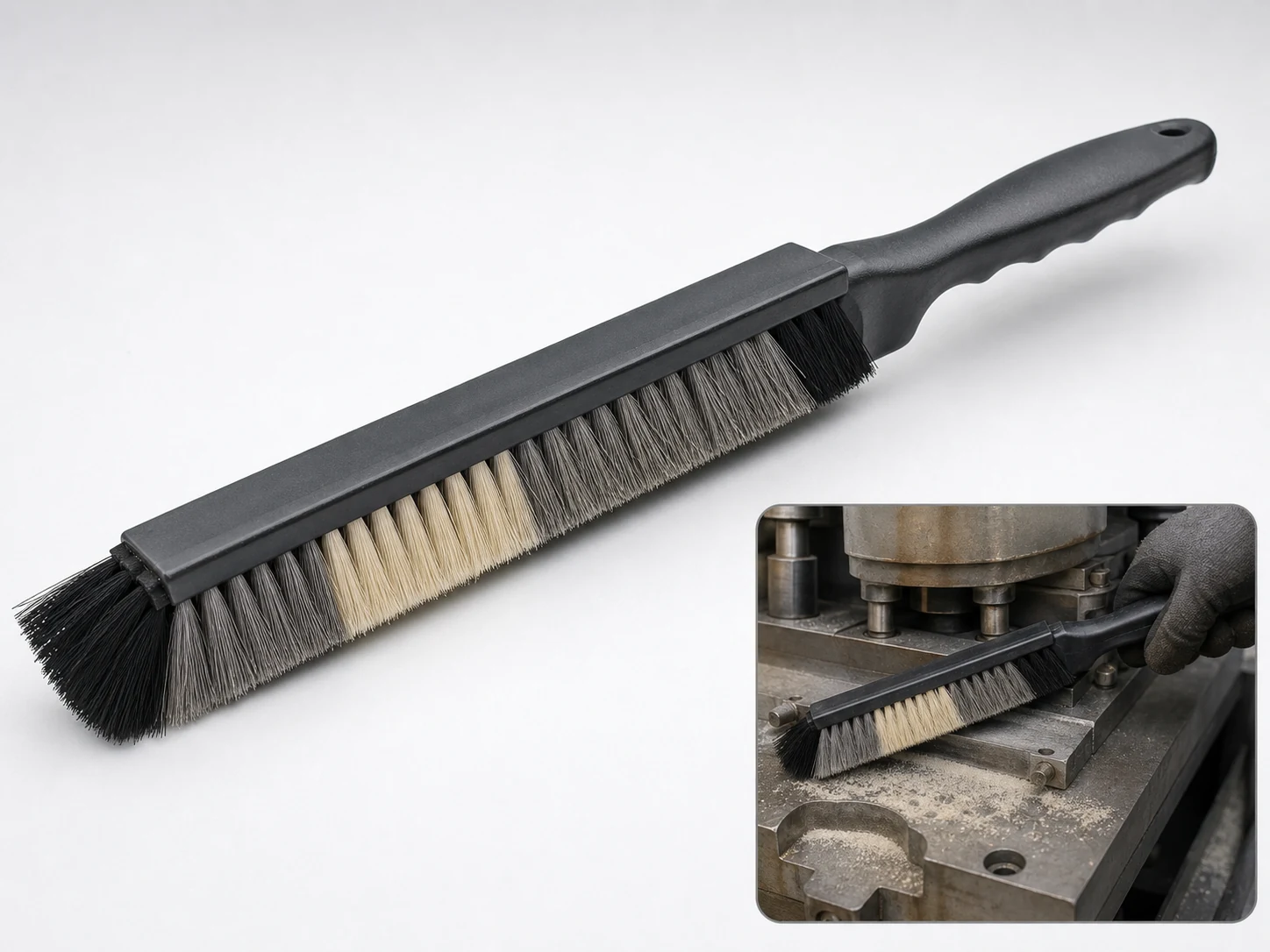
Custom powder press cleaning brushes with goat hair, microfiber, or nylon PA fills for tablet presses, powder metal presses, rollers, and change parts.
Small brush
500 pcs
Minimum order
Held in one hand: tube, bottle, detail and swab brushes — including long-handled ones with a small head.
Production lead time, once the specification is confirmed
- Up to 500 pcsWithin 7 days
- 501–50,000 pcsWithin 14 days
- Over 50,000 pcsWithin 21 days
Peak season can extend these times; the shipping date is confirmed in writing with your quotation. Sampling and shipping are quoted separately.
A precision maintenance brush for powder press changeovers and line upkeep, built with selectable goat hair, microfiber, and nylon PA fills to remove fine powder, oil films, fiber, and lightly bonded residue from compaction equipment without scratching finished surfaces. Choose hand, ferrule, thread, shank, bracket, or machine-bar mounting for manual or fixed wiping duty.
What can this brush do for you?
Captures fine powder instead of pushing it into the next station
Goat hair and microfiber tips hold fine dust at the contact line rather than flicking it into turret pockets, cam tracks, or adjacent stations. On dry die tables and feed frames, this keeps a changeover cleanup from turning into a second contamination spread.
Wipes oil and lubricant films without marring polished tooling
The soft natural and microfiber fills lift a thin grease or oil film from polished, lapped, or chrome-plated surfaces while leaving the finish intact. Nylon PA is reserved for spots where residue has built into a hard layer and needs firmer edge contact.
Reaches the gaps a rag cannot follow
Head widths from 10 mm and trims up to 100 mm let the brush follow narrow clearances around punch barrels, under feed frames, along guide rails, and into pocket corners. Chisel and angled faces put the fill into shoulders instead of sliding over them.
One fill package for manual and mounted cleaning
The same head configuration can be supplied on a hand handle for operator maintenance, on a ferrule or threaded end for extension reach, or on a bracket or slotted machine bar for a fixed wiper station. That keeps one replacement part for both routine PM and the press-side cleaning point.
Zone-mixed rows handle pickup and scraping in one stroke
Fill rows can be split so soft pickup material leads and firmer nylon follows at the edges. This removes loose powder and oil film while dislodging the compacted edge buildup that usually resists a single-material brush.
What is a Powder Press Cleaning Brush?
A powder press cleaning brush is a maintenance tool for exposed and semi-exposed surfaces on powder compaction and pressing lines, including rotary tablet presses, powder metal and ceramic presses, briquetting and compacting equipment, and adjacent belts, rollers, screens, drums, guides, and fixtures. It is not a compaction die component; it is the brush operators and maintenance crews use between batches, during product changeovers, and during scheduled preventive maintenance to remove powder carryover, lubricant film, fibers, coating residue, and light scale.
In service, the brush is drawn or stroked across die tables, feed frames, turret pockets, punch barrels, cam tracks, and guide faces, either dry or with a compatible solvent. The fill row contacts the surface, lifts fine material, and carries it out of the working zone. Dense short trims give control and cut pressure on flat surfaces; longer trims conform around curved rollers and drums; angled faces clean shoulders and pocket edges.
This is not a heavy descaler and not a substitute for final critical-surface wiping. Its value is controlled contact: enough firmness to lift residue from precision surfaces, but not enough to cut into hardened tooling, chrome plating, or polished finishes. In critical cleaning areas, it normally works ahead of vacuum extraction or lint-free wiping.
Technical Specifications
All dimensions, fills, and mountings can be adjusted to the machine and cleaning point. The table shows the standard working range for a custom powder press cleaning brush.
| Parameter | Value / Options |
|---|---|
| Head width | 10–100 mm, matched to the access gap between tooling, rails, or pockets |
| Working length | 20–300 mm, set by the contact zone the operator or wiper must cover |
| Trim length | 10–100 mm; short trims for controlled flat contact, longer trims for roller and drum conformability |
| Overall length | 120–400 mm, adjusted for hand reach, fixed mounting depth, or extension position |
| Filament diameter | 0.08–1.00 mm for nylon and microfiber; goat hair has a naturally tapered shaft and varies by grade |
| Fill materials | Goat hair, microfiber, nylon PA in single, alternating, or zone-mixed rows |
| Fill pattern | Straight, staggered, chisel or angle face, end tuft, notched side, or custom multi-zone layout |
| Mounting | Handle, threaded ferrule, plain ferrule, shank, bracket, or slotted machine bar |
| Core / body | Stainless steel wire or rod, aluminum channel, or polymer back selected for the cleaning environment |
| Use environment | Dry, light oil, or solvent-assisted cleaning; material and adhesive choices are matched to washdown or temperature exposure |
| Brush type | Custom Handheld Detail Brushes |
| How it is driven | Hand-guided |
| Cleaning target | rotary tablet press, densification line, and belt conveyor cleaning |
| Surface or part | punches, fixtures, tracks, roller, belts, metal, frames, and ceramic |
| Residue or debris | powder, oil, fiber, oil film, hair, scale, coating residue, and light scale |
| Mounting / connection | Handle, threaded ferrule, plain ferrule, shank, bracket, or slotted machine bar |
Specify the narrowest gap the head must enter and the residue to be removed when ordering; those two values determine the most important size and fill decisions.
Where does this brush work best?
- Rotary tablet presses: die table surfaces, turret pockets, punch barrels, feed frame bases, and cam tracks during product changeover, line clearance, or scheduled PM.
- Powder metal and ceramic compaction presses: powder feed shoes, die sets, core rods, guide rails, ejection paths, and surrounding fixtures where fine metallic or ceramic powder and lubricant residue collect.
- Briquetting, compacting, and densification lines: feed hoppers, metering surfaces, transfer points, and tool holders with compacted powder or polishing compound residue.
- Belt conveyors, rollers, screens, and drums: surfaces adjacent to pressing operations that collect dust, fibers, oil film, coating residue, and light scale.
- Change parts and fixtures: guides, spacers, nests, and mounting plates with corner buildup that cloths and flat wipes do not reach.
How do I choose the right one?
Work from the machine dimension, the residue, and the way the brush will be used.
Start with the narrowest opening
Measure the smallest gap the head must enter, between punches, cam tracks, guide rails, or fixture walls. The head width plus trim must pass through without wedging, but still contact the surface. If the head is too wide, the fill folds and the brush skips the area. If it is too narrow, cleaning takes multiple strokes and leaves streaks.
Match the fill to the residue and surface
| Cleaning condition | Recommended fill | Use note |
|---|---|---|
| Fine dry powder on polished, lapped, or coated surfaces | Goat hair | Softest contact, lifts fines with little scratch risk |
| Oil, grease, or mixed dust film | Microfiber | Wipes and holds film and particles for removal |
| Caked powder, coating residue, or light scale | Nylon PA | Firmer edge that breaks bonded material; use with care on very soft metals or sensitive coatings |
| Loose powder plus edge buildup in one pass | Zone-mixed rows | Soft center pickup with firmer nylon side rows |
Decide between hand use and fixed mounting
A handle is the right form for operator PM and toolroom cleaning. A threaded ferrule or shank suits extension rods and hard-to-reach upper or rear press faces. A bracket or slotted machine bar fits a fixed wiper station where the brush contacts a moving belt, roller, or turret surface on every cycle.
Check the environment before locking materials
Natural goat hair can mat and retain heavy oil or water, so reserve it for light oil or dry service. Microfiber is washable but needs the stem and adhesive to match the cleaning solution. Nylon PA is the most chemical-resistant option when solvent-assisted cleaning is part of the process.
When to use something else
Use a wire or abrasive brush when scale is heavy, carbonized, or fused and would simply shred a soft fill. Use a small-diameter tube brush for blind die bores, punch tip holes, or internal passages that a flat brush cannot enter. Use lint-free wipes or vacuum extraction for final critical-surface cleaning after the brush has lifted the gross residue.
Can I customize this brush?
Yes. Powder press cleaning brushes are specified to the machine and the cleaning point. Send the machine type, the surface or station to be cleaned, the minimum access gap, the residue type, whether cleaning will be dry or solvent-assisted, and the preferred mounting. A photo or drawing of the area shortens the specification work.
Adjustable elements
- Head geometry: width, length, trim, angled or chisel face, notched sides, end tuft, multi-width profile for mixed surfaces.
- Fill configuration: single material, alternating rows, soft pickup center with firmer edges, tuft density, and row spacing.
- Fill materials: goat hair grade and color, microfiber type and denier, nylon PA 6 or PA 6.6 in flagged or straight form.
- Core / back: stainless steel wire or rod, aluminum channel, or polymer back selected for corrosion, weight, and cleaning exposure.
- Mounting: handle shape and length, thread size, ferrule or shank dimensions, bracket with slotted holes, machine bar length and hole spacing.
- Marking and packaging: color-coded fills or handles for product or area identification, pad print or laser marking on the handle, bulk packing, or individually bagged packaging for cleanroom-adjacent storage.
If your project requires material declarations, inspection documents, or third-party testing support, we can assist with those requirements during the customization process.
When is a powder press cleaning brush worn out rather than just dirty?
What fill should I use on chrome-plated or polished tooling?
Choose goat hair for dry fine powder and microfiber for oily films. Nylon PA is harder than either and can dull a bright finish or create fine marks if pressed hard. If a nylon edge is needed on stubborn residue, use a zone-mixed brush and keep the nylon contact on the residue, not on the polished surface around it.
Can I use solvents or degreasers with this brush?
Short-contact solvent use is generally acceptable if the fill and the stem adhesive are specified for it. Goat hair should not be soaked for long periods because the natural fiber can swell and mat. For wet or solvent-heavy cleaning, select microfiber or nylon PA with a solvent-rated adhesive and a corrosion-resistant core.
How can I check that the brush will not shed fibers into the powder?
Run a pull test on a sample: grip a tuft and tug firmly; properly set bristles should stay anchored. Follow with a tape-lift check by pressing clear tape against the fill and inspecting for loose fibers. If any bristles release under normal hand force, retire the brush from product-contact areas.
Should I use the same brush on different product lines?
Consider dedicating brushes by product or material whenever cross-contamination is a risk. Color-coded fills or handles make assignment visible at the press. Between uses, clean and dry the brush completely before moving it to another line.
Will this brush clean inside die bores and blind punch holes?
No. A flat or strip brush reaches exposed faces, pockets, and shoulder edges, but it cannot follow a full internal bore or blind hole. Use a small-diameter tube or twisted-in-wire brush for those passages, and keep the powder press cleaning brush on the accessible surfaces around them.
How should the brush be stored between maintenance shifts?
Store it hanging or resting fill-side up, away from oil mist, open powder, and high-traffic areas. Keep natural goat hair dry and away from strong solvents. If the fill has been contaminated with oil or mixed product, clean and dry it before returning the brush to service.
Guides that go deeper on this
We have not written a guide specific to this one yet. The material that covers selection, filament, dimensions, maintenance and sourcing is collected in the technical resources library.
Custom Manufacturing RFQ
Describe Your Application
For a custom quote, we need the key dimensions, surface or part, residue, material preference, quantity, and reference image or drawing.
Drawing or photo optional — it speeds things up, it does not gate the enquiry.
Custom Brush RFQ
Send Your Brush Project
Upload a drawing, product photo, or sample photo and provide the core dimensions and cleaning conditions.
“We need a brush to remove wet residue from a stainless steel conveyor, about 800mm wide. The current brush wears quickly. We can send photos.”
“We sell drinkware and need a cleaning brush to include with the product. Quantity around 5,000 pieces.”