
Material
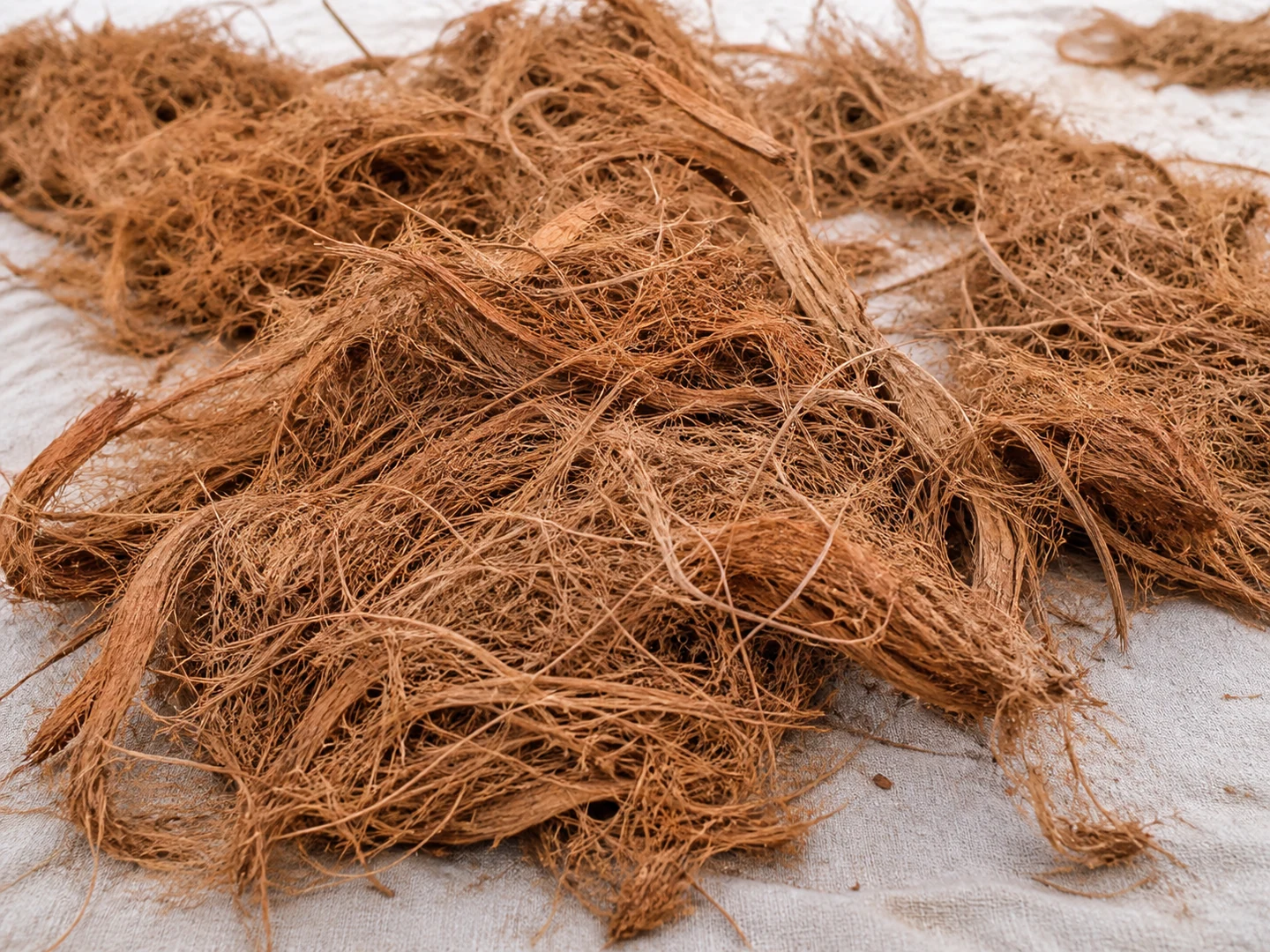
Coconut Coir Fiber
Natural plant fiber
Choose Coconut Coir Fiber based on its stiffness, recovery, wear, wet-service, chemical, and temperature behavior. For a usable stiffness specification, provide the material, filament diameter, free trim, density, grade, and operating conditions.
Datasheet values
- Fiber form
- Natural coconut coir
- Hardness
- No uniform Shore or Rockwell hardness applies to natural coir fibers
- Moisture behavior
- Moisture absorbing; uptake depends on fiber condition and treatment
- Temperature use
- No universal continuous brush-service value; validate the actual thermal cycle
Coconut Coir Fiber is used as brush fill or contact media where its property profile fits the cleaning duty.
What is Coconut Coir Fiber, and what makes it different from other brush filaments?
Coconut Coir Fiber belongs to the natural plant fiber group, supplied as filament, strip fill, roller fill, drawn in natural porous and irregular sections and set in straight rows, staggered, zoned and random fill patterns.
Coconut Coir Fiber is a custom brush contact material selected by filament or blade geometry, temperature, moisture, chemicals and surface risk.
Change material when temperature, chemicals, static, shedding or surface marking becomes limiting.
What stiffness and contact pressure can I expect from Coconut Coir Fiber?
Coconut coir has no Shore or Rockwell figure — natural fibres are not measured on those scales, and a single number quoted for one would be made up. What can be stated is this: coir is a coarse plant fibre, stiff for a natural fibre, with low to medium flexibility in the tuft, and it carries water well. Stiffness in a coir brush comes from fibre grade, bundle density and free trim, and it is confirmed by sample rather than by a hardness number.
The part people get wrong: stiffness is not a property of the material on its own. A 0.50 mm filament on a 15 mm trim is stiffer than a 0.30 mm filament on a 25 mm trim in the same grade. Fix diameter and trim first, then confirm the material.
How does water affect Coconut Coir Fiber performance?
Coir takes up roughly 8–15% moisture, and the figure moves with fiber condition and any treatment, so ask for data on the batch you are actually buying.
Coir absorbs moisture; uptake varies with fiber condition and treatment, so use supplier or test data for the actual fiber batch and process.
What this means for your application: the filament grows and softens as it takes on water, and tip pressure goes with it. The reach you measured dry is not the reach you get wet.
A practical check: soak a sample for an hour and re-measure the trim. If it has moved enough to change the contact band, the grade is wrong for the duty.
What temperature limits apply to Coconut Coir Fiber?
Do not assign a universal continuous or peak brush-service temperature to coir. Thermal studies show moisture loss below about 150°C and major decomposition at higher temperatures; actual brush use must be validated at much lower process conditions.
Where it stops working: A permanent bend under load means the answer is a higher-temperature filament family, not a heavier trim.
The usable limit also moves with diameter, trim and contact pressure. A fine filament under light load tolerates more than a thick one under heavy scrubbing.
What chemicals attack Coconut Coir Fiber?
Fiber treatment changes coir moisture and mechanical behavior. Validate the exact cleaner, concentration, temperature, exposure time, and drying cycle rather than using a generic chemical-resistance label.
The same cleaner can be harmless or destructive depending on how strong it is, how hot it runs and how long it sits. Quote the concentration and the dwell time, not just the product name.
Before you commit to a quantity: Use resin or alloy grade TDS, ISO/ASTM property method and lot traceability when specified.
What is the practical lower limit for filament diameter?
About 0.10 mm. Below that the filament turns fragile and breaks under ordinary contact pressure, so 0.10–0.50 mm is the working range.
Free trim runs 15–250 mm, and the two interact: a finer filament needs a shorter trim to keep useful stiffness, while a thicker one carries a longer trim and still lands pressure on the tip.
Split the range by duty: roughly 0.10–0.2 mm for light wiping, dusting and surfaces that mark easily, and 0.2–0.50 mm where residue is packed on and point pressure matters more than surface risk.
Tip treatments available on this filament: cleaning, carding, dyeing, anti-mildew treatment and oiling.
In practical brush terms: reaching deep into a bore or crevice is a diameter problem before it is a length problem. A thicker filament on a moderate trim pushes further in before the tips fold over.
What applications typically use Coconut Coir Fiber?
Custom cleaning brushes requiring Coconut Fiber for its mechanical, temperature, moisture or chemical behavior.
The applications that keep coming back to this grade:
- Floor Scrubbing
- Heavy Grease Industrial Floor Cleaning
The constructions that usually carry it:
- Custom Floor Scrubber Sweeper Brushes
The trade-off: Natural-fiber behavior varies with fiber condition, treatment, moisture, trim, density and process temperature; validate repeated wet or chemical service for the actual brush.
How do I specify Coconut Coir Fiber for a custom brush?
A usable specification carries the construction, the filament diameter and free trim, the density and contact setting, and the service conditions: wet or dry, temperature, and what the cleaner actually is.
The mistakes that most often send a sample back:
- Selecting only by material name without defining diameter, trim, density, engagement and operating conditions
Reference standards behind the figures on this page: ISO 139; ISO 5079; ISO 20743.
Source: Coir Board of India — Coir Fibre. Coir Board supports coir/bristle fibre as a natural coconut-husk fibre. Thermal, moisture and chemical behavior still depends on fibre condition and treatment; no universal finished-brush temperature is claimed.
What else does the datasheet specify for Coconut Coir Fiber?
| Filament cross-section | Natural Porous / Irregular |
|---|---|
| Electrical behaviour | Anti-Static When Wet; Insulating When Dry |
| Continuous service temperature (°C) | 70–90 |
| Peak temperature (°C) | 110–130 |
Questions this page is asked
Which details should define coconut coir used in brush fill?
State whether the fibre is retted white or mature brown coir, extraction and treatment method, length distribution, bristle-fibre fraction, color, impurity limit, moisture condition, diameter or bundle range where controlled, and lot. Use the applicable official grade or an agreed incoming method because the words natural coir do not control pith, short fibre, sand or process history.
What should a repeated wet and dry trial verify for coir fill?
Cycle the complete brush through the actual water or cleaner, dwell, mechanical work, rinse and installed drying orientation while recording mass or moisture return, contact force, recovery, length loss, loose fibre and odor. Release reuse only when the brush reaches its defined dry state and repeats the cleaning result, since retained moisture and natural-fibre damage can vary between lots.
How should coir be checked for cleaner and surface compatibility?
Test each controlled fibre treatment with the named cleaner, concentration, temperature and exposure time on the representative surface, including repeated contact and rinse cycles. Inspect discoloration, dye or natural-extract transfer, residue, scratching, swelling, fibre breakage and finish change, then keep acceptance tied to that fibre lot and treatment rather than to coir as a whole.
Guides that go deeper on this
No catalogue item for this yet
Every brush here is made to order, and this one has no catalogue entry so far. Send the working surface, the residue, the access opening and the quantity, and it is quoted through the same specification route as the rest of the range.
Custom Manufacturing RFQ
Discuss This Material
Share the working surface, residue, dimensions, material direction, interface, quantity and drawing or sample photo.
Custom Brush RFQ
Request a Custom Cleaning Brush Quote
Upload a drawing, product photo, or sample photo and provide the core dimensions and cleaning conditions.
“We need a brush to remove wet residue from a stainless steel conveyor, about 800mm wide. The current brush wears quickly. We can send photos.”
“We sell drinkware and need a cleaning brush to include with the product. Quantity around 5,000 pieces.”