
Custom Cleaning Brush
Plastic Flake Washing Brush
Wet-process roller brush for PET, HDPE and PP flake washing. Scrubs labels, adhesives and fines. Custom cores, filaments and windings.
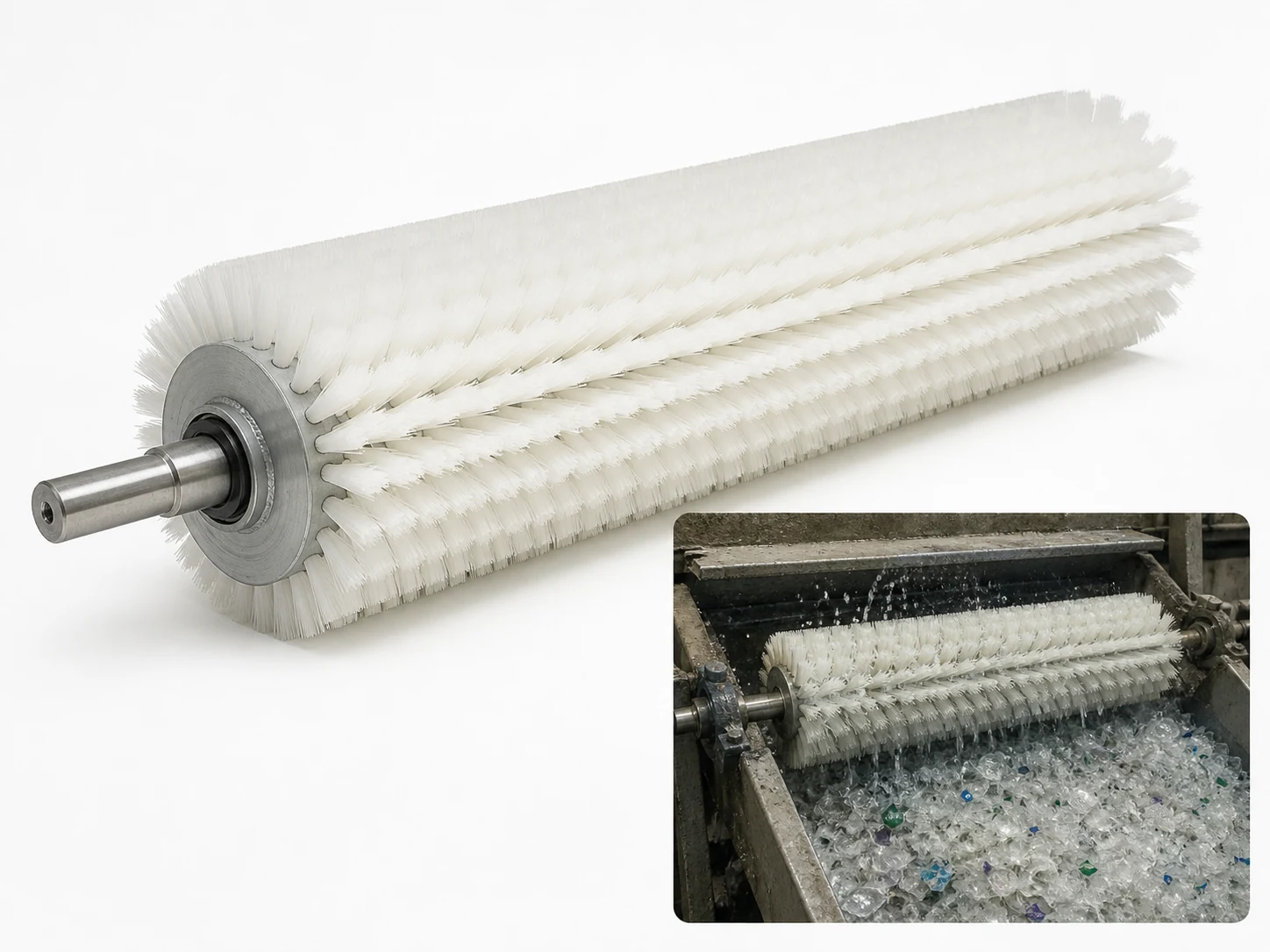
Large-format brush
100 pcs
Minimum order
Built one at a time on a core or channel: full-width rollers, sweeper brooms and long strip.
Production lead time, once the specification is confirmed
- Up to 100 pcsWithin 20 days
- 101–1,000 pcsWithin 30 days
- Over 1,000 pcsConfirmed with your quotation
Peak season can extend these times; the shipping date is confirmed in writing with your quotation. Sampling and shipping are quoted separately.
A wet-process industrial roller brush engineered for plastic flake washing lines. It scrubs dirt, labels, adhesives, paper fibers, oils and fines from PET, HDPE and PP flakes while giving you control over cleaning aggressiveness and conveying action.
What can this brush do for you?
Dense Filament Face Scrubs the Entire Flake Surface
The brush is wound with a high filament count across the working width, so every flake passing through the contact zone is hit by many filament tips. This continuous contact is what removes paper label fibers and loosens adhesive before the wash water carries them away.
Filament Tips Shear Off Labels, Not the Flakes
Polymers like PET and PP are chosen to be stiff enough to peel labels and rub off dirt, but flexible enough to deflect rather than crush the flakes. This balance keeps your flake size distribution intact and avoids generating excessive fines that would have to be screened out later.
Wet-Process Materials Survive Hot Water and Chemicals
PET polyester, polypropylene and nylon filaments are all selected for submerged washing environments. Depending on your water temperature and chemical dosing, we match the filament so it keeps its stiffness and does not soften, swell or break down during continuous duty.
Winding Pattern Sets Cleaning vs Conveying
Close winding gives maximum scrubbing density for stationary or slow-moving contact. Pitch winding or helical strip construction adds a conveying component, so the same brush can move flakes forward through a washing trough while it cleans. You can choose the pattern to match your machine’s flow direction and retention time.
Built to Your Machine Drawing
The core, shaft journals and overall dimensions are taken directly from your equipment drawings. This eliminates wobble, reduces vibration and speeds up installation, because the brush arrives ready to drop into the existing bearing and drive positions.
What is a Plastic Flake Washing Brush?
A plastic flake washing brush is a cylindrical roller brush or a set of strip brushes mounted on a rotating shaft inside a wet washing system for recycled plastic flakes. It is installed in friction washers, paddle washers, washing troughs or flake conveyors, where its filament tips contact the flakes as they pass through water.
The brush does two jobs at once: mechanical scrubbing and flake transport. The filament face rubs the flake surfaces to dislodge dirt, adhesive, label fibers and organic residue, while the winding pattern and rotation speed control how fast flakes move through the contact zone. This combination is what allows a washing line to handle large volumes of mixed flake without manual cleaning.
This is not a dry brush for conveying virgin pellets, and it is not a wire brush for stripping baked-on carbon. It is a wet-process polymer filament brush designed for continuous immersion, chemical exposure and constant contact with abrasive fines. The right configuration depends on your flake polymer, flake size, water temperature, chemical type, required residence time and the amount of contaminant you need remove.
Technical Specifications
| Parameter | Value / Options |
|---|---|
| Fill materials | PET polyester, polypropylene (PP), nylon (PA) |
| Filament diameter | PET: 0.2–0.8 mm; PP: 0.07–2.0 mm; Nylon: 0.05–1.2 mm (project-selected for aggressiveness) |
| Brush OD (tip diameter) | Set from machine drawing and housing clearance; typically 100–400 mm for flake washing rollers |
| Working length (face width) | Matched to tank or trough width; up to 2500 mm per section |
| Core OD and construction | Steel tube, stainless steel 304/316, or polymer core; OD per shaft size |
| Shaft / journals | Solid shaft, hollow shaft with keyway, end journals with bearings or flanges per drawing |
| Winding pattern | Close wound, pitch wound, or helical strip-roller |
| Engagement (tip deflection) | Set by process trial; no fixed 2–10 mm rule applies |
| Operating environment | Submerged wet washing, chemical and detergent exposure, abrasive fines |
| Temperature range | PP up to 80°C; PET up to 100°C; Nylon up to 120°C in fresh water (chemical exposure reduces limits) |
| Brush type | Custom Roller and Conveyor Brushes |
| How it is driven | Machine-driven, mounted in the equipment |
| Cleaning target | pet bottle flake washing, friction washer and paddle washer, and rinse and dewatering feed section cleaning |
| Surface or part | roller, plastic, conveyors, containers, and housings |
| Residue or debris | fines, adhesive, fiber, labels, paper fibers, oil, pitch, and milk |
| Mounting / connection | Shaft-Mounted / Fixed |
Because these brushes are machined to the washing machine, the table shows the selection range. The actual build values come from your drawing and process parameters.
Where does this brush work best?
- PET bottle flake washing — scrubbing label paper, hot-melt adhesive and surface dirt from flakes before or after the hot caustic wash stage.
- HDPE and PP container regrind washing — cleaning milk jugs, shampoo bottles, caps and crates after granulation.
- Friction washers and paddle washers — high-turbulence zones where brush rollers increase flake-to-flake and flake-to-brush contact.
- Rinse and dewatering feed sections — dislodging loosened fines and residual contaminants after the main wash.
- Transfer troughs and inclined conveyors — helical or pitch-wound brushes that convey flakes while providing residual cleaning action.
How do I choose the right one?
Start with the machine envelope
Measure the shaft diameter, bearing centers, housing clearance and available brush OD. The brush OD minus engagement should fit inside the machine without touching stationary walls. Working length must cover the full flake path width. These dimensions come from the machine drawing; if you don’t have a drawing, we will ask for a sketch with measurements.
Match filament material to temperature and chemistry
| Material | Stiffness | Best for | Watch out for |
|---|---|---|---|
| PET polyester | Medium | General-purpose washing, good chemical resistance, high wet modulus | Not for very high impact contact with hard contaminants |
| Polypropylene PP | Low–medium | Cold and warm water, highly chemical resistant, cost-effective | Softens above 80°C; lower scrubbing force |
| Nylon PA | High | Hot water up to 120°C, high abrasion, aggressive label removal | Absorbs water, swells, loses stiffness in strong caustic; may be over-aggressive for thin flakes |
Choose the material that keeps enough stiffness at your operating temperature without damaging flakes. If you need more stiffness, go to nylon or increase filament diameter; if you need gentler action, PP or smaller diameter.
Select winding pattern and density
Close winding for maximum scrub coverage and stationary or slow contact. Pitch winding when you need to let water and debris pass and want less resistance. Helical strip for conveying and cleaning at the same time in a screw or paddle washer.
Set engagement from process results
Start with the brush just touching the flake bed or housing surface, then increase filament tip deflection in small steps. Watch label removal and flake breakage. If labels remain, increase engagement or filament diameter; if you see excessive fines or flake curling, reduce engagement or switch to a softer filament. There is no universal 2–10 mm rule; the correct engagement is the one your process trial proves.
When this brush is not the right tool
Use a different cleaning method if you need to remove heavy glue lumps or very hard mineral scale that requires metal brushes; if your process is dry, use a dry cleaning brush with dust collection; if flakes are very fine powder, a wet scrubber may be better. Also if the washing line operates above 120°C or uses strong solvents that attack all common polymers, you may need a specialty material.
Can I customize this brush?
Every plastic flake washing brush is built to the washing machine. We will need your machine drawing, shaft diameter, housing clearances, flake polymer and size range, water temperature, chemical type and concentration, desired engagement and rotation speed. A process description or a damaged brush sample also helps.
- Core and mounting — steel tube, stainless steel 304/316, polymer core; solid or hollow shaft; keyways, set screws, end journals, flanges, drive couplers
- Brush dimensions — outside diameter, working length, core OD, overall length, journal length
- Filament selection — PET, PP, nylon; diameter, length, crimp or straight filament, trimmed or untrimmed
- Winding pattern — close wound, pitch wound, helical strip, multi-row, or segmented strip brush assembly
- Engagement and trim — filament tip profile, cut depth, tip treatment (flagged, straight, abrasive-impregnated)
- Color and marking — custom filament color for line identification, core marking, laser or ink marking
- Packaging — bulk, individual crate, palletized, or project-specific packing with protection for journals
If your project requires material documentation, inspection reports, or third-party testing, we can support those requirements during the customization process.
How long does a plastic flake washing brush last, and how is it cleaned between runs?
How do I know if the brush is set too aggressively?
Check the flakes after the washing stage. If you see a measurable increase in fines, curled edges, or a drop in flake size, the engagement or filament diameter is too high. Reduce tip deflection or switch to a softer filament. Label removal should happen without visible damage.
Can I run the same brush in hot and cold water?
Not always. PP filaments soften above 80°C, so they are not suitable for hot caustic stages. PET and nylon handle higher temperatures, but nylon can lose stiffness in strong alkali. If your line has both hot and cold sections, you may need different filament materials for each section, even if the core and mounting are identical.
How often should I replace the brush?
Measure the remaining filament length. When filament tips have worn down by 30–40% from new, scrubbing pressure drops and labels begin to survive. Modular strip brushes can be re-stripped without replacing the core; full roller brushes are typically replaced as a unit. Base replacement on measured cleaning performance, not a fixed time.
What if my brush is not removing all the labels?
Before changing the brush, check three things: Is the engagement deep enough? Is the water temperature correct for the adhesive type? Is the filament material too soft? If all three are correct, you may need to increase filament stiffness or switch from pitch to close winding to increase contact time.
Does the brush need to rotate, or can it be stationary?
It can be either. A rotating brush provides higher scrubbing speed and works well inside paddle washers. A stationary brush mounted in a trough acts as a fixed scrubbing surface as flakes are pushed past it. The choice depends on your machine design and available drive power. Our team will match the construction to your motion type.
Can this brush be used for dry flake cleaning?
No. This brush is designed for wet washing with water and detergent. Dry flake cleaning requires different brush geometry and dust management, and polymer filaments may build static charge or become brittle in dry, high-friction service. Use a separate dry-cleaning brush for that application.
Guides that go deeper on this
Custom Manufacturing RFQ
Describe Your Application
Please include the main sizes, application, residue, preferred material, interface, quantity, and any drawing or sample available.
Drawing or photo optional — it speeds things up, it does not gate the enquiry.
Custom Brush RFQ
Send Your Brush Project
Upload a drawing, product photo, or sample photo and provide the core dimensions and cleaning conditions.
“We need a brush to remove wet residue from a stainless steel conveyor, about 800mm wide. The current brush wears quickly. We can send photos.”
“We sell drinkware and need a cleaning brush to include with the product. Quantity around 5,000 pieces.”