
Custom Cleaning Brush
Shaver Head Brush
Custom Shaver Head Brush with fine nylon or anti-static filaments for foil and rotary shaver cleaning.
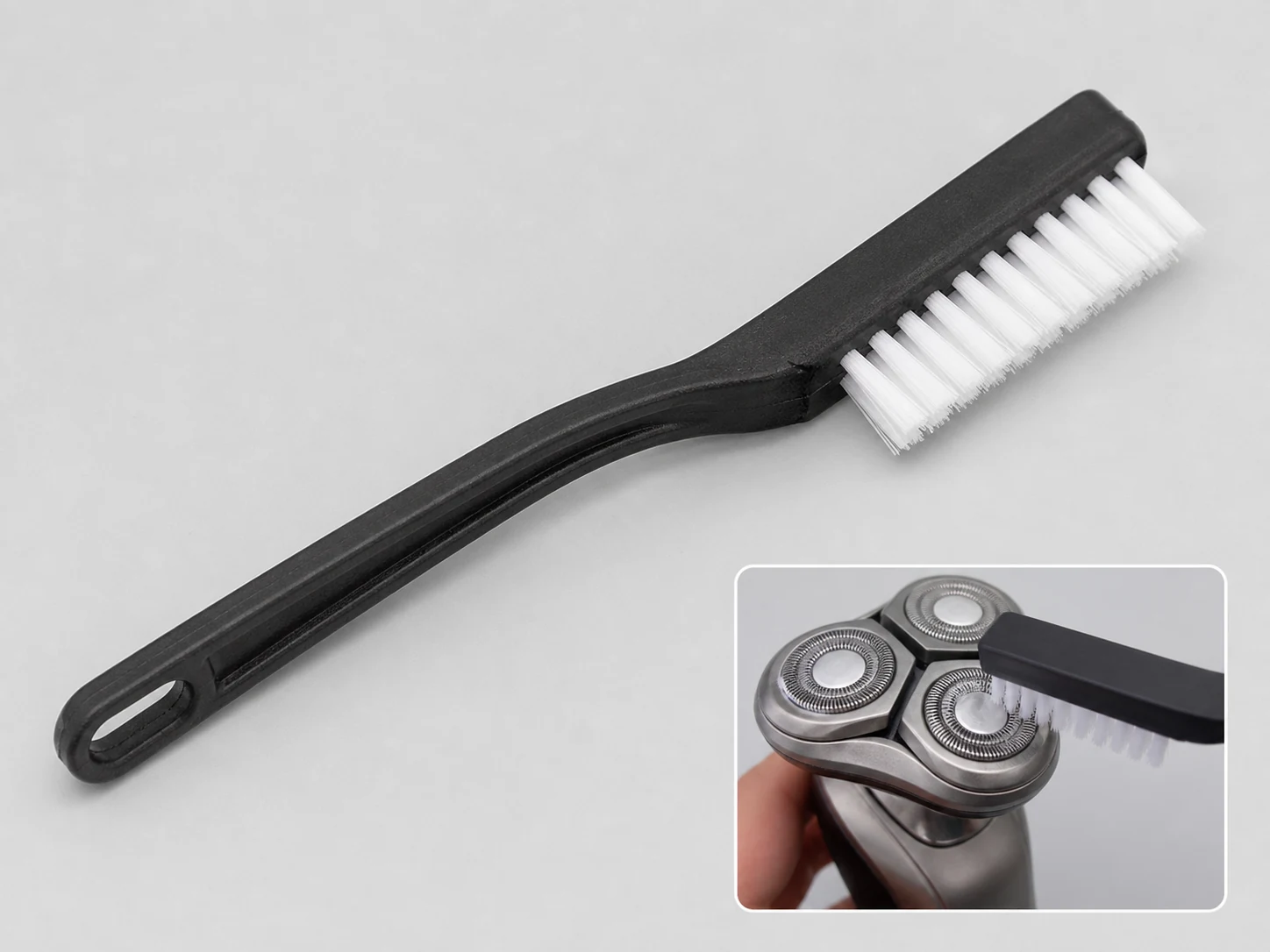
Small brush
500 pcs
Minimum order
Held in one hand: tube, bottle, detail and swab brushes — including long-handled ones with a small head.
Production lead time, once the specification is confirmed
- Up to 500 pcsWithin 7 days
- 501–50,000 pcsWithin 14 days
- Over 50,000 pcsWithin 21 days
Peak season can extend these times; the shipping date is confirmed in writing with your quotation. Sampling and shipping are quoted separately.
A precision cleaning brush engineered for electric shaver heads — fine-diameter nylon or anti-static filaments remove cut hair, skin flakes, and light grooming residue from foil frames, cutter assemblies, and trimmer cavities without scratching delicate components.
What can this brush do for you?
Fine Filaments Enter Foil Mesh and Micro-Gaps
Filament diameters from 0.08 mm reach into foil perforations and between cutter teeth where conventional brushes cannot enter. The result is thorough removal of trapped hair and debris that would otherwise clog the cutting system and reduce shaver performance.
Gentle Contact Protects Foils and Coatings
Nylon PA and PBT filaments are softer than wire, preventing scratches on foil surfaces and preserving cutting performance. For thin or coated foils, softer filament grades flex on contact instead of deforming the screen, so the brush cleans without creating new wear points.
Anti-Static Option Prevents Debris Re-Attachment
Anti-static filaments dissipate static charge, so cut hair and skin flakes release during brushing instead of clinging back to the surface or to the brush itself. This is particularly useful in dry, low-humidity environments where static buildup makes standard nylon brushes less effective.
Compact Head Reaches Trimmer Cavities and Recesses
Head widths as narrow as 3 mm and working lengths up to 80 mm allow the brush to enter narrow trimmer slots, pop-up trimmer channels, and plastic housing recesses that general-purpose brushes cannot access. One brush geometry can cover the foil, cutter, and trimmer areas in a single pass.
Configurable Interface for Hand or Machine Use
Choose a simple handle for manual cleaning, a snap-in head for tool holders, a D-shaft for rotary drive, or a custom socket for automated cleaning stations. The brush integrates into existing shaver head cleaning fixtures without redesigning the surrounding equipment.
What is a Shaver Head Brush?
A Shaver Head Brush is a small, specialized cleaning brush built for the internal surfaces of electric shaver heads — both foil and rotary cutter systems. It is used by appliance manufacturers during production cleaning, by service centers during repair, and in aftermarket cleaning kits sold with grooming devices. The brush contacts the foil frame, inner cutter, trimmer comb, and surrounding plastic housing to lift away cut hair, skin flakes, dust, and light grooming oils.
During use, the operator or machine guides the brush across the head surfaces. Fine filaments flex into mesh openings and micro-gaps, dislodging debris with a light sweeping motion. The brush is primarily a dry-cleaning tool; it does not replace washing or sanitizing steps, but it removes the bulk debris that clogs cutter movement and reduces shaving quality. Use light pressure — heavy scrubbing can deform thin foils or dull cutter edges.
The right configuration depends less on the shaver brand than on the specific head geometry, foil perforation size, cutter slot width, and whether the brush is used manually or in an automated fixture. A brush matched to these parameters cleans more completely with fewer strokes and lower risk of surface damage.
Technical Specifications
| Parameter | Typical Options / Range |
|---|---|
| Head width | 3–30 mm, matched to shaver head cavity width |
| Working length | 10–80 mm, set by cutter depth and recess reach |
| Overall length | 50–150 mm for hand tools; shorter or longer for machine mounting |
| Trim height | 5–25 mm, controlling bristle length exposed from base |
| Filament diameter | 0.08–0.35 mm; finer for foil mesh, thicker for trimmer channels |
| Filament material | Nylon PA6, PA6.6, PBT, or anti-static filament |
| Bristle density | Configurable tuft pattern, from sparse for delicate foils to dense for deeper cleaning |
| Interface | Handle, snap-in head, D-shaft, gear, end cap, or custom socket |
| Operating temperature | 5–100°C (filament dependent) |
| Color | Natural, black, white, or custom for identification |
| Brush type | Custom Handheld Detail Brushes |
| How it is driven | Hand-guided |
| Cleaning target | electric shaver production line, grooming appliance service center, and aftermarket cleaning kit cleaning |
| Surface or part | cavities, trimmer cavities, slots, foil frames, recesses, comb, fixtures, and housings |
| Residue or debris | hair, cut hair, skin flakes, dust, oil, fiber, and shavings |
| Mounting / connection | Handle, snap-in head, D-shaft, gear, end cap, or custom socket |
All dimensions and materials are project-configurable. When you provide a sample shaver head or a drawing showing cavity dimensions, perforation size, and trimmer location, we adjust the brush geometry and filament selection to match the actual cleaning task.
Where does this brush work best?
- Electric shaver production lines: final cleaning of assembled shaver heads before packaging, removing manufacturing dust, test debris, and stray fibers.
- Grooming appliance service centers: routine maintenance brushes for foil shavers, rotary shavers, and body groomers, reducing service time and improving cleaning consistency.
- Aftermarket cleaning kits: small brush included with shaver purchase or sold as an accessory for user maintenance, sized to fit the original head cavity.
- Trimmer and clipper head care: cleaning pop-up trimmer cavities and comb slots on multi-grooming devices where hair packs tightly into narrow recesses.
- Automated cleaning stations: brush heads mounted on rotary or linear actuators for high-volume cleaning in factories, with interface options to match existing drive systems.
How do I choose the right one?
Measure the shaver head cavity first. Record the internal width, depth, and any partitions or obstructions. The brush head must fit without forcing, leaving 0.5–2.0 mm clearance from sensors or fragile foils when used in an automated fixture. A drawing or sample of the shaver head shortens this step significantly.
Match filament diameter to the cleaning target. Foil shavers have micro-perforations — use 0.08–0.15 mm filaments to enter holes without pushing against the foil. Rotary cutters with larger slots can handle 0.2–0.35 mm filaments for more effective debris removal. Trimmer channels often need stiffer, thicker filaments to dislodge packed hair.
Select material based on static and chemical exposure. Nylon PA6 offers good wear resistance; PBT has lower moisture absorption and better dimensional stability in humid environments. Anti-static filaments prevent hair reattachment in dry, low-humidity conditions. If any cleaning solvent or disinfectant will contact the brush, specify it so we select a compatible base and bonding method.
Decide on the interface. For manual brushing, a simple handle is enough. For machine integration, choose D-shaft, snap-in, or custom socket to fit your existing actuator or cleaning head. The interface must hold the brush rigidly during use without introducing vibration that could break fine filaments.
When to use a different cleaning tool. If the shaver head has baked-on deposits, heavy oil, or mineral scale, brushing alone may not be sufficient — ultrasonic cleaning or chemical soaking may be required first. Wire brushes should be avoided on shaver foils because they scratch the thin metal screen. For purely metallic debris or sharp burrs on non-foil components, a fine wire brush may be appropriate, but not on the cutting surfaces.
Can I customize this brush?
Shaver head brushes are configurable because every shaver model has different cavity geometry, foil perforation patterns, and trimmer designs. To define a custom brush, provide the shaver head drawing or sample, the target debris type, the cleaning cycle speed if automated, and any environmental conditions such as humidity or chemical exposure.
We can adjust:
- Head geometry — width, working length, shape, taper, and profile to match the exact cavity and reach trimmer recesses.
- Filament specifications — material (nylon PA, PBT, anti-static), diameter, trim height, tuft pattern, bristle density, and color.
- Interface and handle — straight or ergonomic handle, loop, snap-in head, D-shaft, gear, end cap, custom socket, or overmolded grip.
- Marking — pad print, laser marking, molded logo, or identification coding for model differentiation.
- Packaging — bulk, individual polybag, retail blister pack, or kit-specific packing for aftermarket sales.
For production programs that require material declarations, inspection reports, or third-party testing, we can support those project-specific documentation needs during the customization process.
Which filament survives the cleaning and still lasts on a shaver head brush?
How do I check whether the brush is removing hair effectively without damaging the foil?
Inspect the foil under magnification after brushing. If hair remains in perforations, the filament diameter may be too large or the trim height too short to reach the bottom of the holes. If the foil shows scratches or deformation, the filament is too stiff or the applied pressure too high. Test with a small sample batch and adjust the filament specification before full production.
What is the difference between anti-static and standard nylon filaments for this application?
Standard nylon can build static charge during brushing, causing cut hair and skin flakes to cling to the brush or reattach to the shaver head. Anti-static filaments contain a dissipative additive that allows charge to bleed off, improving debris release and keeping the brush cleaner between strokes. Use anti-static for dry environments or when the residue is very fine.
Can this brush be used with wet cleaning or disinfectant solutions?
Nylon and PBT filaments resist many mild cleaning agents and water, but the base material and tuft bonding method must be specified for wet use. Dry brushing is typical for shaver heads. If your process includes a wet cleaning step, choose a fully bonded construction with a water-resistant base. Note that brushing does not sterilize; disinfection remains a separate step if required.
How often should the brush be replaced in a service center or production line?
Monitor filament wear: when tips become rounded, collapsed, or filaments start breaking off, cleaning effectiveness drops and replacement is needed. In high-volume production, set a cycle-based replacement schedule after validating brush life with your quality team. Bent or missing filaments leave debris behind and increase the risk of damaging delicate foils.
When is ultrasonic cleaning a better option than this brush?
Ultrasonic cleaning can reach blind holes and dissolve residues that mechanical brushing cannot dislodge. Use ultrasonic cleaning for heavy oil, caked debris, or when the shaver head has inaccessible internal channels. Brushes are better for quick, manual, or automated removal of loose hair and skin flakes without fluid handling or drying time.
Guides that go deeper on this
Custom Manufacturing RFQ
Describe Your Application
Please share the brush dimensions, working area, residue type, material direction, quantity, and a drawing or photo for quotation.
Drawing or photo optional — it speeds things up, it does not gate the enquiry.
Custom Brush RFQ
Send Your Brush Project
Upload a drawing, product photo, or sample photo and provide the core dimensions and cleaning conditions.
“We need a brush to remove wet residue from a stainless steel conveyor, about 800mm wide. The current brush wears quickly. We can send photos.”
“We sell drinkware and need a cleaning brush to include with the product. Quantity around 5,000 pieces.”