
Custom Cleaning Brush
180mm Conductive PCB Disc Brush
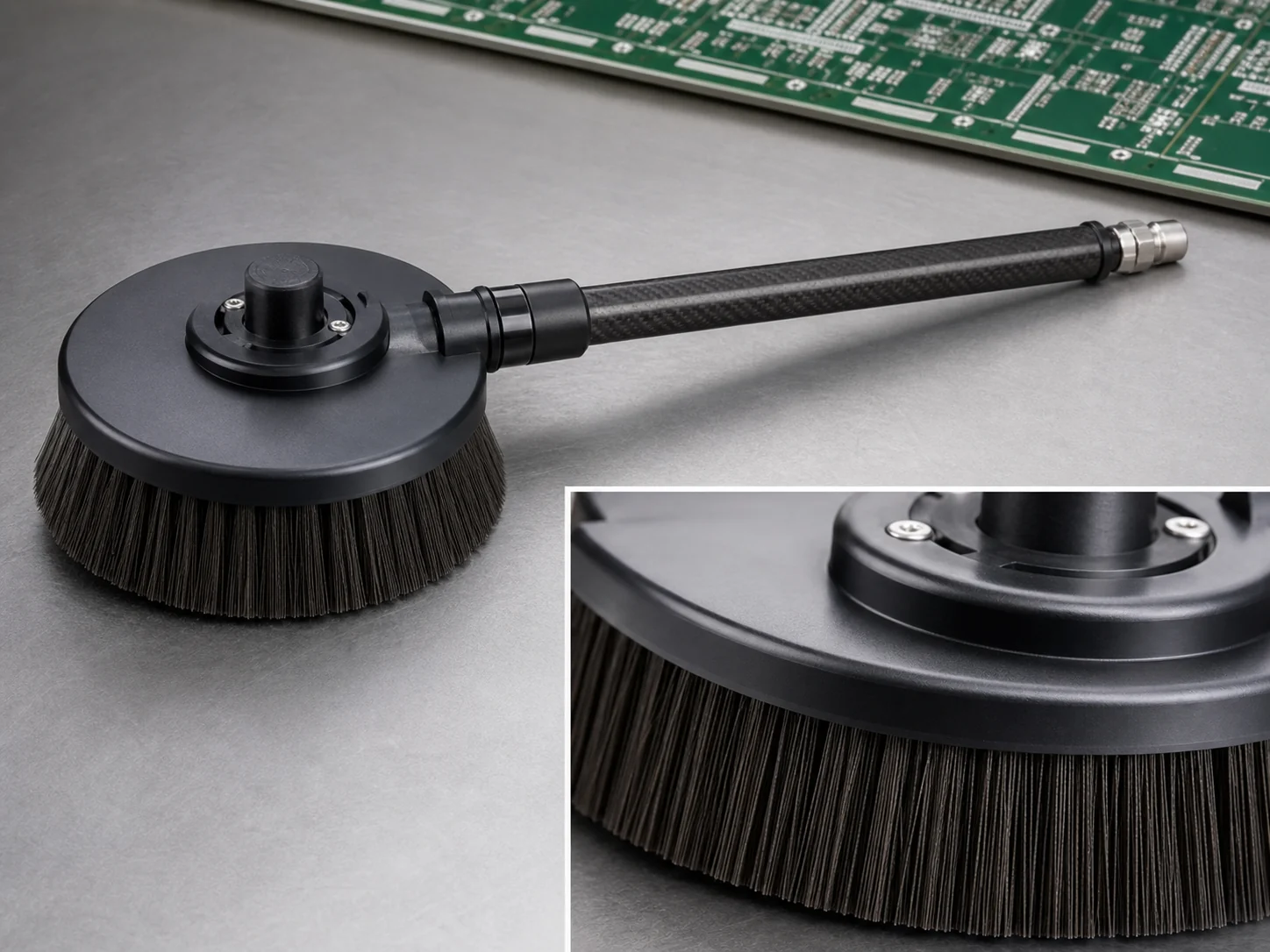
180mm conductive PCB disc brush with conductive nylon bristles and a carbon-fiber body, for flux, dust and oxide removal in ESD-protected PCB assembly.
Medium brush
100 pcs
Minimum order
Worked with two hands or on a pole: chimney, gutter and pond-filter brushes, discs, cups and tank brushes.
Production lead time, once the specification is confirmed
- Up to 100 pcsWithin 7 days
- 101–5,000 pcsWithin 14 days
- 5,001–50,000 pcsWithin 21 days
- Over 50,000 pcsConfirmed with your quotation
Peak season can extend these times; the shipping date is confirmed in writing with your quotation. Sampling and shipping are quoted separately.
A 180 mm precision brush with a disc-shaped conductive nylon head for cleaning printed circuit boards, component contacts, carriers, slots, and assembly fixtures in static-sensitive electronics operations. The compact head, lightweight carbon-fiber composite body, and quick-change coupling let operators remove flux residue, dust, lint, and oxide without scratching board surfaces or turning the brushing action into an electrostatic risk.
What can this brush do for you?
Drains charge while it cleans
Conductive nylon filaments and a carbon-fiber composite body create a defined electrical path instead of the insulative surface of a standard brush. When the quick-change coupling or holder is bonded to ground, or the operator works with a wrist strap and dissipative mat, charge generated by brushing has a route away from the board. That matters around CMOS devices, BGA packages, and other static-sensitive components.
Cleans around components instead of bulldozing them
The disc-shaped head keeps the bristle contact area compact and predictable. Operators can scrub flux from SMT pads, through-hole leads, and connector lands without bending tall neighbors or pushing residue into adjacent joints. The low head profile also clears under components when vertical clearance is tight.
Head swaps without replacing the whole tool
The quick-change coupling lets a production line keep straight, curved, soft, and firm head versions for different jobs. One body, dedicated heads per work zone or chemistry, less cross-contamination risk and less tooling inventory.
Light enough for rework benches and long inspection shifts
Carbon-fiber composite is stiffer than many plastic handles and lighter than a comparable metal tool. Operators can hold the brush near the work for extended manual use without arm fatigue, and the material does not corrode after repeated contact with IPA and common PCB cleaners.
Stiffness matched to the residue, not the brush
Soft conductive nylon removes dust and lint from gold contacts without marking the plating. Medium and firm versions work through no-clean flux films and light oxide. Because filament diameter, trim length, and fill density can be specified, the same disc geometry can be tuned from gentle contact to aggressive scrubbing without changing tool shape.
What is a 180mm Conductive PCB Disc Brush?
A 180mm Conductive PCB Disc Brush is a precision cleaning tool built around a circular disc-shaped brush face at the end of a carbon-fiber composite shank. The 180 mm overall length places the 20 mm bristle section close to the board surface for controlled manual or fixture-mounted use, while the quick-change coupling provides the interface to a holder, extension, or automation mount.
In use, the brush is worked across PCB surfaces, component leads, edge connectors, carrier pockets, or fixture surfaces with light-to-moderate pressure. Cleaning usually happens alongside a solvent such as IPA or DI water, which softens flux and floats loosened particles away. The conductive nylon filaments and conductive body prevent the tool itself from building static charge while those particles are being moved.
This is not a heavy-duty scrub brush. It is not intended for carbonized flux deposits, corrosion removal from steel tooling, or high-temperature immersion. It is designed for regular precision cleaning in ESD-protected areas where surface preservation and controlled static behavior are more important than brute mechanical force.
Technical Specifications
Standard dimensions and material selections are listed below. Overall length, head length, bristle stiffness, and coupling interface can be adjusted to the production requirement.
| Parameter | Specification / Options |
|---|---|
| Overall length | 180 mm |
| Head length | 20 mm (bristle section at the working end) |
| Head geometry | Disc / circular cleaning face; flat or domed trim; straight or curved body version |
| Bristle material | Conductive nylon (PA) mono-filament |
| Body / shank material | Carbon-fiber composite |
| Connection | Quick-change coupling; interface matched to holder, extension, or fixture |
| Handling surface | Carbon-fiber composite body; optional overmold for manual use |
| Bristle stiffness | Soft, medium, or firm via filament diameter and trim length |
| Chemical compatibility | IPA, DI water, and common PCB cleaning solvents; avoid strong acids and high-heat immersion |
| Static control | Conductive-grade bristle and body provide charge dissipation path; typical bristle surface resistance below 106 ohm (project value confirmed at order) |
| Operating environment | ESD-protected electronics assembly, rework, and inspection areas; ambient solvent use |
| Brush type | Custom Disc Brushes |
| How it is driven | Machine-driven, mounted in the equipment |
| Cleaning target | rework and hand-soldering bench, edge connector and gold finger, and smt carrier cleaning |
| Surface or part | boards, carriers, fixtures, composite, tooling, assembly fixtures, connectors, and pads |
| Residue or debris | flux, dust, lint, oxide, flux residue, particles, adhesive residue, and static-attracted particles |
| Mounting / connection | Quick-change coupling; interface matched to holder, extension, or fixture |
The quick-change coupling is specified at order because holder and fixture standards differ between lines. Provide the existing holder part number or a mating drawing so the brush seats and grounds correctly.
Where does this brush work best?
- Rework and hand-soldering benches: removing no-clean flux residue from QFP, SOIC, and discrete pads after touch-up or hand placement, where the disc head stays inside the repair area and avoids disturbing nearby joints.
- Edge connectors and gold fingers: cleaning dust, pad debris, and light oxides from PCB edge contacts, test points, and plug interfaces; conductive nylon removes contamination without plating wear from metal bristles.
- SMT carriers, trays, and assembly fixtures: brushing dust, adhesive residue, and flux splatter from component nests, tooling pockets, and pick-and-place surfaces that hold or locate boards.
- Pre-coating and pre-potting preparation: lifting lint and static-attracted particles from board surfaces before conformal coating or potting, which reduces the chance of encapsulating particles into the coating.
- ESD-sensitive component handling areas: cleaning trays, reels, and work surfaces where insulative brushes would create a charging risk.
How do I choose the right one?
Start with the smallest access clearance
Measure the gap between the tallest component and any adjacent surface or tooling. The 20 mm head length and 180 mm overall length must fit the working space without forcing the operator into an awkward angle. Choose a straight body when the board surface is open; choose a curved body when cleaning under connectors, inside carriers, or around tall components.
Match stiffness to the residue and surface
Soft conductive nylon suits dust, lint, and light flux haze on gold contacts and unpopulated pads. Medium suits standard rosin and no-clean flux films after solvent softening. Firm suits dried flux or oxide films. Keep metal filaments out of populated board cleaning: a brass or stainless brush removes more aggressive contamination on steel tooling but risks scratching pads and leaving conductive metal particles on the board.
| Cleaning condition | Configuration to select |
|---|---|
| Dust and lint on gold contacts | Soft conductive nylon, domed trim |
| Flux residue around SMT pads | Medium conductive nylon, flat trim |
| Dried flux or light oxide | Firm conductive nylon, higher fill density |
| Tight clearance under components | Curved body, reduced head diameter |
| Fixture-mounted automated use | Quick-change coupling matched to holder, grounding contact specified |
Confirm the coupling and grounding path
The quick-change interface must match the holder, bench extension, or fixture. Without a grounded holder or operator wrist strap, the conductive body still helps drain local charge, but the full dissipative path is not guaranteed. Include the brush in the site ESD control plan and verify resistance from bristle tips to the grounded point after installation.
Check the solvent and process
Conductive nylon and carbon-fiber composite handle IPA, DI water, and mild PCB cleaners well, but any coupling seals, o-rings, or overmold materials need to be specified for the actual chemistry. Avoid acid cleaners, heated solvent tanks, and long-term solvent soaking unless the project materials are selected for that exposure.
When to use a different brush or method
- Use a brass or stainless wire brush on steel stencils, frames, and tooling with heavy corrosion – never on populated boards.
- Use a wider flat brush, foam swab, or automated inline brush for large-area board washing or high-volume lines.
- Use a swab or applicator for sub-millimeter cavities and BGA underfill gaps where the disc head cannot seat.
- If the job allows a non-conductive tool and ESD risk is not present, a standard nylon brush may be more economical, but retaining the conductive version across mixed production avoids process risk.
Can I customize this brush?
The 180 mm conductive disc brush is a standard configuration, not a fixed end point. Most production applications adjust at least the coupling interface or bristle stiffness. For a custom build, specify the board or carrier dimensions, minimum access clearance, residue type, cleaning solvent, manual or fixture mounting, and grounding method. A drawing or sample of the existing holder shortens the process significantly.
Configurable elements
- Overall length and head length: standard 180 mm and 20 mm; extended or shortened for bench reach or machine clearance
- Head geometry: disc diameter, flat/domed/angled trim, curved body angle, reduced head for narrow slots
- Bristle material: conductive nylon filament diameter, stiffness, trim length, fill density; alternative conductive filaments such as carbon-filled PP or PBT
- Body material: carbon-fiber composite standard; alternative materials for chemical exposure, weight, or color
- Connection: quick-change coupling type, retention mechanism, holder diameter, and grounding contact position
- Handling surface: optional overmold, textured grip, hanging feature, laser marking, part number printing
- Packaging: bulk, individually sealed cleanroom bags, labeled kits, or project-specific packing
If the project requires material declarations, resistance measurement reports, third-party inspection, or ESD-related documentation, those can be included as part of the customization scope.
When is a 180mm conductive PCB disc brush worn out rather than just dirty?
How do I verify that the brush is dissipating charge rather than storing it?
Measure resistance from the bristle tips to the coupling or body using a surface resistance meter or ohmmeter with the bristles dry. A conductive-grade nylon brush should read in the conductive range, typically below 106 ohm. Clean and dry the brush before measuring; solvent residue or loose dust can give a misleading reading. In service, confirm the holder or operator grounding path is intact.
Can I use this brush with isopropyl alcohol?
Yes. The conductive nylon bristles and carbon-fiber composite body are compatible with IPA, DI water, and common PCB cleaning solvents. After wet use, rinse the head with clean solvent or DI water and allow it to air-dry upright on a dissipative rack. Do not soak the coupling mechanism in solvent unless the retention and seal materials are specified for immersion.
How long does a head last before it should be replaced?
There is no fixed cycle count because wear depends on brushing pressure, residue abrasiveness, solvent exposure, and contact frequency. Replace the head when bristles become splayed, matted, or unevenly shortened, or when the disc no longer contacts the board surface consistently. A worn head sheds filaments and loses its cleaning profile, so inspect under magnification after heavy flux or adhesive jobs.
Does this brush replace solvent cleaning or an ultrasonic process?
No. Brushing loosens flux and particles and moves them out of tight areas, but the loosened material still needs to be rinsed away. For high-reliability boards, follow brushing with the specified solvent rinse, DI water rinse, and ionic contamination verification as required by the process specification.
What should I check before putting the brush on a production board?
Verify the head is dry and free of loose filaments, the coupling is fully seated, and the grounding path from coupling to bench or wrist strap is intact. Check that no bristles from a previous job remain trapped in the head. If the board has bare gold fingers or sensitive components, run the chosen stiffness on a scrap or test coupon first.
When is this conductive disc brush the wrong cleaning tool?
Use a different tool when the residue is carbonized, heavily corroded, or requires metal-filament scrubbing; when the access space is too small for the 20 mm head; when the area to clean is larger than a few square centimeters and a wider brush or inline system is more efficient; or when the process does not require static control and a standard brush is acceptable.
Guides that go deeper on this
Custom Manufacturing RFQ
Describe Your Application
To prepare the correct quotation, provide the dimensions, cleaning task, residue, material, mounting details, quantity, and a drawing or photo.
Drawing or photo optional — it speeds things up, it does not gate the enquiry.
Custom Brush RFQ
Send Your Brush Project
Upload a drawing, product photo, or sample photo and provide the core dimensions and cleaning conditions.
“We need a brush to remove wet residue from a stainless steel conveyor, about 800mm wide. The current brush wears quickly. We can send photos.”
“We sell drinkware and need a cleaning brush to include with the product. Quantity around 5,000 pieces.”