
Custom Cleaning Brush
Conductive Nylon PCB Hand Brush
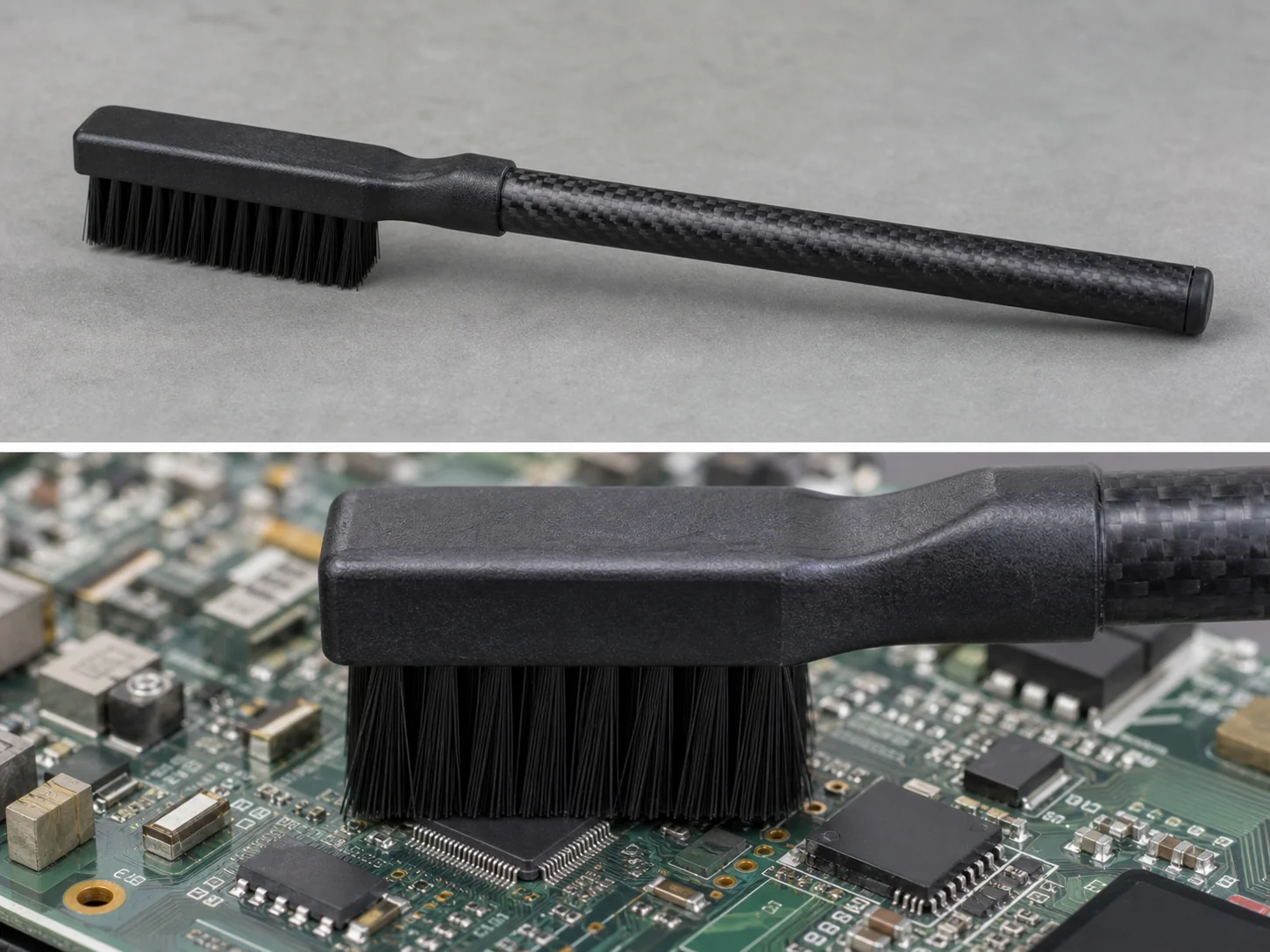
Conductive nylon PCB hand brush with carbon-fiber handle for flux, dust and particle removal from boards, card edges and fixtures.
Small brush
500 pcs
Minimum order
Held in one hand: tube, bottle, detail and swab brushes — including long-handled ones with a small head.
Production lead time, once the specification is confirmed
- Up to 500 pcsWithin 7 days
- 501–50,000 pcsWithin 14 days
- Over 50,000 pcsWithin 21 days
Peak season can extend these times; the shipping date is confirmed in writing with your quotation. Sampling and shipping are quoted separately.
A hand-guided PCB cleaning brush built with carbon-filled conductive nylon bristles on a fixed carbon-fiber composite handle. It sweeps flux dust, solder balls, lint, and static-attracted particles off populated boards, card edges, and assembly tooling while giving the brushing action a static-dissipative path instead of storing charge in the bristles.
What can this brush do for you?
Turning a static risk into a controlled path
Ordinary nylon bristles are insulators. Sweep them across a PCB and friction can charge the brush and the surrounding surfaces, leaving a charged object next to sensitive devices. The conductive carbon filler in these nylon filaments provides an intentional dissipation path, so charge from brushing does not simply accumulate at the bristle tips. Used inside a grounded ESD workstation, the brush supports the static-control plan instead of working against it.
Polymer contact that removes particles without metal damage
Conductive nylon is still nylon: softer than brass or steel, with no exposed metal tips at the working face. It picks up loose flux residue, dust, and solder particles from solder mask, pads, and component bodies without cutting or gouging unprotected copper.
A wide face that clears board lanes, card edges, and connectors
The 25 mm × 100 mm rectangular head passes across populated areas, card-edge contact zones, backplane slots, and fixture rails with fewer strokes than a point brush. The long side aligns with component rows, so one forward pass follows the board’s natural layout.
A rigid handle that keeps the brushing accurate
The head is fixed to the handle rather than jointed or socketed, so pressure at the handle goes straight into bristle contact instead of wobbling at a connection point. The carbon-fiber composite handle stays light and stiff through a full shift at a rework bench or inspection station.
What is a Conductive Nylon PCB Hand Brush?
A Conductive Nylon PCB Hand Brush is a hand-guided cleaning tool in which the working face is formed from carbon-filled nylon bristles and the holding side is a carbon-fiber composite handle. The operator uses dry sweeps or light solvent-assisted passes to lift particles and loose flux residues from board surfaces before inspection, test, coating, or final assembly.
The brush is a mechanical cleaning step, not a defluxing system. It breaks the attachment between loose contamination and the board surface, then carries or pushes that debris toward a wipe, vacuum pickup, or cleaning station. It is not intended to replace solvent cleaning for tacky or hardened flux, and it does not apply cleaning chemistry by itself. Typical process placement is after automated cleaning or soldering to remove residual particles, or before conformal coating to prepare a contamination-free surface.
Technical Specifications
These values describe the standard configuration. Head dimensions, trim, resistivity, and handle details can be adjusted for the project.
| Parameter | Value / Options |
|---|---|
| Head width | 25 mm |
| Head length | 100 mm |
| Head shape | Rectangular, flat working face |
| Bristle material | Conductive nylon, carbon-filled |
| Bristle trim length | 20 mm nominal; adjustable for component clearance and flex |
| Filament diameter | 0.15–0.25 mm, selected for stiffness and target residue |
| Bristle surface resistivity | 10³–10⁵ Ω/sq typical; project value can be specified |
| Handle material | Carbon-fiber composite, static-dissipative |
| Handle length | 150 mm |
| Grip diameter | 20 mm |
| Connection | Fixed; no exposed metal contact parts |
| Overall length | Approx. 250 mm |
| Operating condition | Dry use or short solvent exposure; confirm solvent compatibility with the specified nylon and handle |
| Brush type | Custom Handheld Detail Brushes |
| How it is driven | Hand-guided |
| Cleaning target | post-reflow and wave-solder line cleanup, rework and repair bench, and conformal coating preparation cleaning |
| Surface or part | boards, edges, composite, pads, slots, connectors, fixtures, and tooling |
| Residue or debris | flux, particles, dust, lint, flux residue, oxide, static-attracted particles, and fiber |
| Mounting / connection | Fixed; no exposed metal contact parts |
Where does this brush work best?
- Post-reflow and wave-solder line cleanup: removes flux dust, solder balls, and lint from boards before AOI, electrical test, or final assembly.
- Rework and repair benches: clears loose rosin flux residue and displaced solder particles around reworked joints.
- Conformal coating preparation: sweeps dust and fibers off pads, traces, and components so coating can wet a clean surface.
- Card edges, connectors, and backplane slots: cleans contact fingers and slot areas where lint and oxide dust collect and static attraction keeps debris in place.
- Carrier, fixture, and stencil-tool cleaning: removes particles that could transfer back onto boards in a static-controlled assembly cell.
How do I choose the right one?
Start with where the bristles actually need to fit
If the board has open component lanes wider than the 25 mm head, this head cleans broad areas efficiently. If cavities between tall components are narrower than the head, a slimmer or angled head prevents bristles from pressing against leads and lifting them. The 100 mm length suits boards where the operator can make full-length strokes; small subassemblies may control better with a shorter head.
Match stiffness to the residue and component sensitivity
Finer filaments and a longer trim create softer, more flexible contact for populated boards with fragile leads. Thicker or shorter-trim filaments apply more cleaning force for denser, stickier loose residue. Conductive nylon stays in the polymer contact class; it will not tear hardened, carbonized deposits off the way a wire brush would.
Set the conductivity target to your ESD control plan
The conductive nylon grade determines the bristle resistivity. For most static-sensitive PCB cleaning, a surface resistivity below 10⁵ Ω/sq is appropriate, but your ESD coordinator may define a different range. Specify the required reading and the brush can be built to that target. The brush is part of the workstation’s static-control strategy, not a replacement for grounded mats, wrist straps, or ionization where the process requires them.
Check the handle and operator fit
The 150 mm handle and 20 mm grip are compact for board-level work at the bench. If operators work with thick ESD gloves, inside equipment frames, or with repetitive passes on large panels, a longer, shaped, or larger-diameter grip may reduce strain. The carbon-fiber composite handle reduces weight, but the stiffness of the fixed connection is what maintains consistent bristle pressure across the pass.
Confirm solvent and cleaning process compatibility
The carbon-filled bristles and handle matrix need to be specified for any chemical the board cleaning process applies: isopropyl alcohol, flux remover, water-based cleaner, or other solvent. If residue is largely tacky flux or baked residue, solvent cleaning, ultrasonic defluxing, or a dedicated cleaner should already be part of the line; this brush aids mechanical loosening and should not be expected to dissolve stubborn material on its own.
Use a metal or abrasive brush only for heavy oxides, corrosion, or carbonized deposits and only when board surfaces and component leads can tolerate that contact. Use lint-free wipes, foam swabs, or vacuum and ionization if loose bristles or particle generation cannot be tolerated. Use a narrower or angled brush if tall component rows block this rectangular head.
Can I customize this brush?
Yes. The standard configuration is a starting point. Tell us the PCB outer dimensions, component density and height, residue type, cleaning solvent, wash temperature, target surface resistivity, and operator ergonomics. A board photo or outline drawing speeds up the definition.
We can adjust:
- Head geometry: width, length, rectangular, rounded or angled head shape, multi-zone layout, or detail edge
- Bristle block: filament diameter, trim length, bristle density, conductivity grade, stiffness, or colored marker filament
- Handle: length, grip diameter, grip texture, hanging hole, carbon-fiber or static-dissipative polymer handle, anti-roll shape
- Connection: fixed head as standard, or alternative integration if the cleaning station requires it
- Marking and packaging: pad print, laser mark, color coding, lot identification, bulk or individually bagged
- Project support: surface resistivity verification, material declarations, inspection documentation, or third-party testing coordinated with your ESD control requirements
Which filament belongs on a conductive nylon PCB hand brush, and how is that verified?
How do I verify the brush is still static-dissipative before using it on a sensitive board?
Measure the resistance from the bristle bundle to the handle or a ground reference with a surface resistance meter. If the reading has risen beyond the resistivity specified for the brush, or if there is no continuity at all, remove the brush from the line. Periodic checks should be part of the workstation ESD audit, especially after solvent exposure.
Can this brush be used with isopropyl alcohol or flux remover?
For routine cleaning, dry use is preferred because a dry conductive nylon brush lifts loose particles without introducing liquid into fine-pitch areas. Short contact with IPA or an approved flux remover is generally acceptable, but the exact solvent, concentration, and exposure time should be confirmed against the selected filament grade and handle. Always dry the brush fully before returning it to ESD-sensitive work.
Does the brush leave conductive particles on the board?
The carbon filler is embedded in the nylon filaments and is not loose metal particulate. Like any bristled brush, it can shed worn or damaged ends if over-pressured or if the trimming was not properly finished, so control pressure and replace the brush when bristles show bending, splitting, or excessive fiber loss. For no-particle processes, use wipes, foam swabs, or vacuum cleaning.
What is the actual difference between conductive nylon and ordinary nylon on a PCB line?
Ordinary nylon is an insulator and can tribocharge during brushing; the charge can attract dust back onto the board and can discharge into sensitive components. Conductive nylon contains a distributed conductive filler that gives charge a controlled path and reduces charge build-up at the bristle tips. The cleaning feel and ability are similar; the static behavior is different.
How should the brush be used around fine-pitch leads and fragile pads?
Brush in the direction of lead rows, not across them, using light forward strokes. Lift the brush to return rather than dragging backward against the leads, and avoid pressing hard enough to deflect pins. If a pass through a dense area produces snagging or lead movement, the brush is too stiff or too wide for that zone.
Does this brush remove baked-on or hardened flux by itself?
No. It removes loose, lightly bonded, or static-attracted material. Hardened or baked flux generally needs a solvent soak, a thermal or mechanical defluxing process, ultrasonic cleaning, or another dedicated step. Use the conductive nylon brush as part of the cleaning sequence, not as the final remedy for heavy residues.
Guides that go deeper on this
Custom Manufacturing RFQ
Describe Your Application
For a custom quote, we need the key dimensions, surface or part, residue, material preference, quantity, and reference image or drawing.
Drawing or photo optional — it speeds things up, it does not gate the enquiry.
Custom Brush RFQ
Send Your Brush Project
Upload a drawing, product photo, or sample photo and provide the core dimensions and cleaning conditions.
“We need a brush to remove wet residue from a stainless steel conveyor, about 800mm wide. The current brush wears quickly. We can send photos.”
“We sell drinkware and need a cleaning brush to include with the product. Quantity around 5,000 pieces.”