
Custom Cleaning Brush
Shower Door Track Cleaning Brush
Custom shower door track cleaning brush with 3–15 mm narrow head for soap scum, dirt, and mold in sliding door tracks and grout lines.
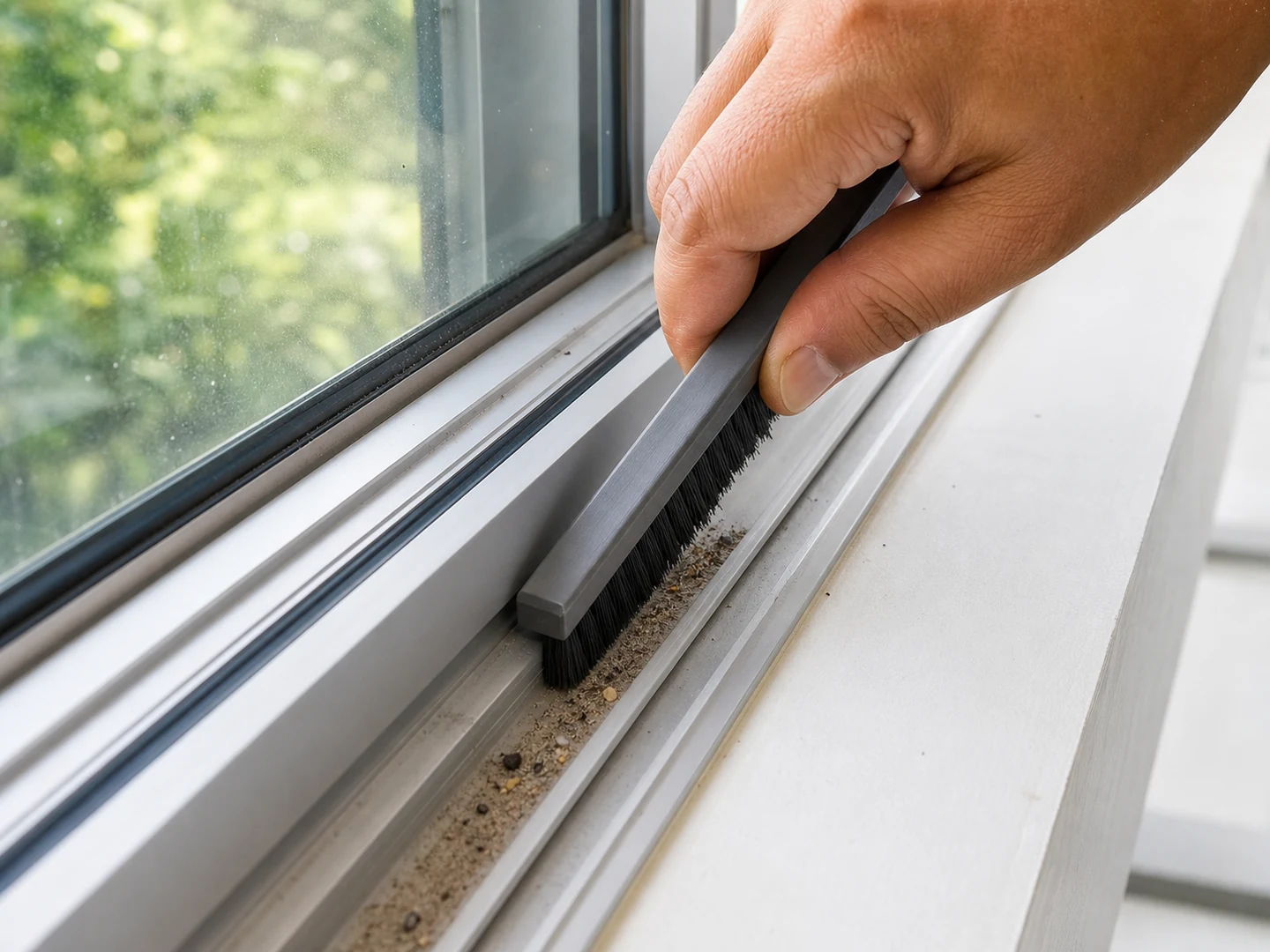
Small brush
500 pcs
Minimum order
Held in one hand: tube, bottle, detail and swab brushes — including long-handled ones with a small head.
Production lead time, once the specification is confirmed
- Up to 500 pcsWithin 7 days
- 501–50,000 pcsWithin 14 days
- Over 50,000 pcsWithin 21 days
Peak season can extend these times; the shipping date is confirmed in writing with your quotation. Sampling and shipping are quoted separately.
A narrow-profile hand brush built for sliding shower door tracks, rails, and grout lines. Its 3–15 mm head follows the channel profile and reaches packed soap scum, hard water residue, and mold that standard brushes and cloths leave behind.
What can this brush do for you?
Fits the actual channel, not just the opening
The head width is kept between 3 mm and 15 mm, and the tip can be shaped as a tapered wedge or rounded point. This lets the bristle block ride inside U-shaped and V-shaped shower door tracks instead of sitting on top, so the bottom of the channel and the lower inside corners are scrubbed in the same stroke.
Breaks up dried soap film and hard water residue
Stiff nylon or PBT filaments concentrate pressure at the track base and side walls, loosening dried soap scum and mineral film without requiring a separate scraper. Filament diameter and trim length are selected so the tips do the cutting, while the short handle gives the operator enough leverage to push firmly with one hand.
Cleans to the edge without tearing seals
The working end is rounded or blunt rather than sharply pointed, so the brush reaches the end of the track without catching on door gaskets, rubber stops, or silicone caulk. Housekeeping and maintenance teams can clean the full length of the rail and still avoid seal damage that leads to leaks or repair callbacks.
Stays stiff and clean in a wet bathroom environment
Nylon PA, PBT, and polypropylene are low-water-absorption materials. The brush does not swell, soften, or support mold growth the way natural-fiber brushes can after repeated exposure to shower humidity, and it rinses clean quickly between rooms in a hotel or facility cleaning operation.
Keeps the hand close to the work
With an overall reach of 140–260 mm and a grip diameter of 10–30 mm, the operator’s hand stays near the track. The short lever improves downward control in floor-level channels, so staff can apply pressure without twisting the wrist or losing contact on the return stroke.
What is a Shower Door Track Cleaning Brush?
A Shower Door Track Cleaning Brush is a hand-guided brush built around a narrow filament head that fits inside the channel under a sliding glass door or screen panel. The working end usually combines a short bristle block or single-row tuft set with a tapered or wedge-shaped tip, mounted on a straight or angled handle. During use, the operator slides the head along the track with short push-pull strokes. The filaments contact the track bottom and the lower section of each side wall, loosening soap scum, body oil film, hair, hardened dirt, and mold that collect where the glass meets the floor channel.
The same head geometry also works along grout lines, tile edge transitions, bathtub rims, and the narrow gap between a fixed glass panel and a tile wall. This is why facility teams often carry one brush for several bathroom touch-up tasks instead of switching tools between the door, the tile, and the tub.
The brush is a maintenance tool for removable or loosely attached deposits. It is not a pry bar, a scraper for silicone, or a replacement for chemical descaling when mineral scale has fully bonded to the track. Head width and depth should be matched to the actual channel before ordering: a head that is wider than the channel folds the filaments sideways and loses contact, while one that is too narrow only polishes the center line.
Technical Specifications
All dimensions can be adjusted to your track sample or drawing. The values below represent the standard engineering range for this product family.
| Parameter | Value / Options |
|---|---|
| Head width | 3–15 mm, selected to fit the narrowest point of the track |
| Working head length | 30–80 mm, matched to track depth |
| Overall length / reach | 140–260 mm, including handle |
| Grip / body diameter | 10–30 mm; larger for gloved hands, smaller for fingertip control |
| Bristle material | Nylon PA6 / PA66, PBT, or polypropylene PP filament |
| Filament diameter | 0.30–0.60 mm, adjusted for required stiffness |
| Trim length | 6–18 mm, depending on head profile and track depth |
| Head profile | Tapered wedge, rounded point, flat end, or single-row line head |
| Tuft row count | 1–4 rows, based on head width and contact requirement |
| Handle material | PP, recycled PP, with optional TPE overmold or textured grip |
| Head-to-handle angle | 0°, 15°, 30°, or project-specific angle |
| Moisture / chemical exposure | Suitable for wet bathroom use with diluted common cleaners; avoid strong solvents and undiluted acids or bleach |
| Color / marking | Custom Pantone color, pad print, laser marking, or molded logo |
| Brush type | Custom Handheld Detail Brushes |
| How it is driven | Hand-guided |
| Cleaning target | sliding glass shower door bottom track, frameless shower enclosure, and bathtub and shower combo cleaning |
| Surface or part | tracks, channel, grout lines, glass, rails, molds, walls, and floors |
| Residue or debris | soap scum, mold, hair, scale, mineral scale, oil, soap film, and oil film |
| Mounting / connection | Fixed Head |
For a customer-specific program, we will confirm the final combination of head width, trim length, filament grade, and handle geometry against your track sample before production.
Where does this brush work best?
- Sliding glass shower door bottom tracks and top rails where soap scum, body residue, hair, and mildew collect out of reach of flat brushes.
- Frameless shower enclosures with floor channels or glass-to-tile gaps; the narrow head follows the seam without scrubbing large glass surfaces.
- Bathtub and shower combos with sliding screen panels; the brush cleans the track along the tub rim and the door guide channel.
- Grout lines and change-of-plane corners on tiled shower walls and floors, where a wide scrub brush cannot stay in the joint.
- Sliding window and patio door tracks in bathrooms or other high-humidity settings, provided the track width is within the head width range.
- Hotel housekeeping, facility maintenance, and janitorial cleaning kits where one hand tool must handle multiple narrow bathroom channels without carrying multiple brushes.
How do I choose the right one?
Measure the track before choosing head width
Use calipers to measure the narrowest internal width of the channel, including any internal ribs, screw heads, or roller guides. The specified head width should be about 1–2 mm less than that measurement so the bristles sweep both side walls without being crushed flat. If the track width varies along its length, size for the narrowest section.
Match head length to track depth
Working head length from the base of the handle to the filament tip should be slightly greater than the measured channel depth. For example, a 12 mm deep track needs a head that can bottom out while the handle remains above the rail. If the brush bottoms out and the handle hits the track edge before the tip reaches the floor, residue will remain in the corners.
Select filament material and stiffness by residue type and surface sensitivity
Soft soap film, body oil, and daily maintenance: medium-stiffness nylon PA6 with 0.35–0.45 mm filament.
Hard water scale, dried mineral film, and mildew: PBT or larger-diameter nylon with 0.45–0.60 mm filament and straight trimmed tips.
Painted, anodized, or coated aluminum tracks where scratching is a concern: polypropylene or flagged nylon with a smaller diameter; pair with a chemical descaler instead of relying on aggressive mechanical action.
Set handle length and angle for the operator
For floor-level shower tracks where the operator kneels or bends, a 140–180 mm overall length provides more control and downward pressure. For standing use or reaching behind a fixed panel, a 200–260 mm handle reduces bending. A 20–30 mm grip diameter suits gloved hands; a 10–15 mm diameter allows fingertip control in cramped corners. A straight head works for horizontal runs, while a 15–30° angled neck reaches the floor-to-glass corner and behind the lower door seal. A wedge-shaped tip helps lift packed debris out of a V-shaped track.
Check chemical compatibility
Tell us which cleaning agents will be used. PBT and PP hold up well in diluted acid and alkaline cleaners and hot water; PA absorbs some moisture but returns to shape when dry. Avoid continuous immersion in strong solvents, undiluted bleach, or concentrated acid. Rinse the brush after use and allow it to dry.
When this brush is not the right tool
For tracks completely filled with hardened mineral scale, loosen the deposits first with a descaler or plastic scraper; the brush removes what remains. For large floor areas, grout restoration, or heavy mold in porous grout, a rotary grout brush, steam cleaner, or extraction equipment is more effective. For broad glass and tile surfaces, a squeegee or large scrub brush is more efficient. This brush is for line-contact cleaning, not surface-area cleaning.
Can I customize this brush?
Shower door track geometry varies by glass thickness, roller design, and door manufacturer, so we build each brush program around the actual channel rather than a generic dimension. To start, we need the track profile width and depth, the type of residue targeted, the cleaning chemical used, the desired handle length and angle, and your packaging requirements. A photo or section drawing of the track is the fastest way to confirm head geometry.
We can adjust the following for your project:
- Head construction — width, working length, tuft row count, single-sided or double-sided bristle placement, and tapered, wedge, rounded, or custom tip profile.
- Filament — material (nylon PA6/PA66, PBT, PP), diameter, trim length, straight or flagged tips, abrasive-filled or color-matched filament.
- Handle — overall length, grip diameter, material and recycled content, overmold, textured grip, thumb rest, hanging hole, and neck angle.
- Attachment method — fused one-piece head, staple-set tufts, molded-in filaments, or a replaceable head module to reduce waste.
- Color and branding — custom Pantone color, pad-printed logo, laser marking, molded brand mark, and private label packaging.
- Packaging — bulk polybag, hang-tab, shelf box, display tray, or project-specific packing.
If your project requires material declarations, inspection reports, third-party testing, or certification support, we can assist with those requirements during the customization process.
Which filament should a shower door track cleaning brush be built with?
How can I tell whether the brush head is too wide for the track?
Insert the dry brush into the track at the widest and narrowest points. If the bristles stay upright and the head moves back and forth with light resistance, the width is workable. If you have to force it and the tufts fold completely sideways, the head is too wide. If the head slides freely and the side walls show no filament contact, it is too narrow. Wide tracks may need a wider head or a two-pass technique, cleaning one side wall at a time.
Can this brush be used on the glass panel itself?
No. The brush is intended for metal or plastic tracks, tile joints, and grout edges. On frosted, etched, coated, or tinted glass, the filament ends can create micro-scratches or remove surface coatings. Use a squeegee blade or a dedicated glass-safe cleaning pad on the glass surface, and limit the brush to the channel and frame areas.
What should I do if soap scum is still visible after brushing?
Brush the track once with a pH-neutral or mild alkaline cleaner, rinse, then wipe the bottom corners with a white cloth. If gray or white residue still transfers to the cloth, repeat the process after applying a calcium and lime remover and allowing the recommended dwell time. Hard mineral scale often needs chemical softening before mechanical removal will be complete.
How do I keep the brush from growing mold between uses?
Rinse the head under running water after each use, shake out excess moisture, and store the brush handle-down in a dry rack rather than leaving it lying in a puddled track. Nylon, PBT, and PP do not support mold growth the way natural fibers can, but trapped soap film can. A weekly soak in diluted bathroom cleaner followed by a rinse will keep the tufts clean.
Can this brush be used on sliding window or patio door tracks?
Yes, when the channel width falls within the head width range. Measure window or patio door tracks separately; some have narrow bottom grooves, sharp drain slots, or dried construction dust that can wear the filament faster. Avoid using the brush on corroded metal channels where sharp flakes can cut the filaments.
What is the difference between nylon and PBT in a wet bathroom environment?
Nylon PA6 is flexible and economical; it absorbs a small amount of water, which temporarily softens the filament, but it returns to shape when dry. PBT absorbs less moisture, keeps its stiffness better when wet, and resists many bathroom chemicals, so it is often selected when hard water scale and daily acid-based cleaners are involved. For the most delicate coated tracks, polypropylene or flagged nylon is the gentler option.
Guides that go deeper on this
We have not written a guide specific to this one yet. The material that covers selection, filament, dimensions, maintenance and sourcing is collected in the technical resources library.
Custom Manufacturing RFQ
Describe Your Application
To quote this brush accurately, send the size, material, cleaning target, residue, quantity, and any available drawing or sample photo.
Drawing or photo optional — it speeds things up, it does not gate the enquiry.
Custom Brush RFQ
Send Your Brush Project
Upload a drawing, product photo, or sample photo and provide the core dimensions and cleaning conditions.
“We need a brush to remove wet residue from a stainless steel conveyor, about 800mm wide. The current brush wears quickly. We can send photos.”
“We sell drinkware and need a cleaning brush to include with the product. Quantity around 5,000 pieces.”