
Custom Cleaning Brush
2-in-1 Kitchen Cup Brush Removable Bottle Brush
Custom 2-in-1 kitchen cup brush with removable bottle brush for cups, mugs, bottles, caps, and narrow necks.
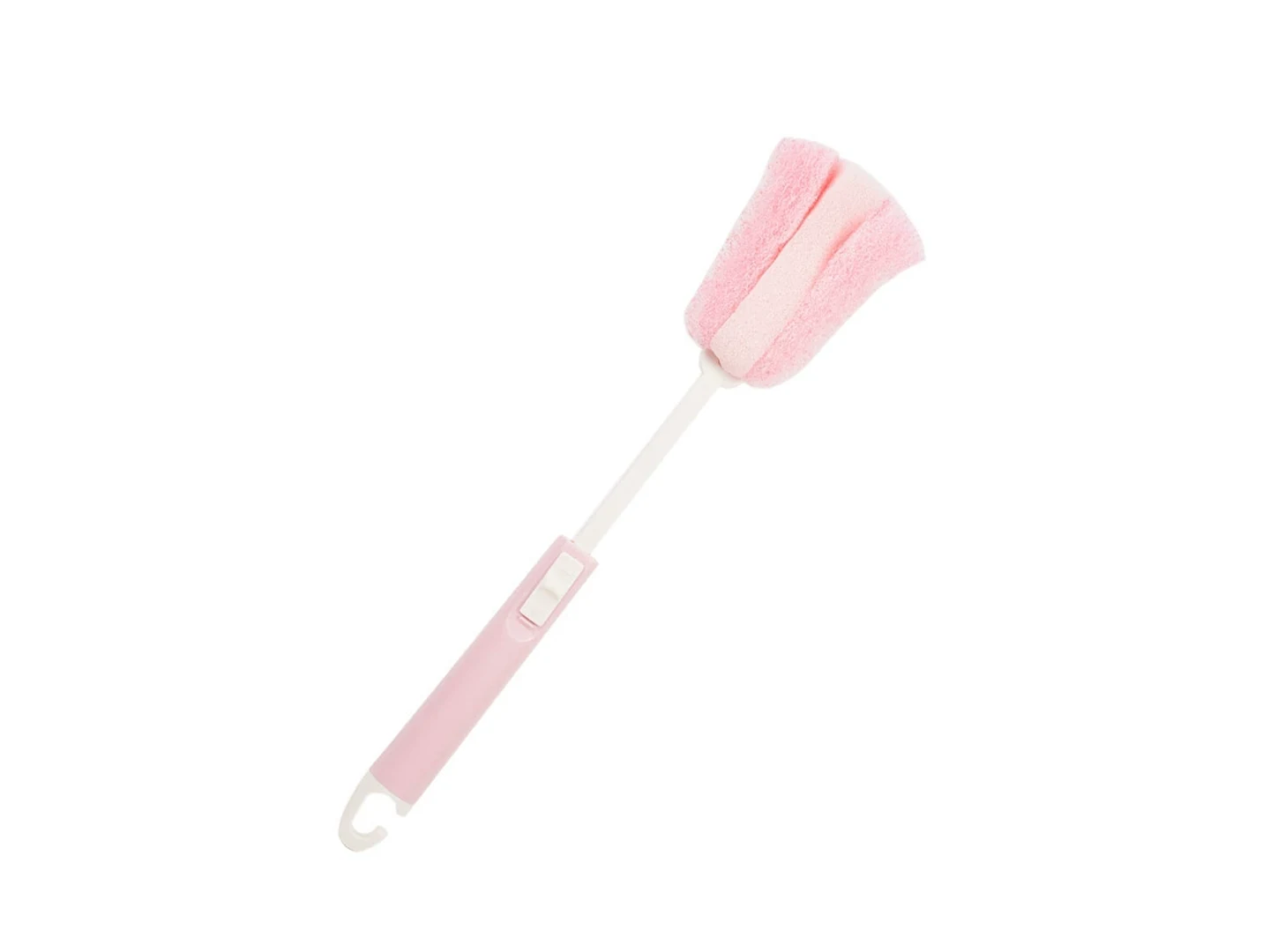
Small brush
500 pcs
Minimum order
Held in one hand: tube, bottle, detail and swab brushes — including long-handled ones with a small head.
Production lead time, once the specification is confirmed
- Up to 500 pcsWithin 7 days
- 501–50,000 pcsWithin 14 days
- Over 50,000 pcsWithin 21 days
Peak season can extend these times; the shipping date is confirmed in writing with your quotation. Sampling and shipping are quoted separately.
This two-part kitchen cleaning brush combines a wide cup-cleaning head with a removable bottle brush for narrow necks, threaded rims, caps, and deep container bases. Buyers get one hand tool that covers open drinkware and closed bottles without carrying two separate brushes.
What can this brush do for you?
One Handle Covers Cups and Bottles
The cup brush head is sized for mugs, glasses, travel tumblers, and food containers, while the removable bottle brush locks into the same handle for narrow mouths and bottle bodies. That removes the need for separate cup and bottle brushes in the kitchen set and gives retailers a single more versatile SKU.
The Bottle Brush Detaches for Threads, Caps, and Valves
Because the bottle brush is a separate removable assembly rather than a folded attachment, it can be used on its own against cap threads, sip-lid valve seats, and neck rings. Those small confined surfaces are exactly where a fixed cup brush cannot reach.
Nylon Fill Returns to Shape After Each Use
Crimped or straight nylon PA filament in both the cup head and the bottle head resists permanent matting, dries faster than foam, and does not create the trapped-moisture odor problem of a sponge. Daily beverage film, milk residue, and soft food deposits are removed without turning the brush itself into a secondary odor source.
Tapered Bottle Head Passes Narrow Openings Without Binding
The removable bottle brush head is configured to the narrowest neck inside diameter, with a tapered or tufted-end profile that enters cleanly and then contacts the sidewall. Neck clearance is sized so the brush does not jam at the rim or scrape the threads during insertion.
Plastic Core and Handle Fit a Wet Kitchen
Polypropylene structural components and nylon PA fill tolerate warm water, common dish detergents, and repeated air drying. With no exposed steel wire in the standard configuration, the brush can be specified where rust staining or metal contact on the bottle surface is undesirable.
A Worn Bottle Head Does Not Retire the Whole Tool
Since the bottle brush is removable, the most heavily used head can be replaced or reordered separately. The cup brush body remains in service, reducing replacement cost and keeping the kitchen set complete longer.
What is a 2-in-1 Kitchen Cup Brush Removable Bottle Brush?
It is a two-part hand cleaning tool built around a cup brush body and a detachable bottle brush assembly. The cup brush half uses a cylindrical or slightly tapered tufted nylon head sized for open-mouth cups, mugs, and jars. The removable bottle brush half is slimmer and longer, shaped to follow the neck, shoulder, sidewall, and base contour of narrow containers. Both halves share one handle, and the bottle brush is attached or removed by hand at a locking collar.
In use, the cup brush cleans the open sidewall and bottom of cups or food containers first. The operator then removes the bottle brush and works the neck threads, cap, valve area, and the lower body of narrow bottles. The attachment interface is designed for repeated wet use, so the connection needs to be evaluated for retention forces, number of attach-detach cycles, and whether the brush will be run through dishwasher cycles.
This is a daily-use kitchen cleaning tool, not a heavy-duty abrasive scrubber. It is designed for water, coffee, tea, milk, juice, protein-shake residue, soft food film, powder, and similar removable deposits. Burnt-on carbon, hardened mineral scale, and similar deposits are outside the intended contact duty of nylon PA fill.
Technical Specifications
The table lists standard and configurable values. Final dimensions are confirmed from the customer’s container drawings, sample cups or bottles, and the chosen head forms.
| Parameter | Standard / Configurable Range |
|---|---|
| Assembled overall length | 200–450 mm, matched to cup depth and bottle reach |
| Cup brush head diameter | 40–70 mm, selected for open cup or mug mouth |
| Cup brush working length | 80–140 mm, covers sidewall and bottom transition |
| Removable bottle brush head diameter | 20–50 mm, matched to the narrowest opening |
| Bottle brush working length | 120–300 mm, selected for bottle body depth |
| Neck clearance | 10–60 mm, acceptable gap between head and target neck ID |
| Filament diameter | 0.10–0.50 mm; finer for glossy or coated interiors, coarser for heavier soft film |
| Fill material | Nylon PA, crimped or straight filament |
| Handle and attachment collar | Polypropylene PP; optional grip overmold |
| Core material | PP or nylon standard; stainless steel core available where higher stiffness is specified |
| Head forms | Cylindrical, tapered, tufted-end, end-tuft tip for cup head; cylindrical, tapered, or tufted-end for bottle head; sponge or silicone contact on request |
| Attachment interface | Twist-lock, push-fit, snap, or threaded collar, selected with customer |
| Operating environment | Warm water and common detergent solutions; confirm chemical and temperature exposure for material grade |
| Brush type | Custom Bottle & Container Brushes |
| How it is driven | Hand-guided |
| Cleaning target | retail kitchen brush set and housewares line, reusable water bottle, and gasket groove cleaning |
| Surface or part | containers, necks, sidewalls, thread, valves, shoulders, rims, and grooves |
| Residue or debris | milk, mineral scale, coffee, food film, carbon, and powder |
| Mounting / connection | Polypropylene PP; optional grip overmold; Twist-lock, push-fit, snap, or threaded collar, selected with customer |
Where does this brush work best?
- Retail kitchen brush sets and housewares lines where one SKU must cover mugs, glasses, tumblers, and reusable bottles.
- Reusable water bottles, sport bottles, and narrow-neck drink bottles whose body is wider than the mouth; the removable head reaches the shoulder and base.
- Caps, sip lids, valve threads, and gasket grooves that need a short, separate cleaning head.
- Food storage containers, meal-prep jars, and wide-mouth jars where the cup head provides full sidewall and bottom contact.
- Workplace kitchens, break rooms, and food-service prep areas where mixed cup and bottle types are cleaned by hand.
How do I choose the right one?
Start With the Narrowest Opening
Measure the minimum internal diameter of the bottle neck. The removable bottle brush head must pass that opening with light pressure and then recover to contact the sidewall. A head that binds at the neck or folds over permanently is too large; a head that slides through without touching the walls is too small and will not clean the body.
Choose Head Forms for the Actual Contact Areas
Open cups with curved bottoms are best served by a cylindrical cup head with an end tuft. Narrow bottles need a tapered or tufted-end bottle head that can reach the shoulder and base. Caps, threads, and valve grooves need a small tufted tip or a dedicated detail section on the removable head.
Match Filament Stiffness to Residue and Surface
Nylon PA is appropriate for daily films from coffee, tea, milk, juice, and soft biofilm. Use finer filament, roughly 0.10–0.20 mm, on polished or coated interiors; use coarser filament, roughly 0.30–0.50 mm, where soft deposits accumulate heavily. If the task is baked-on or mineralized residue, a stiffer PBT or abrasive scrubber will outperform nylon.
Set Working Lengths for Control and Reach
The assembled length should allow a user to hold the handle comfortably while reaching the bottom of the deepest bottle. The bottle brush working length should match bottle depth; too long reduces control, too short leaves the base untouched. The cup brush working length should cover the sidewall plus the bottom corner where film collects.
Evaluate the Attachment Interface Under Wet Use
If the bottle brush will be removed frequently, select a twist-lock or push-fit interface that holds after repeated wet and detergent cycles. If the bottle head stays attached for most uses, a simpler snap may be sufficient. Test retention with wet hands, during vigorous scrubbing, and after drying cycles before locking the design.
When This Product Is Not the Right Choice
If the customer only needs to clean narrow bottles and never washes cups, a dedicated bottle brush may be simpler and lower cost. For burnt-on sugar, carbonized food, or hard mineral scale, use a stiffer brush or scraper. For single-use sanitary requirements or cross-contamination control, a disposable swab or dedicated process brush may be more appropriate. This 2-in-1 brush is intended for regular kitchen container maintenance.
Can I customize this brush?
Yes. The 2-in-1 configuration is highly project-specific. To define a custom build, provide the cup mouth diameter and depth, the bottle neck ID and interior depth, the residue type, cleaning chemical, wash temperature, expected attach-detach cycles, and the preferred handle form. Sample cups, bottles, and lids help us confirm fit faster.
We can adjust:
- Heads — cup brush diameter, shape, fill density, filament length, end tuft; bottle brush diameter, taper, tip form, and working length
- Attachment — interface style, retention force, collar design, and one-hand release direction
- Handle — length, shape, grip material, hanging loop, and brand marking position
- Materials — nylon PA grade and filament diameter, PP grade, optional stainless steel core, or softer sponge/silicone contact where needed
- Color and marking — custom color coding, pad printing, embossed logo, or identification marking
- Packaging — bulk box, poly bag, retail card, hanging sleeve, or set-ready kit with spare bottle head
If your project requires material documentation, third-party testing, or inspection support, we can assist with those requirements as part of the customization process.
When is a 2-in-1 kitchen cup brush removable bottle brush worn out rather than just dirty?
How can I tell whether the removable bottle brush head fits a target bottle?
Measure the narrowest internal neck diameter. The head should pass with light pressure and then spring back to contact the sidewall. If it folds over and does not recover, it is too large. If it slides through with no sidewall contact, it is too small. Also check that the head does not scrape the neck threads during insertion.
Should I remove the bottle brush before cleaning a cup?
You do not have to, but removing it improves clearance inside wide mugs and lets both heads dry separately. For cups with deep bottom corners, use the removable bottle head or its end tuft to finish the bottom edge after the cup head has cleaned the main walls.
How do I check the attachment interface before use?
Wet the collar lightly and cycle the bottle brush in and out several times. It should lock without excessive force and should not loosen when the brush is shaken or pulled. If the head wobbles during scrubbing or releases too easily, the interface or the bottle assembly should be replaced.
Can this brush handle boiling water or hot cookware?
The standard nylon PA and PP construction is designed for warm water and normal kitchen wash temperatures. Do not expose the brush to boiling water, steam cycles, or hot cookware for extended periods. If the process requires higher heat, a specific heat-resistant grade must be selected at the specification stage.
What does this brush not replace?
It removes daily film, beverage residue, powder, and soft food deposits. It does not replace a scraper or abrasive tool for burnt-on sugars, carbonized residue, or hard mineral scale. Those deposits should be loosened with a more aggressive method before finishing with this brush.
How should the two heads be stored after use?
Remove the bottle head, shake excess water from both heads, and store them separately with bristles pointing downward or on a hanging loop. Nylon fill air-dries quickly. If the project uses a sponge or foam head option, drying time and replacement intervals will be different and should be called out in the care instructions.
Guides that go deeper on this
Custom Manufacturing RFQ
Describe Your Application
For a custom quote, we need the key dimensions, surface or part, residue, material preference, quantity, and reference image or drawing.
Drawing or photo optional — it speeds things up, it does not gate the enquiry.
Custom Brush RFQ
Send Your Brush Project
Upload a drawing, product photo, or sample photo and provide the core dimensions and cleaning conditions.
“We need a brush to remove wet residue from a stainless steel conveyor, about 800mm wide. The current brush wears quickly. We can send photos.”
“We sell drinkware and need a cleaning brush to include with the product. Quantity around 5,000 pieces.”