
Custom Cleaning Brush
Cleaning Brush Medical
Medical cleaning brush with nylon PA filaments for surgical lumens, cannulas, and endoscopic channels. Diameters 1–10 mm, custom lengths and filaments.
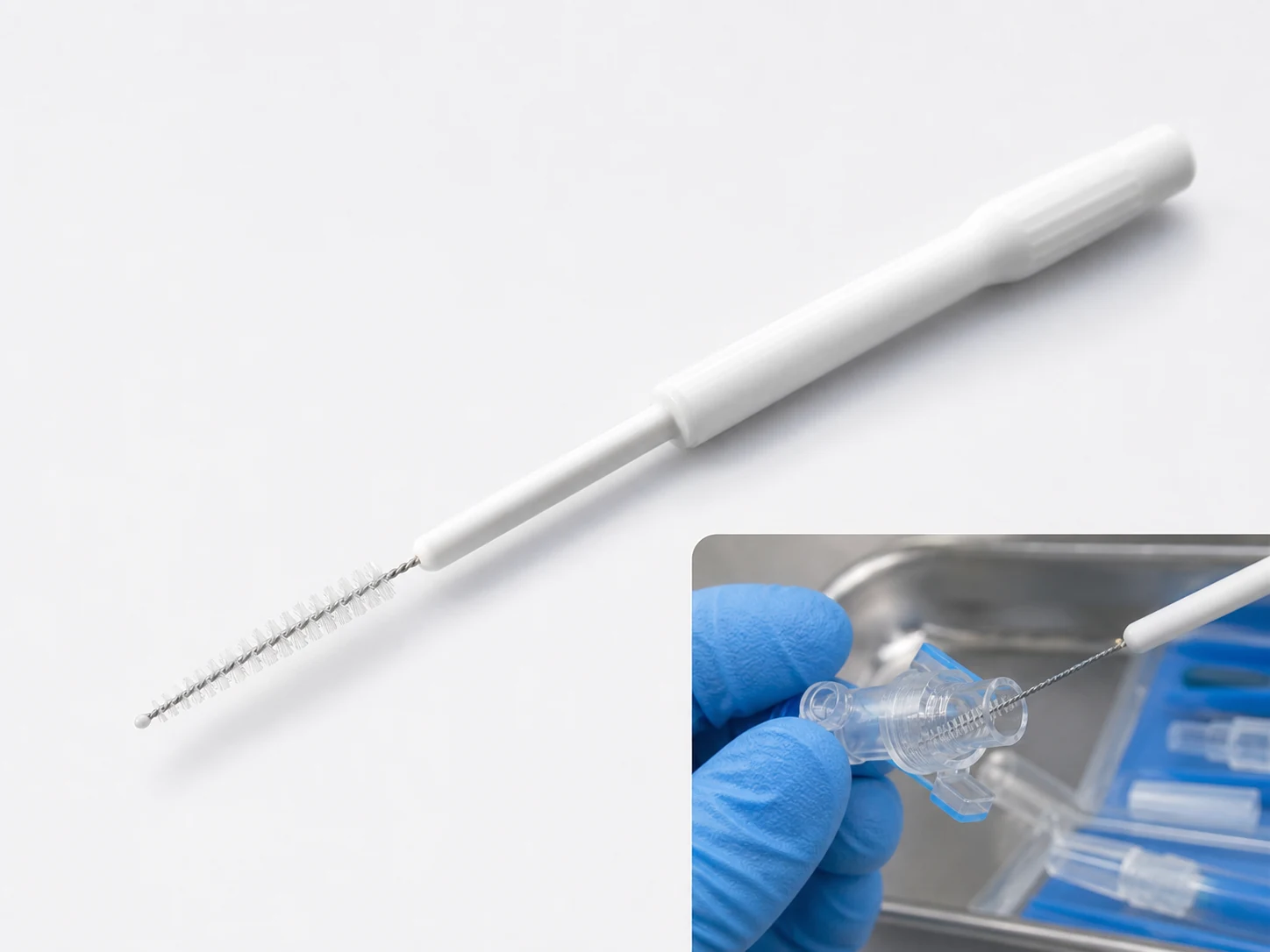
Small brush
500 pcs
Minimum order
Held in one hand: tube, bottle, detail and swab brushes — including long-handled ones with a small head.
Production lead time, once the specification is confirmed
- Up to 500 pcsWithin 7 days
- 501–50,000 pcsWithin 14 days
- Over 50,000 pcsWithin 21 days
Peak season can extend these times; the shipping date is confirmed in writing with your quotation. Sampling and shipping are quoted separately.
This medical cleaning brush removes blood, tissue, bone debris, and organic film from surgical instrument exteriors and from the narrow lumens, cannulas, and channels that many reusable devices carry. Available in diameters from 1 mm to 10 mm, it reaches the internal passages that a conventional instrument brush cannot enter, preparing devices for automated washing, disinfection, and sterilization.
What can this brush do for you?
Fits into the small passages where residue hides
Lumens and cannulas collect protein-based soil that soaking alone cannot remove. The 1–10 mm brush diameter range and 10–100 mm brush section length place nylon filaments against the inside wall, not just at the opening, so push-and-rotate strokes lift residue from the full passage.
Cleans stainless steel without wire-brush damage
Nylon PA filament is harder than the dried soil it removes but softer than passivated stainless steel and most instrument coatings. The filament ends scrub the surface while the body of the filament flexes, reducing the surface marking and scratching risk that a stainless wire brush introduces on critical instrument surfaces.
Removes dried blood, tissue, and biofilm
Filament diameters from 0.05 mm to 0.30 mm set the cleaning force. Fine filaments clean delicate or coated surfaces and small channels; heavier filaments break up dried blood, endoscopic protein film, and soft tissue residue during manual decontamination.
Withstands the decontamination environment
Nylon PA filaments tolerate common enzymatic cleaners, neutral detergents, and alkaline instrument detergents used in reprocessing areas. The material can be specified to match the chemicals, water temperature, and handling conditions of the actual cleaning line.
Keeps the cleaning result easy to verify
The open filament construction releases loose soil during rinsing instead of trapping it in a dense mass. A clean, dry towel drawn through the passage after brushing shows whether residue remains, supporting visual inspection and cleaning verification.
What is a Cleaning Brush Medical?
A Cleaning Brush Medical is a hand-guided, nylon-fill brush built for the manual cleaning stage of reusable medical device reprocessing. It is used on cannulas, suction tubes, endoscopic channels, and other lumened instruments after use and before washer-disinfector processing.
In its standard form, the brush has a small-diameter nylon PA filament section captured in a twisted wire or polymer stem. The operator guides the tip into the lumen, then uses short push-pull and rotating strokes under water or detergent solution. The filament tips scrape loosened blood, tissue, bone fragments, and protein film from the walls while the stem carries the working end through the full channel length.
The brush is not a sterilizer and not a chemical cleaning agent. It is the mechanical step that breaks the soil’s attachment so the subsequent detergent, thermal, and sterilization steps can reach the surface. It is also a reusable decontamination tool: it must be rinsed, disinfected, and inspected between uses just like other reprocessing accessories.
Technical Specifications
Standard range shown below. The critical fit dimensions are brush diameter, brush section length, and overall length; all can be adjusted to a specific device.
| Parameter | Value / Options |
|---|---|
| Brush diameter | 1–10 mm, matched to measured lumen ID |
| Brush section length | 10–100 mm |
| Overall length | 150–500 mm, matched to working depth and hand clearance |
| Filament diameter | 0.05–0.30 mm |
| Fill material | Nylon PA |
| Stem / core | Twisted stainless steel wire standard; flexible polymer stem for curved or metal-free requirements |
| Handle | Straight wire handle, loop handle, or molded hub; material per project |
| Tip | Rounded, blunt end standard; closed-tufted or shaped tips optional |
| Filament density | Medium standard; dense or sparse fill adjusted to diameter and soil type |
| Operating environment | Manual cleaning with enzymatic, neutral, and alkaline detergents; grade selected for process temperature and chemicals |
| Brush type | Custom Tube & Pipe Bore Brushes |
| How it is driven | Hand-guided |
| Cleaning target | surgical suction tube and lumened instrument, cannula and arthroscopic or laparoscopic port, and reusable endoscopic device and channel cleaning |
| Surface or part | channel, instruments, passages, lumens, guides, tubes, narrow passages, and walls |
| Residue or debris | blood, protein, protein film, leaves, organic film, biofilm, and scale |
| Mounting / connection | Fixed |
For canal or cannula sets, diameter increments can be supplied as matched cleaning brush sets with visible size identification.
Where does this brush work best?
- Surgical suction tubes and lumened instruments. Removes blood and tissue from inner bores before the automated washer handles the rest of the device.
- Cannulas and arthroscopic or laparoscopic ports. Reaches side holes and narrow passages where rinsing alone leaves protein film.
- Orthopedic tools and bone preparation instruments. Cleans guides, taps, reamers, and crevices carrying bone debris or cement residue.
- Reusable endoscopic devices and channels. When built to the manufacturer’s specified channel diameter and length, removes protein and biofilm from suction and biopsy channel areas.
- Central sterile processing departments and device reprocessing lines. Standardized diameter sets allow techs to select correct brush for the device family and support repeatable cleaning.
How do I choose the right one?
Match the brush diameter to the lumen ID
Measure the smallest internal diameter the brush must pass. A correctly sized brush should enter with light friction and should be felt along the wall; generally 0.5–1 mm above lumen ID works for straight stainless lumens. If it falls through, it cannot clean; if it jams, the stem bends and bristles flatten.
Set the brush section longer than the soiled path
The brush section should cover the full length that carries residue, with a small extra length to exit the far end or blind bottom. A section too short leaves a dirty distal area; too long in a narrow passage can fold over and lose wall contact.
Select filament diameter for the surface and soil
0.05–0.15 mm filaments suit delicate surfaces, fine channels, and removable protein film. 0.15–0.30 mm filaments provide more tip pressure for dried blood, tissue, and softer cement deposits on stainless instruments. If the deposit is rock-hard scale, burned, or strongly adhered cement, move to a wire brush or an approved cement removal method.
Consider stem flexibility with overall length
Long overall lengths require a stem stiff enough to push without buckling. Straight stainless lumens accept twisted wire; curved cannulas or channels may need a flexible polymer stem. Test the dry brush in the device before introducing detergent.
Check the cleaning process, not just the brush
Specify the enzymes, detergents, wash temperature, and whether the brush will be thermally disinfected or sterilized. Nylon PA handles common reprocessing detergents, but handle and stem material must match the full process.
Use a different tool when:
- Residue is hardened cement, scale, corrosion, or carbon that nylon cannot cut — use a stainless wire brush or chemical/ultrasonic method.
- The device is a flexible endoscope or a single-use high-risk channel where only the manufacturer’s validated channel brush or a disposable brush is permitted.
- The passage has sharp internal edges or non-round cross-sections that can shear nylon filaments on every pass.
Can I customize this brush?
Yes. Medical cleaning brushes are configured around a specific device or instrument family. To define the brush, provide the target device name or reference, minimum inner diameter, channel length and shape, surface material, residue, cleaning chemicals and temperature, and any handle or packaging requirement. A sample, drawing, or CAD file shortens the design step.
Customizable elements include:
- Brush diameter, tolerance, and section length
- Filament material, diameter, color, and fill density
- Tip style: rounded, tufted, cup, or custom-molded end
- Stem/core: stainless steel wire, coated wire, or flexible polymer
- Handle: straight wire, loop, ergonomic grip, or hub for mounting
- Color coding, printed marking, or size identification
- Packaging: bulk, individually bagged, matched sets, or project-specific kits
- Project-specific material declarations, inspection data, and third-party testing support
What size should a cleaning brush medical be, and how long does it last?
How can I tell whether the brush diameter is right for a lumen?
Wet the brush and insert it into the lumen. It should enter with light, even friction and produce slight resistance when rotated. If no resistance and no soil appears on the bristles after withdrawing, go up one diameter. If the stem buckles or the brush stops at the entrance, go down. Finish by drawing a clean white wipe through the lumen to check that removed soil and no fresh scratches are present.
Can this brush be used inside flexible endoscope channels?
Only if the diameter, length, and stiffness match the endoscope manufacturer’s validated cleaning accessories. Flexible endoscope channels can be damaged by an incorrect brush. We can build a brush to the stated channel dimensions, but the reprocessing facility must confirm it against the device reprocessing instructions before use.
Should I soak the instrument before brushing?
Brush as soon as possible after use, before blood and tissue dry. If soil has already dried or the lumen is heavily contaminated, follow the instrument’s instructions for pre-soaking in an enzymatic solution, then brush. Brushing does not replace the pre-soak for hardened deposits.
How often should this medical cleaning brush be replaced?
Inspect before each use: check for flattened, bent, or missing filaments; kinked or corroded stem; cracked handle. Replace the brush if the filaments no longer spring back after bending, the stem will not return to its original shape, or visible filament loss occurs. Heavily used fine-diameter brushes will need replacement more often than larger brushes.
Does brushing remove all biofilm from a device?
Brushing mechanically disrupts biofilm and attached soil, which improves what later chemical or thermal steps can remove. Complete decontamination still requires the full validated cleaning, rinsing, disinfection, and sterilization process for the specific device. Do not treat brushing as a replacement for those steps.
What is the difference between this reusable brush and a disposable channel brush?
This nylon cleaning brush is intended for reprocessing instrument sets where the brush can be cleaned, disinfected, and dried between uses. Disposable brushes are typically used for single-pass cleaning of contamination-critical channels or when the brush itself cannot be reliably reprocessed in the facility.
Guides that go deeper on this
We have not written a guide specific to this one yet. The material that covers selection, filament, dimensions, maintenance and sourcing is collected in the technical resources library.
Custom Manufacturing RFQ
Describe Your Application
To quote this brush accurately, send the size, material, cleaning target, residue, quantity, and any available drawing or sample photo.
Drawing or photo optional — it speeds things up, it does not gate the enquiry.
Custom Brush RFQ
Send Your Brush Project
Upload a drawing, product photo, or sample photo and provide the core dimensions and cleaning conditions.
“We need a brush to remove wet residue from a stainless steel conveyor, about 800mm wide. The current brush wears quickly. We can send photos.”
“We sell drinkware and need a cleaning brush to include with the product. Quantity around 5,000 pieces.”