
Custom Cleaning Brush
Medical Instrument Cleaning Brush
Hand and channel brushes for surgical, dental and endoscopic reprocessing. 316 stainless wire or PA610/PA612 nylon, 1–50 mm heads, 1–20 mm lumens.
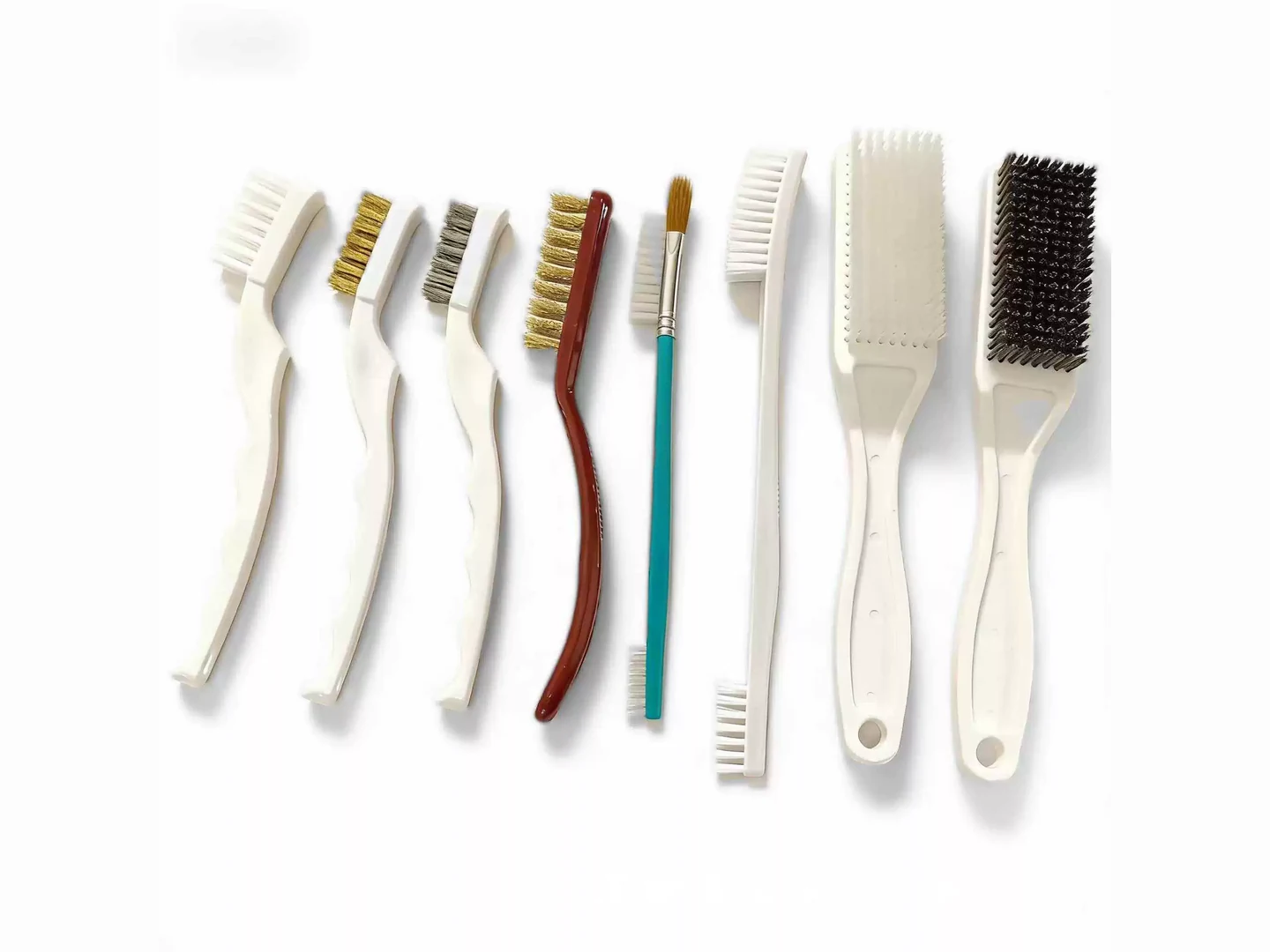
Small brush
500 pcs
Minimum order
Held in one hand: tube, bottle, detail and swab brushes — including long-handled ones with a small head.
Production lead time, once the specification is confirmed
- Up to 500 pcsWithin 7 days
- 501–50,000 pcsWithin 14 days
- Over 50,000 pcsWithin 21 days
Peak season can extend these times; the shipping date is confirmed in writing with your quotation. Sampling and shipping are quoted separately.
A hand and channel brush family for reprocessing reusable surgical, dental, and endoscopic instruments — sized to enter box locks, serrations, hinged joints, and 1–20 mm lumens, and configurable in PA610/PA612 nylon or 316 stainless steel to match instrument material and soil load. Reusable and single-use configurations support manual pre-cleaning before disinfection and sterilization.
What can this brush do for you?
Push into box locks, ratchets, and serrations
The brush head is trimmed and crimped to enter narrow hinge gaps and serrated grip surfaces where sponges, wipes, and general-purpose brushes cannot maintain contact. Fine nylon filament diameters down to 0.05 mm let individual bristles slip into teeth and grooves and lift out dried protein, bone debris, and lubricant film from the areas most likely to fail post-cleaning inspection.
Follow flexible channels, cannulas, and suction tubes
For suction tubes, trocar sleeves, cannulated screws, and endoscopic working channels, a spiral-wound or tufted fill on a flexible 316 stainless steel core bends with the lumen. Channel brushes from 1 mm diameter up scrub the full internal circumference along the entire working length instead of cleaning only the entry area.
Keep the brush itself from becoming a contamination source
PA610 and PA612 nylon filament resist moisture uptake and dimensional swelling through repeated wet cycles, enzymatic cleaners, and washer-disinfector thermal exposure to 93°C. 316 stainless steel wire handles aggressive manual scrubbing and steam exposure without rusting. Brushes that shed, corrode, or lose trim become a new residue problem; these materials are selected to hold their fill and shape until the brush is retired by inspection.
Offer reusable and disposable formats without changing the operator’s motion
Single-use brushes remove the inspection and transport step and reduce cross-instrument concerns. Reusable brushes lower per-cycle supply cost in high-volume central sterile departments. Both can be built to the same head geometry, so you choose the format that fits the reprocessing SOP, not a different cleaning technique.
Match contact aggressiveness to the instrument surface
Nylon filament is the default for delicate, plated, anodized, and precision-ground surfaces. 316 stainless steel wire is reserved for robust stainless instruments with dried-on or tenacious deposits. The contact material is specified explicitly for each instrument family, so a scratch risk is not left to the operator’s judgment.
What is a Medical Instrument Cleaning Brush?
A Medical Instrument Cleaning Brush is a hand-guided brush used during the manual cleaning step of instrument reprocessing. It is built for the geometry that other cleaning methods miss: the box lock of a hemostat, the serrated jaw, the hinge recess, the inside of a cannula, the narrow lumen of a suction tube, and the crevice around an insulated connector. Organic soil or detergent film left in these zones can shield microorganisms from the later disinfection or sterilization process, so the brush removes that load before the instrument moves to the mechanical stage.
Typical hand brushes use a twisted or coated wire core that anchors rows of filament trimmed to a controlled diameter and tip profile. Channel brushes use a continuous spiral or tufted fill over a flexible core long enough to follow the lumen. Handles may be fixed, T-shaped, looped, or tray-color-coded; for small joints, a double-ended brush can carry a different head size at each end.
The brush is used wet—under running water or immersed in detergent or enzymatic solution—because dry brushing drives protein deeper into fine clearances and creates aerosols. The operator works from the least contaminated area toward the most contaminated area, then performs a visual or borescope check before the instrument proceeds. This is a manual pre-cleaning accessory, not a replacement for a washer-disinfector or ultrasonic cleaner.
Technical Specifications
| Parameter | Available / Standard Range | What to check for your instrument |
|---|---|---|
| Configuration | Hand brush, channel/tube brush, double-ended brush, end-tuft brush, wire brush, disposable | Select by access path: open hinge, small cavity, internal lumen, or combined kit |
| Fill material | PA610 nylon, PA612 nylon, 316 stainless steel wire | Nylon for gentle, moisture-stable contact; stainless wire for tenacious deposits on robust instruments |
| Filament diameter | 0.05–0.35 mm (nylon); wire gauge selected per brushing task | Finer filament enters serrations and crevices; heavier filament provides more scrubbing pressure |
| Head / brush outside diameter | 1–50 mm | Sized to hinge gap or minimum lumen ID; channel fill must contact the full internal wall |
| Working length | 5–100 mm standard hand brushes; 300–2,400 mm flexible channel brushes | Must reach the deepest surface while leaving enough operator control |
| Overall length | 100–600 mm for standard hand tools; longer for deep channel brushes | Check sink, tray, and storage fit as well as single-hand use |
| Stem / core | 316 stainless steel wire, twisted core, coated wire, polymer shaft | Flexibility, kink resistance, and chemical compatibility should match the reprocessing environment |
| Channel compatibility | 1–20 mm internal diameter | Below 1 mm or dead-end cavities may require a flush/swab method instead of a bristle brush |
| Handle | PP, nylon, stainless steel, or overmolded grip; color coding by size or station available | Handle material must withstand the same wash and thermal cycle as the brush head |
| Reprocessing exposure | Manual soak/wash with enzymatic detergent, washer-disinfector cycle to 93°C, steam sterilization at 121–134°C for PA610/PA612 and 316 stainless configurations | Final material choice is confirmed against the customer’s detergent, pH, temperature, and cycle profile |
| Brush type | Custom Tube & Pipe Bore Brushes | |
| How it is driven | Hand-guided | |
| Cleaning target | central sterile and instrument reprocessing department, box-lock, hinged and cannulated instrument, and dental, micro-surgical and laboratory equipment cleaning | |
| Surface or part | instruments, channel, lumens, serrations, hinges, tubes, joints, trays, and passages | |
| Residue or debris | lubricant, protein, detergent film, fine particles, protein residue, dust, process residue, reagent film, and tissue residue | |
| Mounting / connection | Fixed |
All values are standard configuration ranges. Final dimensions and materials are confirmed against your instrument drawings, lumen IDs, and reprocessing instructions during quotation.
Where does this brush work best?
- Central sterile and instrument reprocessing departments: manual pre-cleaning of hinged surgical instruments—hemostats, forceps, needle holders, scissors, and towel clamps—before washer-disinfector processing.
- Instrument sets with internal channels: suction tubes, trocars, cannulas, irrigation lines, and laparoscopic shafts, where a flexible channel brush follows the bend while scrubbing the internal wall.
- Dental and micro-surgical instruments: small end-tuft or pointed brushes for hinges, serrations, and grooves on delicate instruments where nylon contact protects fine surfaces.
- Orthopedic trays: cannulated screws, drill guides, depth gauges, and trial implants with blind holes, internal threads, or narrow bores that hold bone debris and lubricant.
- OEM instrument kits and procedure packs: companion brushes supplied with reusable instrument sets, brushes for post-manufacturing residual check, or single-use brushes for single-use procedural kits.
How do I choose the right one?
Start with the smallest access feature, then work outward to handle, material, and reprocessing format.
- Identify the access problem first. Hinges, serrations, and crevices call for a hand or end-tuft brush. Internal lumens, cannulas, and channels call for a flexible channel brush. Combined instrument families often justify a double-ended brush.
- Measure the narrowest clearance or smallest lumen ID. The brush outside diameter should be a controlled fit: enough to create filament deflection against both walls, but not so large that it jams in a stepped or curved passage. For tapered channels, provide the minimum and maximum ID.
- Choose filament by instrument material and soil type. PA610 or PA612 nylon handles protein, lubricant, and detergent film on general stainless and delicate surfaces. 316 stainless wire is only for robust stainless instruments with dried-on or tenacious deposits. Do not use wire on titanium, anodized aluminum, plated, or mirror-finished surfaces.
- Set reach and handle length together. Working length must reach the deepest surface; overall length must still give the operator control at the sink or workstation. Very long flexible brushes may need supported insertion to prevent kinking at the entry port.
- Decide reusable versus disposable. Reusable brushes suit high-volume departments that inspect and reprocess their own tools. Single-use brushes fit strict traceability requirements, procedure pack integration, and workflows where brush reprocessing is not practical. Both can use the same head geometry.
- Confirm the reprocessing environment. Detergent pH, enzyme class, immersion time, washer-disinfector temperature, and steam cycle all affect brush life. Specify these so the stem, handle, and filament are all selected for the actual cycle, not just for the instrument geometry.
When another tool fits better
Use a flush or brushless lumen-cleaning method for passages below 1 mm or blind cavities where bristle shedding cannot be tolerated. Use the washer-disinfector or ultrasonic bath as the primary mechanical cleaning step; this brush is the manual pre-cleaning accessory. For delicate optics and dead-end cavities, a lint-free foam or swab applicator may be safer than a filament brush. Do not use stainless wire brushes on fine, coated, anodized, or precision optical surfaces.
Can I customize this brush?
Every instrument family has different hinge gaps, lumen IDs, lengths, and reprocessing chemistry, so most medical instrument cleaning brushes are built to the customer’s tray list rather than picked from stock. To specify a configuration, provide the instrument drawings or catalog numbers, the minimum lumen ID or hinge gap, the residue type, the detergent and thermal cycle, and the preferred reusable or disposable format. A sample or retired instrument speeds up validation.
We can adjust:
- Head form: tufted, twisted-in-wire, spiral channel fill, end-tuft, double-ended, tapered, or blunt tip
- Filament: PA610 or PA612 nylon, filament diameter, fill density, trim length, wire grade, and crimp style
- Core and stem: 316 stainless steel wire, coated wire, or polymer shaft with the required flexibility and kink resistance
- Handle: material, length, shape, hanging hole, grip texture, color coding by instrument size or station, and laser or pad-printed ID marking
- Dimensions: brush outside diameter from 1 mm upward, working length from short end-tuft to multi-meter channel configurations, and total length matched to tray or workstation
- Packaging: bulk cartons, individual peel pouches, tray-specific packs, procedure kit integration, or private-label retail packaging
- Documentation and testing support: material datasheets, lot traceability, incoming inspection reports, and coordination of third-party testing against your project requirements
If your reprocessing validation requires material declarations, destructive testing of crimp retention, or third-party test reports, we can coordinate those project-specific requirements during customization.
How do you confirm a medical instrument cleaning brush has actually cleaned the surface?
How do we confirm a channel brush will not jam inside a stepped or curved lumen?
Provide the narrowest internal diameter and the tightest bend radius. We size the brush to pass the narrow section with controlled clearance and build enough fill in the working section to deflect against the wall. Run a test pass through a representative or retired lumen before full implementation.
What should an operator check on a reusable brush before each use?
Pull on the brush head and tuft rows to verify filament security. Inspect the core for kinks, loose crimps, or corrosion, and check the handle for cracks or softening. If any bristle is loose or the core shows fatigue, retire the brush. Always brush under fluid—never dry-brush instrument surfaces.
How do we verify the lumen or hinge is actually clean before moving to disinfection?
For open hinges and serrations, inspect under magnification or wipe with a clean white cloth. For lumens, flush with clean water and examine the rinse; for long or blind channels, use a borescope or channel-check swab according to department SOP. If residue reappears, adjust brush diameter, working length, or the number of passes before changing the detergent.
Is a medical instrument cleaning brush a substitute for the washer-disinfector or ultrasonic cleaner?
No. The brush removes surface-attached soil from complex geometry; the mechanical cleaning equipment provides standardized impingement and cavitation across the entire instrument. Use the brush on areas the equipment alone cannot reach, then run the complete instrument through the prescribed cycle.
Can the same brush be used on titanium, anodized aluminum, and stainless steel instruments?
Nylon filament brushes can generally be used across intact metal surfaces, including titanium and anodized components. Stainless wire brushes are limited to robust stainless steel surfaces and should not be used on titanium, anodized, plated, or mirror-finished components. Separate color-coded brushes per material family reduce mix-up risk.
What does the choice between PA610 and PA612 actually change in use?
Both handle enzymatic and alkaline cleaning solutions and wet heat well. PA612 typically absorbs slightly less moisture and may hold tuft trim more consistently through long wet cycles; PA610 is a widely accepted reprocessing filament. If your cycle includes prolonged hot immersion or a high-pH detergent, share the process details so we can recommend the better fit and confirm trim retention.
Guides that go deeper on this
Custom Manufacturing RFQ
Describe Your Application
An accurate custom quote starts with the dimensions, working surface, residue, material choice, connection, quantity, and reference files.
Drawing or photo optional — it speeds things up, it does not gate the enquiry.
Custom Brush RFQ
Send Your Brush Project
Upload a drawing, product photo, or sample photo and provide the core dimensions and cleaning conditions.
“We need a brush to remove wet residue from a stainless steel conveyor, about 800mm wide. The current brush wears quickly. We can send photos.”
“We sell drinkware and need a cleaning brush to include with the product. Quantity around 5,000 pieces.”