
Custom Cleaning Brush
Fixture Cleaning Brush
Industrial fixture cleaning brush with brass wire or nylon PA fill for mold cavities, parting lines, fixture faces, and tool interfaces.
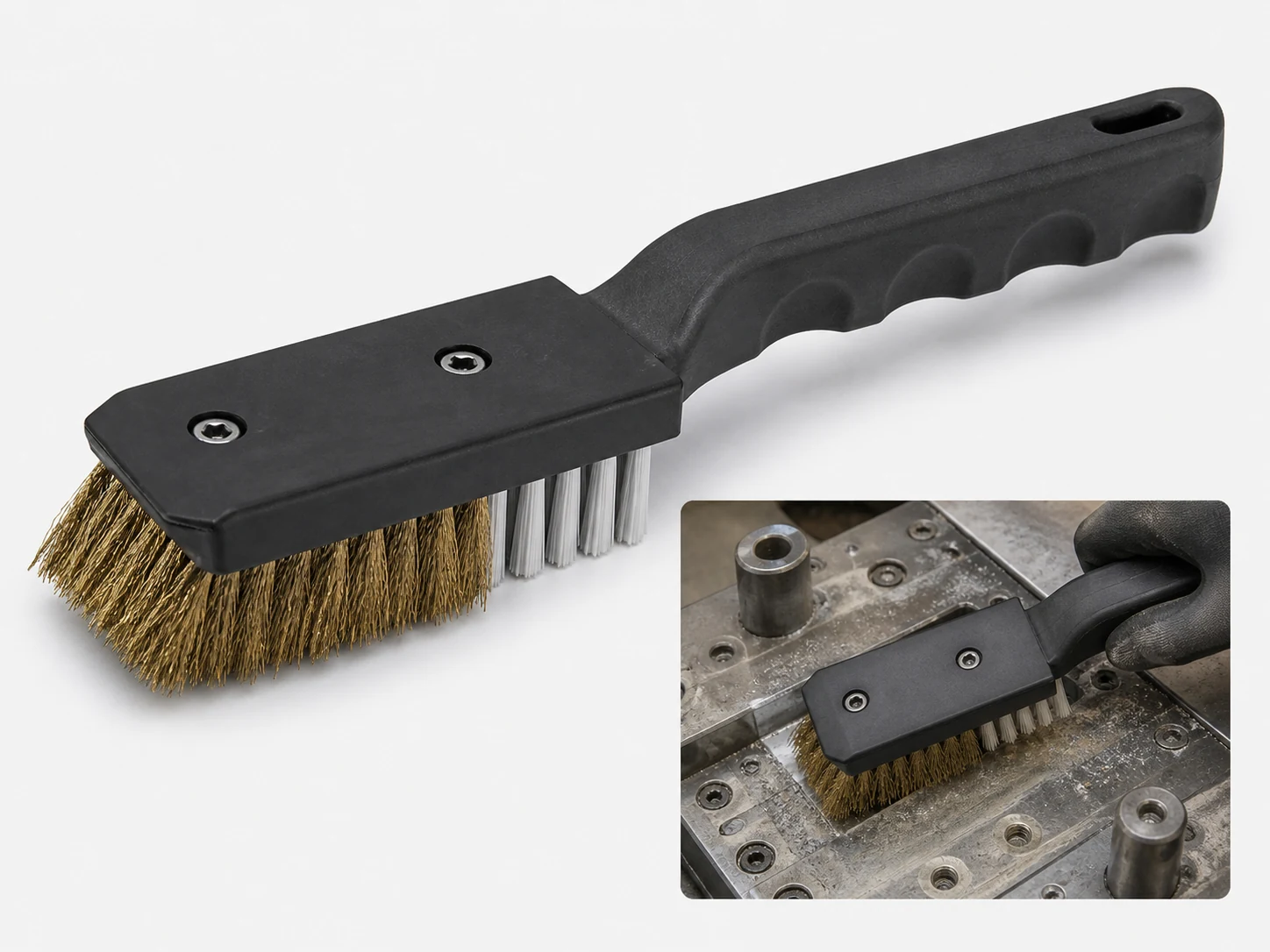
Medium brush
100 pcs
Minimum order
Worked with two hands or on a pole: chimney, gutter and pond-filter brushes, discs, cups and tank brushes.
Production lead time, once the specification is confirmed
- Up to 100 pcsWithin 7 days
- 101–5,000 pcsWithin 14 days
- 5,001–50,000 pcsWithin 21 days
- Over 50,000 pcsConfirmed with your quotation
Peak season can extend these times; the shipping date is confirmed in writing with your quotation. Sampling and shipping are quoted separately.
A configurable industrial brush for cleaning mold cavities, parting lines, fixture faces, and tool interfaces where residue builds up in tight spaces. Choose brass wire fill for hardened tool steel and heavy deposits, or nylon PA fill for coated, textured, and non-marring surfaces.
What can this brush do for you?
Reaches into Mold Cavities, Parting Lines, and Vents
Head widths from 10 mm and trim lengths from 10 mm let the brush enter narrow openings and clean the sidewalls, corners, and vent channels that a rag or flat scraper cannot reach. Overall lengths from 120 mm to 1000 mm put the working end in reach for the operator or the machine.
Brass Wire Fill Removes Baked Deposits Without Damaging Hardened Tool Steel
Brass is softer than hardened tool steel, so a brass wire brush scrapes away release agent, polymer flash, carbon, oxide, and oil without the deep scratches that a steel wire brush can leave on mold surfaces. This preserves the molded surface finish and extends the time between re-polishing operations.
Nylon PA Fill Protects Coated and Textured Fixture Faces
For anodized aluminum, plated surfaces, textured mold faces, or parts with non-stick coatings, nylon PA fill removes light release agent, dust, and oil without metal transfer or marring. It also works well in wet and solvent-assisted cleaning where brass may not be the best match.
Mounts the Way Your Process Needs
Choose a handheld handle for operator cleaning between cycles, a threaded stud, ferrule, or shank for drop-in replacement in an existing holder, or a bracket or machine bar for automated cleaning stations. The same fill and trim specification can be supplied across multiple mounting styles.
Rebuildable Strips and Blocks Reduce Replacement Cost
When wear is uneven or the brush is used at high frequency, the fill can be built as a replaceable strip or block. You replace the worn section rather than the entire tool, which lowers maintenance cost and keeps a consistent cleaning geometry.
What is a Fixture Cleaning Brush?
A Fixture Cleaning Brush is an industrial hand or machine-applied brush built to clean the precision surfaces of molds, dies, jigs, fixtures, and machine components between production cycles or during maintenance. Unlike a general-purpose wire brush, it is specified by contact geometry, backing, fill material, trim length, and mounting.
The brush may be a short handheld tool, a long handled strip for pallet T-slots, a block shaped to fit a mold cavity, or a bar that traverses a machined surface. Brass wire and nylon PA are the two most common fill materials because they remove residues typical of molding, stamping, and machining while controlling the risk of surface damage. The brush can be used dry or with cleaning solvents, manually or in automated linear or rotary motion.
It is not a final cleaning step. Brushing loosens attached residue; vacuuming, air blow-off, or a lint-free wipe removes what the brush has freed. But by doing the mechanical work first, it makes those final steps faster and more consistent.
Technical Specifications
Dimensions are project-specific and matched to the fixture. The ranges below cover the most common industrial fixture cleaning brush configurations.
| Parameter | Options / Range |
|---|---|
| Head width | 10–400 mm, matched to fixture face or cavity opening |
| Working length | 20–300 mm, distance from backing to filament tips |
| Overall length | 120–1000 mm, includes handle or machine interface |
| Trim length | 10–100 mm, exposed filament length |
| Filament diameter | Brass wire: 0.08–1.00 mm; Nylon PA: 0.10–1.00 mm |
| Fill materials | Brass wire, nylon PA, or mixed brass/nylon configuration |
| Filament pattern | Straight, crimped, or straight/crimp combination |
| Mounting | Handheld handle, threaded stud, ferrule, shank, bracket, or machine bar |
| Backing / base | Hardwood, PP, aluminum, or steel |
| Brush type | Custom Handheld Detail Brushes |
| How it is driven | Hand-guided |
| Cleaning target | injection mold maintenance, die casting die and trim tooling, and cnc fixture and workholding cleaning |
| Surface or part | fixtures, cavities, molds, parting lines, dies, vents, bars, and aluminum |
| Residue or debris | mold, release agent, oil, carbon, oxide, coolant residue, metal particles, and chips |
| Mounting / connection | Handheld handle, threaded stud, ferrule, shank, bracket, or machine bar |
Chemical compatibility and operating temperature depend on the selected fill, backing, and handle materials. Provide the cleaning agent and process temperature with your inquiry.
Where does this brush work best?
- Injection mold maintenance: cavities, cores, ejector pins, vents, and parting lines where release agent builds up between cycles.
- Die casting dies and trim tooling: removing aluminum or zinc flash, oxide, and release agent from die faces and clearances.
- CNC fixtures and workholding: clearing chips, oil, and coolant residue from locating faces, clamp surfaces, and jaws before part loading.
- Stamping and forming dies: removing carbon, drawing compound, and fine metal particles packed into radii and clearances.
- Machine tool tables and pallet receivers: cleaning T-slots, indexers, and pallet locating surfaces during planned maintenance or changeover.
How do I choose the right one?
Start with the fill material. Use brass wire on hardened tool steel, cast iron, and steel alloy molds or fixtures where the residue is baked release agent, carbon, light oxide, polymer flash, or oil. Brass is harder than nylon but softer than hardened steel, so it removes more aggressive deposits while leaving shallower surface marks than a steel wire brush. Avoid brass on polished optical surfaces or chrome-plated faces where faint brass transfer would be unacceptable. Use nylon PA on aluminum, anodized, plated, coated, or textured surfaces where metal contact is not allowed. Nylon removes light release agent, dust, oil, and soft residue; it will not remove heavy carbon, scale, or flash.
Match the geometry to the access and contact area. Measure the narrowest cavity opening, the deepest recess, and the farthest point you need to reach. The head width must clear the opening, and the trim length must reach the bottom of the feature without bending excessively. A wider head cleans more surface per stroke but cannot enter narrow vents or parting lines. Use multiple widths or a shaped head if the fixture has mixed regions.
Select the mounting for how the brush will move. A handheld handle suits operator cleaning between cycles. A threaded stud, ferrule, or shank matches an existing holder. A bracket or machine bar works for automated linear or rotary cleaning motions. The mounting must withstand the applied force and cycle frequency.
Confirm the operating environment. Brass wire tolerates oil and moderate heat, while nylon PA suits wet and many solvent-based cleaning steps but loses strength at elevated temperatures. Check the cleaning chemical, temperature, and contact time against the fill and backing materials before finalizing the specification.
When to use a different brush or method. For heavy rust, weld spatter, deep scale, or baked-on material that requires aggressive scraping or grinding, use a steel wire brush, power brush, or abrasive tool. For narrow deep holes and internal bores, a twisted-in-wire or tube brush reaches better than a flat fixture brush. For static-sensitive electronic fixtures, use ESD-safe nylon fill and avoid brass. Always test on a non-critical area when the surface finish tolerance is tight.
Can I customize this brush?
Fixture cleaning brushes are almost always project-specific. To build the right configuration, provide the fixture drawing or dimensions, surface material, residue type, cleaning chemical, and whether the brush will be hand-used or machine-driven.
- Head geometry: width, length, shape, angle, multi-row layout, cavity profile, and trim angle.
- Fill: brass wire, nylon PA, or mixed fill; filament diameter; density; length; straight, crimped, or combination pattern.
- Backing: material, thickness, replaceable strip design, and mounting holes or slots.
- Handle or interface: handle length and grip style, threaded stud size, ferrule, shank, bracket, or machine bar with the required mounting pattern.
- Color and marking: color coding, laser marking, pad printing, or part number identification.
- Packaging: bulk, individually wrapped, kit, or project-specific packing.
We can also assist with material declarations, inspection documentation, and third-party testing if your project requires them.
Which filament survives the cleaning and still lasts on a fixture cleaning brush?
How do I know if brass wire is safe for my mold surface?
Brass is softer than hardened tool steel and most mold steels, so it generally removes residue without cutting into the base material. Test it on a non-critical area first. If you see metal transfer or a change in surface gloss, switch to nylon PA or a lighter-gauge brass fill.
What is the difference between crimped and straight filament in fixture cleaning?
Crimped filament is wavy, which makes the fill more flexible and helps it release debris instead of packing it. Straight filament is stiffer and gives a more aggressive scraping action. Many fixture brushes use a straight/crimp combination to clean both flat faces and corners.
When should I replace the brush fill?
Replace the fill when the filament no longer springs back, when the tips are flattened or broken, or when cleaning takes noticeably more passes. On replaceable strip and block designs, you swap the worn section without replacing the handle or mounting hardware.
Can this brush be used with solvents or other cleaning chemicals?
Yes, but the fill and backing materials must match the chemical. Brass wire works with most oil-based and hydrocarbon solvents but can be attacked by strong acids. Nylon PA tolerates many water-based cleaners and mild solvents, but check the specific chemical and temperature. Provide the cleaning agent with your inquiry so the brush is built for it.
Does brushing replace wiping or vacuuming during fixture cleaning?
No. Brushing loosens attached residue, but the loosened material still needs to be removed by vacuum, air blow-off, or a lint-free wipe. On precision locating surfaces, use a final wipe after brushing to confirm the surface is clean before installing the next part.
What if my fixture has both heavy carbon and coated surfaces?
Specify a mixed-fill or dual-zone brush: brass wire in areas that need aggressive cleaning, nylon PA in areas that require non-marring contact. The brush can be built with different fills on different faces or sections, matched to the fixture drawing.
Guides that go deeper on this
Custom Manufacturing RFQ
Describe Your Application
For a custom quote, we need the key dimensions, surface or part, residue, material preference, quantity, and reference image or drawing.
Drawing or photo optional — it speeds things up, it does not gate the enquiry.
Custom Brush RFQ
Send Your Brush Project
Upload a drawing, product photo, or sample photo and provide the core dimensions and cleaning conditions.
“We need a brush to remove wet residue from a stainless steel conveyor, about 800mm wide. The current brush wears quickly. We can send photos.”
“We sell drinkware and need a cleaning brush to include with the product. Quantity around 5,000 pieces.”