What Is a Heat Treatment Fixture Brush?
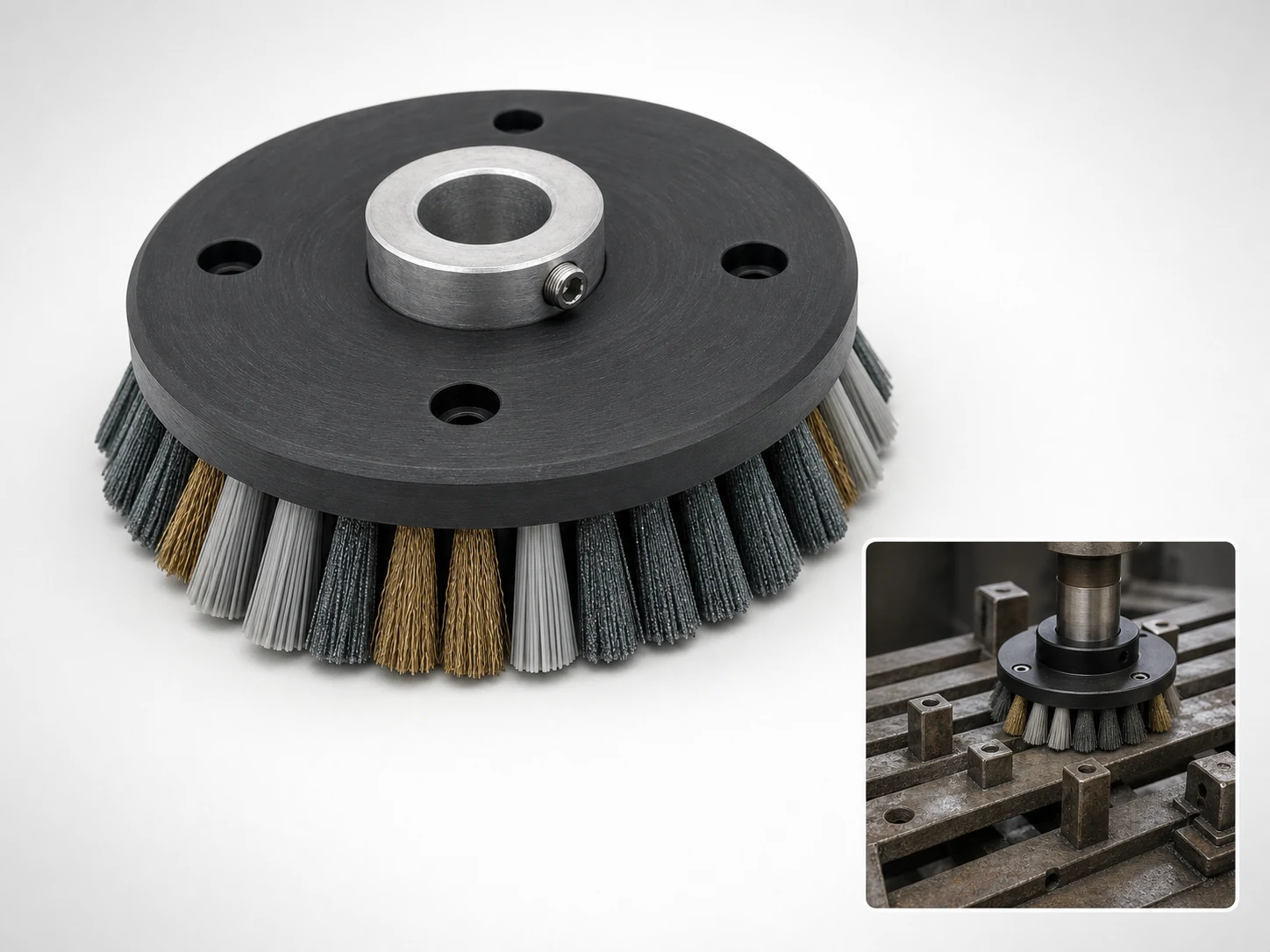
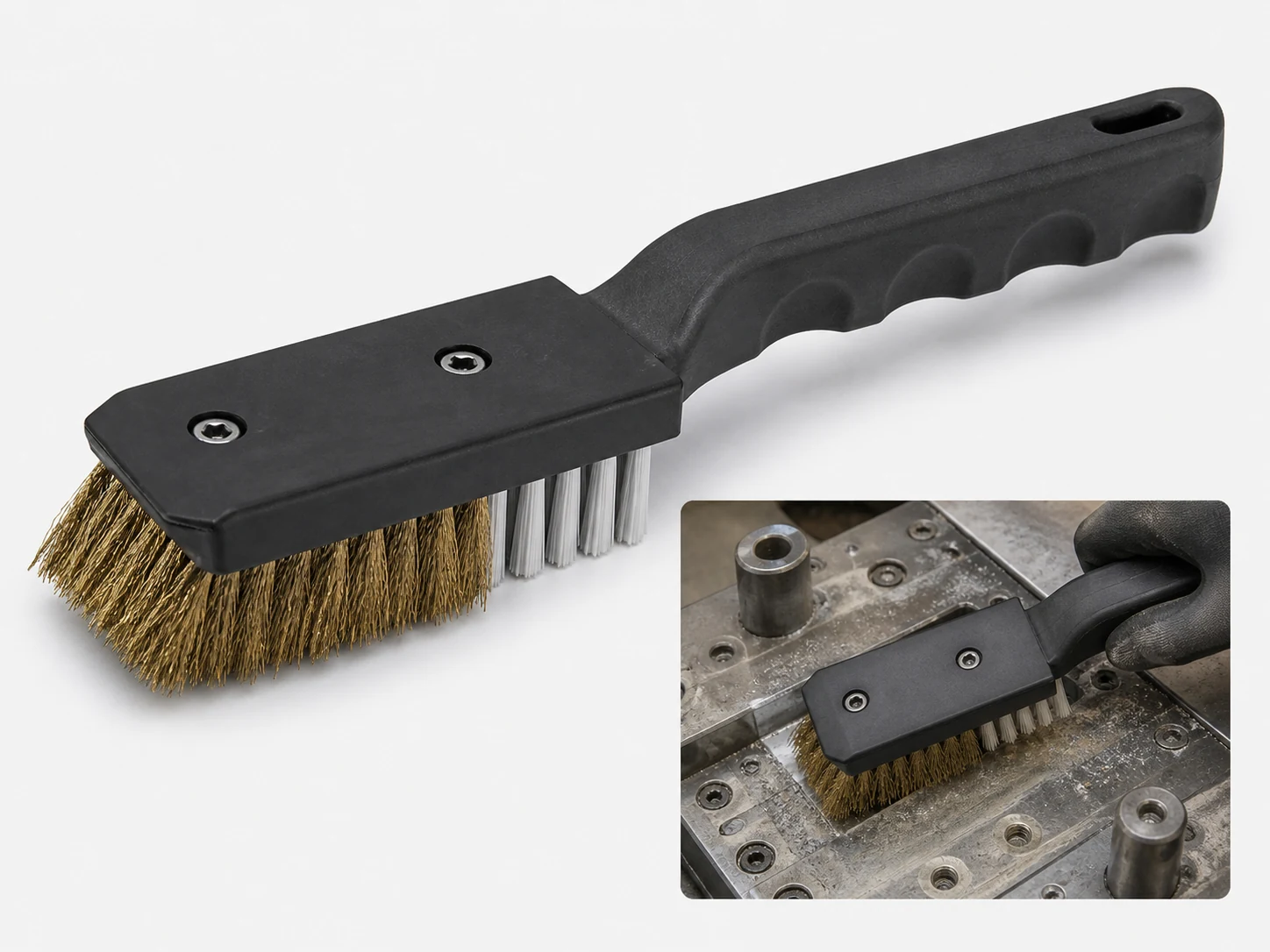
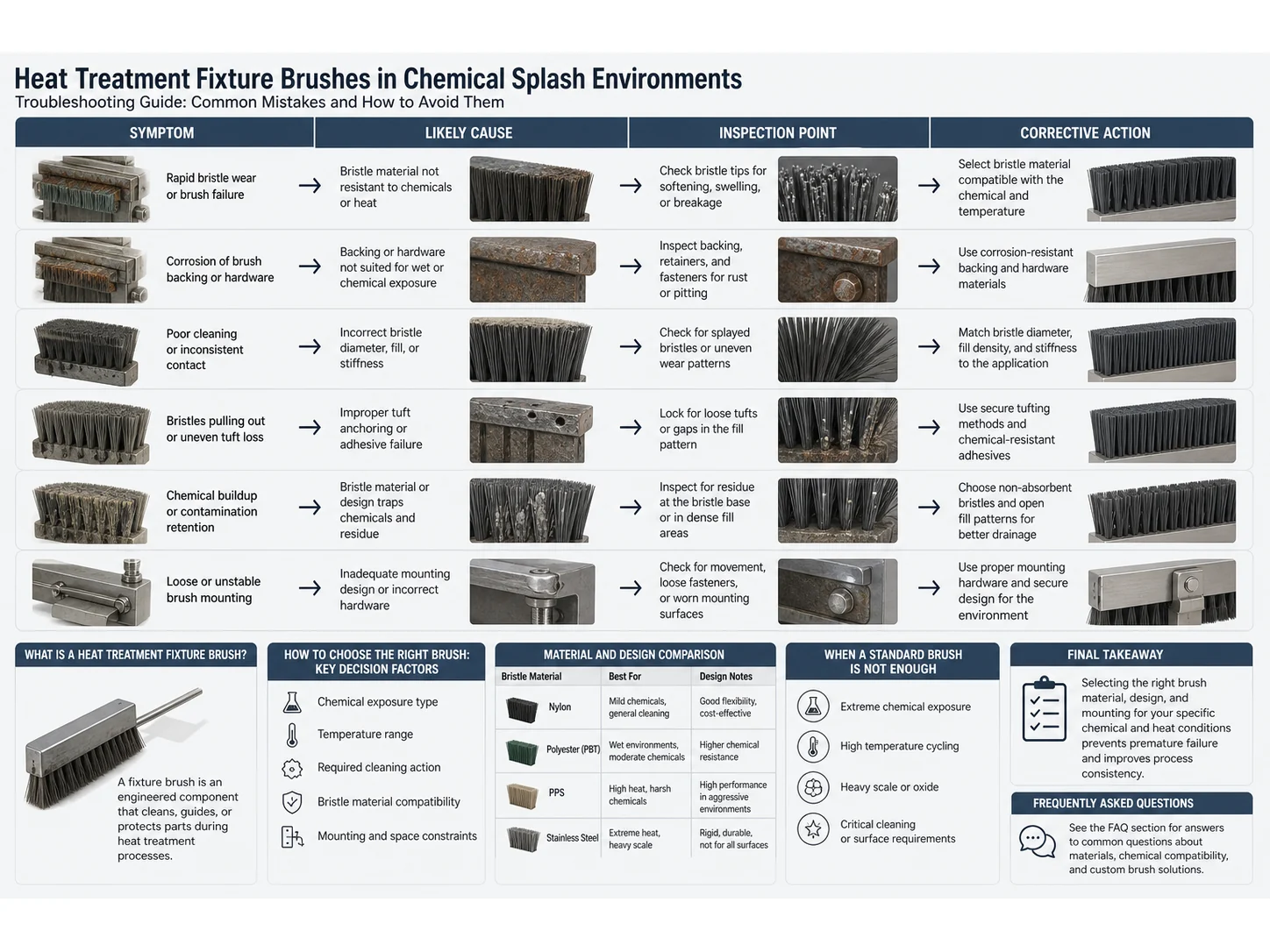
A heat treatment fixture brush is a cleaning or surface-contact brush designed specifically for maintaining fixtures used in heat treating operations. Its bristles or filaments are arranged in strips, rolls, cups, or wheels to reach into slots, holes, or over flat surfaces. Unlike general industrial brushes, these brushes must withstand residual heat, heavy scale, and frequent chemical exposure without shedding, deforming, or contaminating treated parts. In wet or chemical-exposure environments, the brush body, filaments, and handle or mounting core all face attack from acids, alkalis, solvents, or salt solutions, making material compatibility a primary concern.
Common Mistakes in wet or chemical-exposure environments
Mistakes often stem from overlooking the chemical interaction or assuming one brush works everywhere. Here are the most frequent errors and how to prevent them:
- Choosing filament material based on cost drivers alone.low-cost nylon or generic plastic filaments soften, swell, or dissolve when exposed to wash chemicals. Always match filament chemistry to the specific splash liquid (e.g., polypropylene for alkaline solutions, stainless steel 316 for chloride resistance).
- Ignoring the handle or core material.Wood handles crack and absorb chemicals; zinc-plated steel cores corrode quickly. Use polypropylene, fiberglass, or stainless steel handles and cores where splashing is frequent.
- Using the same brush for dry scale and wet chemical residue.A stiff wire brush may score sensitive surfaces after chemical exposure makes the oxide softer. Separate brushes for dry mechanical cleaning and wet chemical cleaning to avoid cross-contamination and surface damage.
- Overlooking mounting end corrosion.A threaded stud or shank can seize in a machine coupling if not made of the correct alloy. Specify 304 or 316 stainless mounting hardware for regular chemical contact.
- Assuming all stainless steel brushes are equal.Type 304 stainless wire may pit in chloride splash; 316 provides better resistance. In high-temperature acidic mists, a high-nickel alloy may be required.
- Ignoring brush stiffness requirements.Soft filaments fail to remove baked-on scale, while overly aggressive wire gouges fixture surfaces. Select filament diameter and trim length to balance cleaning power with surface protection.
- Not testing a sample in actual splash conditions.A lab data sheet cannot replicate real chemical mixtures, temperature swings, and mechanical wear. Always run a small-batch trial before a large order.
How to Choose the Right Brush: Key Decision Factors
Use the following factors to systematically evaluate a heat treatment fixture brush for a chemical splash application:
- Residue type: Hard oxide scale needs abrasive or wire filaments; soft carbon deposits may only require a medium-stiffness synthetic filament.
- Surface sensitivity: Soft fixture alloys or polished surfaces require non-metallic bristles (e.g., Tampico or soft nylon) to prevent scratching.
- Equipment interface: Check the brush width, diameter, and mounting pattern against your fixture design. A brush that cannot reach the gap or attach securely is useless.
- Chemical exposure: Identify the chemicals (acids, alkalis, solvents, salts), concentration, temperature, and contact duration. Provide this to your supplier as a list or a safety data sheet.
- Hygiene expectations: In processes where ferrous contamination is forbidden (e.g., certain aerospace or medical heat treating), use non-ferrous or non-metallic filaments only.
- Maintenance frequency: A quick-change strip or cup brush may be preferred if downtime for replacement is costly. Determine whether the brush will be cleaned, reused, or disposed after a set number of cycles.
- Custom size requirements: Non-standard lengths, diameters, or special attachment threads are common. Provide a drawing with tolerances to avoid ordering the wrong size.
Material and Design Comparison
The table below compares common filament and body materials used in heat treatment fixture brushes, highlighting their performance in wet or chemical-exposure environments.
| Filament Material | Chemical Resistance | Typical Max. Temp. | Stiffness / Aggressiveness | Best Use Case | Limitations |
|---|---|---|---|---|---|
| Stainless Steel Wire (304) | Good general resistance; poor in chlorides | 300–400°F (150–200°C) | High; aggressive | Heavy scale in mild wash solutions | Pitting in chlorine splashes; can scratch soft metals |
| Stainless Steel Wire (316) | Better chloride resistance than 304 | 300–400°F (150–200°C) | High | Scale removal with chloride-containing quench leaks | Higher cost; still subject to crevice corrosion in stagnant wet zones |
| Brass Wire | Fair; attacked by ammonia and strong acids | 250°F (120°C) | Medium | Non-sparking cleaning when ferrous contamination is allowed | Softens quickly under heat; may discolor workpieces |
| Nylon 6.6 | Poor in strong acids and phenol; good in alkalis | 250°F (120°C) dry | Medium–hard | Dry scale or light chemical residues where acid exposure is minimal | Degrades rapidly in hot acid splash; absorbs water and swells |
| Polypropylene | Excellent acid and alkali resistance | 180°F (82°C) | Soft–medium | Wet chemical cleaning, fume hoods, acid wash lines | Low temperature ceiling; not for hot fixture contact |
| Tampico Fiber | Moderate; alkali resistant, attacked by strong mineral acids | 200°F (93°C) | Soft | Sensitive part wiping, light residue, when non-scratch is critical | Wears quickly; cannot handle heavy scale or sharp edges |
| Abrasive-Impregnated Nylon | Similar to nylon base; abrasive grit may be attacked | 250°F (120°C) | High; aggressive cutting | Burr removal combined with cleaning on hard alloy fixtures | Grit can shed into chemical bath; not for food-grade or high-purity processes |
When a Heat Treatment Fixture Brush Is the Wrong Choice
A standard catalog brush may not solve every cleaning challenge in a chemical splash environment. Recognize these boundary conditions:
- Extreme chemical mixtures. If the splash contains multiple aggressive agents (e.g., hot sulfuric and hydrochloric acid traces), off-the-shelf filament materials may fail within days. A custom brush with a high-performance polymer (PEEK, PTFE) or a high-nickel alloy wire may be necessary, and a supplier drawing review is essential.
- Complex fixture geometry. Deep holes, narrow channels, or irregular shapes may require a multi-head brush, a contoured strip, or a custom-shaped brush that standard catalogs do not offer. A sample test fixture or 3D scan can help validate the design.
- High-purity processing. When any filament shedding or trace metal contamination is unacceptable (e.g., semi-conductor or vacuum heat treating), the brush may need to be a single-use, cleanroom-grade component with documented material certs.
- Brush not the right tool. If residues are heavy and chemically bonded, a brush alone may not be effective. Consider combining brush use with soaking, ultrasonic cleaning, or dry ice blasting. Sometimes the answer is to eliminate the chemical splash source rather than find a better brush.
- No sample test. Never order a large production run of a new brush without testing a few samples in the actual chemical splash, at operating temperature, and with the real fixture. A trial reveals handle corrosion, filament softening, or mounting failure that supplier data sheets cannot predict.
Final Takeaway
Avoid the most common heat treatment fixture brush mistakes by matching filament and core materials to the specific chemical splash, verifying dimensions and mounting, and performing a wet-sample trial before purchasing. Treat the brush as a process consumable that must be specified with the same care as a furnace thermocouple or quenching media. When in doubt, share a chemical list and a fixture drawing with your supplier to get a documented recommendation.
Frequently Asked Questions
How do I know if my brush material will hold up to our chemical splash?
Request chemical compatibility charts from the filament manufacturer for the specific chemicals, concentration, and operating temperature. Ideally, perform a soak test followed by a short wear trial on your actual fixtures.
Can I use a stainless steel brush for all heat treatment fixture cleaning?
Not if the splash contains chlorides or if the fixture surface cannot tolerate scratching. Type 304 wire may pit in chloride-rich quench fluids, and wire stiffness can damage soft fixturing. Evaluate the alloy, wire diameter, and surface sensitivity before committing.
What’s the difference between nylon and polypropylene for chemical resistance?
Nylon absorbs moisture, softens in hot acid, and is susceptible to strong mineral acids. Polypropylene resists most acids and alkalis but cannot handle high heat or abrasive wear. Choose polypropylene when wet chemical resistance is the priority and operating temperatures stay below 180°F (82°C).
How often should I replace a fixture brush in splash zones?
There is no fixed interval. Replace the brush when filaments show significant wear, permanent deformation, corrosion, or when cleaning effectiveness drops. In aggressive splash environments, a weekly inspection is common, with replacement often needed monthly or quarterly depending on use.
My brush handle keeps corroding—what should I look for?
Switch to a handle made of polypropylene, fiberglass-reinforced resin, or stainless steel. Avoid wood, plain steel, or zinc-plated handles. Also check that the handle-to-core junction is sealed or uses a compatible adhesive to prevent wicking of chemical into the joint.
Do I need a custom brush if my fixture has deep holes?
Likely yes. A standard strip brush may not reach the bottom of deep holes, and the bristles near the handle may be too short. A custom long-reach brush with an extended core or a small-diameter cup brush can be designed; a drawing with the hole depth and diameter will help the supplier propose the right design.
Can I test a sample brush before ordering a full batch?
Always. A reputable supplier will provide a few sample brushes or a small pilot batch. Test them under the same chemical splash, temperature, and mechanical conditions that occur in production. Evaluate filament loss, handle integrity, and cleaning quality before placing a production order.
When would I switch to a non-brush cleaning method?
If the chemical splash so quickly corrodes brush filaments that replacement is impractical, or if the residue is extremely tenacious, consider ultrasonic cleaning, high-pressure water jetting, or dry ice blasting. Sometimes the most cost-effective solution is to contain the splash or change the quench medium to reduce brush-destroying conditions.
Technical References
Which bristle material fits this job — AISI 304 Stainless Steel Wire, Nylon PA or Tampico Fiber?
| Material | Continuous temperature (°C) | Peak temperature (°C) | Water absorption | Hardness |
|---|---|---|---|---|
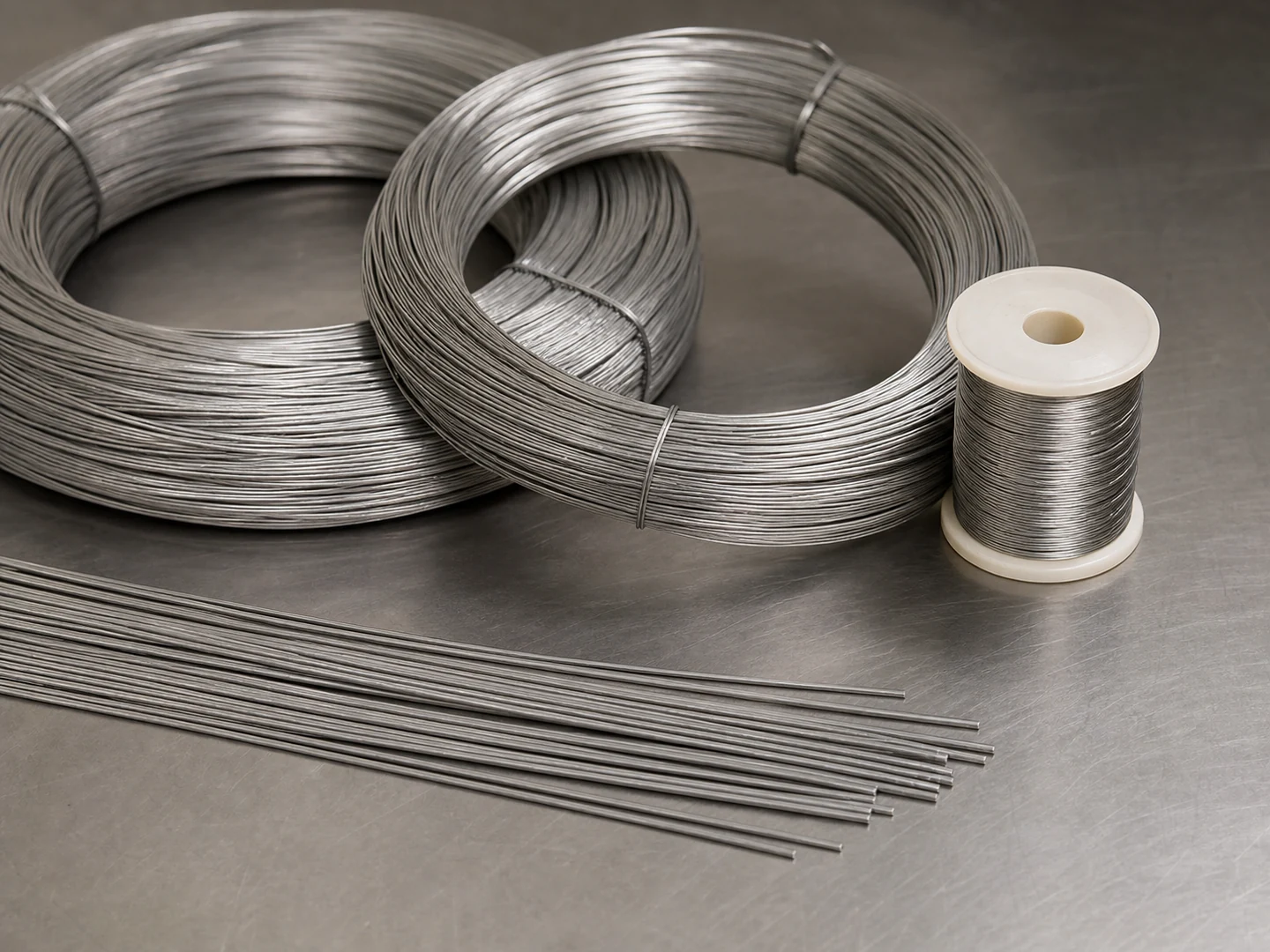
| AISI 304 Stainless Steel Wire | 400 | 500 | 0% | Rockwell B 70–95 depending on temper and cold work |
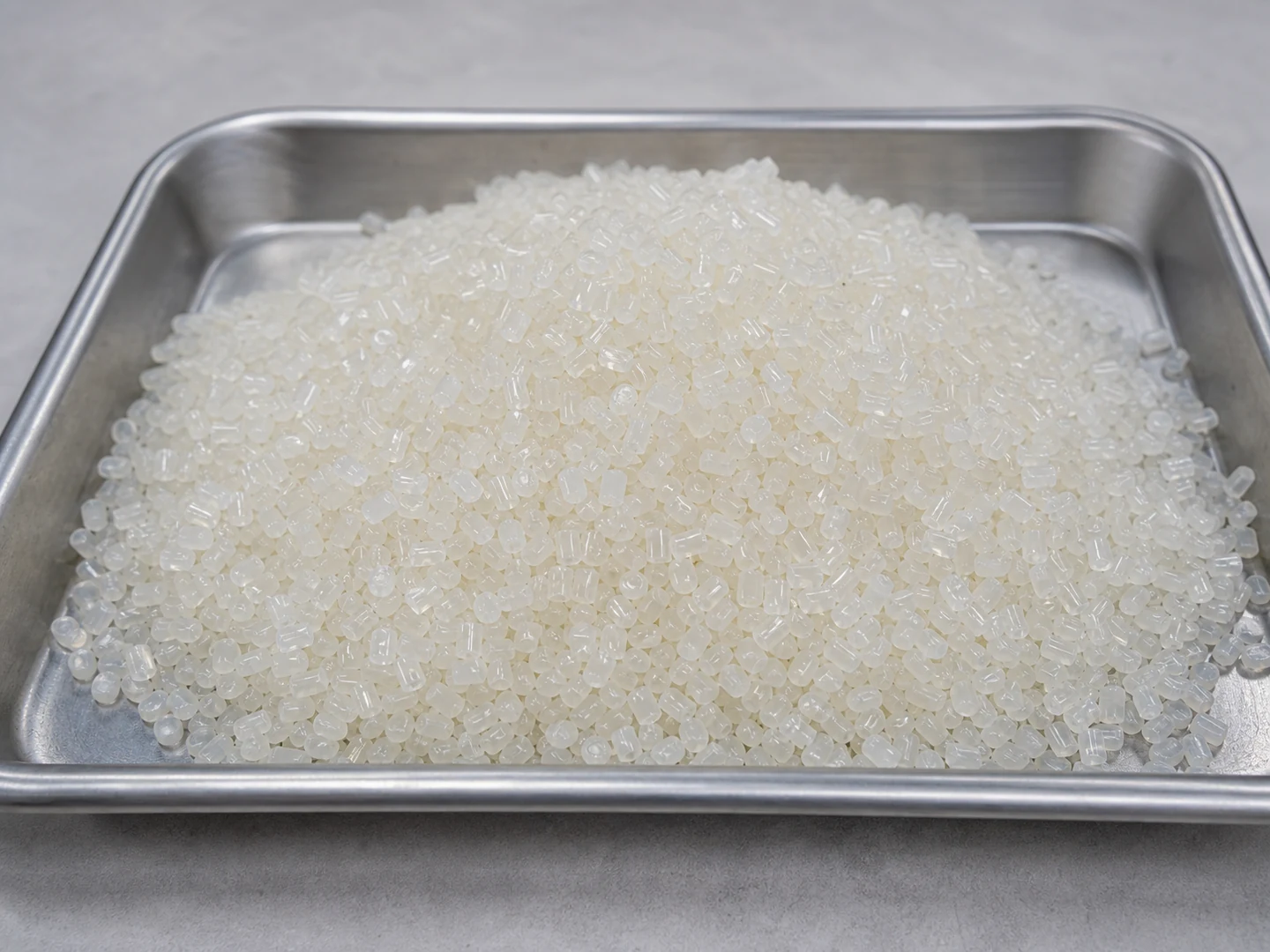
| Nylon PA | 93 | 121 | 0.3–9% by PA grade and conditioning | Medium to firm; filament diameter and trim length control bending force. |
| Tampico Fiber | 70–90 | 110–130 | 10–18% | — |
| Brass Wire | 150–200 | 250–300 | 0% | Rockwell B 40–90 |
| AISI 316 Stainless Steel Wire | 400 | 500 | 0% | Rockwell B 70–95 depending on temper and cold work |
Figures as published by Alleima; Brushtec / DuPont. Confirm the exact grade against the supplier datasheet before ordering.
What should replace Roller and Conveyor Brushes for heat treatment fixture brush?
- Roller and Conveyor Brushes — Roller and conveyor brushes hold cylindrical line contact across a working width, including helix-wound builds where the filament path is set to move loosened material toward one side; a strip brush holds the same line without rotating, so it seals or wipes but cannot carry residue along the width.
- Handheld Detail Brushes — Handheld detail brushes cover general precision cleaning; auto-detailing brushes impose tighter controls for painted, polished, leather, display, and trim surfaces.
- AISI 304 Stainless Steel Wire — Use AISI 316 stainless steel wire for chloride, marine, dairy, beverage, chemical washdown, or higher pitting-resistance requirements. Use carbon steel for dry aggressive cutting and brass or abrasive nylon for lower marking risk.
- Nylon PA — Compare Nylon PA with PP, PBT, PET. Change material when wet stiffness, temperature, chemical resistance, conductivity, particle shedding, or surface marking becomes the limiting factor.