
Custom Cleaning Brush
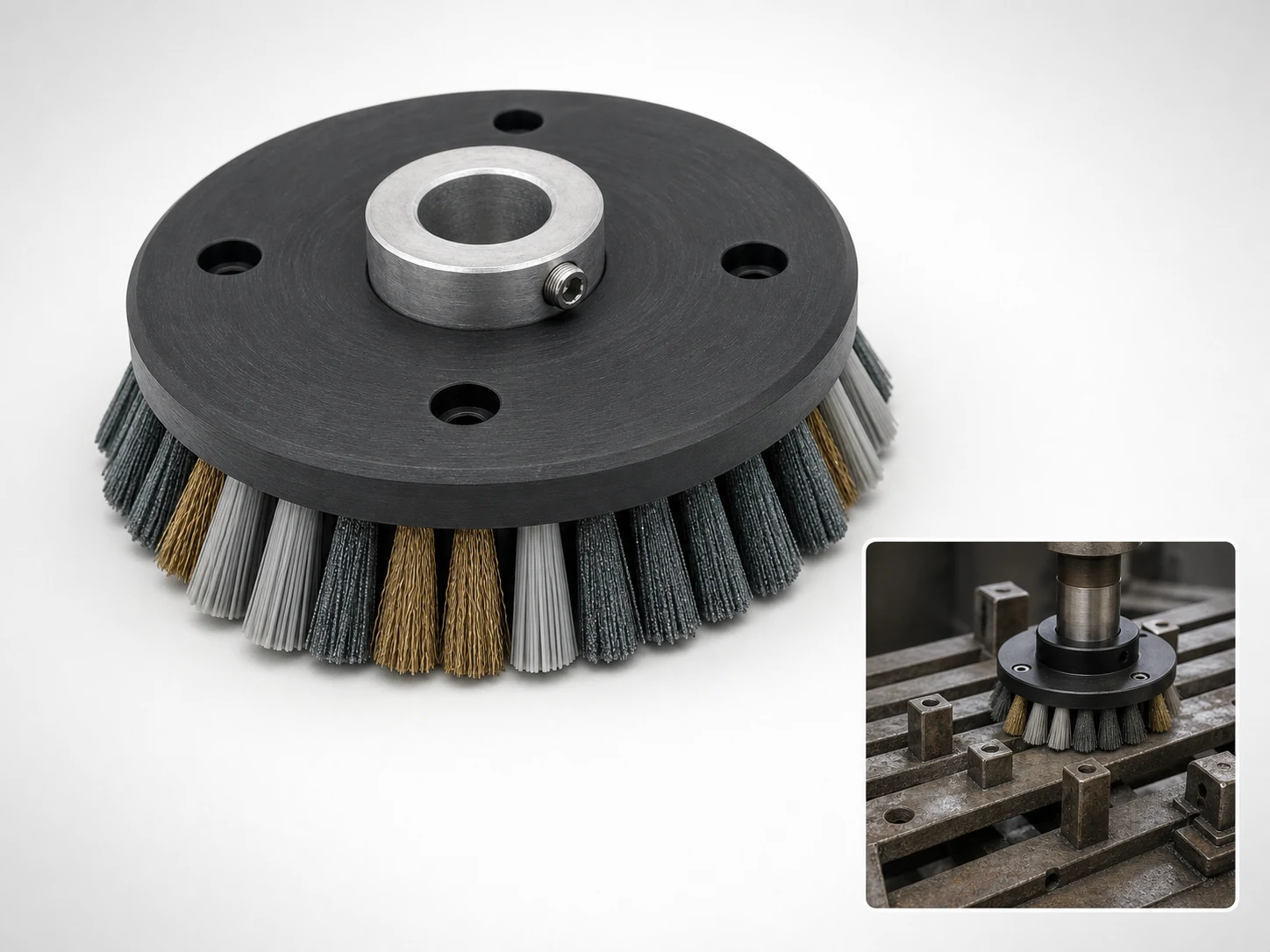
Heat Treatment Fixture Brush
Clean heat scale, oxide, and carbon from furnace baskets, racks, trays, and pins. Cup, wheel, or end brushes in brass, stainless, SiC nylon, or PA fill.
Large-format brush
100 pcs
Minimum order
Built one at a time on a core or channel: full-width rollers, sweeper brooms and long strip.
Production lead time, once the specification is confirmed
- Up to 100 pcsWithin 20 days
- 101–1,000 pcsWithin 30 days
- Over 1,000 pcsConfirmed with your quotation
Peak season can extend these times; the shipping date is confirmed in writing with your quotation. Sampling and shipping are quoted separately.
This heat-treatment fixture brush removes heat scale, oxide, and carbonized process build-up from furnace baskets, racks, trays, hooks, and locating surfaces before the next cycle. It is configured as a cup, wheel, or end brush in brass wire, stainless steel wire, SiC abrasive nylon, or PA fiber, matched to the fixture alloy and the contamination limits of the parts being treated.
What can this brush do for you?
Returns Load Points to Their Design Position
Scale does not build evenly. It grows fastest on the parts of a fixture that carry weight and see repeated thermal cycling: grid intersections, rail edges, hook contact faces, and pin seats. When those points grow even a thin oxide layer, parts no longer sit the same way, quench contact changes, and hot spots begin to appear. A fixture brush removes that layer right where it forms, before it changes how the load seats.
Removes Scale Without Removing the Fixture
Brass wire, SiC abrasive nylon, and nylon PA fills cut through surface oxide without gouging the underlying heat-resistant alloy. On cast or fabricated fixtures made from materials that are expensive to replace, the brush clears the build-up and stops work at the base metal, which keeps the fixture in service longer than a flap disc or hard grinding wheel would.
Gets Into Intersections, Pin Seats, and Threaded Pockets
Shot blasting cleans broad surfaces well but often leaves scale inside the places a blast stream cannot reach: crossed-wire junctions, threaded retainers, locating holes, and clamped corners. Cup and end configurations carry the fill into those restricted areas and sweep the deposit out.
Handles Heavy Scale and Final Touch-Up in One Maintenance Step
Knotted wire fills break heavy furnace scale faster, while crimped wire or SiC abrasive nylon can be used immediately after on the same fixture for a cleaner, smoother surface. The maintenance crew does not have to switch processes between roughing and finishing.
Keeps Loose Oxide Out of the Next Batch
Loose scale on a rack or tray shears off during loading or the first thermal cycle and falls onto parts, into the quench tank, or onto other fixture surfaces. Brushing removes it at the source instead of letting it contaminate the next heat-treatment lot.
What is a Heat Treatment Fixture Brush?
A Heat Treatment Fixture Brush is a powered maintenance brush built as a cup, wheel, or end configuration with the fill material selected for the scale and the fixture alloy. It is not a universal cleaning brush with one fixed wire type; it is configured around three variables: where the deposit is, what the fixture is made of, and what kind of contamination the parts can tolerate.
During use, the operator mounts the brush on an angle grinder, die grinder, straight grinder, or bench motor and sweeps the rotating fill across the cooled fixture. The wire tips or abrasive filaments strike and shear the oxide layer from the surface, throwing the loosened particles away from the work.
The brush is used between furnace cycles, after the fixture has cooled, in the same maintenance bay where fixtures are inspected and reassembled. It covers accessible surfaces: rack arms, tray edges, basket grids, hooks, pins, clamping faces, and the seams around welded joints. It does not clean the inside of long tubes, blind cavities, or passages that a wire or abrasive fill cannot physically enter.
Scale removal with a fixture brush is a surface-preparation step. It restores contact surfaces, reduces contamination, and extends the interval between full descaling treatments, but it does not replace shot blasting, chemical stripping, or dimensional rework when the fixture has deep build-up or worn geometry.
Technical Specifications
| Parameter | Value / Options |
|---|---|
| Brush form | Wheel, cup, or end brush, selected by access geometry |
| Fill material | Brass wire, stainless steel wire, SiC abrasive nylon, nylon PA |
| Fill construction | Crimped wire for lighter oxide and smoother contact; knotted or twisted wire for heavy scale and more aggressive removal; straight or twisted abrasive nylon |
| Wire diameter | 0.15–0.50 mm (0.006–0.020 in) for wire fills |
| Trim length | 5/8–1-1/2 in (16–38 mm); shorter trim for firm contact, longer trim for conforming to irregular profiles |
| Brush diameter | 3–6 in (75–150 mm) typical; larger or smaller configurations for special fixtures |
| Face width | 3/8–1 in (9.5–25 mm) for wheel brushes; cup height and end brush length set per project |
| Mount / interface | Threaded nut M14 x 2 or 5/8-11 UNC, female thread, arbor hole, or 1/4 in / 6 mm shank |
| Maximum operating speed | Engraved on brush; matched to the selected diameter and fill; do not exceed the marked RPM |
| Hub material | Steel or stainless steel; aluminum option for lighter weight where tool speed allows |
| Operating condition | Ambient-temperature cleaning of cooled fixtures; dry scale removal standard |
| Brush type | Custom Roller and Conveyor Brushes |
| How it is driven | Machine-driven, mounted in the equipment |
| Cleaning target | basket grid and furnace tray, rack arm, and base plate and tray edge cleaning |
| Surface or part | fixtures, trays, racks, baskets, edges, pins, rails, and holes |
| Residue or debris | scale, oxide, fiber, leaves, particles, and carbon |
| Mounting / connection | Threaded nut M14 x 2 or 5/8-11 UNC, female thread, arbor hole, or 1/4 in / 6 mm shank |
Where does this brush work best?
- Basket grids and furnace trays where scale forms at wire intersections and contact pads.
- Rack arms, support rails, and hanger hooks that position parts in batch, continuous, or vacuum furnaces.
- Base plates and tray edges where uneven oxide buildup causes misseated loads and uneven heat transfer.
- Locating pins, threaded retainers, clamping faces, and quench-fixture surfaces too dimensionally sensitive for aggressive media blasting.
- Pre-reconditioning and recoating preparation for fixtures being rebuilt or coated.
- Light-to-medium descaling after shot blasting, where media cannot produce the required finish on mating surfaces.
How do I choose the right one?
Four decisions define the correct heat-treatment fixture brush: access geometry, fill material, trim and wire gauge, and mount and speed.
Step 1: Pick the Brush Form from the Actual Cleaning Area
| Cleaning situation | Recommended brush form |
|---|---|
| Wide flat areas, tray edges, large grid surfaces | Cup brush or wheel brush |
| Open corners, pin seats, holes, threads, recessed intersections | End brush |
| Long exposed seams, plate edges, weld joints | Wheel brush |
| Irregular rack arms and hooks with mixed contours | Cup brush with longer trim or flexible end brush |
Step 2: Match the Fill to the Fixture Alloy and Contamination Rules
| Fixture condition / requirement | Fill recommendation |
|---|---|
| Carbon or low-alloy steel fixture, heavy scale, ferrous transfer not a concern | Stainless steel wire |
| Stainless or high-alloy fixture, iron or steel residue on treated parts must be avoided | Brass wire |
| Fixture dimensions or surface finish must be preserved with minimal stock removal | SiC abrasive nylon |
| Loose carbon, light process film, or final cleaning before handling | Nylon PA fiber |
| Heavy fused scale in tight corners | Knotted wire, usually stainless or brass based on contamination rules |
Step 3: Set the Wire Gauge and Trim Length for the Scale, Not Just the Finish
Fine wire, 0.15–0.25 mm (0.006–0.010 in), with longer trim conforms to the fixture profile, removes lighter oxide, and leaves a less visible pattern. Heavier wire, 0.35–0.50 mm (0.014–0.020 in), with shorter trim provides stronger impact on thick scale. For SiC abrasive nylon fills, specify the grit according to scale thickness and the final surface requirement.
Step 4: Match Mount and Speed to the Tool
Use M14 x 2 threads for European angle grinders, 5/8-11 UNC for common North American tools, or a 1/4 in / 6 mm shank for die grinders. Verify that the tool’s free speed stays below the brush’s marked maximum RPM and use the correct guard. Larger wheel diameters require lower speeds.
When a Different Approach Makes More Sense
If the scale has penetrated deeply into the base metal, if the fixture has blind cavities or internal passages that the fill cannot enter, or if the geometry is worn beyond surface cleaning, use shot blasting, chemical descaling, ultrasonic cleaning, or machining first. The fixture brush is the right tool when the problem is accessible surface build-up, not structural repair.
Can I customize this brush?
Heat-treatment fixture brushes are built to the fixture and the tool. Send a fixture drawing or photos, the alloy type, the scale thickness and location, the power tool model and thread, the maximum speed, and any contamination limits for the heat-treated parts.
- Form and geometry: cup, wheel, or end brush, overall diameter, face width, trim length, shank length, and hub profile.
- Fill material and construction: brass wire, stainless steel wire, SiC abrasive nylon, or PA fiber; crimped, knotted, twisted, or straight fill; wire diameter and abrasive grit.
- Mount / interface: M14 x 2 threaded nut, 5/8-11 UNC threaded nut, female thread, arbor hole, 1/4 in or 6 mm shank, or a quick-change arbor when the tool requires it.
- Hub material: steel, stainless steel, or aluminum, balanced to the operating speed.
- Marking: speed rating, batch code, company logo, or identification marking on the hub.
- Packaging: bulk cartons, individual labeled boxes, mixed-size kits, or pallet configurations for maintenance programs.
If the project requires material declarations, inspection reports, or third-party testing support, we can assist with those documentation requirements during the customization process.
Which filament is safe on the surface a heat treatment fixture brush touches?
Can this brush be used while the fixture is still warm?
No. Allow the fixture to cool to ambient temperature before brushing. Wire and abrasive nylon fills are selected for scale removal on cooled tooling; heat accelerates wire fatigue and can damage the brush, and hot scale is more likely to embed in the fill.
What should I do if the brush begins to load up with scale?
Ease the pressure and let the wire or abrasive tips do the cutting. For knotted wire brushes, run the brush against a clean piece of scrap steel or use a suitable brush conditioning tool. For abrasive nylon fills, blow out loose debris with dry compressed air between uses. If the fill stays packed, switch to a heavier or knotted construction.
How do I know when to replace the brush?
Inspect before each use. Replace the brush when the trim length becomes uneven, wire clusters are flattened or missing, the hub shows cracks or wobble, or vibration increases even after remounting. A brush that throws wire should be removed from service immediately.
Does a finer wire diameter always produce a better finish on the fixture?
Not always. Fine wire with a longer trim produces a smoother, lighter pattern, but on thick heat scale it may burnish the surface instead of removing it. Match the wire gauge and trim first to the scale thickness; use finer wire for the final pass after the heavy scale is gone.
Will a brass wire brush always be safe in a hazardous or non-sparking location?
Brass wire reduces sparking compared with steel wire and avoids ferrous contamination, but the power tool, work environment, and complete system must still be approved for the location. Do not rely on the brush alone to make a hazardous-area setup safe.
Can brushing alone restore a badly scaled fixture to production?
Brushing removes accessible scale and prepares contact surfaces, but it does not replace a full descaling process for deep internal cavities, heavily fused deposits, or dimensional rework. Use shot blasting, chemical descaling, or ultrasonic cleaning for hidden areas, then finish load-bearing points with the fixture brush.
Guides that go deeper on this
Custom Manufacturing RFQ
Describe Your Application
To prepare the correct quotation, provide the dimensions, cleaning task, residue, material, mounting details, quantity, and a drawing or photo.
Drawing or photo optional — it speeds things up, it does not gate the enquiry.
Custom Brush RFQ
Send Your Brush Project
Upload a drawing, product photo, or sample photo and provide the core dimensions and cleaning conditions.
“We need a brush to remove wet residue from a stainless steel conveyor, about 800mm wide. The current brush wears quickly. We can send photos.”
“We sell drinkware and need a cleaning brush to include with the product. Quantity around 5,000 pieces.”