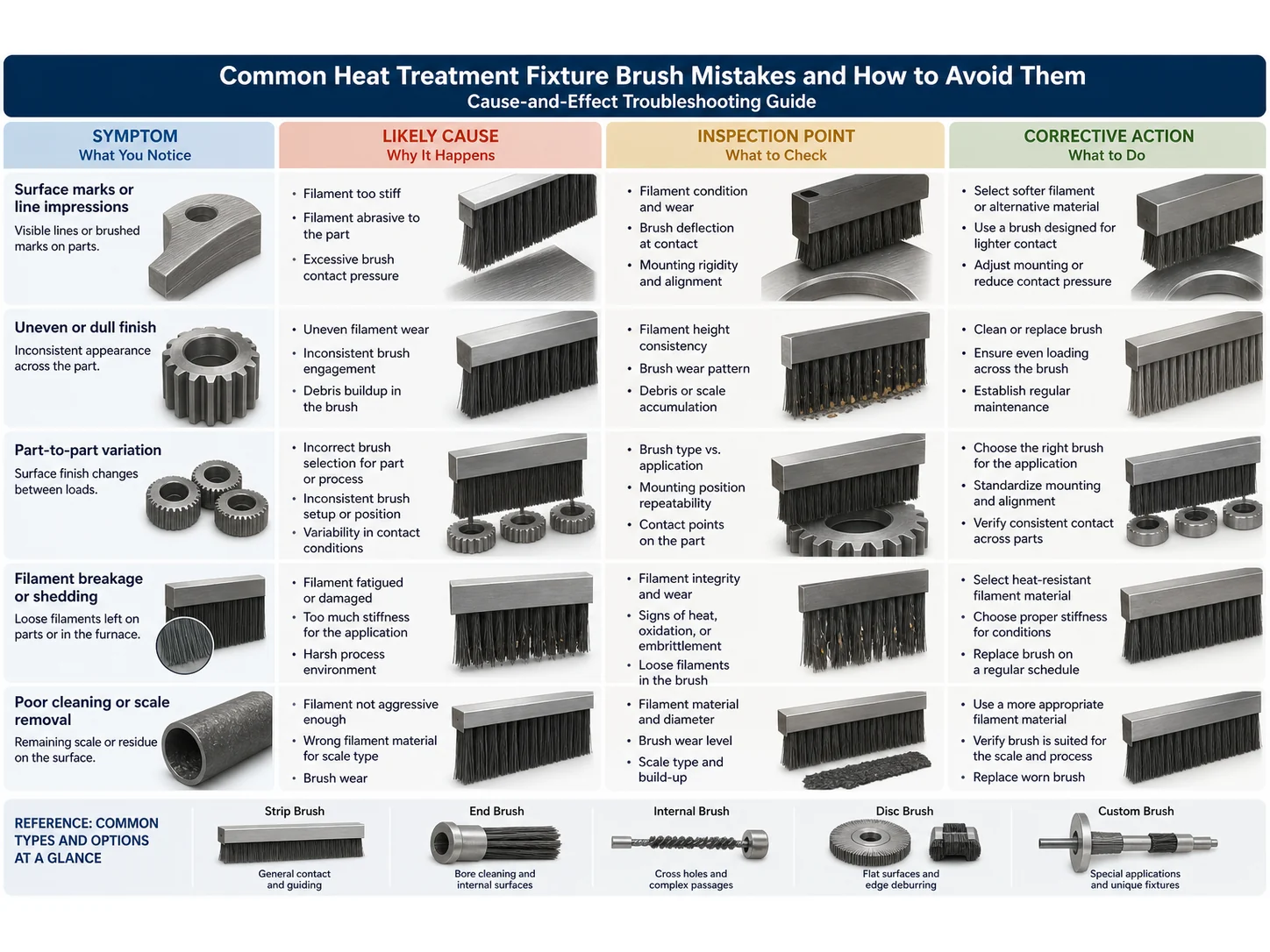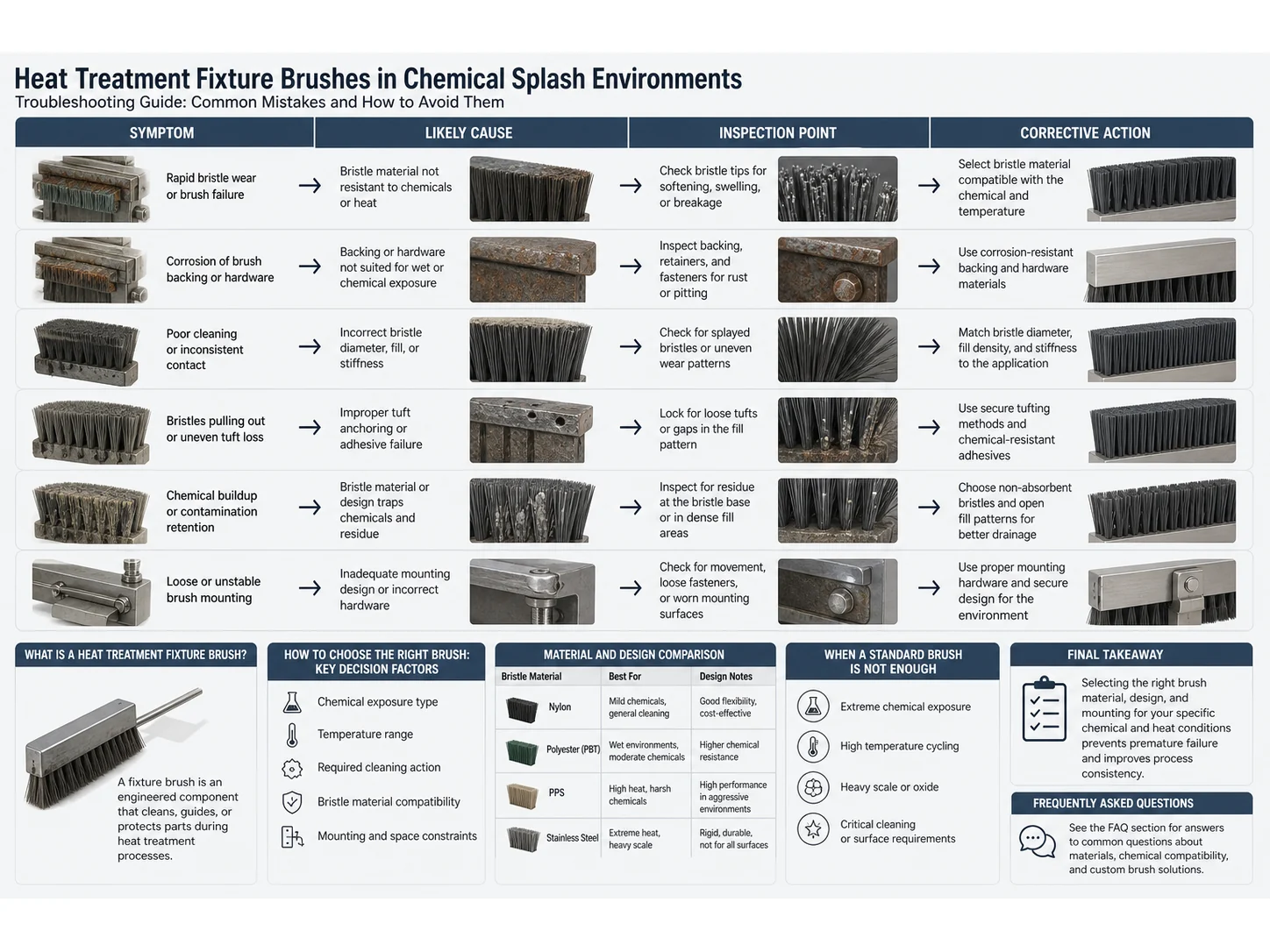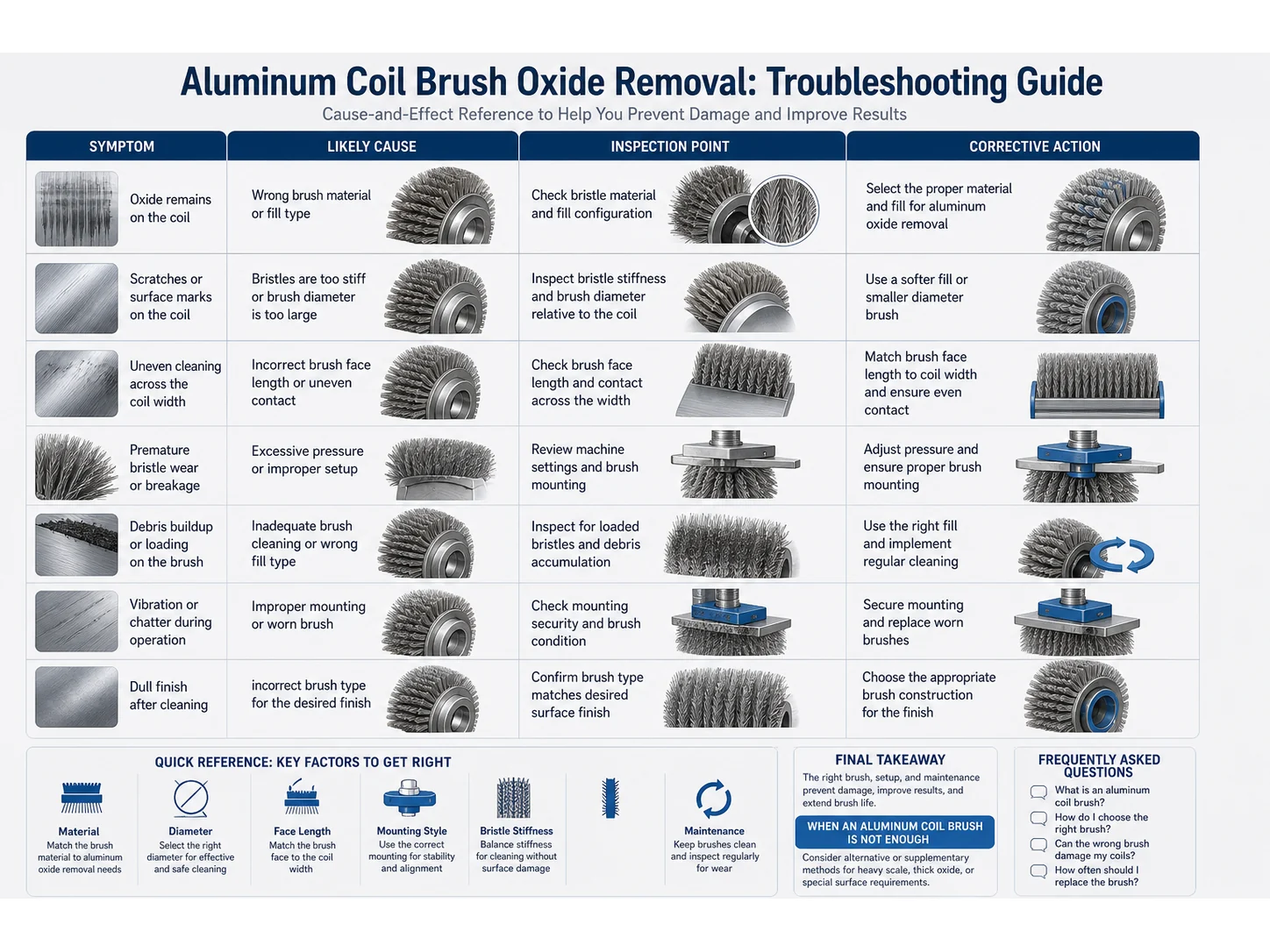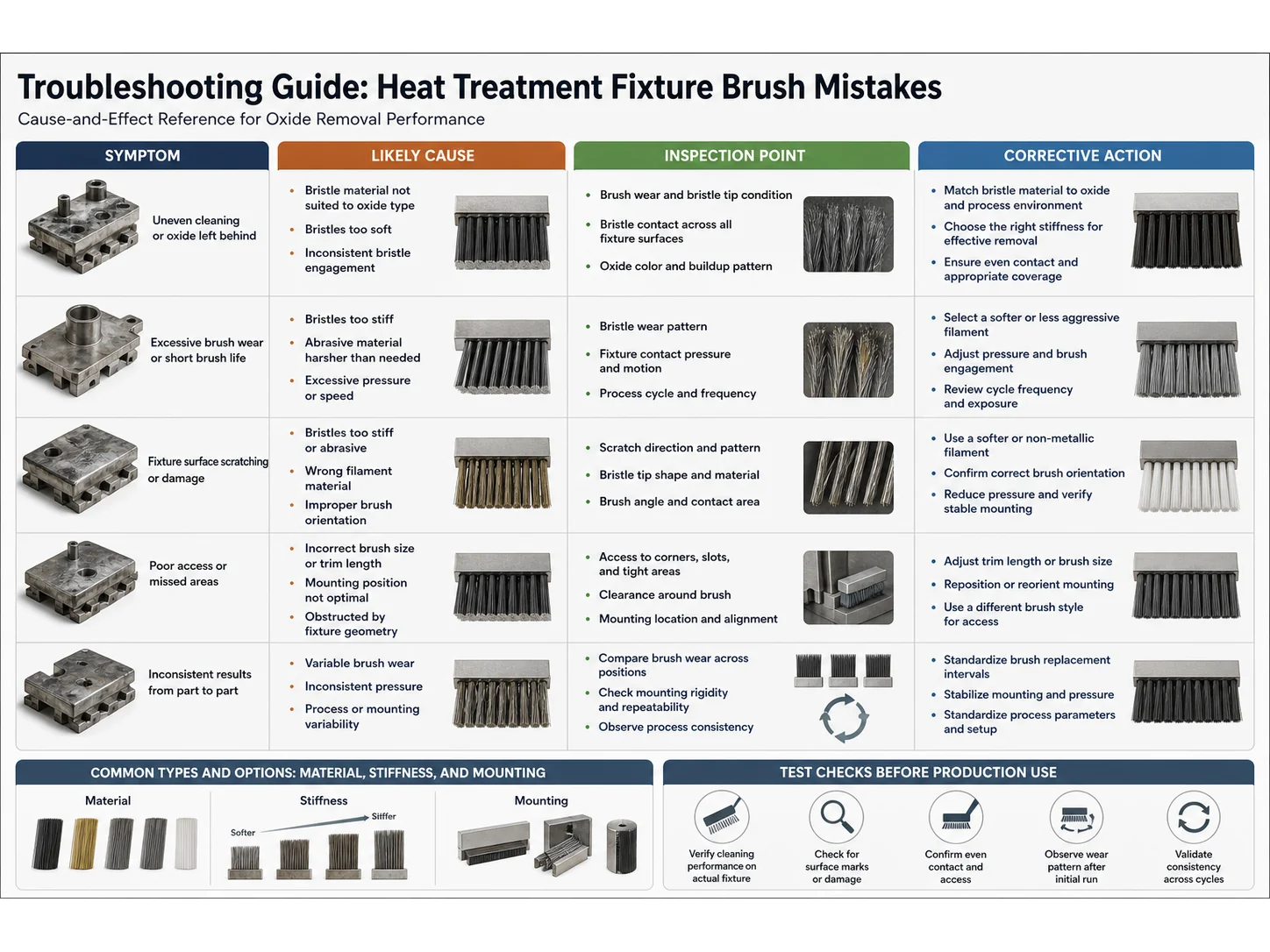
What Is a Heat Treatment Fixture Brush?
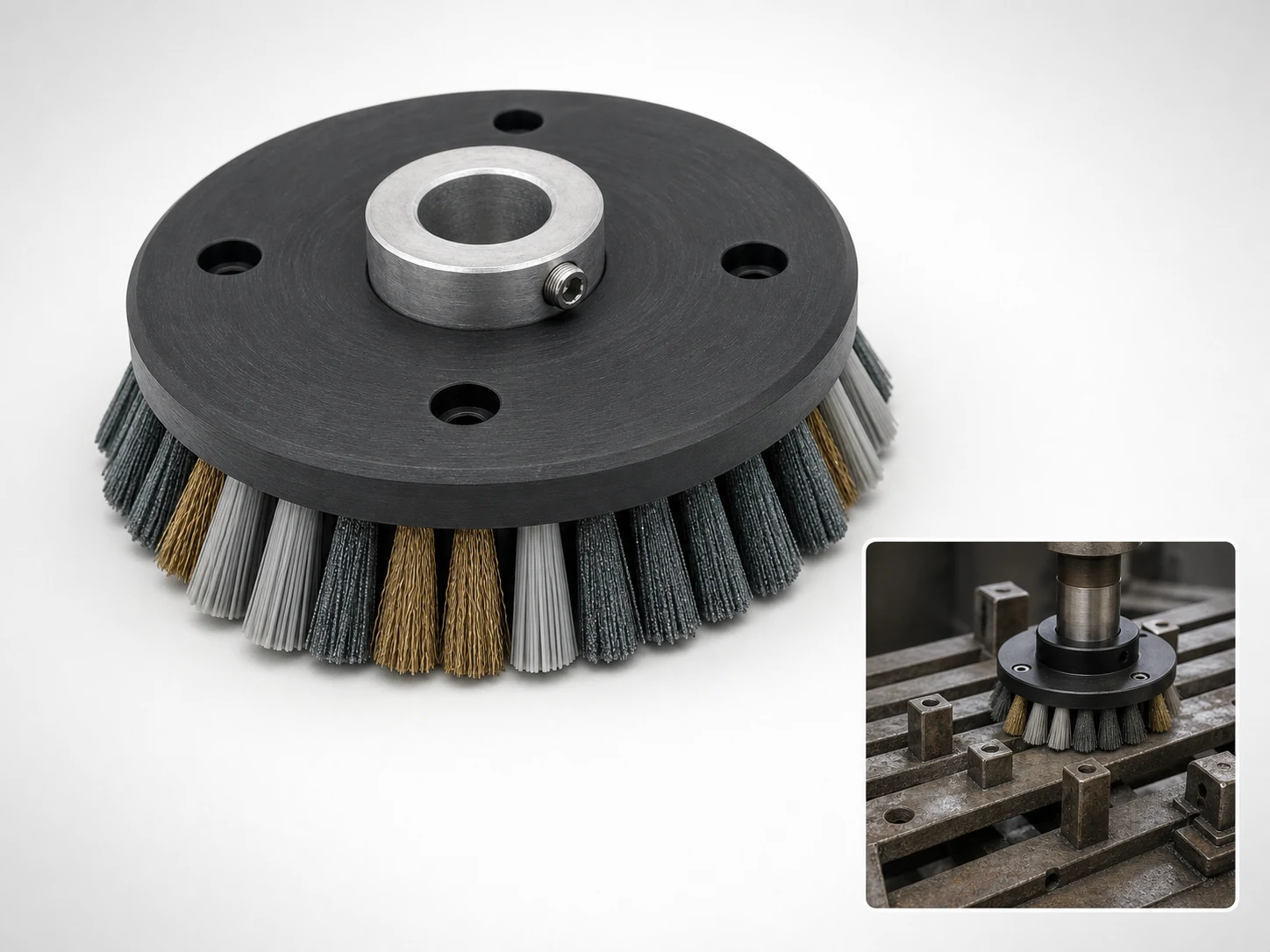
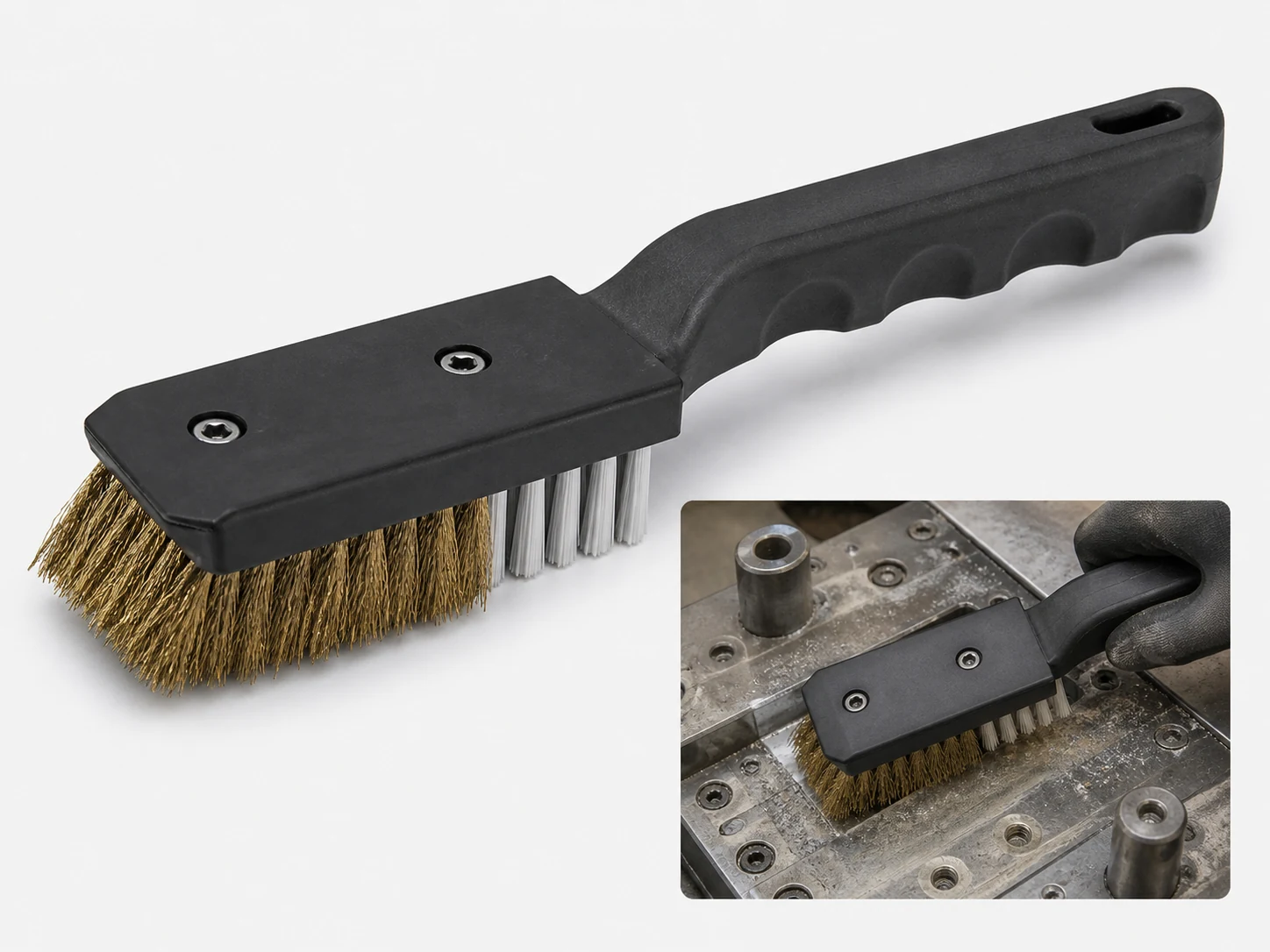
A heat treatment fixture brush is a cleaning tool designed to remove oxide layers and process residues from metal fixturing used in furnaces, ovens, and quench systems. The brush’s bristle material, stiffness, and mounting configuration determine its effectiveness on different oxide types without scratching or deforming the fixture base metal. These brushes often encounter high temperatures, thermal cycling, quenching media, and chemical cleaning solutions, so material selection directly affects brush life and cleaning performance.
Common Types and Options: Material, Stiffness, and Mounting
Choosing the wrong brush type is one of the most frequent mistakes. The table below compares common bristle materials, stiffness ranges, and mounting styles used in heat treatment fixture cleaning.
| Bristle Material | Typical Stiffness | Heat Resistance | Chemical Compatibility | Mounting Options | Best For |
|---|---|---|---|---|---|
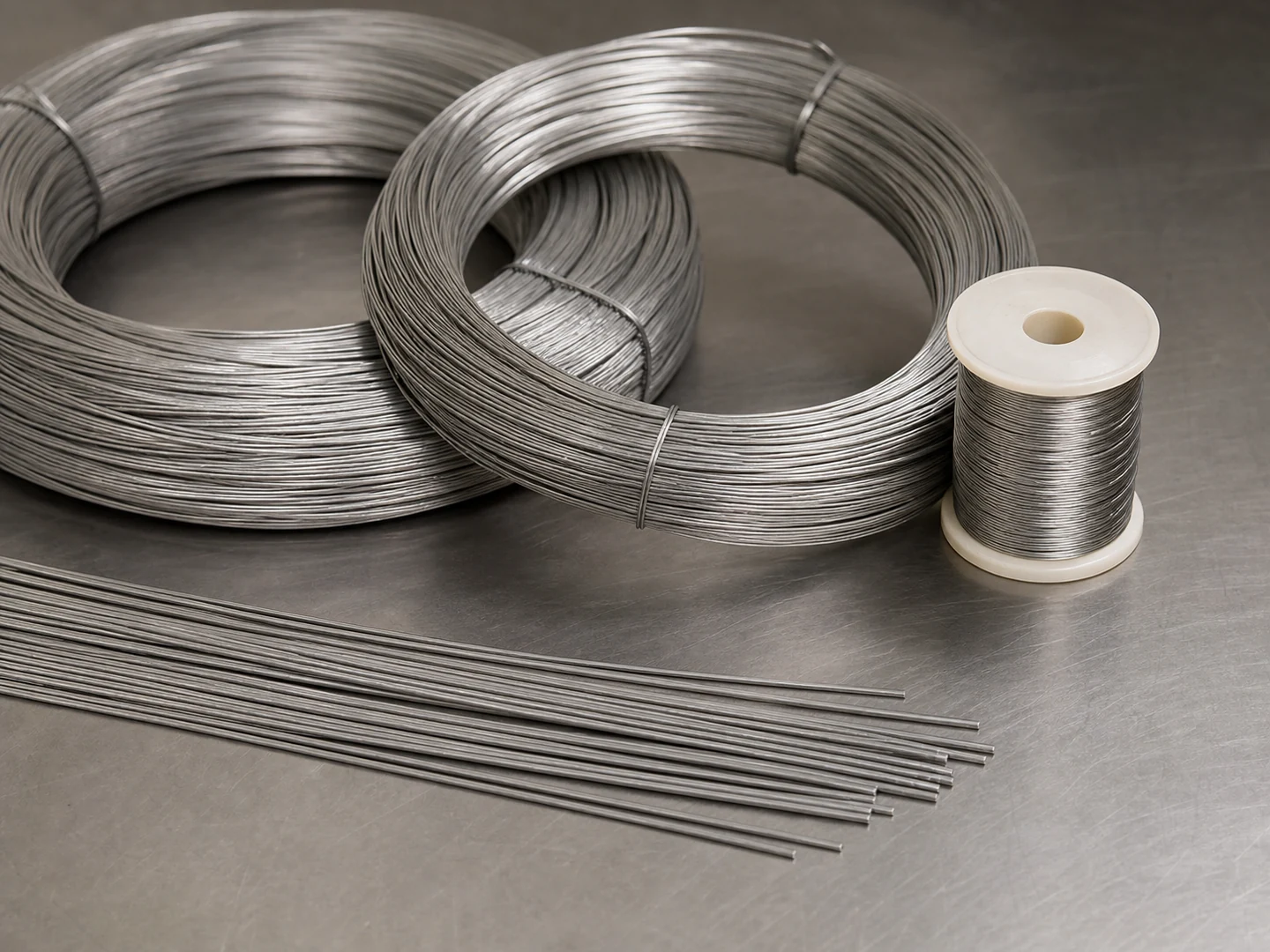
| Stainless Steel Wire | Medium to High | Up to 500°C (continuous) | Good with most solvents, mild acids; avoid chlorides | Handle, shaft, or cup brush | Heavy oxide scale on steel fixtures |
| Brass Wire | Medium | Up to 200°C | Fair; may corrode in strong acids | Handle or strip holder | Non-sparking cleaning of softer fixtures |
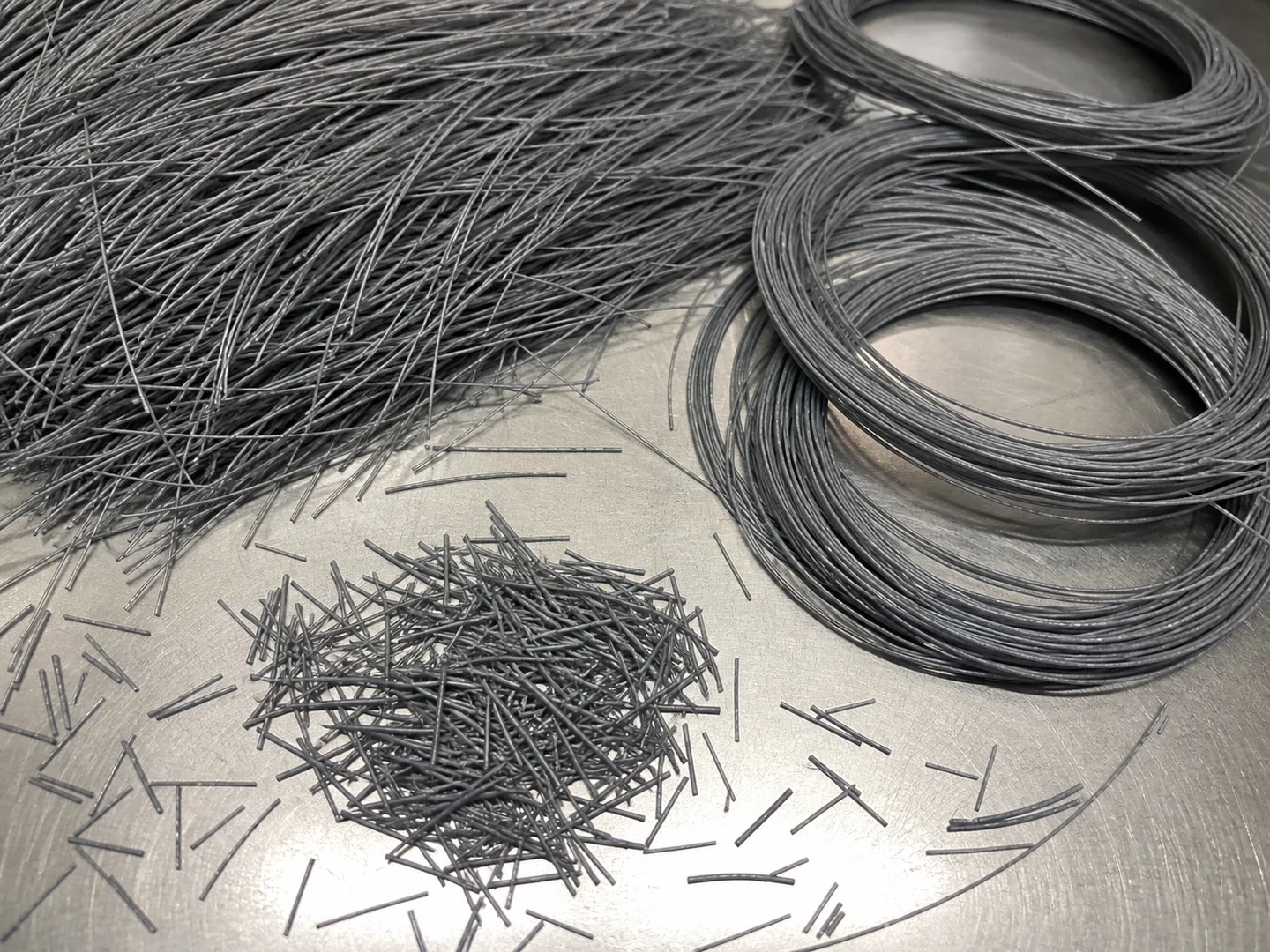
| Abrasive Nylon (Silicon carbide or aluminum oxide filled) | Medium to High | Up to 150°C (continuous), 200°C intermittent | Excellent with oils, coolants, mild chemicals | Wheel, cup, or end brush; shank or arbor mount | Uniform oxide removal without gouging; adjustable aggressiveness by grit |
| Natural or Synthetic Fiber (with abrasive grit) | Low to Medium | Up to 120°C | Good with water-based cleaners; limited solvent resistance | Strip, twisted-in-wire, or staple-set | Light oxide dusting, final surface conditioning |
| PTFE (Teflon) or Plastic Filament | Low | Up to 260°C | Excellent with aggressive acids and solvents | Handle or clamp-mounted strip | Cleaning fixtures used in vacuum or protective atmospheres; non-abrasive |
Mistakes often start here: ordering a generic “wire brush” without specifying bristle diameter, alloy type, or corrosion resistance leads to premature failure, contamination, or fixture damage.
How to Choose a Brush for Oxide Removal on Heat Treatment Fixtures
Selection must address the real cleaning problem, not just the equipment type. Evaluate these factors:
- Oxide type and thickness: Heavy, adherent scale requires aggressive brushing (stainless steel or abrasive nylon with coarse grit). Light dusting or discoloration can use softer fibers.
- Fixture base metal sensitivity: Aluminum or thin-wall stainless fixtures can be gouged by harsh wire brushes. Use abrasive nylon or fiber with controlled grit.
- Equipment interface: The brush must match the tooling (handheld shaft, robotic arm, or manual strip holder). Mismatched mounting causes downtime and poor contact.
- Wet or chemical exposure: If cleaning involves acidic descaling baths or alkaline degreasers, bristle material must be chemically compatible. Stainless steel performs well but may suffer pitting in chloride solutions; PTFE or nylon resists most chemicals.
- Hygiene expectations: For vacuum heat treatment or clean-room applications, avoid bristle materials that shed particles. PTFE or sealed nylon filaments reduce contamination risk.
- Maintenance frequency and brush life: Brushes that wear quickly increase operating cost and risk inconsistent cleaning. Choose a material and stiffness that balance cleaning speed with longevity under operating conditions.
- Custom size requirements: Off-the-shelf brushes often miss corners or deep pockets in fixturing. Consider custom trim lengths, brush face widths, or angled configurations to reach all oxide-prone areas without manual touch-up.
Common Mistakes in Selection, Ordering, and Use
Diagnosing these frequent errors helps avoid rework, damage, and extended downtime:
- Choosing by cost drivers alone. Cheaper brushes often use lower-grade wire or poorly bonded abrasive filaments that wear out quickly, shed debris, or bend permanently. The lowest unit cost rarely gives the lowest cost per cleaning cycle.
- Ignoring bristle diameter and fill density. Too fine a wire bends without removing scale; too coarse can scratch or embed into the fixture. Fill density (number of bristles per area) affects cleaning force and clogging tendency.
- Using the same brush for different oxide types. A brush optimized for dry furnace scale will load up in wet slurry or react with acid cleaners. Separate brushes for different cleaning steps extend life and prevent cross-contamination.
- Neglecting handle or shank material. Wooden handles swell in chemical baths; plastic melts near hot fixtures. Specify stainless steel or reinforced composite handles for durability.
- Over-pressuring the brush. Excessive force compresses bristles, reducing cutting action and generating heat that can anneal wire or soften nylon. Let the bristle tips do the work with moderate, consistent pressure.
- Skipping sample testing. Ordering large quantities without testing on actual oxide conditions leads to rejected lots. Always request sample brushes and run a cleaning trial on representative fixturing.
- Assuming standard sizes fit all fixtures. Gap dimensions, hole diameters, and internal corners require brush profiles that match. Custom brush dimensions prevent manual scrubbing with ill-fitting tools.
When a Standard Heat Treatment Fixture Brush Is the Wrong Choice
A brush alone cannot solve every oxide removal problem. Consider these boundaries:
- Heavy, fused scale: If oxide layers exceed 0.5 mm and are fused to the fixture by high-temperature brazing or sintering, mechanical brushing may not be sufficient. Pre-treatment with chemical descaling or thermal shock may be required before brushing.
- Complex internal geometries: Deep blind holes or intricate lattice structures may need custom-designed brush profiles, but even then, abrasive blasting or ultrasonic cleaning could be more effective and consistent.
- Strict surface finish requirements: If the fixture must maintain a certified Ra value (e.g., for aerospace or medical work), confirm that the brush bristle and any abrasive media do not alter the surface profile beyond acceptable limits. A supplier drawing review or lab analysis of brush impact is advisable.
- Automated integration without process data: When retrofitting a brush into a robotic cell, brush wear rate, compliance force, and trajectory must be validated with the brush supplier to avoid premature failure or uneven cleaning.
- Hygiene-critical or clean-room use: Standard brushes may shed particles or outgas. In these cases, a thorough material certification and clean-room packaging protocol may be necessary, going beyond a simple part number.
Final Takeaway
Avoiding heat treatment fixture brush mistakes comes down to matching bristle material, stiffness, mounting, and size to the specific oxide removal task, and validating performance through sample testing before scaling up. Focus on total cleaning cost and fixture longevity instead of initial brush cost drivers alone. When conditions exceed a brush’s capability—fused scale, complex geometry, or tight surface specs—consider complementary methods or custom engineering support.
Frequently Asked Questions
Can I use the same brush for dry oxide dust and wet descaling?
It is not recommended. Wet chemicals can corrode wire brushes or degrade natural fibers. Use separate brushes for dry and wet processes, or select an all-resistant material like stainless steel or PTFE if cross-use is unavoidable.
How often should I replace heat treatment fixture brushes?
Replace when bristles show permanent bending, loss of fill density, or clogging that cannot be cleaned. Typical replacement intervals depend on usage intensity and oxide load—track cleaning cycles per brush set to establish a baseline.
What is the best brush material for cleaning stainless steel fixtures without scratching?
Abrasive nylon with fine silicon carbide grit or a soft brass wire brush (if sparking is not a concern) provide effective oxide removal with low risk of deep scratching. Always test on a non-critical area first.
Does brush diameter affect cleaning performance?
Yes. Smaller diameters reach into corners and holes but cover less area per pass. Larger diameters speed up cleaning of flat surfaces but may not conform to curved fixtures. Match brush diameter to the smallest radius or gap to be cleaned.
Can I order heat treatment fixture brushes in custom sizes?
Many brush manufacturers offer custom trim lengths, diameters, and mounting configurations. Providing a drawing or sample fixture helps the supplier design a brush that reaches all critical areas without interference.
Why do my abrasive nylon brushes load up with oxide after a few uses?
Overloading often occurs when the grit size is too fine for the oxide type or when pressure is too high, causing debris to embed. Try a coarser grit or a brush with wider spacing between bristles to improve self-cleaning.
Is a stiffer brush always better for heavy oxide removal?
Not necessarily. Very stiff brushes can dig into the fixture or break brittle oxide into sharp particles that redeposit. Sometimes a medium-stiffness brush with a faster stroke rate or chemical pre-softening works better without damage.
Technical References
Which bristle material fits this job — AISI 304 Stainless Steel Wire, Abrasive Nylon or Nylon PA?
| Material | Continuous temperature (°C) | Peak temperature (°C) | Water absorption | Hardness |
|---|---|---|---|---|
| AISI 304 Stainless Steel Wire | 400 | 500 | 0% | Rockwell B 70–95 depending on temper and cold work |
| Abrasive Nylon | 120 | 150 | 0.1–1.0% | Abrasive filament; stiffness and cutting level is controlled by PA base, grit type, grit size, filament diameter and trim height. |
| Nylon PA | 93 | 121 | 0.3–9% by PA grade and conditioning | Medium to firm; filament diameter and trim length control bending force. |
| Brass Wire | 150–200 | 250–300 | 0% | Rockwell B 40–90 |
| AISI 316 Stainless Steel Wire | 400 | 500 | 0% | Rockwell B 70–95 depending on temper and cold work |
Figures as published by Alleima; Perlon; Brushtec / DuPont. Confirm the exact grade against the supplier datasheet before ordering.
What should replace Roller and Conveyor Brushes for heat treatment fixture brush?
- Roller and Conveyor Brushes — Roller and conveyor brushes hold cylindrical line contact across a working width, including helix-wound builds where the filament path is set to move loosened material toward one side; a strip brush holds the same line without rotating, so it seals or wipes but cannot carry residue along the width.
- Handheld Detail Brushes — Handheld detail brushes cover general precision cleaning; auto-detailing brushes impose tighter controls for painted, polished, leather, display, and trim surfaces.
- AISI 304 Stainless Steel Wire — Use AISI 316 stainless steel wire for chloride, marine, dairy, beverage, chemical washdown, or higher pitting-resistance requirements. Use carbon steel for dry aggressive cutting and brass or abrasive nylon for lower marking risk.
- Abrasive Nylon — Compare Abrasive Nylon with PP, PBT, PET. Change material when wet stiffness, temperature, chemical resistance, conductivity, particle shedding, or surface marking becomes the limiting factor.