
Custom Cleaning Brush
Glass Solar Panel Brush
Custom glass solar panel brush with soft nylon or PBT filaments for dust, pollen, salt film, and bird residue without scratching anti-reflective coatings.
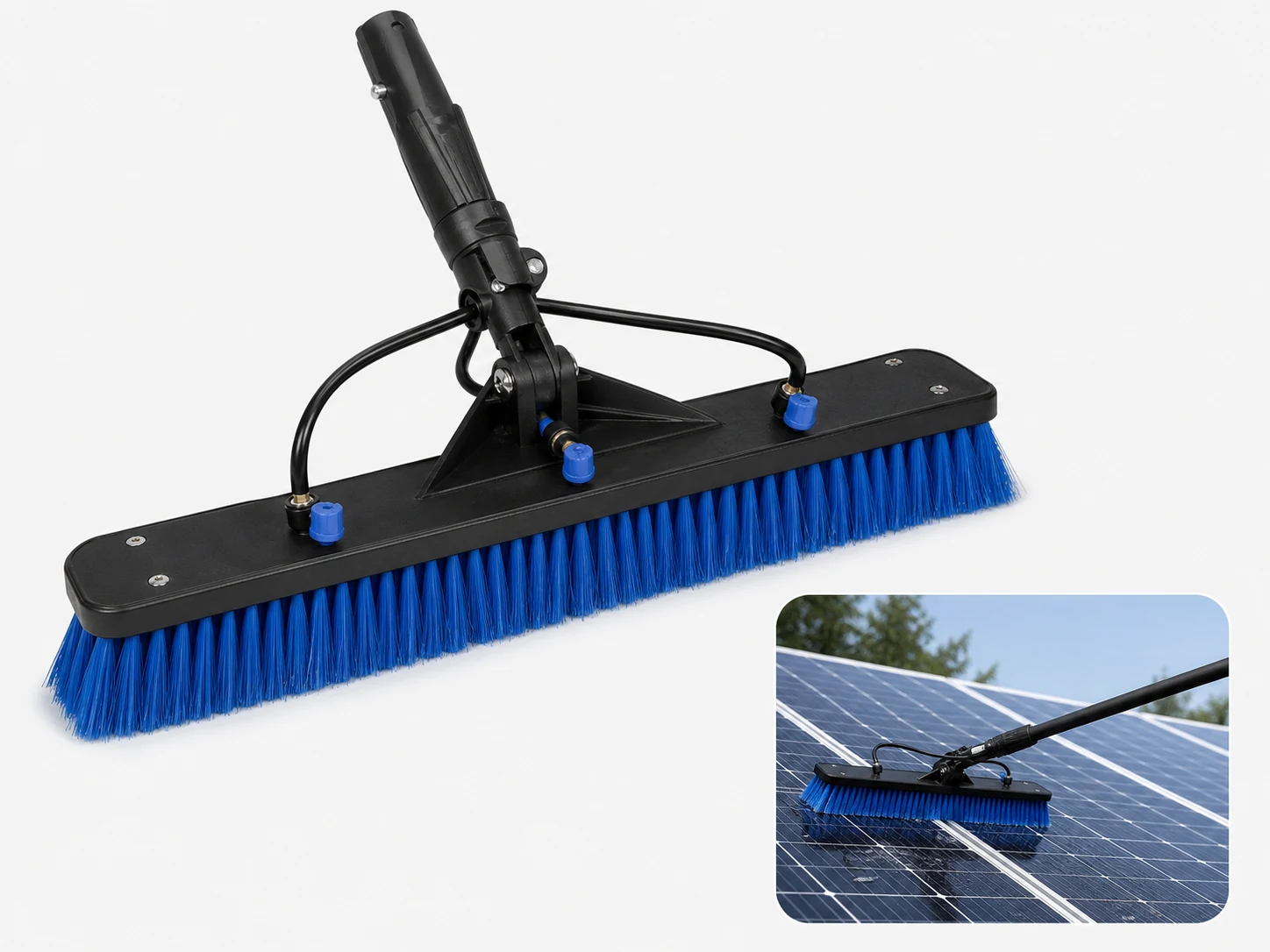
Large-format brush
100 pcs
Minimum order
Built one at a time on a core or channel: full-width rollers, sweeper brooms and long strip.
Production lead time, once the specification is confirmed
- Up to 100 pcsWithin 20 days
- 101–1,000 pcsWithin 30 days
- Over 1,000 pcsConfirmed with your quotation
Peak season can extend these times; the shipping date is confirmed in writing with your quotation. Sampling and shipping are quoted separately.
A soft, non-marring nylon brush for cleaning tempered glass and coated surfaces of photovoltaic modules. It lifts dust, pollen, salt film, bird droppings, and atmospheric residue while protecting the anti-reflective coating that keeps panel output high.
What can this brush do for you?
Non-scratching contact for coated module glass
Photovoltaic glass carries a thin anti-reflective coating that micro-abrasions can permanently reduce light transmission. This brush uses soft nylon or PBT filaments with rounded or flagged tips and no metal contact, so particles are lifted away instead of ground into the surface. The result is fewer micro-scratches and more stable panel efficiency over the array’s service life.
Wide coverage for fast, uniform cleaning
The head width is matched to the module or cleaning row so a single stroke covers the full glass surface. Multi-strip configurations apply even filament pressure across the entire width, eliminating the light-and-heavy contact bands that cause streaking. Cleaning crews finish faster with fewer passes and less rework.
Works wet or dry, in deionized water and dilute detergents
Nylon PA filament retains its shape and resilience when wet and resists common panel-washing solutions. The brush can be used in dry dusting runs, with water-fed poles, or on automated systems using spray nozzles. One brush covers multiple cleaning regimes without filament collapse or chemical breakdown.
Replaceable brush strips extend asset life
Filaments are set into an extruded backing channel that can be swapped independently from the handle, pole adapter, or machine mount. When filament wear reduces cleaning quality, you replace only the strip. For fleet or service operations, this lowers lifecycle cost per panel and keeps spare-part inventory small.
Lightweight and balanced for manual or automated use
Aluminum or polymer backing keeps the complete assembly light enough for a technician to control on a pole or for a robotic arm to move without extra load. The balanced head maintains consistent contact pressure, reducing operator fatigue and preventing uneven wear on one side of the brush.
What is a Glass Solar Panel Brush?
A Glass Solar Panel Brush is a wide-face cleaning tool built specifically for the flat tempered glass surface of solar modules. It consists of one or more rows of soft polymer filaments anchored in a rigid backing strip, attached to a handle, pole adapter, or machine frame. During cleaning, the brush moves across the panel in linear or overlapping strokes, sweeping loose debris and light atmospheric film off the glass.
The brush is designed for compliant contact: filament tips flex under light pressure and follow the glass plane without digging into the coating. This separates it from wire, abrasive, or stiff industrial brushes, which would scratch anti-reflective coatings and reduce module output. The brush can operate dry to remove dust and pollen, or wet to dissolve salt film and soften bird droppings before they are brushed away.
Operating considerations are straightforward. Keep pressure light and even, avoid grinding embedded grit into the glass, and rinse or wipe the surface after wet cleaning. The brush handles routine maintenance cleaning; it is not a heavy deposit remover for cured scale, silicone, or paint splatter.
Technical Specifications
All dimensions and materials are project-configurable. Contact us with panel size, cleaning method, and residue type to match the specification to your operation.
| Parameter | Typical Specification / Options |
|---|---|
| Filament material | Nylon PA 6/6, PBT, or equivalent non-marring polymer; metal-free |
| Filament diameter | 0.05–1.2 mm catalog range; 0.15–0.40 mm typical for solar glass cleaning |
| Filament length (trim) | 15–40 mm, set according to contact pressure and panel condition |
| Fill pattern | Straight, crimped, or flagged tips; density configured for uniform tip contact |
| Working width | Per strip 100–600 mm; multi-strip arrays matched to module width or cleaning row |
| Backing / channel | Aluminum, stainless steel, PVC, or PP extrusion with stapled or resin-set filaments |
| Mounting interface | Handle socket, threaded pole adapter, quick-release clamp for robotic or trolley use |
| Overall length | 300–2200 mm or project-specific |
| Operating temperature | -20°C to 80°C typical for nylon; wider range available with other polymers |
| Chemical exposure | Compatible with common panel-washing detergents, deionized water, pH 6–10 |
| Color / marking | Custom color coding, pad printing, or laser marking available |
| Brush type | Custom Roller and Conveyor Brushes |
| How it is driven | Machine-driven, mounted in the equipment |
| Cleaning target | utility-scale solar farm, commercial and industrial rooftop array, and residential or small commercial panel cleaning service cleaning |
| Surface or part | panels, glass, tempered glass, aluminum, frames, thread, edges, and profiles |
| Residue or debris | bird droppings, dust, pollen, salt, atmospheric film, scale, fiber, and sand |
| Mounting / connection | Handle socket, threaded pole adapter, quick-release clamp for robotic or trolley use |
Where does this brush work best?
- Utility-scale solar farms where dust and sand accumulate daily; wide brush heads clean row after row quickly without scratching the glass.
- Commercial and industrial rooftop arrays with bird droppings, pollen, and atmospheric film; flagged filaments lift soft residue without leaving marks.
- Residential or small commercial panel cleaning services using water-fed poles or handheld tools; the brush attaches to standard pole threads or ergonomic handles.
- Panel manufacturing lines for final cleaning before packing; non-marring contact protects fresh anti-reflective coating from handling marks.
- Robotic and semi-automated cleaning systems that need a replaceable brush element; the backing strip is designed for quick mounting and change-out.
- Coastal installations with salt film that requires regular light scrubbing; nylon filaments resist saltwater exposure better than many natural fibers.
How do I choose the right one?
Start with your cleaning method and access
Determine whether the brush will be hand held, mounted on a water-fed pole, or integrated into a machine or robot. That decision sets the backing profile, mounting interface, weight target, and head width. A manual operator needs a light, balanced head; an automated system may accept a heavier aluminum backing for longer service life.
Match filament stiffness to the coating and residue
Soft flagged nylon is right for daily dust and pollen. Slightly stiffer crimped or straight filaments handle bird droppings and light atmospheric film. Do not specify abrasive grit unless you have a defined oxide-removal or polishing process that the panel manufacturer has approved. For heavy baked-on deposits, pre-soak the area and use a scraper or chemical cleaner before brushing; forcing the brush over hard material risks damaging the coating.
Size the head to the panel and operator
Wider heads reduce the number of passes but require even pressure from edge to edge. Narrower or segmented heads conform better to tilted or uneven surfaces. Filament length affects tip pressure: longer filaments flex more and transfer less force; shorter filaments are firmer. Choose the combination that gives consistent contact without exceeding the pressure your coating can tolerate.
Consider wet or dry operation and chemical exposure
If you use deionized water, detergent, or anti-static rinse, confirm filament and backing compatibility. Some low-cost polymers can degrade or leave residue on glass. Nylon PA is generally suitable for pH 6–10 and common panel cleaners, but verify against your exact chemistry. For dry-only routes, flagged tips improve debris pickup without water.
Decide on durability and replaceability
For large fleets, choose replaceable brush strips mounted in a reusable backing. For small operations, a one-piece brush may be simpler to manage. Also consider whether the backing metal will react with your cleaning solution: aluminum is light but can corrode in aggressive detergent; stainless steel is corrosion resistant but heavier; polymer backing avoids metal contact entirely.
This brush is not the right tool for removing heavy scale, cement splatter, silicone residue, or baked bird droppings without pre-treatment. Wire or abrasive brushes are never suitable for coated solar glass. If the glass is cracked or the laminate is delaminated, stop brushing and switch to a soft cloth with distilled water.
Can I customize this brush?
Yes. Every solar cleaning operation has its own panel size, access method, and residue profile. To quote a custom configuration, we need the module width and length, cleaning method (manual pole, handheld, robotic, trolley), residue type, wet or dry operation, preferred mounting, and any corporate color or marking. A drawing or sample photo accelerates the process.
We can adjust:
- Filament: nylon PA, PBT, or other approved polymer; diameter, length, tip treatment (flagged, crimped, straight), density, and color.
- Backing: extruded aluminum, stainless steel, PVC, or PP profile; length, number of strips, channel shape for replacement strips.
- Mounting: threaded pole adapter, quick-release bracket, bolt pattern, custom handle, ergonomic grip, or machine interface.
- Width and geometry: single or multi-strip, angled edges for frames, seam brushes, built-in water feed channels, or split heads.
- Finish and marking: custom color coding, printed logo, identification coding, or barcode labels.
- Packaging: bulk bins, individual poly bags, retail sleeves, or kit packs with replacement strips.
If your project requires material declarations, inspection reports, or third-party testing, we can assist with those requirements during the customization process.
How long does a glass solar panel brush last before it needs replacing?
Will this brush scratch anti-reflective coated glass?
Not when the filament is selected correctly and used with light, even pressure. We recommend soft nylon with rounded or flagged tips and contact pressure below 0.5 kg per cm². Always test on a sample panel or an inconspicuous area first. Blow or rinse loose grit off the glass before brushing to prevent dragging abrasive particles across the coating.
How do I know when to replace the brush strip?
Inspect every 200–500 cleaning cycles, or monthly for high-use operations. Replace when filament length is worn down by more than 50%, tips are flattened or smooth, or the backing shows cracks or corrosion. A worn brush loses contact and increases streaking and rework time.
Can I use this brush with a water-fed pole?
Yes, if the brush is built with a compatible mounting socket or adapter. For water-fed use, choose a backing and filament material that resist your water chemistry, and specify whether you want a built-in rinse channel. We can provide a screw-in adapter for standard pole threads.
Does brushing remove lichen or hard mineral deposits?
No. Brushing removes loose dust, film, and softened bird droppings. Lichen, hard scale, or cured silicone require pre-treatment or a different tool. Brushing over hard deposits can damage the coating and smear residue. Remove hard deposits with approved cleaning agents before using this brush.
What is the best way to avoid streaks when brushing?
Use straight, overlapping strokes in one direction, preferably with a wet or damp brush, and rinse or wipe with a soft rubber blade immediately after. Avoid circular motions and excessive pressure. For dry dusting, use a soft flagged brush and follow with a dry microfiber cloth if a spot-free finish is required.
Can the brush handle freezing temperatures?
Nylon remains flexible in cold weather, but wet cleaning below 0°C can freeze on the glass and create a hazard. For cold-climate operations, consider dry brushing or specify a filament material rated for lower temperatures. Confirm the backing and mount also tolerate thermal cycling without becoming brittle.
Guides that go deeper on this
Abrasive Nylon Grit and Filament Selection
Read this guideGuideBrush Speed, Engagement, and Heat
Read this guideGuideConveyor Belt Cleaning Brush Design
Read this guideGuideSolar Panel and Glass Cleaning Brush Design
Read this guideGuideSolar Panel Cleaning Brushes: Soft Bristles for Coated Glass
Read this guideCustom Manufacturing RFQ
Describe Your Application
To quote this brush accurately, send the size, material, cleaning target, residue, quantity, and any available drawing or sample photo.
Drawing or photo optional — it speeds things up, it does not gate the enquiry.
Custom Brush RFQ
Send Your Brush Project
Upload a drawing, product photo, or sample photo and provide the core dimensions and cleaning conditions.
“We need a brush to remove wet residue from a stainless steel conveyor, about 800mm wide. The current brush wears quickly. We can send photos.”
“We sell drinkware and need a cleaning brush to include with the product. Quantity around 5,000 pieces.”