
Custom Cleaning Brush
Goat Hair Optical Dusting Brush
Soft natural goat hair brush for dry dust removal on lenses, mirrors, prisms, and coated optics. Protects AR coatings, custom sizes, and ESD options.
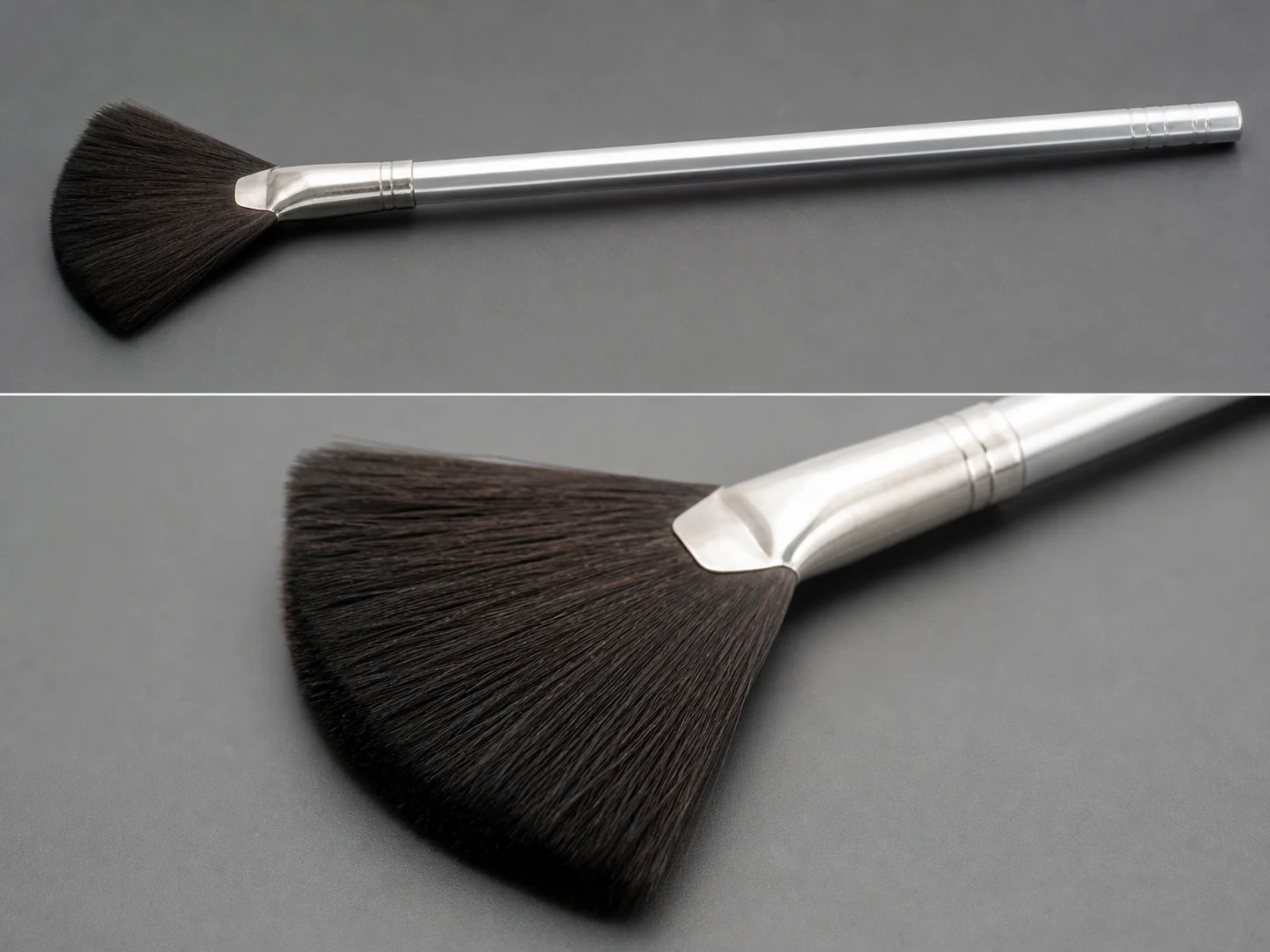
Small brush
500 pcs
Minimum order
Held in one hand: tube, bottle, detail and swab brushes — including long-handled ones with a small head.
Production lead time, once the specification is confirmed
- Up to 500 pcsWithin 7 days
- 501–50,000 pcsWithin 14 days
- Over 50,000 pcsWithin 21 days
Peak season can extend these times; the shipping date is confirmed in writing with your quotation. Sampling and shipping are quoted separately.
A soft natural-hair dusting brush built for dry removal of loose particles from coated and uncoated optical surfaces. Its fine goat hair filaments lift dust from lenses, mirrors, prisms, filters, and precision glass without scratching AR coatings or leaving lint, making it the last-contact tool before inspection, bonding, or packaging.
What can this brush do for you?
Protects coated optics while removing dust
Goat hair has naturally fine, tapered shafts with soft tips that flex at the point of contact instead of digging into the surface. This low-abrasion contact removes loose particles from AR-coated lenses, mirrors, beamsplitters, and other coated optics without producing the micro-scratches that stiffer synthetic or abrasive filaments can leave.
Lifts fine particles instead of pushing them around
The natural scale structure and loft of the hair bundle trap dust, glass fines, and light fiber debris within the filaments. A single pass carries the particles away from the optic rather than redistributing them across the surface, which reduces the number of cleaning strokes and the chance of recontamination.
Reaches lens edges, bevels, and recessed mount gaps
Head profiles can be trimmed flat, chisel, round, or tapered to follow concave and convex curvatures and to fit into the narrow gaps between an optic and its cell or barrel. This lets the same brush clean the visible surface and the edge transition where dust tends to collect before final assembly.
Fits dry-room and clean-bench workflows
The brush is available with washed and degreased goat hair, a low-parting finish, and inspected filament bundles to reduce the risk of loose fiber release. It works well alongside filtered air, ionizing blowers, and lens tissue protocols as the dry particle removal step before inspection or bonding.
Light, balanced handle gives controlled strokes
A small ferrule and lightweight handle make the brush easy to maneuver over delicate optics without hand fatigue during repetitive QC, assembly, or packaging operations. Operators can keep stroke pressure consistent, which matters when the surface is a thin-film coating.
What is a Goat Hair Optical Dusting Brush?
A Goat Hair Optical Dusting Brush is a hand-guided dry-dusting instrument whose working end is a shaped bundle of natural goat hair set into a ferrule and handle. In optical manufacturing and service, it is used to remove ambient dust, glass fines, fiber particles, and other loose, non-adhered debris from optical surfaces before final inspection, coating, bonding, or packaging.
The brush works by sweeping the soft hair tips across the surface. The filaments conform to the curvature of the optic, lift loose particles into the bundle, and carry them away when the brush moves off the part. The ferrule controls the spread and shape of the hair, while the handle provides the operator with a stable grip for precise strokes.
This is not a scrubbing brush and not a solvent application brush. It is intended for dry particle removal on clean, sensitive surfaces. If the optic carries oil film, fingerprints, dried slurry, or adhesive residue, those contaminants are better addressed with a solvent wipe or a cleaning protocol designed for adhered films. The brush should also be kept dry, because absorbed moisture can mat the natural hair and change its contact behavior.
Technical Specifications
| Parameter | Value / Options |
|---|---|
| Filament material | Natural goat hair; washed and degreased; antistatic treatment optional |
| Hair grade | Fine, medium, or coarse, selected for surface sensitivity and particle load |
| Working face width | 10–50 mm (0.4–2.0 in); custom sizes outside this range |
| Trim length | 10–30 mm (0.4–1.2 in) exposed filament |
| Overall length | 100–200 mm (4–8 in); longer builds available for instrument reach |
| Head profile | Flat, chisel, round, tapered, knife edge, or custom trimmed shape |
| Ferrule | Nickel-plated brass, stainless steel, aluminum, or plastic; crimped or epoxy-set |
| Handle | Wood, plastic, or ESD-dissipative polymer; round, flat, or ergonomic |
| Static control | Untreated natural hair or antistatic finish; dissipative handle option |
| Packaging | Individual sleeve, bulk tray, cleanroom-ready bag, or labeled kit |
| Operating environment | Dry dusting; 10–40 °C typical; not intended for continuous liquid immersion |
| Brush type | Custom Handheld Detail Brushes |
| How it is driven | Hand-guided |
| Cleaning target | camera and microscope optic, coated mirror and beamsplitter, and flat panel glass cleaning |
| Surface or part | glass, filters, edges, gaps, flat panels, profiles, precision surfaces, and plastic |
| Residue or debris | hair, particles, dust, fiber, loose particles, adhesive, lint, and oil film |
| Mounting / connection | Fixed |
Dimensions shown are standard working ranges. We adjust head width, trim length, overall length, and handle form to your part geometry and access conditions.
Where does this brush work best?
- Camera and microscope optics: final dusting of lens surfaces before assembly, test, or packaging.
- Coated mirrors and beamsplitters: dry particle removal on AR, dichroic, and metallic coatings where contact pressure must stay low.
- Prisms, filters, and laser optics: cleaning flat or angled faces in photonics and telecom transceiver modules.
- Reticles, sensor covers, and flat panel glass: removing dust from planar precision surfaces without fabric fibers.
- Lens barrels and cell gaps: reaching the edge, bevel, and recessed mount areas that a cloth or wipe cannot enter cleanly.
- Coating and bonding prep stations: last-touch dust control before adhesive application, optical contact, or final QC.
How do I choose the right one?
Start with the surface and the residue
Identify whether the optic is coated or uncoated and what kind of particles you are removing. For AR-coated lenses, filters, or mirrors, choose a fine goat hair grade with a longer trim length so the hair tips flex and conform with minimal pressure. For uncoated glass or larger flat panels, a medium hair grade with a shorter trim can give a slightly firmer, more positive sweep while still avoiding scratches.
Match the head profile to the optic geometry
Flat and chisel profiles work well on planar surfaces such as filters, reticles, and windows. Round or tapered profiles follow concave and convex lens curvature and reach into mirror dishes. A knife-edge or bevel profile is better for cleaning the edge transition, mounting bevel, and the narrow gap between an optic and its cell.
Check the trim length for control and access
Longer trim lengths conform to curved surfaces and can reach slightly recessed areas, but they reduce feedback and make stroke pressure harder to control. Shorter trim lengths provide more direct contact and better control on flat optics. Choose the shortest trim that still lets the hair tips reach the full surface without the ferrule touching the part.
Choose the handle and ferrule for the workstation
For repetitive inspection and assembly, a lightweight wood or plastic handle reduces operator fatigue. If the brush may contact cleaning chemicals or humid air, a stainless or nickel-plated brass ferrule resists corrosion better than plain steel. In electrostatic-sensitive areas, specify an ESD-dissipative handle and consider an antistatic hair treatment.
Decide whether static control matters
Natural goat hair can carry a small charge, especially in dry air. If dust re-attraction or ESD damage is a concern in your process, use the brush with an ionizing blower, or request an antistatic treatment and dissipative handle. Test the combination in your actual humidity and cleanroom environment before qualifying it for production.
Know when to choose a different tool
If the optic carries oil film, fingerprints, dried adhesive, or polishing compound that has adhered, the brush will not remove these films and may smear them. Use a solvent wipe or appropriate cleaning tissue for those residues. For heavy loose debris, blow off the surface with filtered air or vacuum first. If your cleanroom requires zero fiber shedding or you are working at ISO Class 5 or tighter with strict no-lint rules, a synthetic cleanroom brush or validated swab may be the better choice.
Can I customize this brush?
Goat hair optical dusting brushes are built around your optic and your cleaning protocol. Provide the part dimensions, surface type, coating, particle source, cleanroom class, and handling preference. A sample part or drawing shortens configuration and lets us match the trim profile to the actual curvature.
- Head geometry: working face width, trim length, and profile, including flat, chisel, round, tapered, knife edge, or fan shapes.
- Hair grade and fill: fine to coarse natural goat hair, bundle density, and pure goat hair or a blend with synthetic fiber for controlled stiffness or static behavior.
- Ferrule: material, plating, crimping style, and set depth to control hair spread and rigidity.
- Handle: wood, plastic, or ESD-dissipative polymer; length, shape, textured grip, hanging hole, or ergonomic contour.
- Static and cleanroom options: antistatic treatment, dissipative handle, washed and degreased hair, and cleanroom-ready packaging.
- Marking and packaging: logo marking, part number printing, individual sleeves, bulk trays, or kit assembly with a blower or storage tube.
- Project support: material declarations, inspection documentation, and third-party testing according to your qualification protocol.
When is a goat hair optical dusting brush worn out rather than just dirty?
Can I use this brush on wet surfaces or with cleaning solvent?
No, this brush is designed for dry dust removal. Natural goat hair absorbs moisture and solvent, which can mat the bundle, change its stiffness, and leave residual material on the optic. If your process includes solvent wiping, use a solvent-compatible applicator or specify a synthetic brush built for that chemistry.
How should I clean and store the brush between uses?
After each use, blow or gently flick out trapped dust. If the hair becomes visibly loaded, wash it in mild detergent and warm water, rinse thoroughly, shake out the excess water, and dry with the filaments hanging downward. Store the brush in a protective tube or clean drawer so the hair does not contact other tools. Never store it damp in a closed container.
How can I check that a new brush is safe for my coated optics?
Inspect the bundle under magnification for loose hairs, bent or split tips, and any foreign particles. Then test the brush on a non-critical witness sample or the edge of a scrap coated part using your normal stroke pressure. If no marks appear, the brush is safe for production use. Repeat this check when you change lots, trim lengths, or suppliers.
Does goat hair create static that attracts dust?
Natural hair can carry a small charge, especially in dry air. If you are working in an ESD-sensitive or particle-sensitive area, use an ionizing blower or specify an antistatic treatment and dissipative handle. Static behavior depends on humidity and surface finish, so test the brush in your actual environment before relying on it.
When is a goat hair brush the wrong choice?
If the optic carries oil film, fingerprints, dried adhesive, or adhered polishing compound, the brush will not remove it and may smear it. For heavy loose debris, use filtered air or vacuum first. For cleanrooms that require zero fiber shedding, a synthetic cleanroom brush or validated swab is often a better fit. The goat hair brush is for final dry particle removal on sensitive surfaces, not for heavy cleaning.
How often should I replace the brush?
Replace the brush when the filaments become matted, contaminated with oil or grease, loaded with embedded particles you cannot remove, or start shedding visibly. In production, set a replacement interval based on daily visual inspection and lot volume. Natural hair dusting brushes are consumable items, and a worn brush is a contamination source rather than a cleaning tool.
Guides that go deeper on this
We have not written a guide specific to this one yet. The material that covers selection, filament, dimensions, maintenance and sourcing is collected in the technical resources library.
Custom Manufacturing RFQ
Describe Your Application
For a custom quote, we need the key dimensions, surface or part, residue, material preference, quantity, and reference image or drawing.
Drawing or photo optional — it speeds things up, it does not gate the enquiry.
Custom Brush RFQ
Send Your Brush Project
Upload a drawing, product photo, or sample photo and provide the core dimensions and cleaning conditions.
“We need a brush to remove wet residue from a stainless steel conveyor, about 800mm wide. The current brush wears quickly. We can send photos.”
“We sell drinkware and need a cleaning brush to include with the product. Quantity around 5,000 pieces.”