
Custom Cleaning Brush
Dusting Brush
Custom dusting brush with nylon PA fill for dry dust, fiber, and fine-particle removal from equipment, conveyors, panels, and narrow machine zones.
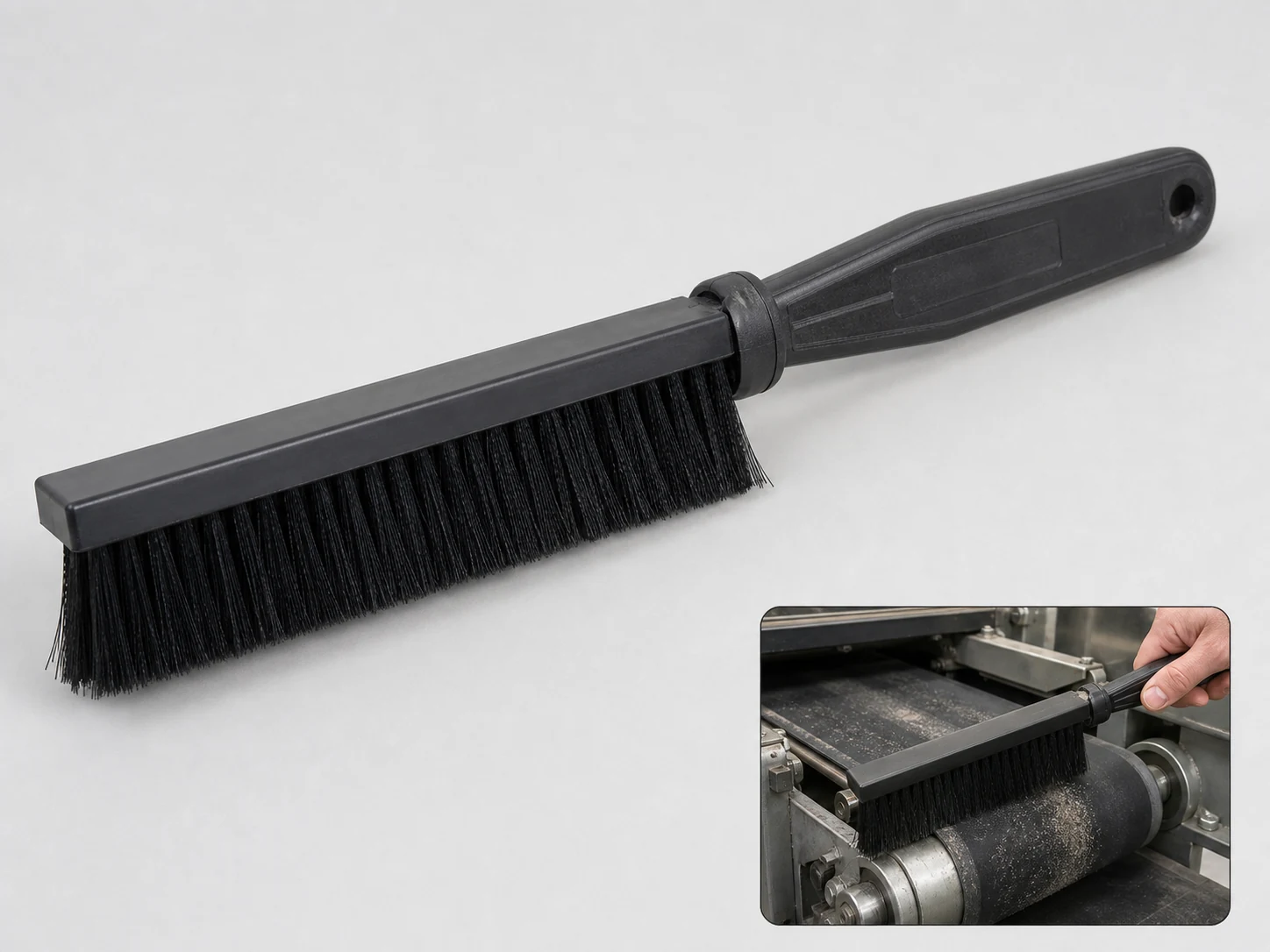
Medium brush
100 pcs
Minimum order
Worked with two hands or on a pole: chimney, gutter and pond-filter brushes, discs, cups and tank brushes.
Production lead time, once the specification is confirmed
- Up to 100 pcsWithin 7 days
- 101–5,000 pcsWithin 14 days
- 5,001–50,000 pcsWithin 21 days
- Over 50,000 pcsConfirmed with your quotation
Peak season can extend these times; the shipping date is confirmed in writing with your quotation. Sampling and shipping are quoted separately.
This dry-cleaning dusting brush uses dense nylon PA filament to lift and carry away dry dust, powder, lint, fibers, and static-attracted particles from equipment surfaces, panels, conveyors, and narrow machine zones. It is built for maintenance crews and operators who need clean, dry residue removal without scratching sensitive surfaces or introducing moisture into the process.
What can this brush do for you?
Dense Filament Face Picks Up Fine Dust Instead of Redistributing It
Fine dust and powder tend to drift, smear, or simply shift position when brushed with sparse or overly stiff fill. The dense nylon PA filament face creates many contact points in each stroke, catching particles into the bristle bed and carrying them forward so they can be collected or cleared from the line. This usually leaves a visibly cleaner surface after fewer passes.
Wide Face Covers Panels and Product Paths in One Pass
Dusting a control panel, conveyor rail, or product contact surface with a narrow brush means overlapping strokes and missed edges. Head widths from 30 mm to 320 mm let the brush face match the width of the surface being cleared, so a single controlled stroke covers the working area and keeps cleaning time reasonable on longer lines.
Dry Contact Keeps Moisture Out of the Process
Powder-based products, paper dust, chaff, and electrical areas usually react badly to wet cloths or foams. This brush works without water, cleaning only through mechanical sweeping. Dry contact prevents dust from turning into paste on the surface and avoids introducing moisture into seals, electronics, or dry product contact zones.
Antistatic Fill Stops Dust from Jumping Back
Standard nylon can build a triboelectric charge during brushing and pull fine particles back onto the surface after the stroke. When static attraction is part of the cleaning problem, surface-resistivity-controlled nylon fill from 10³ to 10⁹ Ω helps dissipate charge and keeps removed dust from re-attaching to panels, sensor faces, or product contact areas.
Filament Choice Balances Particle Removal and Surface Protection
Filament diameters from 0.05 mm to 0.40 mm and trim lengths from 25 mm to 100 mm tune the brush for either fine powder on painted or coated surfaces or heavier fiber and chaff on metal frames. The brush can be gentle enough for finished surfaces while still aggressive enough to move compacted lint and fibers from rough machine zones.
What is a Dusting Brush?
A Dusting Brush is a hand-guided dry-cleaning tool with nylon PA filaments anchored in a wood, polypropylene, aluminum, or stainless steel backing and handle. It removes loose dry contamination — dust, powder, lint, fibers, chaff, and static-attracted particles — from equipment surfaces, conveyors, product paths, panels, and narrow machine zones.
Filament diameter, trim length, fill density, and head width all control how much contact the brush makes per stroke and how much particulate it picks up and carries. During use, the brush is pulled or pushed across the surface in short controlled strokes; the filament tips flick particles off the substrate and into the bristle bed. For best results, the surface should be dry and free of oil or grease, because oil and grease will smear into the fill and coat the filaments, sharply reducing pickup.
This is a surface cleaning tool, not a deep scrubbing brush. It does not remove baked-on deposits, scale, or grease films. Where airborne particle control is the priority, a vacuum or extraction system should be used alongside the brush, but a properly specified dusting brush still earns its place for releasing electrostatically attached dust and clearing irregular surfaces that vacuum nozzles miss.
Technical Specifications
The table lists project-proven ranges for custom dusting brushes. Every dimension and material can be adjusted to match the specific surface, access condition, and operating environment.
| Parameter | Value / Options |
|---|---|
| Head width | 30–320 mm, selected to cover the surface width in fewer strokes |
| Trim length | 25–100 mm, controls reach into gaps and filament flex |
| Overall length | 150–400 mm, matched to operator reach and handle preference |
| Filament diameter | 0.05–0.40 mm; finer picks up fine powder, heavier moves fiber and chaff |
| Fill material | Nylon PA; PA6, PA6.6, or PA6.12 grades available for project conditions |
| Surface resistivity | Standard nylon fill; antistatic or conductive fill from 10³ to 10⁹ Ω where static control is required |
| Handle / backing | Wood, polypropylene, aluminum, or stainless steel, selected for environment and weight |
| Operating temperature | -20°C to 100°C in dry service |
| Filament arrangement | Straight, flagged, or crimped fill to tune pickup and dust release |
| Face profile | Flat, angled, or shaped to match the surface contour |
| Brush type | Custom Handheld Detail Brushes |
| How it is driven | Hand-guided |
| Cleaning target | conveyor frame, control panel, and product contact path cleaning |
| Surface or part | panels, conveyors, narrow machine zones, gaps, equipment surfaces, frames, rails, and aluminum |
| Residue or debris | particles, dust, powder, lint, fiber, chaff, grease, and oil |
| Mounting / connection | Fixed |
Antistatic and conductive fill are selected when electrostatic attraction is part of the dust problem; standard non-treated nylon PA remains available where static control is not required.
Where does this brush work best?
- Conveyor frames, rails, and slider beds in dry processing lines where chaff, dust, and fibers accumulate without heavy oil or grease.
- Control panels, machine housings, sensor faces, and operator stations where wet cleaning or compressed air could force particles into seals or electronics.
- Product contact paths on packaging, textile, tobacco, or grain lines — before filling, printing, sealing, or inspection — where lint and powder must be removed without leaving residue.
- Narrow machine zones between rollers, feed guides, and side frames; trim length and head width can be reduced so the brush reaches into gaps without touching moving parts.
- Static-sensitive assembly and packaging areas where antistatic fill prevents removed particles from re-attaching to the surface.
- Filters, vents, and mesh guards that require periodic dry cleaning during operation or scheduled maintenance.
How do I choose the right one?
Start with the surface you need to clear and the access around it. The right dusting brush is the configuration that covers the area quickly, reaches the particle-trapping gaps, and does not damage or re-contaminate the surface.
Match head width to the working surface
For a wide panel or conveyor rail, choose a head width that covers most of the surface in one pass. For narrow gaps between machine elements, specify a narrower head and longer trim so the filaments reach into the channel without the backing hitting surrounding parts.
Choose trim length for reach and control
Short trim gives firmer contact and more control on flat surfaces; long trim flexes better around contours and reaches deeper crevices. If the brush must clean behind a lip or inside a recess, measure the gap depth before specifying trim length.
Select filament diameter from particle size and surface sensitivity
Fine powder on painted, coated, or polished surfaces usually calls for a finer filament — around 0.05 mm to 0.15 mm — to avoid visible scratching. Heavier fiber, chaff, or compacted lint on metal frames can use 0.20 mm to 0.40 mm filament for more mechanical push. If you are unsure, start with a finer filament and increase only if the residue does not release.
Decide whether static control is required
If dust re-appears on the surface minutes after cleaning, static attraction is likely involved. Ask for antistatic or conductive fill within the 10³–10⁹ Ω range and verify the brush against your target surface before full line introduction.
Pick the handle and backing material for the environment
Wood backings are lightweight and economical for general dry use. Polypropylene resists moisture and chemicals slightly better and is often preferred in washdown-adjacent zones. Aluminum and stainless steel suit higher-temperature or more demanding hygienic environments; stainless steel also avoids corrosion in humid areas.
Use a different tool when the residue or environment changes
For oil, grease, baked-on deposits, or wet residue, choose a wet-cleaning brush with appropriate chemical-resistant filament instead of a dry dusting brush. For airborne dust control in cleanrooms or around sensitive electronics, a vacuum or extraction system should do the collection work — the dusting brush can precede it to mechanically release attached particles. For small, localized dusting, a narrower head may be enough; do not over-spec width.
| If your situation is… | Consider this configuration |
|---|---|
| Fine dust on painted panels | 0.05–0.15 mm nylon PA, medium-dense fill, flat face |
| Long conveyor rails or wide product paths | Wider head with consistent flat trim to cover in one pass |
| Narrow gaps or around sensors | Narrow head, longer trim, shaped face |
| Static-attracted lint or powder | Antistatic or conductive fill, 10³–10⁹ Ω |
| Higher temperature or humid area | Aluminum or stainless backing with project-matched PA grade |
Can I customize this brush?
Dusting brushes are configuration-heavy because surfaces and access conditions differ across lines. To define the right brush, provide the surface material, area dimensions, gap depths, particle type, operating temperature, whether static control is required, and the handle or holder interface you prefer. A drawing or photo of the machine zone helps us get the first sample closer to final.
We can adjust:
- Head width, shape, angle, and face profile — flat, angled, offset, or contoured
- Trim length and edge contour, including tapered or stepped faces for channel access
- Filament material — nylon PA6, PA6.6, or PA6.12; diameter from 0.05 to 0.40 mm; straight, flagged, or crimped
- Fill density and pattern, tuned for pickup volume and dust release
- Antistatic or conductive fill where electrostatic attraction is a concern
- Handle and backing — wood, polypropylene, aluminum, or stainless steel; custom lengths, grip shapes, hanging holes, or attachment points
- Mounting interface — drilled holes, brackets, or holder dimensions if the brush is stored or used on a fixture
- Color, marking, identification coding, and project packaging
If your project requires material declarations, inspection documentation, or third-party testing support, we can assist with those requirements during the customization process.
Which filament survives the cleaning chemicals a dusting brush meets?
When should I use a dusting brush instead of compressed air or a vacuum?
Use the dusting brush when particles are attached to the surface by static or mechanical contact and would be blown into surrounding areas by compressed air. A brush mechanically lifts and carries the dust; compressed air can drive particles into seals or electronics, and a vacuum may not release particles that are statically bonded or packed into grain lines. On many lines the best sequence is brush first to release the dust, then vacuum or extraction to collect it.
Does standard nylon PA fill create static that re-attracts dust?
Standard nylon can build a triboelectric charge during brushing, and fine powder or lint may drift back onto the surface after the stroke. If you see dust returning to the surface within minutes, specify antistatic or conductive fill with controlled surface resistivity in the 10³–10⁹ Ω range. Verify the chosen resistivity on the actual surface, because a conductivity level that works on one plastic panel may behave differently on another.
How do I know if the filament diameter is too fine or too coarse for my dust?
Check the surface after a single pass. If a fine textile dust is left smeared or the brush slides over the surface without moving particles, the filament may be too soft or too fine. If the surface shows fine scratches, hazing, or visible fiber marks after use, the filament is probably too coarse or too stiff for that substrate. Start with the finest filament that still moves the residue, then increase only if necessary.
What should I inspect before putting the brush on a production line?
Check that the filaments are dry, clump-free, and free of oil or grease. Confirm the backing and handle show no splits or cracks, and that no loose filament is present that could detach into product. If the line is static-sensitive, verify the brush resistance before first use. Any brush that has been wet, oiled, or contaminated should be set aside until it is cleaned or replaced.
What is the correct way to clean the brush between production runs?
Tap the brush face against a covered surface or use low-pressure dry air from the backing side outward to remove retained dust from the bristle bed. Avoid water or solvents, because moisture absorbed by nylon PA filaments mats the fill and can leave residue on the next surface. If dry cleaning no longer restores the fill, or if the filaments stay flattened and clumped, the brush has reached the end of its useful life and should be replaced.
Guides that go deeper on this
We have not written a guide specific to this one yet. The material that covers selection, filament, dimensions, maintenance and sourcing is collected in the technical resources library.
Custom Manufacturing RFQ
Describe Your Application
Please include the main sizes, application, residue, preferred material, interface, quantity, and any drawing or sample available.
Drawing or photo optional — it speeds things up, it does not gate the enquiry.
Custom Brush RFQ
Send Your Brush Project
Upload a drawing, product photo, or sample photo and provide the core dimensions and cleaning conditions.
“We need a brush to remove wet residue from a stainless steel conveyor, about 800mm wide. The current brush wears quickly. We can send photos.”
“We sell drinkware and need a cleaning brush to include with the product. Quantity around 5,000 pieces.”