
What Is an Annealing Furnace Cleaning Brush?
An annealing furnace cleaning brush is a brush engineered for the harsh conditions of metal heat-treatment lines. It typically features bristles made from stainless steel, high-temperature nylon, PTFE (Teflon), or alloy blends, and is built into a core or handle designed to mount on manual rods, automated cleaning systems, or rotary tools. These brushes must withstand continuous or intermittent contact with hot surfaces, chemical splash, and abrasive residues without degrading, shedding, or causing contamination.
Common Brush Types for wet or chemical-exposure environments
Not all brushes are equal in chemical exposure. Below are the material families most often considered for furnace and process-line cleaning:
- Stainless steel bristles – Excellent for high heat, mechanical abrasion, and moderate acid/alkali resistance. Common grade 304 or 316 wire.
- Brass bristles – Softer than steel, non-sparking, good for light oxidation removal but limited chemical resistance.
- High-temperature nylon (e.g., 6.6, 6.12) – Good up to ~350°F; chemical resistance varies by type; less abrasive, suited for softer surfaces.
- PTFE (Teflon) bristles – Outstanding chemical inertness and high-temperature rating (up to 500°F+), but lower mechanical abrasion capacity.
- Advanced synthetics (PEEK, PPS, aramid) – High-performance blends for specific chemical and temperature combinations; usually custom-engineered.
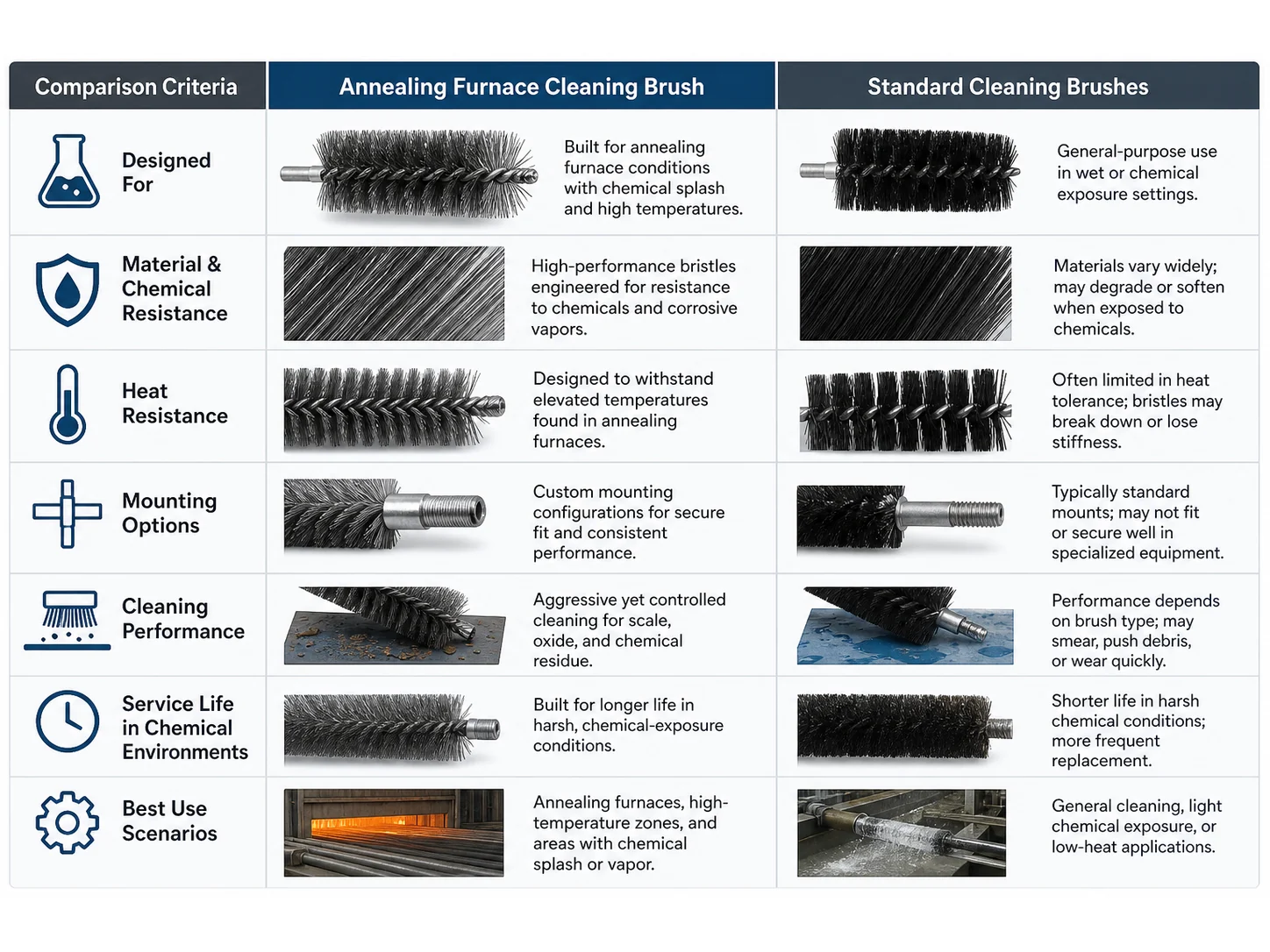
Annealing Furnace Cleaning Brush vs Standard Cleaning Brushes: A Practical Comparison
| Feature | Annealing Furnace Cleaning Brush | Standard Cleaning Brush |
|---|---|---|
| Typical Bristle Material | Stainless steel, heat-resistant polyamides, PTFE, or alloy wire blends | Carbon steel, plain nylon, polyester, natural fibers |
| Chemical Resistance | High; engineered for acids, alkalis, solvents, and pickling solutions | Limited; may degrade rapidly in aggressive chemicals |
| Temperature Tolerance | Often rated for continuous exposure to 400°F–800°F (or higher), depending on material | Typically 150°F–250°F; may melt, soften, or lose stiffness |
| Bristle Stiffness and Abrasiveness | Available in wide range; controlled stiffness to match surface sensitivity and residue type | Often general-purpose; may be too soft or too aggressive for delicate surfaces |
| Mounting and Handle Options | Customizable shank, threaded, or quick-connect for automated or manual systems | Fixed wooden or plastic handles, standard mandrels |
| Typical Service Life in Chemical Splash | Longer when matched to chemical environment; reduces downtime | Short; rapid bristle loss, corrosion, or structural failure |
| Cost | Higher initial investment; lower total cost for demanding environments | Lower purchase cost drivers; frequent replacement may increase overall cost |
| Best Application | Annealing furnace sections, pickling lines, degreasing stations, chemical cleaning zones | Light maintenance, dry cleaning, non-critical cleaning tasks |
How to Choose an Annealing Furnace Cleaning Brush for wet or chemical-exposure environments
Selection must be driven by the specific residue, chemical, and equipment conditions. Use this checklist as a decision guide:
- Residue Type: Heavy scale and high-tenacity deposits require stiffer wires (stainless steel or alloy). Light chemical residues or films can be removed with PTFE or softer synthetics.
- Surface Sensitivity: For polished stainless steel or specialty alloy surfaces, choose a non-abrasive bristle to avoid micro-scratches that can lead to corrosion or product defects.
- Equipment Interface: Confirm whether the brush needs to clean tubes, flat strips, rolls, or complex geometries; this determines diameter, length, and profile.
- Wet or Chemical Exposure: If the brush stays continuously submerged or splashed, select materials with proven chemical compatibility charts (e.g., PTFE for strong acids).
- Hygiene Requirements: In food-grade or pharmaceutical adjacent lines, choose FDA-compliant materials and stainless steel cores to prevent particle shedding.
- Maintenance Frequency: High-frequency, automated cleaning demands robust mounting and longer-life bristle materials to minimize changeover.
- Custom Dimensions: Off-the-shelf sizes rarely fit perfectly. Work with a supplier that can produce brushes to your exact gap, bore ID, or roll-width specifications.
Common Mistakes When Selecting an Annealing Furnace Cleaning Brush
- Using standard carbon steel brushes in acidic environments: Carbon steel corrodes rapidly, leaving rusty contamination on the metal surface and weakening the brush structure.
- Ignoring the temperature rating: Even high-temperature nylons can soften or melt in direct contact with annealing furnace interiors, causing deformation and potential safety hazards.
- Picking the wrong bristle stiffness: Too stiff scratches delicate metal surfaces; too soft fails to remove heavy scale, requiring extra passes and increasing downtime.
- Overlooking mounting compatibility: A brush that cannot be securely attached to the existing cleaning lance or automated arm will cause delays and may damage equipment.
- Applying a one-size-fits-all approach: Reusing a brush designed for a different tube diameter or roll gap often leads to uneven cleaning and premature wear.
When an Annealing Furnace Cleaning Brush Is the Wrong Choice
While these brushes handle most chemical splash and heat conditions, there are limits. Extremely corrosive substances like hot hydrofluoric acid or molten salt baths may require exotic alloy bristles (e.g., Hastelloy) or ceramic-bristle brushes. When surface finish requirements are sub-micron, abrasive brush cleaning could introduce scratches that only non-contact methods (ultrasonic, chemical passivation) can avoid. Always involve a brush engineering team for custom drawing review when the chemical exposure, temperature cycle, or mechanical clearance is outside standard ranges.
Final Takeaway
In wet or chemical-exposure environments, standard cleaning brushes fail fast and can become a source of contamination themselves. Annealing furnace cleaning brushes, built with chemical- and heat-resistant materials, provide safer, longer-lasting performance and help maintain line uptime. Match the bristle material, stiffness, and mounting to your residue type, chemical exposure, and surface sensitivity, and verify through sample testing whenever possible.
Frequently Asked Questions
What makes an annealing furnace cleaning brush different from a standard wire brush?
Annealing furnace cleaning brushes use materials like stainless steel, PTFE, or high-temperature nylon that resist chemical attack and high heat, whereas standard wire brushes often use carbon steel that rusts and degrades quickly in aggressive environments.
Can I use a standard boiler tube cleaning brush instead of an annealing furnace cleaning brush?
Not recommended. Boiler tube brushes are designed for soot and light scale removal at moderate temperatures and may not withstand acidic chemical splashes or high heat found in annealing processes.
How do I know the right bristle stiffness for my cleaning task?
Consider the residue tenacity and surface hardness. For heavy scale on durable surfaces, a stiffer steel bristle may be appropriate. For softer alloys or thin oxides, a softer nylon or Teflon brush reduces scratching risk. Many suppliers offer sample kits for on-site testing.
Can annealing furnace cleaning brushes be custom-sized for our unique furnace rolls?
Yes. Most manufacturers provide custom diameter, length, bristle pattern, and mounting options. Provide a drawing or measurements of the roll gap or tube ID for precise fit.
How often should we replace an annealing furnace cleaning brush in a chemical splash environment?
It varies by chemical concentration, temperature, and abrasive load. Visual inspection for bristle loss, deformation, or corrosion is the best guide. In heavy-duty lines, some brushes last weeks; with proper material match, they can last months.
Are there hygienic options for food-grade or pharmaceutical adjacent processes?
Yes, PTFE or FDA-compliant nylon brushes with stainless steel cores are available for applications requiring minimal particle shedding and chemical inertness. Always confirm with the supplier that materials meet your specific regulatory needs.
What happens if I use a brush that is too aggressive in a chemical splash zone?
Aggressive bristles can score metal surfaces, creating nucleation sites for corrosion or product defects downstream. It can also accelerate brush wear and contaminate the cleaning solution with metal particles.
Can an annealing furnace cleaning brush handle solvents like MEK or acetone?
Many annealing furnace cleaning brushes with PTFE or stainless steel bristles and chemical-resistant cores can handle common solvents. However, always check the material compatibility chart with the brush manufacturer for specific chemicals.
Technical References
Which bristle material fits this job — AISI 304 Stainless Steel Wire, Nylon PA or Brass Wire?
| Material | Continuous temperature (°C) | Peak temperature (°C) | Water absorption | Hardness |
|---|---|---|---|---|
| AISI 304 Stainless Steel Wire | 400 | 500 | 0% | Rockwell B 70–95 depending on temper and cold work |
| Nylon PA | 93 | 121 | 0.3–9% by PA grade and conditioning | Medium to firm; filament diameter and trim length control bending force. |
| Brass Wire | 150–200 | 250–300 | 0% | Rockwell B 40–90 |
Figures as published by Alleima; Brushtec / DuPont. Confirm the exact grade against the supplier datasheet before ordering.
What should replace Handheld Detail Brushes for annealing furnace cleaning brush?
- Handheld Detail Brushes — Handheld detail brushes cover general precision cleaning; auto-detailing brushes impose tighter controls for painted, polished, leather, display, and trim surfaces.
- AISI 304 Stainless Steel Wire — Use AISI 316 stainless steel wire for chloride, marine, dairy, beverage, chemical washdown, or higher pitting-resistance requirements. Use carbon steel for dry aggressive cutting and brass or abrasive nylon for lower marking risk.
- Nylon PA — Compare Nylon PA with PP, PBT, PET. Change material when wet stiffness, temperature, chemical resistance, conductivity, particle shedding, or surface marking becomes the limiting factor.
- Brass Wire — Compare Brass Wire with Steel wire, stainless wire, nylon. Change material when wet stiffness, temperature, chemical resistance, conductivity, particle shedding, or surface marking becomes the limiting factor.