
Custom Cleaning Brush
Annealing Furnace Cleaning Brush
Annealing furnace cleaning brush with brass wire or Nylon PA fill removes scale, carbon, and ash from rolls, refractory, and kiln cars.
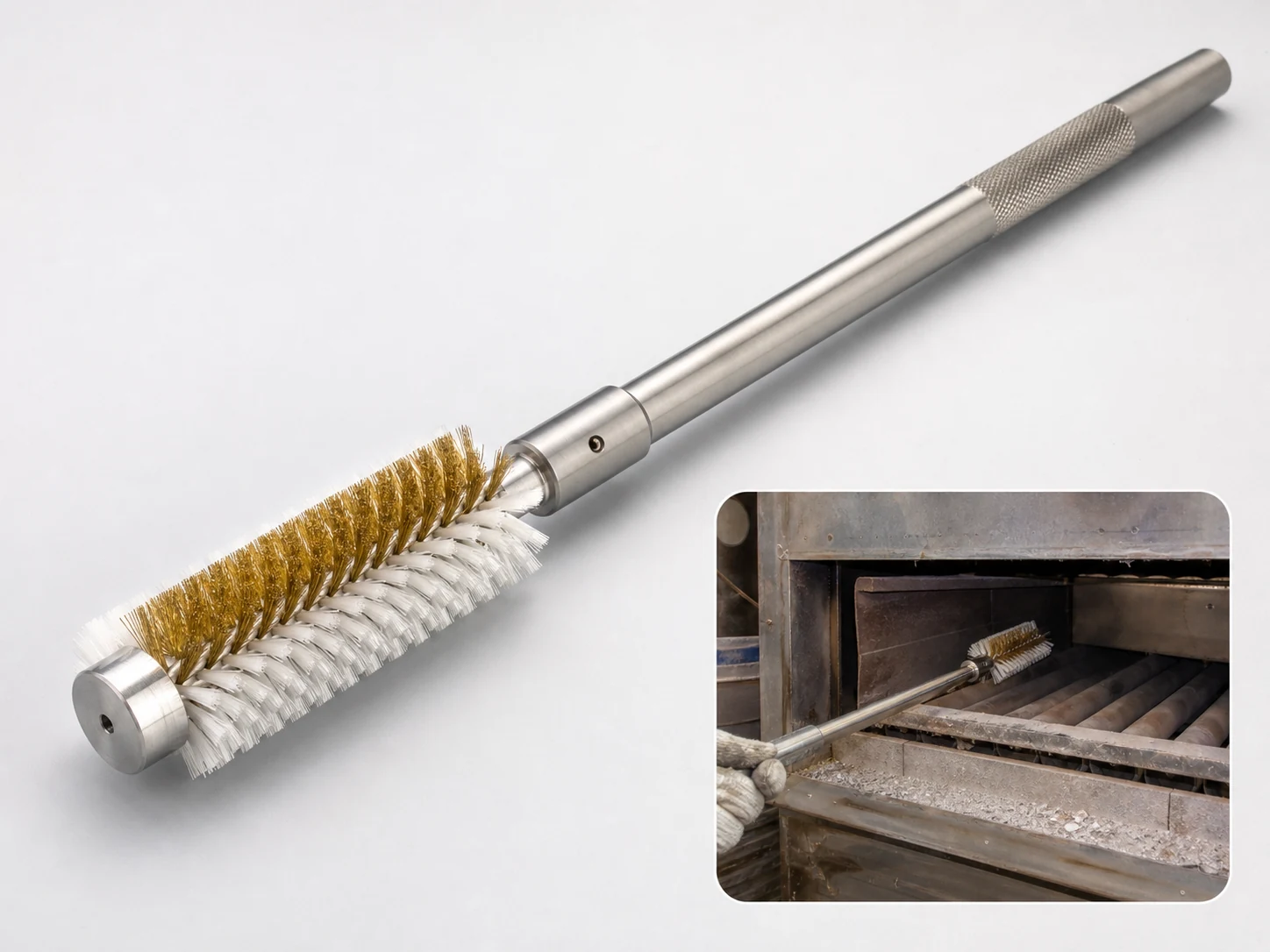
Medium brush
100 pcs
Minimum order
Worked with two hands or on a pole: chimney, gutter and pond-filter brushes, discs, cups and tank brushes.
Production lead time, once the specification is confirmed
- Up to 100 pcsWithin 7 days
- 101–5,000 pcsWithin 14 days
- 5,001–50,000 pcsWithin 21 days
- Over 50,000 pcsConfirmed with your quotation
Peak season can extend these times; the shipping date is confirmed in writing with your quotation. Sampling and shipping are quoted separately.
An annealing furnace cleaning brush is a maintenance tool for removing scale, oxide, carbon smut, ash, and baked process deposits from furnace rolls, refractory surfaces, kiln cars, and thermal-processing fixtures. It is available with brass wire or Nylon PA fill, with high-temperature metal fill and custom mounting options for your line layout.
What can this brush do for you?
Removes oxide and carbon buildup without scoring precision furnace parts
Brass wire is firm enough to dislodge light-to-moderate oxide films, carbon smut, and baked dust from stainless rolls, skid rails, radiant tubes, and annealing bases, yet softer than the steel surfaces it contacts. That means you can clean roll faces and strip-contact hardware during shutdown without leaving deep scratch lines that would mark the next coil or strip run.
Gets into the tight spaces maintenance crews actually have to clean
Head widths start at 10 mm, and working lengths can be set from 20 mm to 300 mm, so the brush can follow gaps between hearth rolls, clear burner ports, and reach into thermocouple wells and expansion joints. Overall lengths up to 1000 mm keep hands away from residual heat and let operators work inside furnace openings without crawling in.
Lets you match the fill to the residue instead of forcing one brush on every job
Brass wire scrapes off attached scale and carbon, while Nylon PA sweeps loose ash, refractory dust, and fine oxide powder from cooler zones, electrical enclosures, and sensor housings without scratching or building static the way some plastic blends do. Choose the standard fill for your main residue, or order both configurations for different parts of the line.
Handles the residual heat of a recently cooled furnace when specified
Standard brass wire and Nylon PA configurations are intended for equipment that has cooled to warm shutdown temperatures. When cleaning must begin while surfaces are still hot, the brush can be built with stainless or heat-resistant metal fill and heat-rated components for assembly temperature ranges from 200°C to 600°C.
Fits the way your crew or cleaning station actually works
The brush can be supplied as a hand tool with a straight or ergonomic handle, on a threaded extension, with a ferrule or shank, on a bracket, or as a machine bar for rail-mounted or automated cleaning heads. The same fill and trim can be adapted to manual maintenance carts or fixed cleaning stations.
What is a Annealing Furnace Cleaning Brush?
An annealing furnace cleaning brush is a purpose-built maintenance brush for thermal-processing equipment. It is not a general-purpose shop wire brush; its fill materials, trim length, reach, and mounting are selected to work on the residues and access conditions found inside annealing lines, batch furnaces, roller hearths, and associated hot-process machinery.
In use, the brush face contacts the surfaces where process residues collect: furnace rolls and support rolls carrying strip or wire, skid rails and charging guides, inner covers and base seals, diffuser plates, kiln car decks, refractory joints, burner ports, and thermocouple protection tubes. Brass wire lifts moderate oxide scale and carbon films, while Nylon PA removes dry soot, ash, and dust in areas where a metal wire would scratch or where conductive fill is not wanted. An optional heat-resistant metal fill covers surfaces that are still warm during teardown.
The brush is designed for scheduled shutdown and maintenance cleaning, not for continuous operation inside a furnace at processing temperature. When you specify the brush, the key inputs are the residue type, the surface material, the maximum residual heat at cleaning time, and the access opening or gap the brush must pass through.
Technical Specifications
| Parameter | Value / Options | Selection Note |
|---|---|---|
| Fill material | Brass wire; Nylon PA; stainless or heat-resistant metal fill (high-temp option) | Brass for attached scale and carbon; Nylon for dry dust and sensitive surfaces; metal fill for hot work |
| Filament diameter | 0.08–1.00 mm | Finer wire for light film and narrow gaps; heavier wire for thicker deposit |
| Trim length | 10–100 mm | Longer trim for irregular surfaces; shorter trim for stiffer scrubbing |
| Working face width | 10–400 mm | Set to the contact width of the roll, rail, or opening |
| Working length | 20–300 mm | Length of fill along the brush face; matched to stroke and part geometry |
| Overall length | 120–1000 mm | Reach into furnace openings and between rolls; long options keep operator away from heat |
| Mounting | Handle, thread, ferrule, shank, bracket, or machine bar | Manual or automated application; specify interface thread or bar size |
| Temperature range | Standard brass/Nylon: safe for residual heat up to approx. 150–200°C; high-temp metal fill: 200–600°C assembly range | Nylon must never be used on hot surfaces; high-temp option requires heat-rated handle and stem |
| Typical residue | Scale, ash, oxide, dust, carbon, baked process deposits | Residue type drives fill and stiffness selection |
| Brush type | Custom Handheld Detail Brushes | |
| How it is driven | Hand-guided | |
| Cleaning target | continuous annealing line, hood annealing furnace, and roller hearth cleaning | |
| Surface or part | metal, rolls, kiln cars, tubes, gaps, rails, ports, and joints | |
| Residue or debris | oxide, carbon, scale, ash, dust, baked process deposits, fine oxide, and soot | |
| Mounting / connection | Handle, thread, ferrule, shank, bracket, or machine bar |
All dimensions can be adjusted to a measured furnace opening, roll diameter, or existing cleaning fixture. If your maintenance procedure uses a specific extension handle thread, bracket hole pattern, or machine interface, include that detail with the inquiry.
Where does this brush work best?
- Continuous annealing lines for steel, stainless steel, and aluminum strip: remove oxide smut, carbon, and fine scale from furnace rolls, support rolls, deflector rolls, and strip-contact surfaces during line stops and roll changes.
- Batch, bell, and hood annealing furnaces: clean inner covers, base seals, load support grids, and diffuser plates between annealing cycles so stacked coils sit flat and atmosphere flow stays even.
- Roller hearth, mesh belt, and wire annealing furnaces: sweep loose ash and oxide from shaft gaps, drive sprockets, belt edges, and hearth tiles where buildup causes tracking problems.
- Wire, rod, and tube annealing equipment: clear guide blocks, straightener rolls, quench-exit rails, and cooling-tube interiors of fine oxide dust that packs into moving parts.
- Kiln cars, ceramic kilns, and glass lehrs: clean car decks, wheel assemblies, side seals, and refractory joints of dust and spalled particles before they contaminate the next charge.
- Burner ports, radiant tubes, and thermocouple wells: use narrow head widths to remove carbon and oxide from openings, flame ports, and protection tubes that affect temperature reading and combustion.
- Auxiliary areas around the furnace: Nylon PA fill handles dry dust on motor cooling fins, fan housings, junction boxes, and sensor bodies without scratching or leaving metal fragments.
How do I choose the right one?
Start with the residue, then the surface, then the access geometry and heat at cleaning time. Those four answers determine the fill, trim, reach, and mounting for your annealing furnace cleaning brush.
Residue type and adhesion
If the deposit is an attached oxide film, carbon smut, or light-to-moderate scale that must be scraped off, select brass wire. If the material is loose ash, refractory dust, soot, or fine powder that can be swept away, select Nylon PA. Brass wire is not intended for heavy mill scale, weld spatter, or sintered material; for those deposits use a steel wire brush, powered wire wheel, or abrasive method before this brush.
Surface sensitivity
Brass is softer than most steel furnace hardware, so it cleans roll bodies and guides without the deep scoring that shows up later as strip marks. Nylon PA is the right choice on painted control panels, ceramic fiber modules, sensor housings, and surfaces where metal fill could scratch or where conductive debris would be a problem. When cleaning hardened or heavily worn surfaces, a more aggressive steel or stainless fill may be acceptable.
Access and reach
Measure the narrowest gap or opening the brush must enter. Working face width should be slightly smaller than that gap but wide enough to cover the contact band on the roll or rail. Working length and trim length determine how much fill contacts the surface on each stroke; longer trim follows irregular contours, shorter trim gives stiffer scrubbing. Overall length should let the operator keep hands outside hot openings; for long reaches, ask about a threaded extension or stiffer shank to keep control.
Heat at cleaning time
If the furnace has cooled below about 150–200°C, standard brass wire or Nylon PA configurations are suitable. If cleaning starts while surfaces are 200°C to 600°C, specify the high-temperature stainless or heat-resistant metal fill with a heat-rated handle and stem. Nylon PA must never be used on hot surfaces; it softens and the fill will flatten or melt into the residue.
When a different brush or method makes more sense
Use a steel wire brush or powered rotary brush for heavy scale, weld splatter, and thick carbon crust. Use vacuum, air blowdown, or chemical cleaning for large open refractory walls where a brush would simply push dust around. Do not expect this brush to clean a furnace while it is still at processing temperature; it is a shutdown maintenance tool.
Can I customize this brush?
Yes. The annealing furnace cleaning brush is configured around your specific line, not the other way around. We need the furnace type, the part to be cleaned, the surface material, the residue type and thickness, the maximum residual temperature at cleaning time, the narrowest access opening, the preferred stroke or motion, and the mounting interface you plan to use. A drawing, photo, or existing worn brush sample helps accelerate the configuration.
We can adjust the following:
- Fill material: brass wire, Nylon PA, stainless or heat-resistant metal fill, or a dual-material configuration if one brush must handle two residue types.
- Filament and trim: filament diameter from 0.08 mm to 1.00 mm, trim length from 10 mm to 100 mm, and fill profile such as flat, diagonal, end tuft, or twisted-in-wire.
- Head and reach: working face width from 10 mm to 400 mm, working length from 20 mm to 300 mm, and overall length from 120 mm to 1000 mm.
- Mounting and handle: hand grip, ergonomic handle, threaded extension, ferrule, shank, bracket, or machine bar. Specify thread size, hole pattern, bar diameter, or quick-change plate.
- Heat-rated construction: heat-resistant metal fill, high-temperature stem and handle materials, and assembly rated for 200°C to 600°C where hot cleaning is required.
- Marking and packaging: handle color, molded or printed identification, barcoded labels, bulk packing, or individual protective sleeves for each brush.
If your project requires material declarations, inspection documentation, or third-party testing support for plant safety or procurement requirements, include those requirements with the configuration request and we will support them during the project.
Which filament lasts longest on an annealing furnace cleaning brush?
How do I decide between brass wire and Nylon PA fill on the same furnace?
Look at the deposit and the temperature. If the deposit is attached oxide, carbon smut, or scale that needs scraping, use brass wire. If it is loose ash, refractory dust, or fine powder that can be swept away, use Nylon PA. On a hot surface above about 150°C, do not use Nylon; select brass wire for warm surfaces up to its limit or the high-temperature metal fill for hotter work.
Can I use this brush while the furnace is still hot?
Only if the brush is specified for the temperature. Standard brass wire and Nylon PA configurations are meant for equipment that has cooled to warm shutdown conditions. The high-temperature option with stainless or heat-resistant metal fill and heat-rated components can be used during cleaning at surface temperatures from about 200°C to 600°C. Always confirm the actual surface temperature before the crew starts.
Will the brass wire scratch my furnace rolls?
Brass wire is softer than stainless and alloy steel roll bodies, so it removes oxide and carbon without cutting deep scratch lines into the roll face. However, if the wire has picked up hard particles or if excessive force is used, any brush can leave marks. Check new brushes for contamination before use, and replace them when wire ends become flattened, bent, or broken.
Does brushing replace vacuuming or air blowdown after furnace maintenance?
No. Brushing loosens and removes attached residue, but the loosened dust, ash, and scale still need to be collected. Vacuum or blow down the area after brushing, and dispose of the debris properly. For large refractory surfaces, a combination of brushing and vacuum pickup is usually faster than brushing alone.
How can I tell when the brush should be replaced?
Inspect the fill before and after each shift. For brass wire, look for flattened, broken, or bent wires that reduce contact and can leave marks or shed fragments. For Nylon PA, check for melted tips, permanent flattening, brittleness, or embedded debris. If the brush no longer removes residue on a normal stroke or if the fill feels soft and collapses, replace it. Keep a spare set near the maintenance station to avoid downtime.
Guides that go deeper on this
Custom Manufacturing RFQ
Describe Your Application
An accurate custom quote starts with the dimensions, working surface, residue, material choice, connection, quantity, and reference files.
Drawing or photo optional — it speeds things up, it does not gate the enquiry.
Custom Brush RFQ
Send Your Brush Project
Upload a drawing, product photo, or sample photo and provide the core dimensions and cleaning conditions.
“We need a brush to remove wet residue from a stainless steel conveyor, about 800mm wide. The current brush wears quickly. We can send photos.”
“We sell drinkware and need a cleaning brush to include with the product. Quantity around 5,000 pieces.”