
What Is an Annealing Furnace Cleaning Brush?
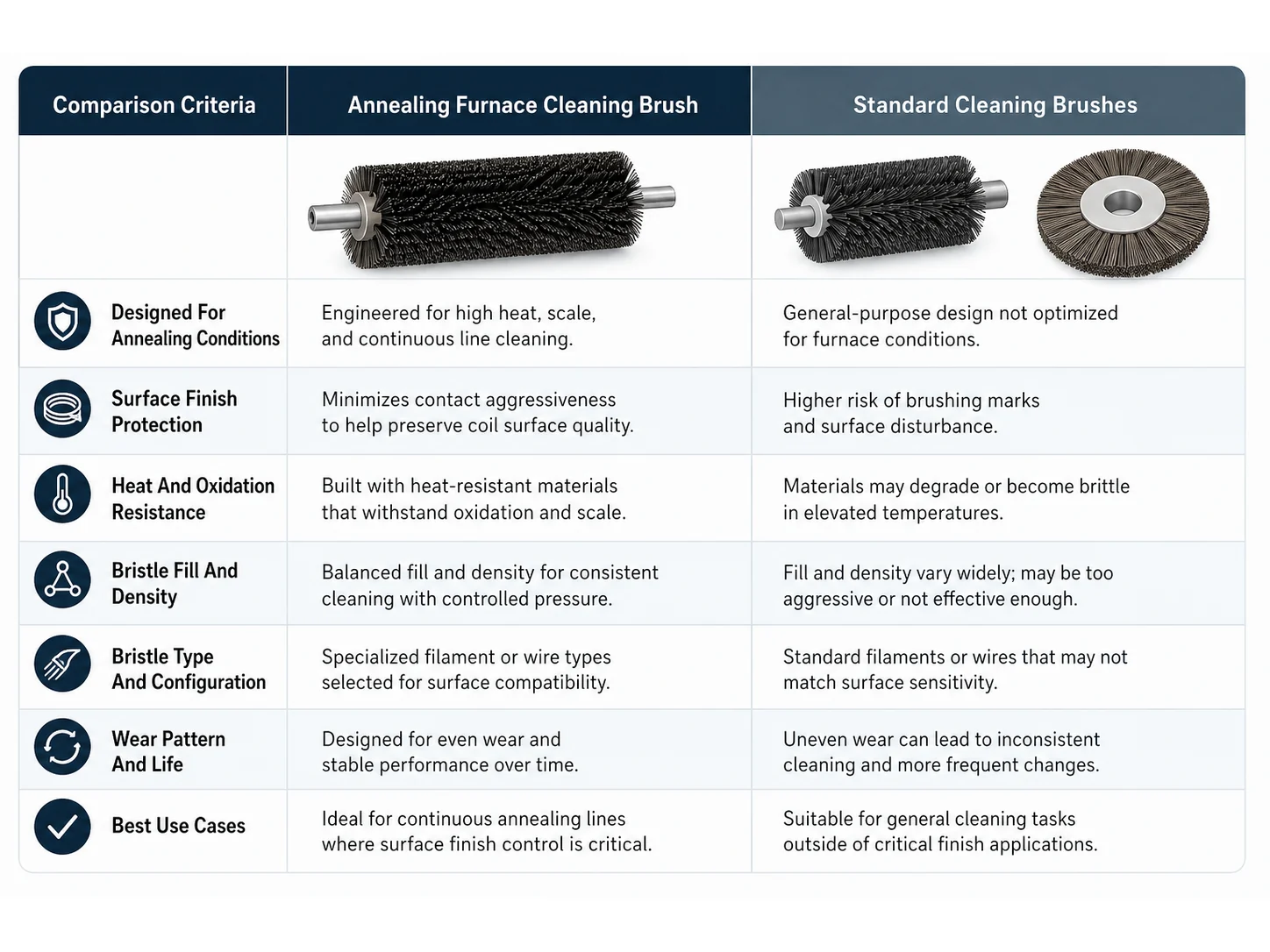
An annealing furnace cleaning brush is a purpose-built brush for removing process residues from annealing furnace components and metal surfaces. It typically features a bristle material and stiffness chosen to avoid scratching or contaminating heat-treated coils, sheets, or strips. The brush may be designed for manual use or for integration into in-line cleaning stations, depending on furnace configuration. Standard cleaning brushes, by contrast, are often generic wire brushes, poly brushes, or abrasive pads made for less sensitive surfaces where finish control is not critical.
How Surface Finish Control Drives Brush Selection
In annealing operations, surface finish is a key quality metric. Even microscopic scratches or embedded particles can cause rejections in later processes like painting, coating, or forming. Therefore, the cleaning brush must:
- Remove residues without altering the base metal surface roughness.
- Avoid leaving behind bristle fragments or foreign material.
- Withstand furnace temperatures if used near-hot surfaces.
- Resist chemicals if used with solvents or pickling agents.
Choosing the wrong brush can lead to costly rework or scrap.
Annealing Furnace Brush vs Standard Cleaning Brushes: Side-by-Side Comparison
| Feature | Annealing Furnace Cleaning Brush | Standard Cleaning Brush | Impact on Surface Finish |
|---|---|---|---|
| Bristle Material | Soft metallic (brass, bronze), synthetic filaments, or non-abrasive materials | Steel wire, hard nylon, or abrasive grit | Prevents scratching and contamination |
| Stiffness | Tailored to the specific residue and base metal hardness | Often a single stiffness for general cleaning | Reduces risk of micro-grooving |
| Dimensions & Profile | Can be custom diameter, length, and shape to match furnace interior or strip width | Off-the-shelf sizes; limited compatibility | Ensures even contact without unintended edge damage |
| Mounting / Interface | Designed for specific machine holders, quick-change systems, or manual handles | Generic handles or drill mounts | Allows consistent pressure and coverage |
| Chemical Resistance | Often resistant to solvents, oils, and light acids used in furnace cleaning | Basic oil resistance only | Prevents bristle degradation and contamination |
| Particle Collection | May include dust-trapping channels or conductive materials | Loose debris generation | Minimizes re-deposition of particles on clean metal |
| Hygiene / Cleanability | Washable and reusable without losing integrity | May trap residue and wear quickly | Supports consistent finish over many cleaning cycles |
Key Brush Characteristics That Affect Surface Finish
When evaluating brushes for surface-sensitive annealing applications, pay attention to these details:
- Material selection: Brass, bronze, or synthetic bristles often provide a good balance between cleaning aggression and surface safety. Hard steel bristles should be avoided for most polished or coated surfaces.
- Stiffness grading: Stiffness should be matched to the residue type—soft for loose carbon powder, moderately stiff for thin oxide layers.
- Diameter and profile: The brush face should evenly cover the target area. Overly narrow brushes may create stripe marks; oversized brushes may hit edges.
- Handle and core design: A secure mounting system prevents brush wobble and uneven pressure, especially in powered or in-line cleaning.
- Wet vs dry use: If chemical cleaners are used, the brush must withstand the solvent or alkaline bath without swelling or shedding.
- Custom sizing: Many annealing lines require non-standard lengths or diameters. A custom brush roll or assembly can reduce the need for multiple passes.
How to Choose the Right Annealing Furnace Cleaning Brush
Use this decision sequence to narrow down your options:
- Identify the primary residue: Is it loose carbon soot, sticky oil, or hard oxide scale? This dictates bristle material and stiffness.
- Check base metal sensitivity: Polished stainless steel, aluminum, or coated steel each have different scratch thresholds.
- Evaluate furnace interface: Does the brush need to attach to a specific shaft, holder, or robot? Confirm mounting type and dimensions.
- Consider chemical exposure: Will the brush contact a cleaning agent, pickling solution, or high-pH degreaser? Choose chemically compatible bristles.
- Plan for maintenance frequency: In high-throughput lines, brushes with longer service life and easy cleaning may offset higher upfront cost.
- Decide on custom vs standard: If standard sizes leave uncleaned edges or require multiple operations, a custom brush may reduce overall cost per coil.
- Request samples or test results: Before bulk ordering, test on representative surface panels to verify no finish degradation.
Common Mistakes to Avoid When Selecting a Cleaning Brush for Annealing Lines
- Using a standard wire brush on polished surfaces: Even a single pass can create visible scratches that require re-polishing.
- Ignoring bristle material compatibility: Brass brushes on copper-based alloys can cause galvanic staining if moisture is present.
- Choosing by cost drivers alone: A low-cost brush that damages coil surfaces can cost far more in rework than the brush’s cost drivers difference.
- Not checking dimensional fit: A brush that is slightly too wide or narrow can miss critical zones or hit furnace walls.
- Skipping wet-use validation: Some bristles soften in solvents, drastically reducing cleaning effectiveness.
- Overlooking hygiene: Brushes that trap particles can transfer contamination from one coil to the next.
When an Annealing Furnace Brush Is the Wrong Choice
An annealing furnace cleaning brush solves many surface-residue problems, but it has limits:
- Heavy, adherent scale: For thick mill scale or embedded scale, mechanical descaling (shot blasting, grinding) or chemical pickling may be required before brush cleaning.
- Fully automated continuous lines: Some lines need integrated brush rolls with precision tension control; a manual or simple mounted brush may not provide the necessary consistency.
- Unusual furnace geometries: If the brush cannot physically reach certain areas, a combination of air knives, vacuum systems, or robotic cleaning may be needed.
- Extreme hygiene requirements: In applications where any residual particle is unacceptable (e.g., bright annealing for medical devices), a full cleaning validation protocol and possibly non-contact cleaning methods should be evaluated.
- Complex residue mixtures: When oil and carbon are heavily mixed, a multi-step process (solvent wipe, then brush, then dry) often yields better results than one brush alone.
Final Takeaway
For surface-finish-critical annealing operations, a purpose-selected annealing furnace cleaning brush almost always outperforms a standard cleaning brush. The key is matching bristle material, stiffness, and geometry to your residue type, base metal sensitivity, and furnace setup. A standard brush may seem like a lower-cost alternative, but the hidden cost of damaged surface finish quickly outweighs any savings. When in doubt, test a sample on your actual material under production-like conditions before committing to a full order.
Frequently Asked Questions
Can a standard wire brush be used for light carbon removal in an annealing furnace?
Only if the metal surface is hard and not sensitive to scratching, such as heavy-gauge hot-rolled plate that will be further machined. For any surface where visual finish, coating adhesion, or post-processing matters, switch to a softer brass or synthetic brush.
What bristle material is safest for stainless steel coils?
Brass or bronze bristles are often recommended because they are softer than stainless steel and less likely to scratch. Nylon with abrasive impregnation is another option for gentle cleaning, but verify it does not leave plastic residue at operating temperatures.
How often should annealing furnace brushes be replaced?
There is no single answer. Monitor for bristle flattening, loss of stiffness, or embedded particles. In high-throughput lines, some brushes last several thousand coils; in manual cleaning, replace when cleaning effectiveness drops or visual wear appears.
Can one brush design work for both in-line and manual cleaning?
Sometimes, but mounting requirements differ. An in-line brush often needs a specific core diameter and keyed drive; manual brushes may need a longer handle. Adapting a single design can save inventory but must be evaluated carefully.
Is a custom brush size worth the longer lead time?
If standard sizes force you to clean in multiple passes or leave unclean borders, a custom brush can reduce labor, increase throughput, and improve finish consistency—often justifying the initial wait and investment.
How do I clean a brush used in wet chemical environments?
Rinse promptly after use with compatible solvent or water, then dry thoroughly. Some synthetic brushes can be ultrasonically cleaned. Store in a dry area away from direct heat to prevent bristle degradation.
What’s the difference between a “brush roll” and a stick brush for annealing?
A brush roll is a continuous, often wide brush that rotates against the strip surface in automated lines. A stick brush (or hand brush) is manually applied. Roll brushes offer more consistent pressure and are preferred for high-volume coil-to-coil consistency.
Technical References
Which bristle material fits this job — AISI 304 Stainless Steel Wire, Nylon PA or Brass Wire?
| Material | Continuous temperature (°C) | Peak temperature (°C) | Water absorption | Hardness |
|---|---|---|---|---|
| AISI 304 Stainless Steel Wire | 400 | 500 | 0% | Rockwell B 70–95 depending on temper and cold work |
| Nylon PA | 93 | 121 | 0.3–9% by PA grade and conditioning | Medium to firm; filament diameter and trim length control bending force. |
| Brass Wire | 150–200 | 250–300 | 0% | Rockwell B 40–90 |
Figures as published by Alleima; Brushtec / DuPont. Confirm the exact grade against the supplier datasheet before ordering.
What should replace Handheld Detail Brushes for annealing furnace cleaning brush?
- Handheld Detail Brushes — Handheld detail brushes cover general precision cleaning; auto-detailing brushes impose tighter controls for painted, polished, leather, display, and trim surfaces.
- AISI 304 Stainless Steel Wire — Use AISI 316 stainless steel wire for chloride, marine, dairy, beverage, chemical washdown, or higher pitting-resistance requirements. Use carbon steel for dry aggressive cutting and brass or abrasive nylon for lower marking risk.
- Nylon PA — Compare Nylon PA with PP, PBT, PET. Change material when wet stiffness, temperature, chemical resistance, conductivity, particle shedding, or surface marking becomes the limiting factor.
- Brass Wire — Compare Brass Wire with Steel wire, stainless wire, nylon. Change material when wet stiffness, temperature, chemical resistance, conductivity, particle shedding, or surface marking becomes the limiting factor.